

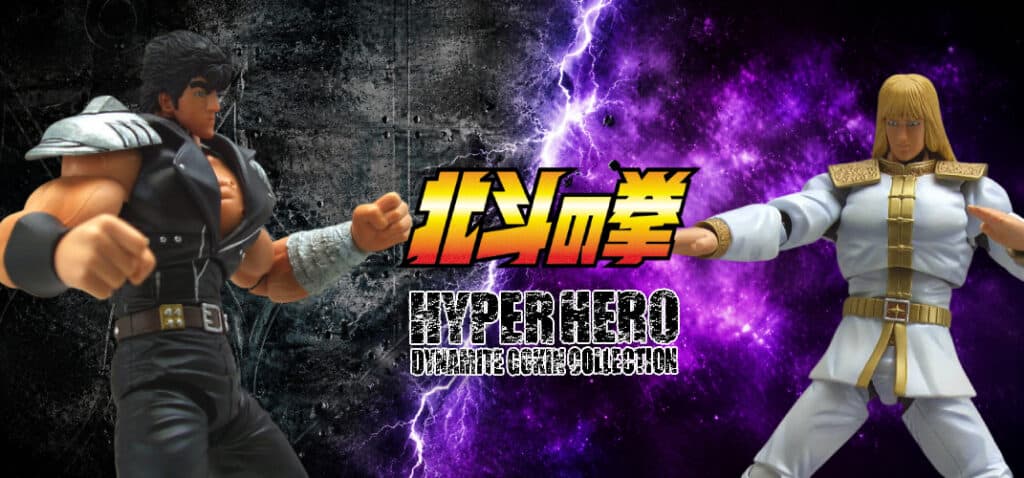
Ohtsuka Kikaku (オオツカ企画) is a small manufacturer based in Koshigaya, Saitama Prefecture, specialising in 1/10 scale action figures sold as kits under the Hyper Hero brand. The principle is the same from one product to the next: a universal articulated body, the Sotai-kun (素体くん), onto which the buyer fits the character’s costume, head and accessories. The line mostly covers tokusatsu. It turned to Hokuto no Ken twice, six years apart, before the company ceased trading.
Details
The anime Kenshiro, Series No.015
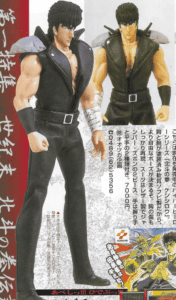
The first release is a Kenshiro made under the anime licence, the copyright line naming Shueisha, Fuji TV and Toei Doga alongside the two authors, which is why the box art is drawn in the style of the television series. It is number 015 in the Hyper Hero Series and was on sale in the summer of 2000. The Sotai-kun body, around 18 cm tall, is injection-moulded ABS and fully articulated. Chest and arms are painted soft vinyl, with the seven scars, the costume is a two-piece leather outfit, jacket and trousers, and two pairs of hands are included, clenched fist and open palm. The kit comes to about fifteen parts and sold for 7,000 yen. The box even invites buyers to mix costumes from the company’s various heroes and repaint the body to create their own.
Details
| Licence | anime, Shueisha, Fuji TV, Toei Doga |
|---|---|
| Scale | 1/10, body approx. 18 cm |
| Body | Sotai-kun in ABS, articulated |
| Materials | painted soft vinyl, leather costume |
| Format | assembly kit, approx. 15 parts |
| Accessories | two pairs of hands |
| Price | 7,000 yen |
| JAN code | 4534598000167 |
| On sale | summer 2000 |
The return in metal, Dynamite Gokin Collection
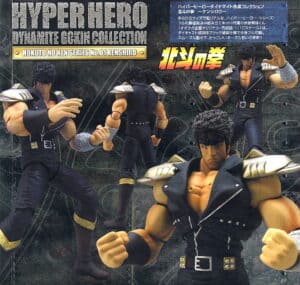
Six years later, Ohtsuka Kikaku came back to the licence with the Hyper Hero Dynamite Gokin Collection (ハイパーヒーロー ダイナマイト合金コレクション), distributed by Happinet. The principle stays the same, the material does not: the body becomes the Gokin Sotai-kun (合金素体くん), in zinc die-cast and polyamide, made in Japan under a registered design, while the rest of the kit is produced in China. The metal is not decorative, it is the figure’s skeleton, which accounts for its weight. The costume parts and head, in pre-painted soft PVC, attach to it. The box itself calls the product a garage kit and sets the minimum age at fifteen.
Kenshiro opens the series as No.01 in December 2006, this time under the NSP licence, in his midnight-blue outfit. A limited colour version also exists. Shin follows as No.02 in January 2007, with four types of hands per side, knife-hand, pointing finger, open and closed, to recreate the moves of Nanto Koshu Ken, and the box reminds buyers that Kenshiro is sold separately. Each piece was priced at 8,000 yen before tax.
Details
| Licence | NSP |
|---|---|
| Scale | 1/10, approx. 20 cm |
| Body | Gokin Sotai-kun in zinc die-cast, made in Japan |
| Materials | die-cast, polyamide, soft PVC |
| Format | assembly kit |
| Price | 8,000 yen before tax |
| Reference | 205020-00087 |
| JAN code | 4534598000877 |
| Release | December 2006 |
| Distribution | Happinet |
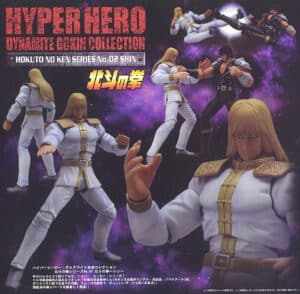
Details
| Licence | NSP |
|---|---|
| Scale | 1/10, approx. 20 cm |
| Body | Gokin Sotai-kun in zinc die-cast, made in Japan |
| Materials | die-cast, polyamide, soft PVC |
| Format | assembly kit |
| Accessories | four types of hands per side |
| Price | 8,000 yen before tax |
| Reference | 205020-00092 |
| JAN code | 4534598000921 |
| Release | January 2007 |
| Distribution | Happinet |
Sources
- Hyper Hero Series No.015 Kenshiro box, Ohtsuka Kikaku, front and back.
- Hyper Hero Dynamite Gokin Collection No.01 Kenshiro (2006) and No.02 Shin (2007) boxes, Ohtsuka Kikaku, front, back and sides.
- Figure Oh No.34, World Photo Press, July 2000, page 19.