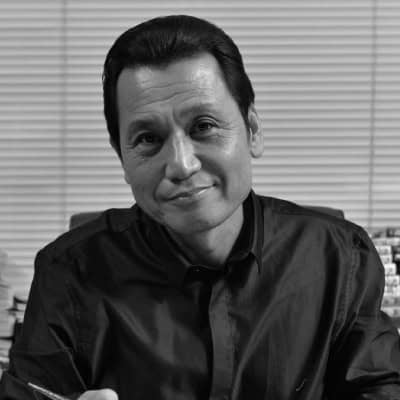
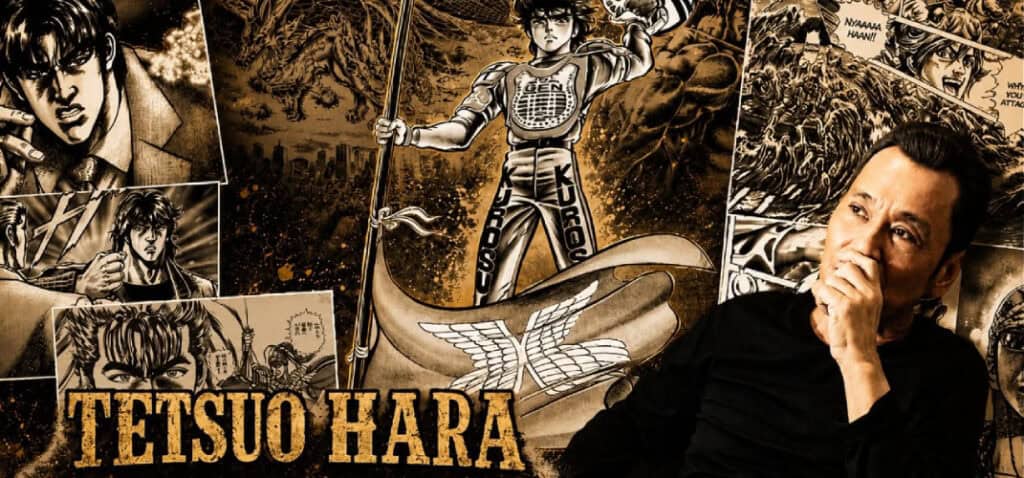
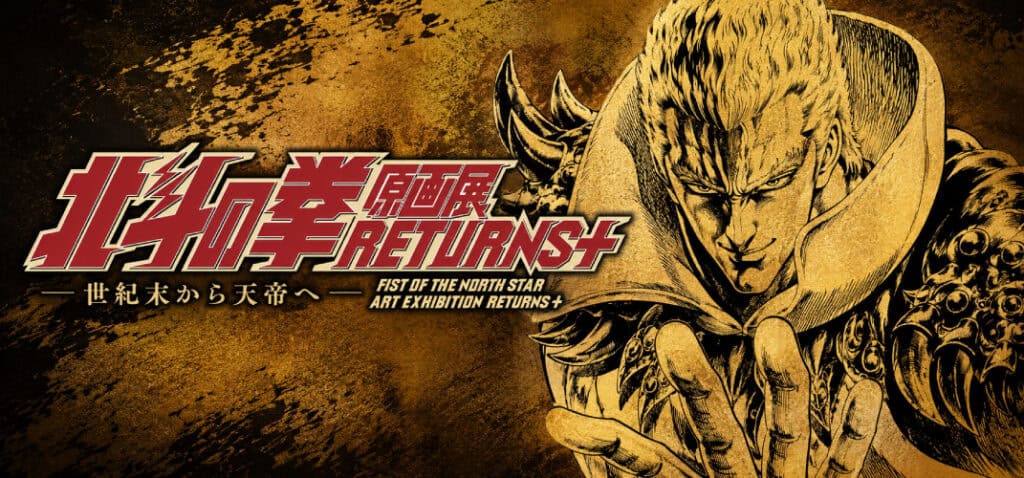
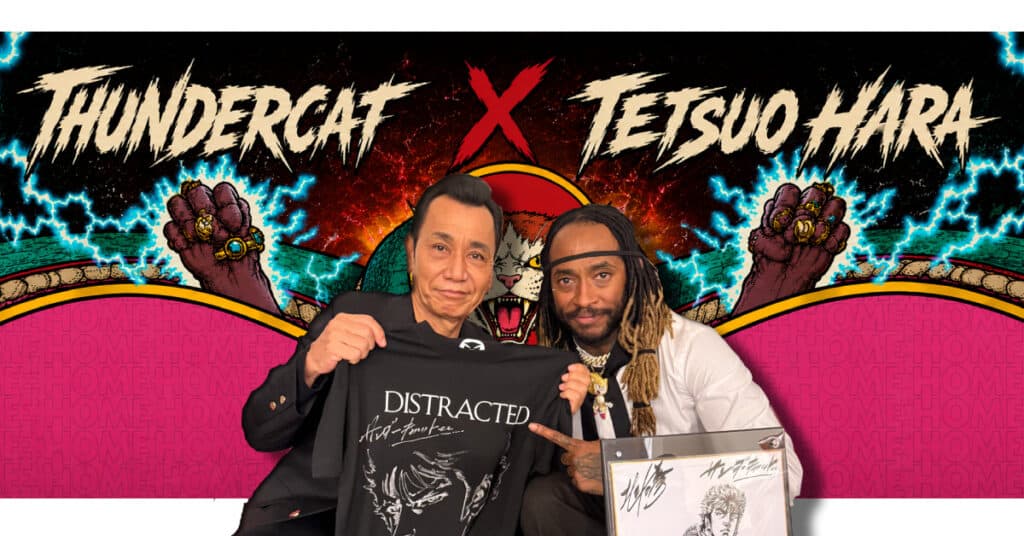
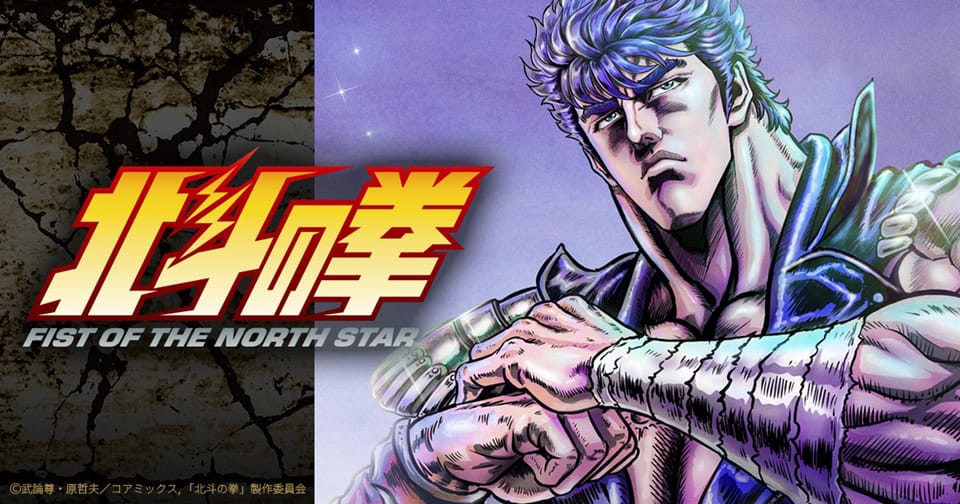
Tetsuo Hara (原哲夫), born on September 2, 1961 in Shibuya, Tokyo, is a Japanese mangaka. He is the artist of Hokuto no Ken and of Hana no Keiji. Having settled in Koshigaya, in Saitama Prefecture, since his fourth year of elementary school, he left a lasting mark on 1980s shōnen with a style characterized by massive musculatures, dense and meticulous linework, highly segmented fight sequences, and extremely expressive faces.
Childhood and the calling to draw
Tetsuo Hara recounts in 2026 that he was already drawing before he could even remember doing so. Manga was forbidden at home. So he would copy Tiger Mask, which he watched on television, a series drawn by Naoki Tsuji and written by Ikki Kajiwara, on the back of flyers found in the mailbox. He was in his second year of elementary school at the time.[1] He did not read manga magazines and considered color animation to be superior, finding a static black-and-white image insufficient. His first manga was given to him by a classmate in his second year of elementary school, a volume of Osomatsu-kun.[2]
As a child, he watched Kamen Rider and believed the job of a mangaka consisted of inventing a new monster every week. He then began drawing one per day so as not to be caught off guard. It was around his second or third year of elementary school that he decided to become a mangaka. The reason was practical. His father was an office worker who got up early and left to catch his train, and Hara knew he could not lead that life. Since he had always been drawing, he looked for a profession that would let him make a living with his pencil.[3] He would have preferred to become a painter, but he gave up on that idea in middle school, convinced it required formal studies.[1][2][3]
One title left a deeper impression on him than any other: Tensai Bakabon by Fujio Akatsuka. It was a humor manga, but its author would at times shift into a very realistic gekiga style, and those were the panels that captivated the child. He copied them in his third and fourth years of elementary school.[1][2] It was also around his third year that he began drawing seriously, after his mother gave him a beginner's guide to manga by Fujiko Fujio, which he describes as the bible of children who loved to draw.[3]
In middle school, he submitted his first works to a four-panel comic contest hosted by Shōtarō Ishinomori in Shōnen Big Comic. He saw it as the best exercise for learning how to construct a story. His pages were sometimes selected, accompanied by a comment pointing out what worked, and he still remembers them. Meeting Ishinomori a few years after his debut, he would be too intimidated to bring it up.[3]
The real conversion came in middle school. A friend lent him a volume of I・餓男, written by Kazuo Koike and drawn by Ryōichi Ikegami. Hara became a devoted follower of Ikegami and developed a passion for gekiga. In his high school club, he tirelessly studied the artist's action scenes and copied his framing and panel layouts, particularly the American arc of the series. Around 2000, he stated he was on his fifth copy of the volume and considered this work his point of origin.[4]
Training and early setbacks
Hara attended the design track at Hongō High School in Sugamo and joined the school's manga and gekiga club. This club had been founded by Osamu Akimoto, the author of Kochikame, who was about ten years his senior. Already a professional, Akimoto came back to the high school during summer vacation and invited the club members to visit his studio. Hara went there.[4][5]
Hara began approaching the Weekly Shōnen Jump by submitting his pages.[4] During his university years, he and the members of his manga club published a homemade magazine, Tenshin Ranman. The first volume had a print run of thirty copies. There would only be two. It included Modern Life, a short story adapted from a story by Shin'ichi Hoshi, whose art style was inspired by Katsuhiro Otomo.[6]
He applied to work under Takao Yaguchi, the author of Tsurikichi Sanpei, to learn the trade. The two accounts he has given of this diverge. In 1986, he said he had been taken on for one summer and had gotten nothing but mockery, so low was his skill level.[6] In 2026, he said he had been turned down and had fallen back on the permanent assistant recruitment ads that the Weekly Shōnen Jump ran, as the magazine was then banking on training young creators to catch up with Sunday and Magazine.[3] Disheartened, he started drawing a rough draft, a story about a detective trying to capture a criminal, hoping to be taken back the following winter. It arrived too late. The project, originally intended for Tenshin Ranman, ended up in the offices of Shōnen Jump, which never returned it, and it remained unfinished. Hara had also sent it to the office of Buichi Terasawa, the author of Cobra whom he admired, in order to be hired as an assistant.[6][1]
He had already sent pages to Shōnen Jump during the summers of his first and second years of high school. The first time came to nothing; the second time he reached the final selection round, which earned him a summons to the editorial office. He was told to come back with something else; he brought a work in progress and received a remark he never forgot: it was bad, and Yudetamago, the author of Kinnikuman, had a series even though he was almost the same age. Stung, he swore he would never call the magazine again. Yet he eventually did, and a young editor manning the switchboard picked up: Nobuhiko Horie.[3]
That phone call changed everything. Until then, Hara had been unable to find a virile story to match his gekiga style, and had been submitting comedic pages for lack of anything better. When he showed Horie his real artwork, Horie was thrilled, and the two men immediately agreed on their shared desire to draw imposing men. It was also Horie who advised him to learn under an already popular author and introduced him to Yoshihiro Takahashi.[3]
The position at Terasawa's was already filled. Hara therefore became an assistant to Yoshihiro Takahashi, the artist of Ginga : Nagareboshi Gin, introduced by editor Nobuhiko Horie, and stayed for a year and a half.[6][4] Takahashi has recounted why Horie sent him to his studio. Hara already had an editor following him when he arrived at the workshop, and that editor had told him that Takahashi was the mangaka whose influence he would be least susceptible to, and that he worked fast, which is what weekly gekiga serialization demands. Hara's fellow studio assistant was Akira Miyashita, the future author of Sakigake!! Otokojuku.[7] At the same time, he attended Kazuo Koike's Gekiga Sonjuku, which he had enrolled in because he was an admirer of I・餓男.[4]
In 1982, a boxing story produced during this period, Super Challenger, won him the Fresh Jump Prize, the award that the Weekly Shōnen Jump then gave to new authors and which would lend its name to the magazine Fresh Jump, launched in July of that same year.[8] The work appeared in a special issue of Weekly Shōnen Jump dated April 10, 1982, and constitutes his debut.[4] Hara recalled having had to turn in his pages in November, just as he was getting his driver's license.[6]
Two more short stories followed that same year. Mad Fighter appeared in the launch issue of Fresh Jump in August. Then Crash Hero appeared in issue 43 of Weekly Shōnen Jump, based on a concept by Tetsuyuki Akusawa.[4][6]
His first series, Tetsu no Donquijote (鉄のドンキホーテ), started in late 1982 in the Weekly Shōnen Jump on Horie's advice, who suggested he draw on his passion for motocross. It reused the hero and the rival team from Crash Hero, and the concept again came from the same Akusawa, with Hara handling the bulk of the story.[6] He had to draw five episodes in advance before launch, and it took him ten days to produce one week's worth of work.[6] The series was canceled after ten weekly installments due to a lack of readers.[9] Informed mid-run, Hara says he poured his heart into it, to the point that the final chapter ranked ahead of Dr. Slump in the reader surveys. The ending was celebrated over yakiniku with his two assistants and his editor, and he swore that night, in the streets of Kōenji, that he would become a star of the manga world.[10]
The birth of Hokuto no Ken
The next step is decided while he is drawing the sixth episode of Tetsu no Donquijote. The cancellation of the series had actually been decided as early as the second episode, since the reader surveys for the first two chapters had been poor, but they had let him keep drawing without telling him. Hara has been a fan of Bruce Lee and Yūsaku Matsuda since middle school and keeps saying he wants to create a kung-fu manga. Horie tells him the series is ending and immediately moves on to the next one: a story where striking secret meridian points causes bodies to explode, with the decisive line "omae wa mou shindeiru." Hara initially takes him for a madman.[3][9]
He draws a resolution from this failure. He had been so focused on his debut that he had not thought about what he truly wanted to draw. He decides to bet everything on the next project and to quit if it fails.[3]
The formula is born from a compromise. Horie envisioned a sober assassination story, in the vein of the television series Hissatsu, where the target is killed by piercing. Hara forcefully grafts onto it what he loves about Bruce Lee. Striking a vital point requires no spectacular action, but he nevertheless invents flashy techniques like the Hokuto Hyakuretsuken, the point supposedly being hit during the demonstration. He is also the one who names the school. Horie had proposed Hokuto Ken, drawing on the Chinese belief that makes the Big Dipper the constellation presiding over death. Hara found the sound poor and borrowed the shinken from a then-popular Jackie Chan film.[3]
Two one-shots are published in Fresh Jump, the first in the April 1983 issue, the second in the June issue.[6] The action takes place in contemporary Japan. The hero, Kasumi Kenshiro, avenges his fiancee Yuki, killed by a criminal organization serving the powerful, by using the assassination art passed down to him by his father, Hokuto Shinken. The rival school is not yet Nanto but Taizanji Kenpō. Yet most of the series' hallmarks are already in place: the secret meridian points, the delayed death, the jacket tearing apart under concentration, and the line destined to become iconic, placed at the climax of the first story. It is phrased there as "anta mou shinderu yo" (あんた もう死んでるよ), in a casual tone, before becoming the "omae wa mou shindeiru" (お前はもう死んでいる) of the series.[11]
Hara recounted in 1986 that he thought he was going to lose his mind drawing that first story, without a single assistant.[6]
Both stories take first place in the reader survey, even though they appear at the back of the magazine. Shigeo Nishimura, editor-in-chief of Weekly Shōnen Jump, approves the transition to a weekly series.[6] Scriptwriter Buronson then joins the project to write the plot and dialogue for the long-running version. Hara reports the reason Horie gave him, bluntly: he takes too long to draw to carry a weekly series on his own.[3] The contemporary setting is abandoned in favor of a post-apocalyptic backdrop inspired by George Miller's Mad Max 2, a reference Buronson claims in his 2026 essay.[12]
The series begins in issue 41 of Weekly Shōnen Jump, dated September 26, 1983 and released on September 13.[6] It runs for five years, two more than originally planned due to its success, and concludes in issue 35 of 1988.[13] Its 245 chapters are collected in 27 bound volumes. Cumulative sales are estimated at sixty million copies in Japan and one hundred million worldwide.[14]
Hara was twenty-two years old at launch. He says he did not feel the wave coming, for lack of the internet and because he refused on principle to know his ranking in the surveys, so as not to let it go to his head. He could guess it from Horie's mood, usually stern and suddenly cheerful, summoning him to the editorial office to take him out for sushi, then to a steak restaurant the following week. He adds that the three major magazines were then stuck at the three-million-copy mark, a threshold said to be unreachable without three flagship series. Jump had Kinnikuman and Captain Tsubasa; Hokuto no Ken completed the trio. The threshold was crossed, the print run increased by two hundred thousand copies per week and reached four million.[3]
Art style and its influences
Tetsuo Hara's line is recognizable at first glance. Its foundation is the gekiga of Ryōichi Ikegami, whose action scenes he copied for years and whom he identifies as his point of origin. He also cites Tetsuya Chiba among the artists he used to imitate.[1][4] In a 2026 interview, he expands the list. On the gekiga side, Ikegami, Takumi Nagayasu, and Noboru Kawasaki. Outside of it, Tetsuya Chiba and Shōtarō Ishinomori. But the first author he ever loved was Fujio Akatsuka, to whom he owes his discovery of comedy, to the point of laughing until he cried.[3]
He sums up his goal in a single phrase: a two-dimensional drawing that looks three-dimensional, capable of making the reader jump when turning the page. He says he saw proof of this one day on the train, watching over the shoulder of a young reader who let out a cry as he turned the page, then turned to his neighbor to show him. No one would have believed he was the author.[3]
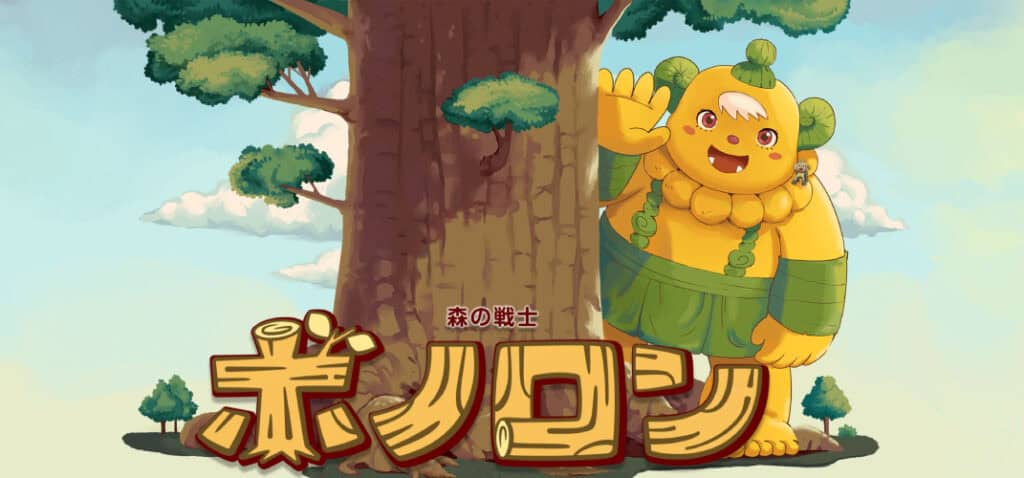
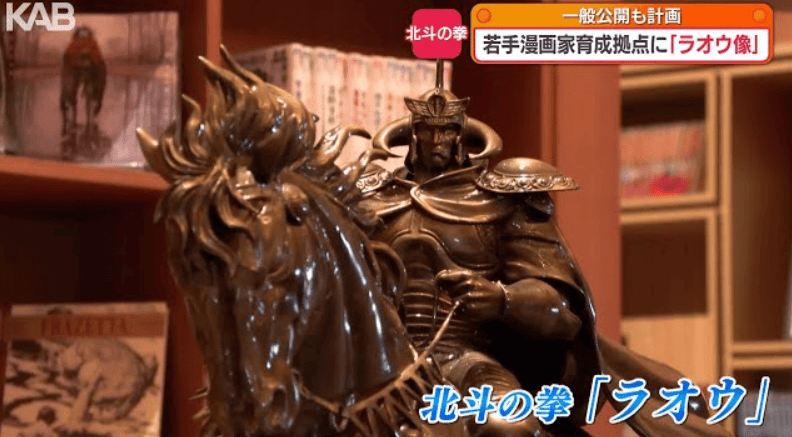
To this was added a source from American illustration, and he owes it to chance. Having learned that Ikegami had been influenced by the American Neal Adams, Hara went looking for a collection at a foreign-book store in Ikebukuro, which he used to ride to by bicycle after school. The shopkeeper did not have one. Browsing the shelves for something else, he came across Frank Frazetta and knew immediately that this was what he had been looking for. What he saw there, he says, were not bodybuilder muscles but fighting muscles, battlefield muscles.[3] That collection remains among his prized possessions.[1] He recounts seeing a figure raising its right arm toward the sky, promising himself he would one day draw his own version, and holding on to the idea for years. In Frazetta's work the fist goes straight up; Hara wanted an oblique angle. The death of Raoh gave him the opportunity he had been waiting for.[15] The influence did not end with his youth. In 2021, describing the design of Bonolon, Hara once again invokes the bold contrasts of the American painter, this time crossing them with the silhouette of a sumo wrestler, the character's head taking the ginkgo-leaf topknot and his belt a mawashi.[16]
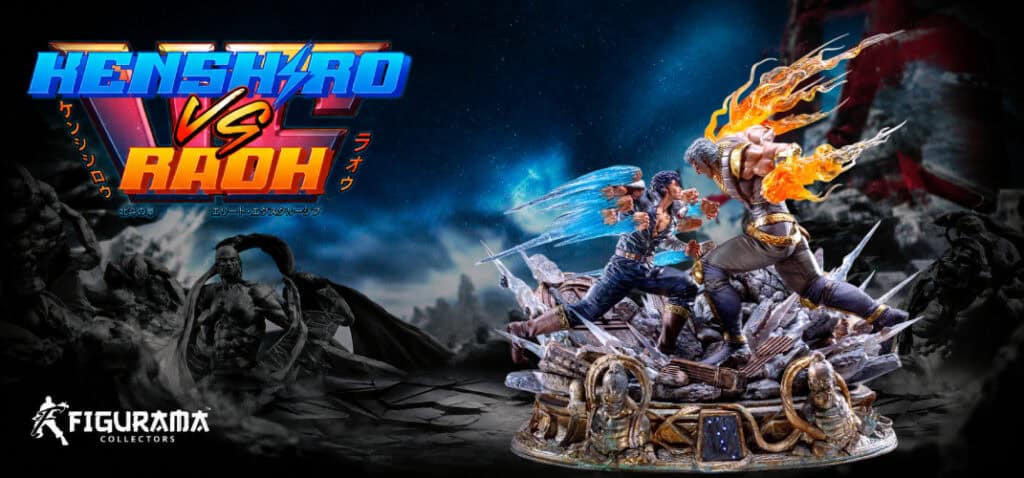
Raoh in fact owes a great deal to this source. Hara says he was born from the combination of a Frazetta painting, discovered in a collection when he was a student and whose rendering of muscles never left him, and the gaze of actor Rutger Hauer. He also acknowledges that he did not want to draw this character, having launched the series in order to draw Kenshiro and now having to make his adversary even stronger.[17]
The horses come from the same source. Hara says he drew the inspiration for Kokuoh-Go and Matsukaze from Frazetta's steeds. He explains his method: he does not start from a live model but from the painting, analyzing the horse as a painter filtered it, before comparing that reading to the real animal and to photographs in order to find his own approach. He sees it as a work of distortion, and that is the word that sums up his graphic ambition. Not comic distortion, but a distortion with a photographic appearance, where an opponent two or three times larger than Kenshiro conveys his power and malice better than an accurate scale would.[3]
For Kenshiro, the models are the Japanese actor Yūsaku Matsuda, martial artist Bruce Lee, and the Mel Gibson of Mad Max 2. As a student, Hara was already drawing portraits of Matsuda in a style identical to the one he is known for today.[4]
Hara suffers from keratoconus, a rare deformation of the cornea that causes it to bulge and severely reduces visual acuity. He first felt its effects around the age of eighteen, before his debut, and not as a result of his profession. The consequences on his work were severe: headaches, nausea, and above all an inability to focus, and therefore to place a line where he aimed it. Contact lenses caused rejection. The doctors he consulted told him that a corneal transplant would not change much. He lived this way for some thirty years, which he sums up in one word: hell on a physical level.[3]
He draws with his affected eye closed, and explains that the density of his line comes from this, since he retraces each line several times to achieve a straight stroke.[4]
He finally decided to undergo the transplant in 2024. The operation was a success and his acuity went from 0.02 to 0.2. He notes that he can now see better than he could during the time he had a series running in Jump, and expresses gratitude for the advances of medicine.[3]
The relationship with Nobuhiko Horie
Horie often repeated that everything hinges on the second chapter. On Hokuto no Ken, revisions piled up until a violent argument broke out. Buronson recounts that Horie tore up the finished manuscript and that Hara cried over it. The chapter ultimately published shows an old man, Misumi, who protects rice seeds at the cost of his life, killed by bandits, which triggers Kenshiro's rage. The calculation proves correct. The series comes in second in the reader survey for its first chapter, first from the second onward, and never relinquishes the top spot for three years.[18]
Hara does not remember this period as one under a tyrannical editor. Interviewed much later alongside Hirohiko Araki, he describes Horie as someone very gentle and says he never endured anything harsh. His only fright was seeing him show up at his home in the evening, tipsy, to demand the pages and get irritated at their progress.[19]
Asked in 2026 about what Horie represents to him, Hara answers: a father. He describes him as a mentor, someone a level above, who allowed him to correct his shortcomings early on. He recalls the strictness of the early days and the countless reworkings of pages, but says he never wavered, determined to show that he was not like the others. He adds that the relationship was beneficial to both of them, as his manga also contributed to his editor's success.[3]
The two men maintained professional ties after Hokuto no Ken and together founded the publishing house Coamix in 2000, after Horie's departure from Shueisha.
After Hokuto no Ken
Hara had planned to stop drawing manga after Hokuto no Ken, not knowing what to draw next. He did not, for a simple reason: most of the series' revenue had gone to taxes, and he had almost nothing left. He says it made him realize how harsh the profession could be.[3]
Barely after Hokuto no Ken ended, Hara moved on to CYBER Blue, a post-apocalyptic science fiction saga published from 1988 to 1989 in Weekly Shōnen Jump, written by Ryūichi Mitsui based on an original work by BOB. It was a commercial success, but the series drew sharp criticism for its violence, and Hara abandoned it after four volumes.
In 1990, he launched a large-scale historical series in Weekly Shōnen Jump, Hana no Keiji -Kumo no kanata ni- (花の慶次 ―雲のかなたに―), written by Mio Asō based on the novel Ichimuan Furyuki by Keiichirō Ryū. The story follows Maeda Keiji, an eccentric samurai of the Sengoku era, and gave Hara the opportunity to apply his style to a realistic historical setting. Published until 1993 in 18 volumes, it became his second major success in Japan. The franchise celebrated its thirty-fifth anniversary in 2025, with a dedicated anniversary website and several events across Japan.
The project came from Horie, who told him he had read five hundred historical novels on his behalf, a figure that still makes Hara smile. The phrase "historical novel" initially brought to mind court costumes and powdered faces, a register beyond his reach, but the character of Maeda Keiji, an eccentric, and the armor of the Sengoku era, blending Japanese and Western elements, immediately struck him as compatible with the kind of bodies he loved to draw.[3]
The series was nonetheless a struggle. Jump took it for granted that historical stories did not appeal to young readers, and on top of that, the aesthetics of the loser had to find their place in a magazine that championed friendship, effort, and victory. Hara never made it back to the top of the reader surveys, peaking around seventh place, and speaks of three and a half years spent flying low. He adds an unexpected difficulty: having drawn only rugged men like Kenshiro or Raoh, he did not know how to draw a smile, and had to redo many of the early pages.[3]
He says he learned from this series the spirit of bushido, which continues to influence his life. He cites a decisive book, the Hagakure, a collection of samurai precepts that Keiichirō Ryū also read, and its notion of jōjū shinimi. Hara interprets it as follows: to kill oneself in thought every morning, to live as though already dead, and thereby gain a heart that nothing can shake, since the dead know no anxiety. He has seen it as his guiding principle since his thirties.[3]
Throughout the decade, Hara shifted heavily toward historical manga and collaborated multiple times with Keiichirō Ryū. Kagemusha Tokugawa Ieyasu, published from 1994 to 1995 in 6 volumes, written by Shō Aikawa through the fourth volume, and SAKON -Sengoku Fuunroku-, published from 1997 to 2000 in 6 volumes written by Shingo Nihashi, continued this Sengoku vein. In 1995, he produced Takeki Ryusei solo, in 3 volumes, handling both the art and the writing, making it one of his very rare entirely personal works. This was followed by darker or commissioned works: Hydra from 1997 to 1998 in one volume written by Tadashi Ikuta, and Kokenryoku Oryo Sosakan Nakabo Rintaro from 1998 to 2000 in 2 volumes, under the supervision of essayist Makoto Sataka. In 2000, Aterui II Sei was published in one volume, written by novelist Katsuhiko Takahashi. It is his only work from this period published outside Shueisha, by Shogakukan.
Hara also ventured beyond manga. He provided illustrations for two novels: Kōryū no Mimi, published from 1991 to 1993 in 4 volumes in the Jump Novels collection, with text by Arimasa Ōsawa, and Hokuto no Ken: Jubaku no Machi, written by Buronson in 1996 and conceived as an ultimate conclusion to the Hokuto no Ken saga. The latter novel was adapted from 2003 to 2004 into an OAV trilogy titled Shin Hokuto no Ken. In 1993, he also created the illustrations and character design for the video game Muscle Bomber, published by Capcom.
The Coamix and North Stars Pictures turning point
Hara stated in 2026 that the idea of founding a company probably came from him. He was going through a difficult period, CYBER Blue having failed and Hana no Keiji having been only a moderate success, and he was worried about what would come next. The success of entrepreneur Takafumi Horie, widely discussed at the time, prompted him to study business management.[3]
The underlying reason was more serious. Hara says he never knew how to negotiate and had let unreasonable conditions be imposed on him, to the point of being offered a reissue of Hokuto no Ken for a fraction of his royalties. He realized he could not protect on his own the work that mattered most to him, and that he needed a team.[3]
He first approached Horie, who had just left his position as editor-in-chief of Weekly Shōnen Jump and was also going through a rough patch. Horie dismissed the proposal, a forty-five-year-old man having little desire to start all over again. Hara insisted, telling him that failure would not be a big deal and that between the two of them, one drawing, the other writing, they would always be able to make manga. Horie eventually agreed, pointed out that they could not do it alone, and went to recruit Tsukasa Hōjō and then Ryuji Tsugihara. Hara sees this as a character trait: Horie starts by refusing, then seizes the project as if it were his own.[3]
Coamix was founded in 2000, with the rights to Hokuto no Ken. Coamix provided the content for the Weekly Comic Bunch, a magazine published by Shinchosha, which featured as its flagship series Souten no Ken (蒼天の拳), a prequel to Hokuto no Ken launched in the inaugural issue dated May 29, 2001. Volume 1 credits Hara as author and Buronson for supervision. The role of scriptwriter played by Nobuhiko Horie, reported by several Japanese sources, does not appear on the colophon.[20] The story takes place in 1930s Shanghai and follows Kasumi Kenshiro, the ancestor of the hero. The series ran until 2010 and spans twenty-two volumes. A sequel, Souten no Ken Regenesis, was published in the Monthly Comic Zenon from 2017 to 2025, drawn by Hideki Tsuji with a script by Hiroyuki Yatsu, Hara being credited only for the original work.
In July 2004, Hara and Horie created North Stars Pictures, a company linked to Coamix, founded for the management of the rights of artists and scriptwriters as well as for animation production.[21] It produced the animated adaptation of Angel Heart, a spin-off series of City Hunter, then starting in 2006 the Shin Kyūseishu Densetsu saga, a large-scale project of films and OAVs that relaunched the Hokuto no Ken franchise. It is credited as producer on the projects from this period, including Hokuto no Ken: Legend of Heroes, and became the publisher of the Monthly Comic Zenon at its launch in 2010.
On April 1, 2020, North Stars Pictures was absorbed by Coamix. The two entities had distinct functions, the editing of works for the former, and publishing and rights management for the latter, and the merger brought both together. North Stars Pictures' activities, publishing, audiovisual adaptations and licensing, continue under Coamix.[22]
This decision to leave Shueisha and regain control of his works is often cited as a precedent in the manga industry, at a time when authors had very few options against major publishers regarding the ownership of their work.
A second career at Coamix
Since moving to Coamix, Hara has pursued one historical or Hokuto-related project after another. Ikusa no Ko -Oda Saburo Nobunaga Den-, a saga devoted to the youth of Oda Nobunaga, ran in Monthly Comic Zenon from 2010 to 2022 and spans twenty volumes. The script is credited to Seibo Kitahara, a pen name of Nobuhiko Horie. Since 2019, Hara has been supervising Maeda Keiji Kabuki Tabi, a prequel to Hana no Keiji that he does not draw himself. The CYBER Blue universe was also extended by two spin-off series drawn by Motoki Yoshihara between 2011 and 2014, with Hara credited only for the original work.
Another part of his work lies outside manga. Since June 2005, Hara has designed and produced Mori no Senshi Bonolon, an illustrated story for children distributed free of charge in Japan, with texts written by Nobuhiko Horie under the name Seibo Kitahara. He recounted in 2021 that the idea came from his own experience as a father. He had observed the effect of picture books and characters on young children and wanted to reach readers younger than those of the Weekly Shōnen Jump. He elaborated in 2026 on what had spurred him: toddlers had little beyond Disney or Anpanman, and as a creator he wanted his own characters to be part of children's lives. He mentioned it to Horie, who had been thinking along the same lines, and the project became an illustrated story.[3] Making it free was a decision from the outset, in a context where the 2008 crisis had brought child poverty to light and where access to books depended on a family's means. Seven Bank answered their call, making free distribution in convenience stores possible. Hara insists on one point: this is not an activity intended to generate profit.[3][16]
Influence and legacy
Tetsuo Hara's influence on action manga is documented by his peers. Kentaro Miura, the author of Berserk, named Hokuto no Ken as the manga that had influenced him the most.[23] He described its effect in precise graphic terms. Kenshiro's fist gave him the impression of coming out of the page toward the reader, and he long searched for how to achieve the same impact with a sword, which graphically remains a line, before achieving it by projecting and spinning the mowed-down bodies.[24] He also attributed the density of his own artwork to Hokuto no Ken and AKIRA.[4]
Hara says he rarely socializes with fellow artists, as relationships between mangaka seldom work, in his view, without a third party to serve as a link. He does, however, see Hirohiko Araki about twice a year, as their wives are friends, and notes with a laugh that Araki immediately responds to his wife's messages but rarely to his own.[3]
Series such as Sakigake!! Otokojuku or Rokudenashi BLUES are regularly compared to his style, though no declaration formally establishes this. In the case of Akira Miyashita, the author of Otokojuku, the proximity may be explained differently, as both men worked as assistants together in Yoshihiro Takahashi's studio.[7]
Recognition in Italy
Hara says he was long unaware of the popularity of Hokuto no Ken in Italy. He visited the country in 2025 and found a reception that surprised him. The country reminded him of Japan in many ways, from the warmth of its people to a sky that is often gray and rainy.[3]
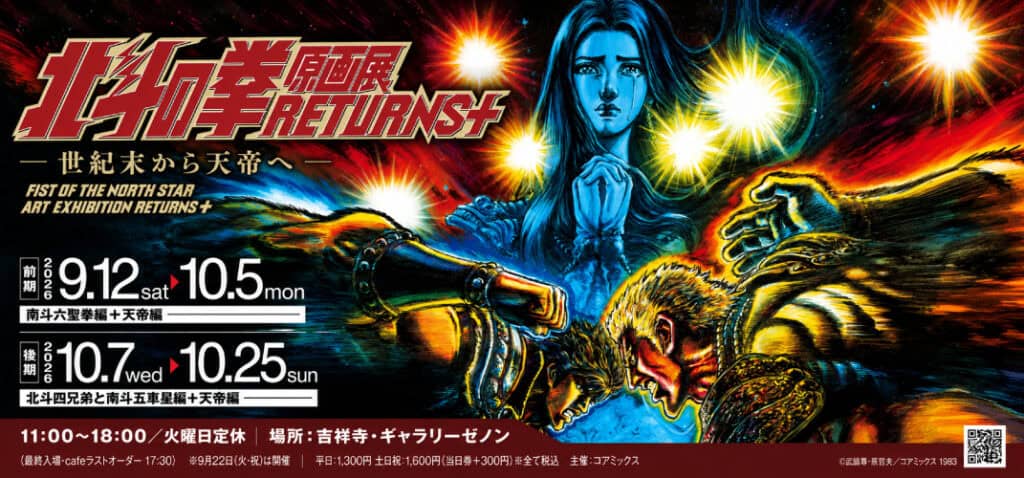
He presented a self-portrait to the Uffizi Gallery. An exhibition of his original pages was organized that same year in a church, where the museum agreed to display his drawings alongside Renaissance works, including those of Baccio Bandinelli, a Florentine artist cited by Giorgio Vasari. Hara understood that it was the beauty of the human body that had created the connection, and noted that in Italy, manga is not separated from art.[3]
He met the Italian Prime Minister, Giorgia Meloni, on January 16. He attributed these connections to a Coamix employee originally from Rome, a passionate reader of the series, who had also been carrying out volunteer activities related to manga in Italy. Hara drew a working rule from this: he only entrusts his projects to people who truly love the work, as the difference in commitment is, in his view, decisive.[3]
Main works
Series
Tetsu no Donquijote (1982-1983, concept Tetsuyuki Akusawa) / Hokuto no Ken (1983-1988, script Buronson) / CYBER Blue (1988-1989, script Ryūichi Mitsui after BOB) / Hana no Keiji -Kumo no kanata ni- (1990-1993, script Mio Asō after Keiichirō Ryū) / Kagemusha Tokugawa Ieyasu (1994-1995, script Shō Aikawa) / Takeki Ryusei (1995, script and art) / Hydra (1997-1998, script Tadashi Ikuta) / SAKON -Sengoku Fuunroku- (1997-2000, script Shingo Nihashi) / Kokenryoku Oryo Sosakan Nakabo Rintaro (1998-2000, supervision Makoto Sataka) / Souten no Ken (2001-2010, supervision Buronson) / Souten no Ken Regenesis (2017-2025, original work only) / Ikusa no Ko -Oda Saburo Nobunaga Den- (2010-2022, script Seibo Kitahara) / Maeda Keiji Kabuki Tabi (since 2019, supervision only)
One-shots and short stories
Super Challenger (1982) / Mad Fighter (1982) / Crash Hero (1982) / Hokuto no Ken, pilot one-shot (April 1983) / Hokuto no Ken II, pilot one-shot (June 1983) / Kiseki moyuru Toki (1996) / Aterui II Sei (2000, script Katsuhiko Takahashi, Shogakukan)
Illustrated novels
Kōryū no Mimi (1991-1993, 4 volumes, text Arimasa Ōsawa) / Hokuto no Ken : Jubaku no Machi (1996, text Buronson, adapted into OAV from 2003 to 2004)
Video games
Muscle Bomber (Capcom, 1993, illustrations and character design)
Sources
- ↑ "こころの玉手箱", interview with Tetsuo Hara in five installments, Nihon Keizai Shimbun, evening edition, September 11 to 15, 2023.
- ↑ Atsuo Nakayama, interview with Tetsuo Hara, Business+IT, January 23, 2026.
- ↑ "私の生き方", 676th installment, interview with Tetsuo Hara, Kōken, July 2026 issue.
- ↑ Hara Tetsuo, Japanese Wikipedia, accessed August 18, 2026.
- ↑ "その2 「一大決心で、家を出るも……。」", official Tetsuo Hara website, October 14, 2014.
- ↑ Hokuto no Ken : All About The Man, Shueisha, 1986.
- ↑ Interview with Yoshihiro Takahashi and Akira Miyashita, Manba, 2024.
- ↑ Fresh Jump, Japanese Wikipedia, accessed August 18, 2026.
- ↑ Interview with Tetsuo Hara, Goethe, 2024.
- ↑ Afterwords by Tetsuo Hara, Jump Super Ace reissue of Tetsu no Donquijote, 1996.
- ↑ Pages from the one-shot Hokuto no Ken, Fresh Jump, April 1983.
- ↑ Buronson, 悪と嘘を描く (Dépeindre le mal et le mensonge), Shogakukan Shinsho no. 507, April 2026.
- ↑ Hokuto no Ken, Japanese Wikipedia, accessed August 18, 2026.
- ↑ Hokuto no Ken, Weekly Shōnen Jump Wiki, accessed August 18, 2026.
- ↑ Thirtieth anniversary interview for Hokuto no Ken, official Hokuto no Ken website.
- ↑ Interview with Tetsuo Hara, Oricon News, February 15, 2021.
- ↑ Interview with Tetsuo Hara, Goethe, November 8, 2023.
- ↑ Interview with Buronson, Mantan Web, April 18, 2014.
- ↑ Cross interview between Tetsuo Hara and Hirohiko Araki, Comic Natalie.
- ↑ Colophon of the first volume of Souten no Ken, Shinchosha, October 15, 2001.
- ↑ Coamix timeline, official company recruitment website, and interview with Nobuhiko Horie for the twenty-fifth anniversary of Coamix, June 2025.
- ↑ "Merger announcement", official Coamix website, accessed August 19, 2026.
- ↑ Interview between Kentaro Miura and Kazuhiko Torishima, Comic Natalie, July 2016.
- ↑ Kentaro Miura, quoted in Denfaminicogamer, July 20, 2021.