

Details
- Title
- Super Challenger (スーパーチャレンジャー)
- Type
- One-shot
- Author(s)
- Tetsuo Hara
- Publisher
- Shueisha
- Release date
- 10 April 1982
Gallery
 6View all images
Super Challenger
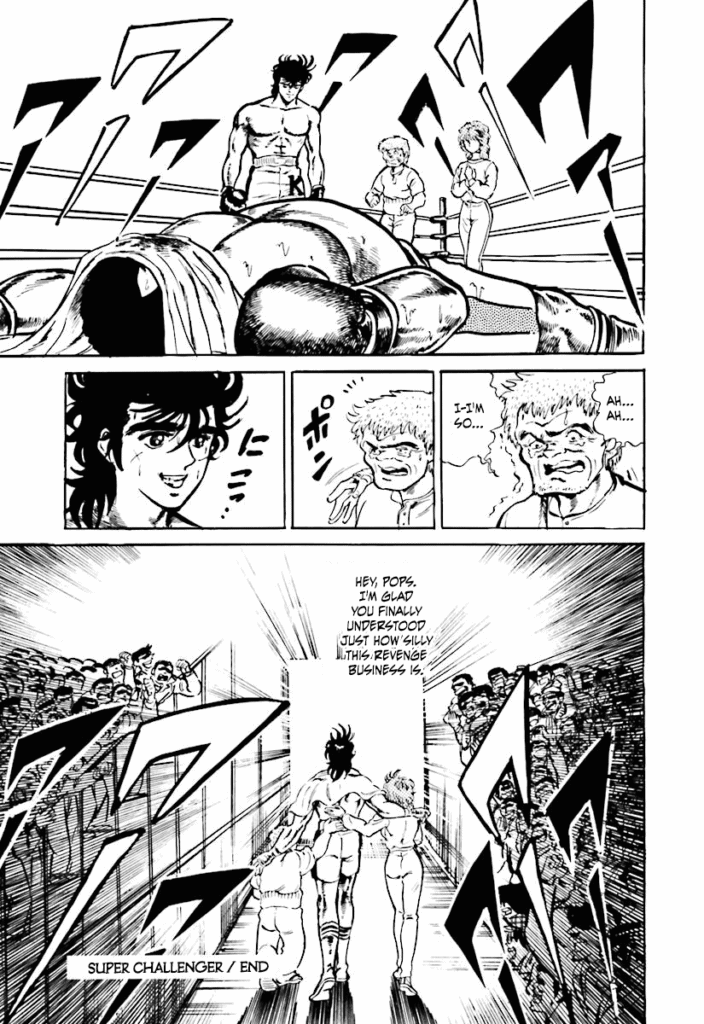
Super Challenger (スーパーチャレンジャー) is the very first published story by Tetsuo Hara, released in 1982 in a special issue of Weekly Shonen Jump dated April 10, by Shueisha. This boxing one-shot, drawn while the author was still working as an assistant, earned him the Fresh Jump Award and represents the true starting point of his career, one year before Hokuto no Ken.
Synopsis
Sawamura Kyotaro, a young high school dropout turned drifter, roams across Japan in search of meaning for his life. After pilfering vegetables from an angry farmer, he takes refuge by chance in an abandoned boxing gym. With a single punch, he demolishes an old punching bag, revealing astounding physical power. The place belongs to a disillusioned old trainer, Nishiyama, who immediately sees in the young man an extraordinary raw talent and offers him room and three meals a day, on one condition: become his gym's heavyweight boxer.
Kyotaro accepts, at first out of pure self-interest. But he soon learns the truth the old man is hiding: Nishiyama wants to turn him into the instrument of his revenge. His own son, Kenichiro, was killed in the ring by the fatal blow of the Japanese heavyweight champion, the fearsome Araiwa. From this tragedy arises a challenge that Kyotaro, stung in his fighter's pride, will ultimately take up in his own way.
Tetsuo Hara's first work
Super Challenger holds a foundational place in Tetsuo Hara's bibliography. It is the work where everything began. Hara conceived this story during his time as an assistant to Yoshihiro Takahashi, while also attending classes at the Gekiga Sonjuku, Kazuo Koike's writing workshop. This boxing story earned him the Shueisha Fresh Jump Award, a distinction given to young authors, sometimes cited as the thirty-third edition of the prize. The award bears that name, but the work itself was published in a special issue of Weekly Shonen Jump dated April 10, 1982, and not in the magazine Fresh Jump, which did not launch until the following summer. This recognition directly paved the way for his first series, Tetsu no Donquijote, obtained on the recommendation of his editor Nobuhiko Horie.
A boxing story with an unexpected twist
Beneath its appearance of a pure sports shonen, Super Challenger surprises with its resolution. The hero, boastful and unpredictable, goes so far as to fake a knock-out mid-fight to better gauge his opponent, before turning the tables and defeating the champion thought to be invincible. But at the very moment he delivers the decisive blow, the old trainer, unable to risk this boy's life the way he lost his son, throws in the towel. The long-desired revenge is abandoned at the last instant, out of love rather than hatred.
The story thus ends on the rejection of revenge, presented as futile, in favor of human bonds. Several hallmarks of the Hara to come can already be detected: the tall and powerful protagonist, the massive and brutal antagonist, the taste for spectacular combat and theatrical staging of the fatal blow, all elements that would reach their full potential a few months later in Hokuto no Ken.
Éditions
Super Challenger has never been published as a standalone volume. The story was included as a bonus in the reissues of Tetsu no Donquijote. It also appears, as a special inclusion, in Shonen Leadom by Ryuji Tsugihara, published by Shinchosha in the Bunch Comics collection. No French edition has been released.