

Details
- Title
- Shin Hokuto no Ken (新・北斗の拳)
- Type
- OAV
- Studio
- A.C.G.T.
- Publisher
- Toei Animation
- Release date
- 24 July 2003
Gallery
 6View all images
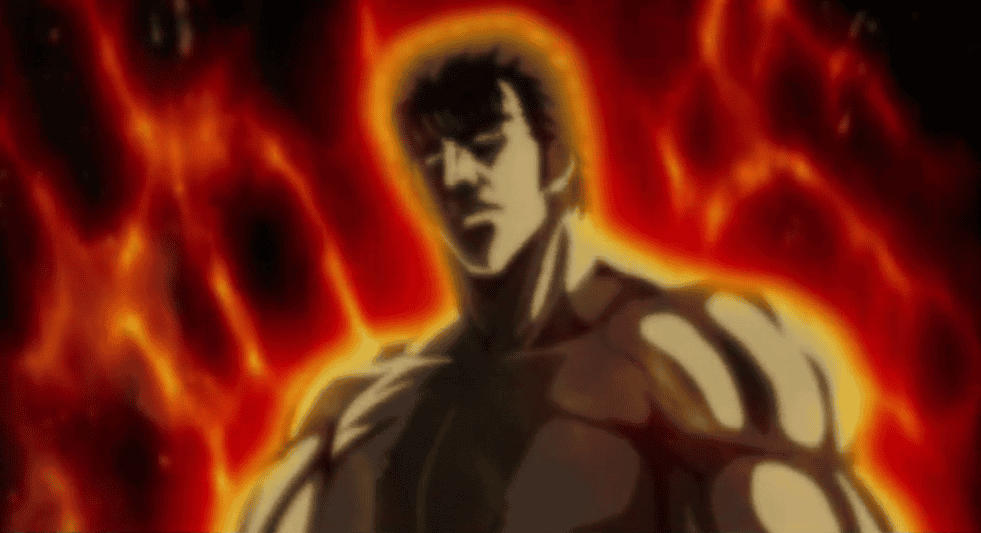
Shin Hokuto no Ken
Shin Hokuto no Ken (新・北斗の拳) is a trilogy of OAVs produced by Coamix, OB Planning and SEGA, and directed by Takashi Watanabe at studio A.C.G.T. A direct adaptation of the novel Jubaku no Machi by Buronson and Tetsuo Hara published in 1996, these three 58-minute episodes released between July 2003 and May 2004 mark the return of the franchise to animation after fifteen years of silence and stand as a direct sequel and narrative conclusion to the Hokuto no Ken canon.
Synopsis
Humanity has survived despite the collapse of civilization. Sanga, the Lord of Lastland, rules as a tyrant over his desert enclave by controlling the sources of drinking water and fanatizing the population around a false god. When he covets the young Sara, nicknamed the Miracle Worker for her healing gifts, Kenshiro enters the scene to free the people from the lie. But he will have to face the disciples of an ancestral rival school, the Hokumon no Ken, and the mysterious Seiji who arrives in Lastland to settle his own scores.
OAV Guide
- OAV 1, The Idolized Fortress (偶像の砦) - July 24, 2003
- OAV 2, The Forbidden Technique (禁忌の拳) - October 23, 2003
- OAV 3, The Full Weight of Compassion (慈悲の重み) - May 28, 2004
The return of Hokuto no Ken after fifteen years
When Shin Hokuto no Ken went into production in the early 2000s, the franchise had not seen an animated adaptation since Hokuto no Ken 2 in 1988. The return was driven by an entirely new team. In 2000, Nobuhiko Horie, the former editor of Buronson and Hara at Weekly Shonen Jump, resigned from Shueisha and founded Coamix with Tetsuo Hara. The new company acquired the Hokuto no Ken rights and planned an ambitious relaunch. Shin Hokuto no Ken became the very first animated project of the Coamix era, predating even the creation of North Stars Pictures.
The choice of source material was consistent with this ambition for a canonical revival. Rather than offering an original story, the authors adapted Jubaku no Machi, the illustrated novel that Hara and Buronson had published through Shueisha in 1996 to provide a true sequel to the manga. The operation made it possible to offer fresh content to fans while remaining strictly within the continuity of the canon. Buronson confirmed this intention in an interview published on the occasion of the release: "This project comes from a novel I wrote in which I wanted to depict Kenshiro after the first story. It is, in a way, the sequel to the previously released anime. Where did Kenshiro go? What is he doing? I wanted to answer those questions."
A technical innovation
On the technical side, Shin Hokuto no Ken relies on an ambitious blend of traditional animation and computer-generated imagery. Executive producer Ren Usami details the method: "First we planned everything out, scene by scene, looked at when we would use 3D and when we would do the animation via new technologies. That is how this project started." The characters remain drawn in 2D because full 3D would have looked, according to Buronson, "quite unrealistic". The backgrounds, vehicles and desert panoramas are instead modeled in 3D to allow for views that would otherwise be impossible.
Buronson highlights the benefit: "In the desert scenes, we could do scenes taken from above as well as panoramic shots. And in the motorcycle scenes, we could have the motorcycles riding forward with 3D. Things that would simply be impossible via conventional animation can be done by mixing 2D and 3D animation." For an OAV project from 2003, this was an innovative approach that many other productions would go on to adopt.
Acknowledged but contested violence
Shin Hokuto no Ken revives the graphic scenes that had made Hokuto no Ken's reputation on television in the 1980s. Heads explode, bodies are torn apart, blood spurts. For Buronson, it is too much: "There was just too much blood spurting everywhere. I don't like that, really barbaric scenes like that." The scriptwriter rates his satisfaction at 80% of the project, then revises it down to 70% because of this excess. The observation echoes his previous reservations about the violence in the 1986 film. Buronson has never been comfortable with the gory escalation of Hokuto no Ken adaptations.
Beyond the debate over the direction, the scriptwriter recalls in the same interview the interpretive key he claims for the entire franchise: "When social structures have disappeared, you can only survive through brute force. But what can triumph over violence? Friendship, love, and the emotions that people have inside them. These win over violence. Love and compassion are more powerful than violence. That is the theme on which I wrote the story." This thesis runs throughout the entire trilogy, and the title of the third OAV, Tout le Poids de la Compassion, explicitly carries its echo.
A prestigious team
The dubbing of Shin Hokuto no Ken marks a symbolic break. Akira Kamiya, who had voiced Kenshiro throughout the original television series, expressed his wish to reprise the role. Hara nevertheless explained the choice of a younger seiyū: "I have known Mr. Kamiya for a long time and he had expressed the desire to play this role, but since he is no longer in his youth, a younger actor was chosen to open up a broader world." The role was entrusted to Takehito Koyasu, the iconic voice of Zechs Marquise in Gundam Wing and Dio Brando in JoJo's Bizarre Adventure. Buronson fully endorsed the performance: "I found him flawless in this role. He fits the character very well, and you can really tell he is a voice acting professional."
The second casting coup was the arrival of J-Pop star Gackt in the role of Seiji. A self-professed fan of Hokuto no Ken, the singer also performed the ending theme Oasis, a track he had composed four years earlier and already pitched to the franchise without success. "For this project, it was selected," he said with delight in the promotional interview. The move brought unprecedented mainstream visibility to an OAV that could have remained under the radar. The rest of the cast was equally prestigious, with Unshou Ishizuka (Joseph Joestar in JoJo Stardust Crusaders) in the role of Sanga, Fumihiko Tachiki (Gendo Ikari in Neon Genesis Evangelion) as narrator, and Romi Paku (Edward Elric in FullMetal Alchemist) in the role of the young Bista.
On the production side, the project benefited from Takashi Watanabe as director, a veteran of Slayers, Shakugan no Shana and Boogiepop Phantom. The music was composed by Yasuharu Takanashi, future composer of Naruto Shippuden and Fairy Tail. But it is arguably the presence of Haruo Sotozaki as character designer and animation director that carries the most weight in hindsight, as Sotozaki would later become the principal director of Demon Slayer at ufotable.
Cast and staff
Main cast
| Kenshiro | Takehito Koyasu (子安武人) |
|---|---|
| Sara | Yurika Hino |
| Tobi | Akimitsu Takase |
| Sanga | Unshou Ishizuka (石塚運昇) |
| Seiji | Gackt |
| Bista | Romi Paku (朴璐美) |
| Giese | Seiji Sasaki |
| Master of Hokumon no Ken | Takaya Hashi |
| Narrator | Fumihiko Tachiki (立木文彦) |
Staff
| Original work | Buronson, Tetsuo Hara |
|---|---|
| Direction | Takashi Watanabe |
| Screenplay | Hiroshi Toda, Nobuhiko Horie |
| Executive producer | Ren Usami |
| Character design | Haruo Sotozaki (外崎春雄) |
| Animation direction | Haruo Sotozaki (外崎春雄) |
| Art direction | Satoru Kuwabara |
| Music | Yasuharu Takanashi |
| Ending theme | Gackt — Oasis |
| Main studio | A.C.G.T. |
| Partner studios | Buyu, Sung San Production, Toei Animation, White Line |
Éditions
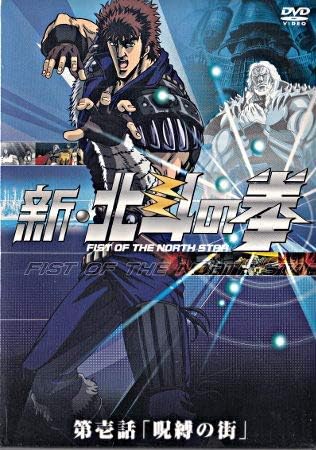
In Japan, Toei Animation released the three OAVs as individual DVDs between July 2003 and May 2004 at a price of 5,000 yen each, accompanied by a promotional interview with the authors. The trilogy was also included in the Blu-ray BOX Shin Kyuseishu Densetsu box set released by Toei in November 2016.
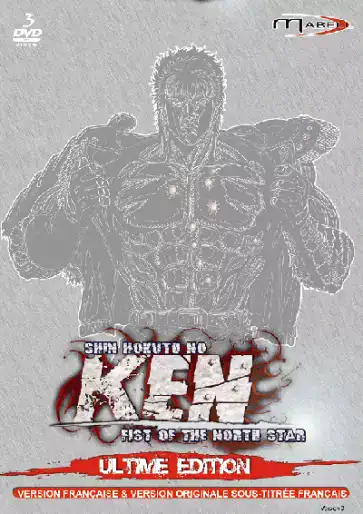
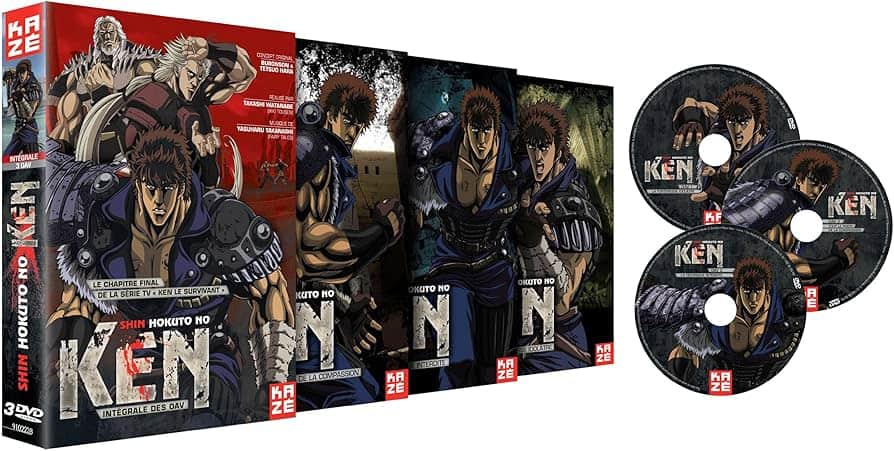
In France, the publisher Mabell released the trilogy on several occasions. The three OAVs were first published as individual dubbed DVDs starting in December 2004 (€9.90 each), followed by an equivalent subtitled version. Mabell then offered two complete box sets in 2005, one dubbed and the other subtitled, at €19.90 each. The reference edition remains the "Edition Ultime" collector box released on July 19, 2007, which brought together for the first time all three OAVs in dubbed and subtitled versions in a single box set, accompanied by an exclusive interview with Buronson, Tetsuo Hara and Gackt (€19.95). A reissue was released by Kazé in 2011 with the complete OAV collection.