



Details
- Authors
- Baptiste Rappin
- Language
- French
Edition
- Publisher
- Les éditions Ovadia
- Collection
- Les Carrefours de l'être
- Release
- November 4, 2019
- Price
- 22 €
- Pages
- 286
- Format
- Paperback, 142 × 205 mm
- ISBN
- 978-2-36392-352-3
- ASIN
- 2363923529
Staff
- Publisher
- Les éditions Ovadia
- Collection
- Les Carrefours de l'être
Written from bibliographic data only
Where to find it
Buy on Amazon France FnacAffiliate link. As Amazon Associates, we earn from qualifying purchases.
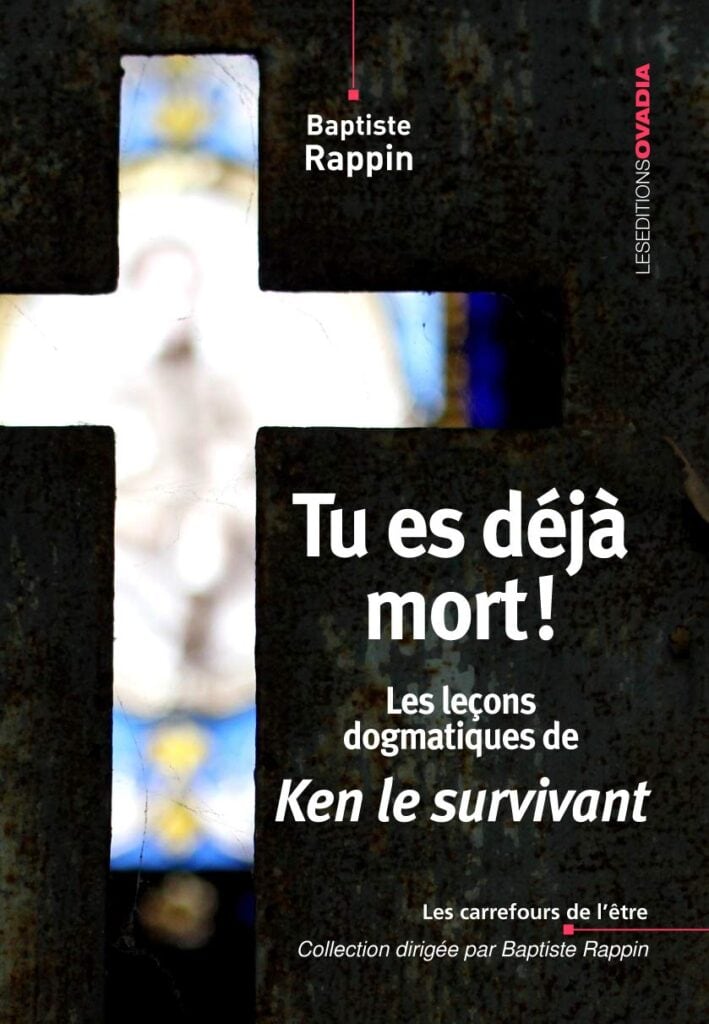
Tu es déjà mort ! Les leçons dogmatiques de Ken le survivant (2019)
In an interview given in August 2020 to the blog Stalker, Baptiste Rappin sets out his starting hypothesis. The manga would be a product of postwar Japan and the atomic bombings, and its devastated world would offer a thought experiment on the disappearance of institutions. The title, a line of Kenshiro, serves him as an image for the delay between a collapse and its effects. The subtitle refers to the thought of the jurist Pierre Legendre. The author also says that each chapter opens with an excerpt from Cormac McCarthy's The Road.
A review published in January 2020 on the website Actu Philosophia gives a few landmarks. The first chapter, “La nostalgie du quadra,” looks back on the reception of the anime series in France in the late 1980s. Then come a history of the manga, pages on the apocalypse and the state of nature, then a chapter titled “Sans foi ni loi, sans dieu ni lieu” on the law of the strongest and legitimacy. The volume ends with a reflection on civilization.
What remains after the apocalypse? What kind of life awaits us in a world devastated by nuclear war, annihilated by the spread of a virus, or engulfed beneath the waters of a cataclysmic flood? This is precisely the kind of situation the post-apocalyptic genre depicts, whether in novels, films or video games. From this standpoint, manga holds a special place, because it owes its very reason for being to the nuclear flash that struck and blinded Japan twice, on August 6 and 9, 1945. Unlike the West, the Archipelago went through the wiping of the slate firsthand. The apocalypse was not a possibility for it, but an actual reality: it had concrete experience of the genealogical rupture and the deficit of origins that form the necessary starting point of manga. The guiding thread of this essay, Hokuto no Ken, known in France under the title Ken le survivant, fits quite naturally into this perspective: the landscapes of ruins serve as the stage for a great biological regression, characterized by the search for water and provisions as well as by the law of the strongest. Does our hero have any choice but to bow to this new nomos of the earth?
Extras and supplements
- No supplements reported