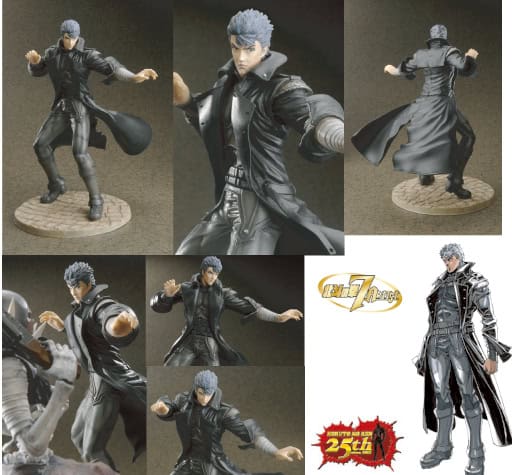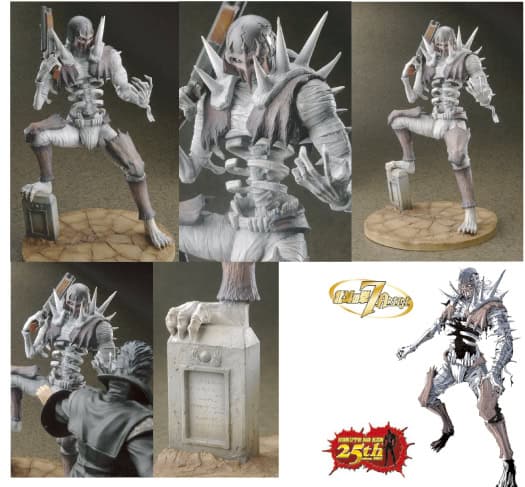


In 2008, to celebrate the 25th anniversary of Hokuto no Ken, seven creators from different backgrounds (designers, painters, illustrators) were invited to freely reinterpret the four brothers of Hokuto. The concept draws on an astronomical metaphor dear to the series: Tetsuo Hara is presented as the polar star around which the seven artists orbit, mirroring the seven stars of the Big Dipper (北斗七星) that give the work its name. Among these reinterpretations, the one by Hirose Soushi (広瀬総士) is arguably the darkest and most radical.
Details
Hirose Soushi, the illustrator
Born in 1970 in Sendai and based in Tokyo, Hirose Soushi has been a freelance illustrator since 1992. He has produced numerous illustrations for Japanese light novels, collectible cards, and character designs for video games, notably the Sangokushi Taisen arcade game series by SEGA. His precise linework and sense of character design have made him a well-regarded artist in the Japanese gaming and illustration world, a profile that stands in contrast to the more pop-oriented designers involved in the rest of the project.
The “Hollows” concept
For Hokuto no Ken, Hirose Soushi imagines a parallel universe where the antagonists become creatures called “Hollows”, half-zombie, half-machine monsters that Kenshiro is tasked with hunting down. This narrative premise, somewhere between cyberpunk and gothic horror, gives rise to spectacular designs that bear little resemblance to the original manga while still preserving the soul of the characters. A bold creative choice that invites the viewer to imagine an entire alternate story.
Two figurines
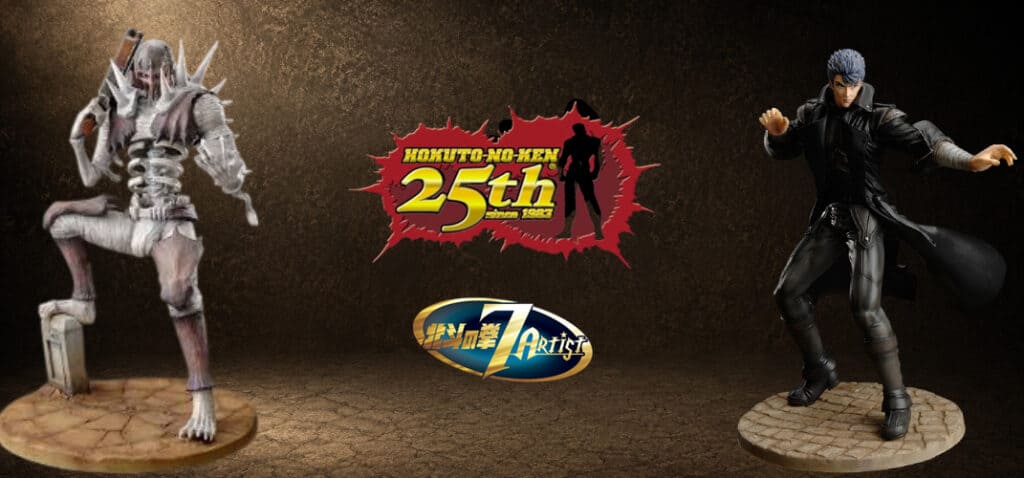
Two pieces were produced, released by Embrace Japan in March 2009 at a price of 8,190 yen each. The first features Kenshiro as a “Hollows Hunter”, the tracker, in a reworked outfit styled as a creature hunter. The second, and most striking, is the “Death Skull Jagi”, a vision of the renegade brother fusing zombie and skeleton, pushing the already monstrous nature of the original character even further into horror. Both come in window boxes, designed to be displayed even in their packaging. These two figurines occupy a unique place in Hokuto no Ken merchandising, that of an auteur reinterpretation, where the license serves as a playground for an artist’s vision rather than as a simple faithful licensed product.