


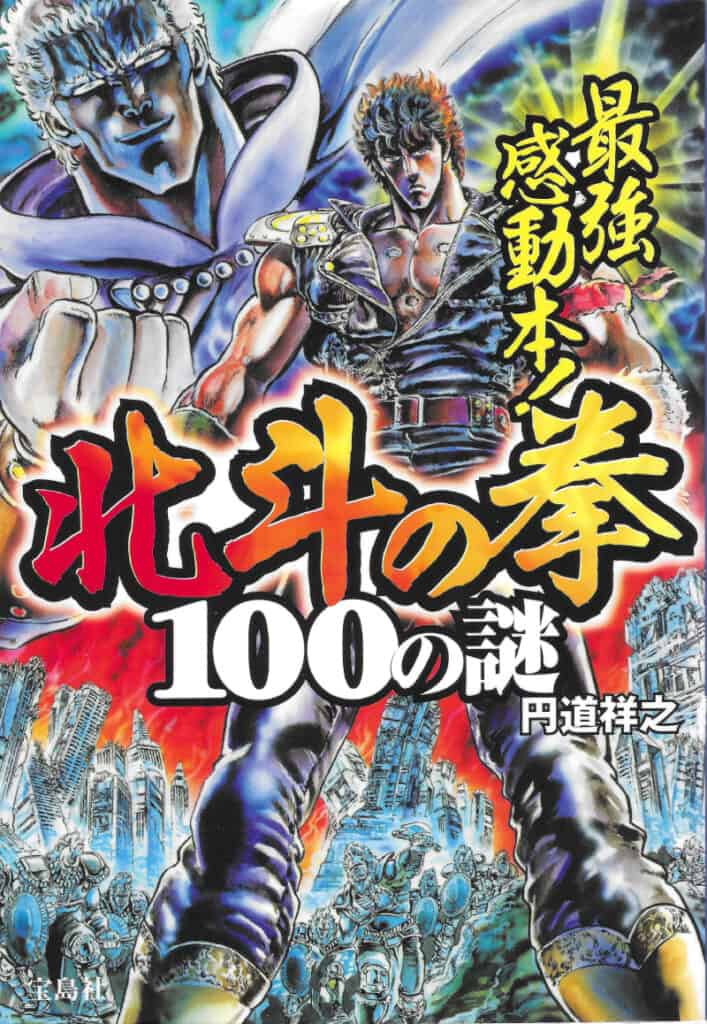
Details
- Original title
- 最強感動本!北斗の拳100の謎
- Authors
- Endō Masayuki (円道祥之)
Edition
- Publisher
- Takarajimasha (宝島社)
- Release
- April 4, 2007
- Colophon date
- April 18, 2007 (2007年4月18日 第一刷発行)
- Price
- 1,100 yen before tax (1,155 including tax at time of publication, 1,210 at the current rate)
- Pages
- 223
- Format
- B6, softcover
- ISBN
- 978-4-7966-5767-9
- Magazine code
- C0076
- ASIN
- 4796657673
Staff
- Author (著者)
- Endō Masayuki (円道祥之)
- Publishing Director (発行人)
- Hasumi Seiichi (蓮見清一)
- Publisher (発行所)
- Takarajimasha (株式会社宝島社)
- Text Design and DTP (本文デザイン・本文DTP)
- Ishibashi Ken'ichi (石橋健一), Igusa Akiko (伊草亜希子)
- Printing and Binding (印刷製本)
- Sankei Sōgō Insatsu (サンケイ総合印刷株式会社)
Written from a physical copy (colophon checked)
Where to find it
Buy on Amazon Japan Takarajimasha (publisher)Affiliate link. As Amazon Associates, we earn from qualifying purchases.
Saikyō Kandō-bon! Hokuto no Ken 100 no Nazo (Takarajimasha, 2007) 最強感動本!北斗の拳100の謎
In the introduction, Endō sets out the rules of the game. The manga explains almost nothing about its background, starting with the nuclear war, and it changes its settings whenever the action benefits. The book treats these contradictions as puzzles to solve, noting that the answers are the author's alone and that the facts are taken from Shōgakukan's Kanzenban edition. The five chapters go from Kenshiro and the world of the end of the century to his friends, Shin, Rei or Mamiya, then to the three Hokuto brothers and the Six Sacred Stars of Nanto, from Jagi to Souther. The fourth brings together Raoh, Yuria and the Five Chariots, the last the Shura, from Jakoh to Kaioh and Ryū. The most serious questions, such as the number of vital points or the absence of firearms, sit next to the most trivial, such as Kenshiro's jacket that mends itself.
A pocket edition, Hokuto no Ken 100 no Nazo (北斗の拳100の謎, Takarajimasha bunko), followed in December 2008.
Table of contents
Opening
- Introduction, "Hokuto no Ken, Another Way to Enjoy It" (『北斗の拳』、もうひとつの楽しみ方)p. 2-3The author presents his method: treating the series' contradictions and unspoken details as enigmas to be solved, drawing on Shōgakukan's Kanzenban edition.
Chapter 1: "The Mysteries of Kenshiro" (ケンシロウの謎 編) (p. 8-65)
- Enigmas 01 to 29p. 8-65Among the questions addressed: Why was Kenshiro chosen as the successor of Hokuto Shinken? Why is Kenshiro's jacket intact again right after being torn apart? How many pressure points, those meridian points through which ki flows, are there in total? Why do bandits die uttering "hidebu," "tawaba," or "abeshi"? There are almost no firearms in the world of the end of the century. Why? Is the main setting of Hokuto no Ken Japan? How could Kenshiro, defeated four times, become the strongest man in history?
Chapter 2: "The Mysteries of the Friends" (親友たちの謎 編) (p. 68-97)
- Story Commentary (ストーリー解説)p. 68
- Enigmas 30 to 43p. 70-97Among the questions addressed: Did Shin really attack Kenshiro and kidnap Yuria solely on Jagi's word? Devil Rebirth killed seven hundred people, so why was he sentenced to only two hundred years in prison? Why did Shin carve seven scars on Kenshiro's chest? Rei is tall and V-shaped, so why did the bandits mistake him for a woman? Why did the Kiba clan believe Mamiya when she claimed to be Kenshiro's fiancée?
Chapter 3: "The Mysteries of the Three Hokuto Brothers and the Six Nanto Saints" (北斗三兄弟と南斗六聖拳の謎 編) (p. 100-157)
- Story Commentary (ストーリー解説)p. 100
- Enigmas 44 to 71p. 102-157Among the questions addressed: Why on earth did Ryūken take a man as despicable as Jagi as his disciple? From whom could Jagi have learned Nanto Seiken? What exactly was the purpose of the imposing helmet Raoh wore? Why did Raoh only want to fight those who had seen the Death Star? Star of Martyrdom, Star of Illusion, Star of Command... who assigned their stars to the Six Nanto Saints, and how? Among the successors of Nanto Hōō Ken, why was Souther the only one to despise love and compassion? How did Raoh and Toki know that Hokuto Shinken had no effect on Souther?
Chapter 4: "The Mysteries of Raoh and Yuria" (ラオウとユリアの謎 編) (p. 160-191)
- Story Commentary (ストーリー解説)p. 160
- Enigmas 72 to 86p. 162-191Among the questions addressed: Why did Raoh, Toki, and Kenshiro have to cross the sea on a small boat? Raoh and Toki come from the Land of Shura, so why did Toki designate another place as his homeland? Yuria does not practice any martial art, so why is she counted among the Six Nanto Saints? Rihaku is reputed to be a genius strategist, so why did he blunder repeatedly? What illness did Yuria have? Why did she ultimately live for several more years? Why did Raoh use so few secret techniques?
Chapter 5: "The Mysteries of the Shura" (修羅たちの謎 編) (p. 194-223)
- Story Commentary (ストーリー解説)p. 194
- Enigmas 87 to 100p. 196-223Among the questions addressed: How was Jakoh able to wield absolute power over the Imperial Capital? The nameless Shura are strong, so why are the named Shura surprisingly weak? Who forged the legend of Raoh that circulates in the Land of Shura? Kenshiro made Kokuō his mount, but how did he feed him? Why were the two kingdoms of Sava and Blanca spared by the nuclear war? Kenshiro left Ryū. Who will inherit Hokuto Shinken?
Table of contents translated and entry compiled by Hokuto Chronicles from the original book. First published on October 6, 2026. © 2026 Hokuto Chronicles. Any reuse, even partial or reworded, must credit Hokuto Chronicles with a link to this page.
Extras and supplements
- No supplements reported