

Details
- Name
- Raiga & Fuga (ライガ & フウガ)
- First appearance
- Hokuto no Ken (Cassandra arc) / anime ep.39
- Appears in
- Hokuto no Ken (manga, 1984 anime, 2026 anime)
- Status
- Ally
- Role
- Twin guardians of Cassandra, successors of Nishin Furaiken
- Martial art
- Nishin Furaiken
- Seiyū 1984
- Keiji Hirai (平井啓二)
Raiga et Fūga
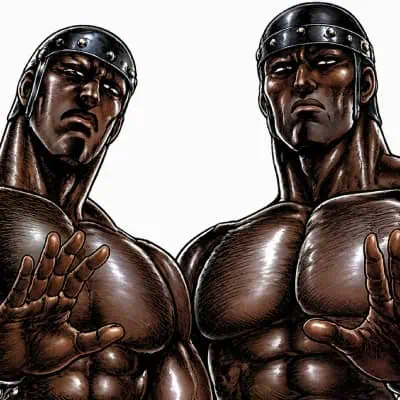
Raiga (ライガ) and Fuga (フウガ) are the twin guardians of Cassandra prison and the last successors of the Nishin Fūraiken (二神風雷拳, Fist of the Two Gods of Wind and Thunder), a martial art reserved for twins who share the same body, the same spirit and the same emotions. Forced to serve Uighur in the name of Ken-Oh to protect their younger brother Mitsu, they switch to Kenshiro's side as soon as he sees the sadness in their eyes. Their tragic end, standing upright, holding up a ceiling to clear the way for Toki, is one of the most memorable deaths in the first part of Hokuto no Ken.
Guardians of Cassandra under blackmail
Raiga and Fuga stand at the monumental gates of Cassandra, the prison-fortress where Raoh locks away martial arts masters whose secret scrolls he has confiscated. Under the direct authority of Uighur, they intercept and strike down intruders who come to free the prisoners, including Toki.
Their obedience is not a choice: their young brother Mitsu is held hostage by Uighur, who threatens to have him devoured by his eagle at the slightest misstep. This pressure tears them apart inside, and behind the armor and metal helmets they wear at all times hide two men crushed by their own role.
The Nishin Fūraiken
The Nishin Fūraiken is one of the most singular martial arts in the manga: it can only be mastered by two practitioners sharing the same flesh, the same spirit and the same emotions. This requirement of perfect twinship makes it a style with an extremely restricted transmission, doomed to disappear if one of the two heirs should die.
The techniques of the Nishin Fūraiken revolve around steel wires of formidable fineness, manipulated by hand and stretched between the two brothers. Synchronized to perfection, Raiga and Fuga encircle their opponent, cross their trajectories and slice him to pieces before he has time to react. The range and speed of their attacks surprise even Rei, master of Nanto Suichō Ken, during a brief exchange at the entrance of Cassandra.
Encounter with Kenshiro
When Kenshiro arrives at the gates of the prison, he confronts the two brothers but perceives in their eyes a pain that does not match that of mere executioners. He spares them. This act frees Raiga and Fuga from an unbearable burden and restores their courage to defy Uighur.
At the very moment Uighur is about to feed Mitsu to his eagle as an example, the two brothers shatter the monumental gates of Cassandra, clearing the way for Kenshiro and triggering the fall of the prison. After Uighur's death, they find Mitsu safe and sound and embrace him in tears.
Heroic death before Toki's cell
The arrival of Ken-Oh's execution squad leaves them no time to savor this liberation. To prevent Kenshiro from reaching Toki's cell, Zarqa and Qasim, two executors of the Royal Guard, trigger a trap: a massive stone block swings down to seal forever the only access to the tower.
Raiga and Fuga arrive just in time to slide their bodies beneath the block, holding it up with all their strength so that Kenshiro and his companions can pass through. While they keep the passage open, Zarqa and Qasim slash them with whips and blades. The two brothers, covered in fatal wounds, never let go of the block. When Kenshiro returns with Toki, he discovers the twins' bodies still standing, supporting the stone even though death has already claimed them. The successor of Hokuto gently closes their eyes and grants them their rest.
Raiga and Fuga's final stance explicitly echoes the legend of the standing death of Musashibō Benkei, the 12th-century Japanese warrior monk who remained standing after succumbing to his wounds, a figure that has become in Japanese culture the symbol of loyalty carried beyond death itself.
Differences with the anime
The 1984 animated adaptation expands on several elements. Mitsu, in this version, does not survive: he is executed before the eyes of the two brothers after their betrayal, which adds even further to the tragic dimension of their final sacrifice. The anime also introduces Sōjin, the twins' former master who has entered the service of Ken-Oh, whom Raiga and Fuga must confront and defeat together using the Nishin Fūraiken before reaching the stone chamber.
Finally, their assassins change: it is no longer Zarqa and Qasim who kill them in the trap, but the samurai Burg, leader of Uighur's suicide squad, who takes advantage of the blockage to lacerate the brothers before being struck down himself by Kenshiro. This modification allows the anime to wrap up a subplot around Burg that was absent from the manga.
Inspirations
The design of Raiga and Fuga is directly inspired by the Niō, the two muscular and wrathful guardians who stand watch at the entrance of Japanese Buddhist temples. The first, Agyō (阿形), is depicted with his mouth open, pronouncing the sound "Ah" which symbolizes birth, while the second, Ungyō (吽形), is depicted with his mouth closed, pronouncing the sound "Un" which symbolizes death. Together, they form the Sanskrit word Aum, the cosmic absolute. This primordial duality, birth and death united in two inseparable bodies, echoes the requirement of perfect twinship in the Nishin Fūraiken and foreshadows the tragic fate of the two brothers.