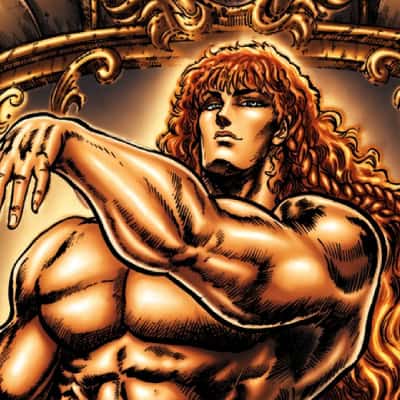
Yuda (ユダ), sometimes romanized Juda or Judah, is the successor of Nanto Kōkaku Ken (南斗紅鶴拳, "Crimson Crane Fist of the South") and one of the six masters of the Nanto Rokuseiken. Representing the Star of Enchantment (妖星, Yōsei), also called the Star of Betrayal (裏切りの星, Uragiri no Hoshi), he seals his fate by leaving the path of Nanto to ally himself with Raoh, taking with him 27 secondary branches of the school. His pathological vanity, his cruelty, and his jealous obsession with Rei make him one of the most memorable antagonists of the first part of Hokuto no Ken. He is voiced by Bin Shimada (the voice of Broly in Dragon Ball Z and Paptimus Scirocco in Mobile Suit Zeta Gundam).
Nanto Kōkaku Ken and the Star of Betrayal
Nanto Kōkaku Ken is a long-range style. Its practitioners cut from a distance using sweeping vertical movements that project blades of atmospheric pressure, capable of slicing an opponent from several meters away without touching them. Yuda is its 64th successor and embodies in the Nanto Rokuseiken sky the Star of Enchantment, which predestines its bearer to a life of glory and glamour but also to duplicity and betrayal.
This dual stellar nature permeates Yuda's entire personality: an extreme narcissist, he considers himself the most beautiful warrior in the world, constantly wears makeup, and surrounds his throne with a harem of women who worship his appearance. But behind the apparent beauty hides a manipulator willing to sacrifice his own lieutenants to preserve his secrets, as Dagarl will tragically learn when he is sliced in two after saying too much to Kenshiro.
The rivalry with Rei
The hatred Yuda harbors toward Rei dates back to their shared training within Nanto Seiken, before the nuclear war. According to the spin-off Sōkoku no Garō: Rei Gaiden, the young Yuda one day witnesses a demonstration of Rei's Hien Ryūbu (飛燕流舞) at the Cliff of Darkness and falls under its spell. But this fascination, which he refuses to acknowledge, quickly turns into corrosive jealousy: his ego cannot accept that another style might be deemed more elegant than his Nanto Kōkaku Ken.
Rather than admitting his admiration, Yuda chooses to sabotage Rei. He notably conspires with Amiba, another candidate for the succession of Nanto Suichō Ken under master Rofu who was ultimately passed over in favor of Rei, to orchestrate the young master's downfall. This jealous, deeply ingrained rivalry shapes the entire subsequent trajectory of Yuda.
The betrayal of the Nanto Rokuseiken
After the nuclear apocalypse, Yuda commits the betrayal that will seal his reputation. He rallies to the army of Raoh, bringing with him 27 subordinate branches of Nanto Seiken, shattering the fragile unity that the Six Stars had maintained since the pre-apocalyptic era. The cohesion of the Nanto Rokuseiken is permanently broken, and the school is now divided between pacifists (around Shu) and belligerents (around Yuda and Raoh).
The manga later reveals that Yuda was in fact manipulated by Souther, who exploits the Star of Betrayal of his rival to fragment his own competitors within Nanto. Souther knew full well that this betrayal would plunge the Nanto Rokuseiken into chaos, and uses it to consolidate his own personal rise to power.
The UD Gang and the abduction of Mamiya
Yuda establishes his own territory from the fragments he has rallied and names his army the UD Gang, after the two letters he has tattooed on the skin of his female prisoners and his soldiers. His primary mission, from that point on, is to abduct beautiful women throughout the desert to fill his harem, which he hands over to his men once he deems them past their prime.
It is in this context that he abducts Mamiya on her twentieth birthday, after slaughtering her parents before her eyes. Branded with the UD mark on her back, she would one day escape to become a warrior. When Rei, years later, discovers the mark on Mamiya's shoulder at Medicine City, his rivalry with Yuda takes on a new dimension: personal vengeance.
The final duel against Rei
Yuda learns from his spies that Rei, struck by the Shinketsushū (心血愁) from Raoh, has only three days left to live. He rejoices, planning to wait for his rival's natural death in order to reclaim his throne of elegance. When Rei forces the duel regardless, Yuda resorts to several tricks: he hides while his lieutenant Dagarl (ダガール), master of Nanto Hiyoku Ken, serves as bait to evaluate Kenshiro's Hokuto Shinken, then cowardly abandons the latter by slicing him in two when he fears having revealed too much.
At the castle of Sajō, the decisive battle begins. To neutralize Rei's Hien Ryūbu, which requires a powerful leg push-off, Yuda has his men destroy the dam of Mamiya's village, flooding the battlefield. With his feet in water, Rei's aerial agility is severely hampered. However, sustained by the one-day reprieve that Toki granted him by pressing his Shinreidai (心霊台), and thanks to Kenshiro's intervention against Yuda's henchmen, Rei overcomes the trap and executes his Hien Ryūbu for the second time. Yuda, paralyzed by the same fascination as at the Cliff of Darkness, drops his guard, and Rei strikes him fatally with his Hishō Hakurei (飛翔白麗), a flying variant of the Hien Ryūbu.
The final confession
Mortally wounded, Yuda commits the ultimate act of his life: he seizes Rei's hands himself and drives them into his own heart, declaring that he would rather die "by the hands of someone so beautiful." With his last breath, he confesses to Rei that he had secretly admired him his entire life, and that his rival's Nanto Suichō Ken had remained forever etched in his heart. He expires in Rei's arms, at his own request, in a scene that has become one of the emotional high points of this part of the manga. This confession, both pathetic and tragic, gives the character an unexpected depth that makes him one of the most complex antagonists in the manga.
Voice acting and creation
Yuda is voiced by Bin Shimada in the original animated series (1984-1988) and the 1986 film, then by Kishō Taniyama in the animated spin-off Ten no Haō (2008). The name Yuda is the Japanese transcription of Judas Iscariot, in keeping with the betrayal theme that defines the character, which also explains the Latin transcription Juda often used in official media. The UD gang owes its name to a nod by Buronson and Tetsuo Hara to the initials of the Japanese name for Judas (Yuda) and to the brand that Yuda imprints on his victims. The one-shot Hokuto no Ken Ichigo Aji - Yuda Gedōden : Ultimate Desire (北斗の拳イチゴ味 ユダ外道伝 Ultimate Desire, 2016) makes him the main protagonist for the first time, in a parodic take.