


“What lies at the bottom is love”: Tetsuo Hara talks about Bonolon (Oricon News, 2021)
Details
- Date
- February 15, 2021
- Type
- Online
- Interviewer
- Oricon News (editorial staff)
- Featuring
- Tetsuo Hara
- Translation
- Hokuto Chronicles
On February 15, 2021, as the hundredth issue of Mori no Senshi Bonolon approached, Oricon News published an interview with Tetsuo Hara, producer of the children’s picture book distributed free of charge at Seven-Eleven and Denny’s locations since 2005 with the support of Seven Bank. Nine questions covering the birth of the project, the character’s design, what Bonolon shares with Kenshiro, and what drives Hara to draw.
“What lies at the bottom is love”
A picture book born from his experience as a father
Oricon. You have drawn manga up until now. What gave you the idea to produce a children’s picture book?
Hara. While raising my children, I saw how picture book and anime characters moved them. That was the starting point. Back when I was drawing Hokuto no Ken and Hana no Keiji in Weekly Shōnen Jump, the way the main characters lived could give boys something to look up to. I wanted to reach even younger children next. I discussed it with Seibō Kitahara, the author of Bonolon, and I was given the opportunity to make it happen.
Oricon. The picture book is distributed free of charge throughout the country. What intention was behind making it free?
Hara. I wanted beautiful stories to reach children regardless of their family circumstances. So that no child who wants to read would be prevented from doing so, we chose to make it free and distribute it at convenience stores, places that are easy to access. It was this shared intention that brought us together with Seven Bank.
Designing the character
Oricon. What image gave birth to Bonolon, the main character?
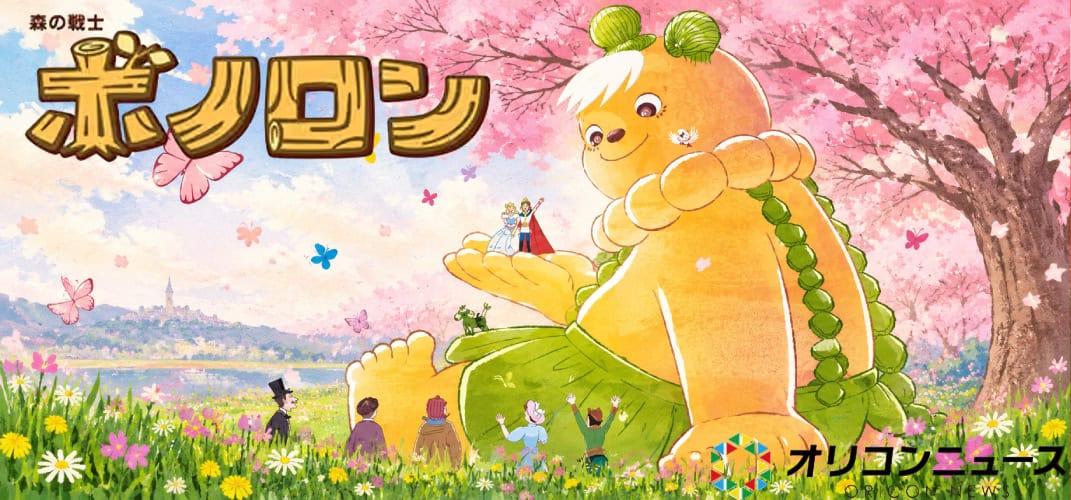
Hara. I designed the character in a world that blends Japanese and Western elements, with the Japanese as a hidden touch. My drawing is influenced by the highly contrasted, baroque-style paintings of the American artist Frank Frazetta. I found it interesting to combine that with the silhouette of a sumo wrestler, which is a Japanese image. The shape of the head therefore borrows the ōichō topknot. The overall arrangement is Western, but what Bonolon wears at the waist is a mawashi. Finally, the sound of the name Bonolon evokes something round, so I gave him a fluffy ruff around the neck.
Common ground with Kenshiro
Oricon. Readers of your works, starting with Hokuto no Ken, have often become parents themselves. Some say they appreciate finding the Hara style in it, the tears and the sadness. What feedback have you received from readers of your past works?
Hara. It is not the end of the century where Kenshiro lived; it is a world of endearing characters, so some people are surprised. But among young parents, reading aloud with their child seems to become a meaningful moment.
Oricon. You can read reactions like “I was reading to my child and almost cried myself” or “I’ve been reading it for years.” The picture book has many adult readers. Is there a particular point you insist on so that the widest audience can connect with it?
Hara. At the core of the work, there is the care people show one another. I have expressed love through the care the characters display. I believe this care is present in people from the very start. But it is easily forgotten, so I think it is important to show it again and again. While watching my children, I noticed that a child under one year old can point a finger to draw attention and put their parents at ease. You must not overlook these signs of care that are unique to children. I feel the weight of responsibility that comes with watching over them.
Oricon. What do you think has made it possible to continue publishing for fifteen years?
Hara. Because Seven Bank supported Bonolon for a long time, with a firm commitment to acting for the future of children. Bonolon will reach its hundredth episode with the December 2021 issue. It is also thanks to Seibō Kitahara’s ability to keep producing stories without stopping, and to Gō Nagayama’s ability to keep drawing without stopping.
Drawing as a mandate from heaven
Oricon. With the pandemic, time spent with family has increased, and everyone uses it in their own way. What role can this work play in times like these?
Hara. I would be happy if this picture book served as an opportunity for parents and children to spend time together. By doing something with their father and mother, a child absorbs affection like nourishment, preparing to go out into the world one day. Whatever the situation, and however modestly, if parents and children cherish the moments they spend face to face, those moments will surely nourish the child’s growth.
Oricon. When the picture book reaches twenty or thirty years, is there something you would not want to see change? And a direction in which you would like to see it evolve?
Hara. The intention has not changed since the beginning: for this picture book to strengthen the bond between parents and children. I want to keep conveying that. The core does not change, but I think the way of expressing it needs to be adapted so that readers receive the message in the context of their own era.
Oricon. You continue to produce works to this day. Tell us about your conviction as a creator.
Hara. After drawing all this time, I sometimes wonder if it is not a mandate received from heaven. When I draw, I feel as though a divinity is giving me its approval. Conversely, when I let up, nothing good comes of it. (laughs) In the beginning, my mother was delighted by the drawings I made for fun, and that made me happy. Then I started drawing while imagining many people, children and adults alike, taking pleasure in them. For me, the joy of others is my own joy. When I draw, I forget myself and immerse myself in it. I would even say that, more often than not, you only do good work by emptying yourself. I do not have a conviction per se, but if I had to name one, it would be mōkorita, that Buddhist term meaning to forget oneself in order to act for the benefit of others. Drawing while forgetting oneself leads to serving others, and something comes back from it. May everyone receive happiness in return.
Reading note
Hara names Seibō Kitahara, the author of the Bonolon stories. It is Oricon that specifies, in parentheses, that this pen name belongs to Nobuhiko Horie, his editor from the days of Hokuto no Ken.
Sources
- Oricon News, « ケンシロウとの共通点も? 『北斗の拳』作者・原哲夫が絵本に込めた想い「根底にあるものは「愛」」 », February 15, 2021, oricon.co.jp/special/55880, two pages. Accessed August 31, 2026.
Quotes translated and entry compiled by Hokuto Chronicles from the original publication. First published on September 6, 2026, updated on October 23, 2026. © 2026 Hokuto Chronicles. Any reuse, even partial or reworded, must credit Hokuto Chronicles with a link to this page.