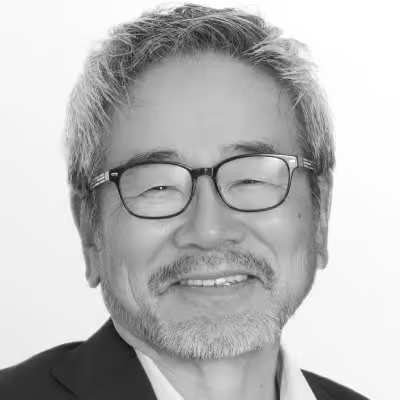
Nobuhiko Horie (堀江信彦), born August 17, 1955 in Kumamoto, is a Japanese manga editor and business executive. Editor of Hokuto no Ken and City Hunter at Weekly Shōnen Jump, he became its fifth editor-in-chief in 1993, then left Shueisha in 2000 to found Coamix, of which he is the president. He also writes under the pen name Seibō Kitahara (北原星望).[1]
Education and joining Shueisha
Horie grew up in Kumamoto and attended the prefectural high school in the city. He then moved to Tokyo, graduated from the Faculty of Law at Waseda University, and joined Shueisha in 1979, where he was assigned to the editorial department of Weekly Shōnen Jump.[1][2]
Buronson, who would work with him for eight years, provides further insight into his profile. Horie was seven years younger than him, had no particular interest in manga, and was assigned to the Jump just as Shigeo Nishimura had been before him. Buronson believes that it was precisely this detachment as a first-time reader that enabled him to judge effectively.[3]
An editor's method
Horie did not take manuscripts as they came. He intervened on the plot, the dialogue, and the page layout, and some of his ideas made it directly into the works.[3]
On Hokuto no Ken, it was he who brought the foundational idea of striking a vital point to make the opponent's body explode. It came to him from an oriental medicine book where a warning indicated that excessive pressure on a beneficial point could instead harm the body. Buronson specifies that the goal was to lighten Tetsuo Hara's drawing workload.[3]
He also believed that the second chapter of a series was decisive. On Hokuto no Ken, he read the script in front of Buronson, in silence, which in his case signaled rejection, then asked for a rewrite. The published chapter shows an old man who spent six months gathering rice seeds, brings them back to the village, and gets slaughtered. When Horie read the old man's line, he smiled. The series reached second place in the reader survey as early as that chapter, first by the fifth, and never relinquished the top spot for two and a half years.[3]
His two authors do not share the same memory of him. Buronson describes weekly meetings where silence signaled rejection, a level of demand that led him to tearfully beg for the series to end after the agreed three years, and a response with no way out, as Horie had no authority to decide since Nishimura had ordered him never to let the series end.[3] Hara, interviewed much later alongside Hirohiko Araki, describes him on the contrary as someone very gentle and says he never experienced anything harsh, his only fright being seeing him show up at his home in the evening, tipsy, to demand the pages.[4]
Before Hokuto no Ken, it was already he who suggested that Hara draw on his passion for motocross for his first series, Tetsu no Donquijote, in 1982. The series was canceled after ten installments. Horie would later confess to Buronson that the cancellation had been decided as early as the second episode.[3] When the editorial team looked for a scriptwriter to pair with Hara, it was once again Nishimura who consulted him, and he replied that he wanted to ask Buronson.[3]
At Jump, he also oversaw Hisashi Eguchi, Tsukasa Hōjō, and Ryuji Tsugihara. He developed with Hōjō Cats' Eye and then City Hunter, for which he had been the editor even before its debut. The heroine of the second series, Kaori Makimura, bears the first name of Horie's daughter, who was born around that time.[2]
Editor-in-chief of Weekly Shōnen Jump
In 1993, Horie became the fifth editor-in-chief of Weekly Shōnen Jump. Under his leadership, the magazine reached its all-time circulation record of 6.53 million copies in 1995, a figure never equaled since and certified by Guinness.[1][2]
He regarded this record as the result of a temporary convergence of popular series rather than a sustainable trend, and launched a tournament for new authors in order to prepare the next generation. The end of Dragon Ball in 1995, however, left a void that nothing could fill, sales plummeted, and he was removed from the editor-in-chief position in 1996.[2]
He was transferred to Men's Non-No, then took charge of the monthly magazine BART starting in 1997. It was in the latter that Tetsuo Hara published Kokenryoku Oryo Sosakan Nakabo Rintaro from 1998 to 2000, a series that ended when the magazine ceased publication. Horie left Shueisha in 2000, upon the announcement of its discontinuation.[2]
The founding of Coamix
Horie left Shueisha in 2000 and founded Coamix with Tetsuo Hara, Tsukasa Hōjō and Ryuji Tsugihara. He became its president. The following year, in May 2001, the company launched Weekly Comic Bunch, a magazine published by Shinchosha, of which he served as editor-in-chief until 2004.[1]
In July 2004, he created North Stars Pictures, a company responsible for managing the rights of artists and scriptwriters as well as animation production. It was absorbed by Coamix on April 1, 2020, as the two entities had distinct roles: publishing works for one, and publication and rights management for the other.[5]
In 2009, he opened Café Zenon in Kichijōji, renamed Galerie Zenon in 2024, launched Monthly Comic Zenon in 2010, of which he served as editor-in-chief until 2013, and founded the company Jizoya in 2011.[1]
The return to Kumamoto
Horie steered Coamix toward a development centered on his home region. The company established a second headquarters there, in Takamori, and in 2020 opened an artists' village in Takamori, the Artist Village AsO, complete with a lodging facility and a restaurant. Since 2022, it has welcomed Japanese and foreign mangaka and aspiring mangaka there, some thirty to date, supported on site by an editor from the company.[1]
In September 2021, an agreement was signed between the city of Takamori, the Kumamoto prefectural board of education, Takamori High School, and Coamix. The high school's manga department opened the following April. It was the first ever created in a Japanese public high school. Horie emphasizes this point: because the institution is public rather than private, all high school students have equal access to it. Coamix sends instructors there, produces the textbooks, and supervises the manga club outside of class hours.[1]
In 2020, he founded an all-female performance troupe in Kumamoto, 096k, whose name is taken from the city's telephone area code, and in 2024 opened a venue housing both the troupe's theater and a gallery of original manga artwork. In 2025, he received the fourth Manga Culture Award from the Kumamoto Nichinichi Shimbun, then in March 2026 the Medal with Dark Blue Ribbon, a Japanese distinction that honors donors who serve the public interest.[1]
Seibō Kitahara
Horie writes under the pen name Seibō Kitahara. Buronson states in his essay that the script for Souten no Ken is credited to him, even though the colophon of the first volume only credits Tetsuo Hara as author and Buronson as supervisor.[3][6]
He also wrote the script for Ikusa no Ko -Oda Saburo Nobunaga Den-, drawn by Tetsuo Hara and published in Monthly Comic Zenon from 2010 to 2022, as well as the stories for Mori no Senshi Bonolon, a series of illustrated children's books distributed free of charge in Japan since 2005, conceived and produced by Hara.[7]
Hara recounts that the Bonolon project was born from a conversation with him. He wanted to reach younger readers than those of Weekly Shōnen Jump, discussed it with Kitahara, and the latter gave him the opportunity to make it a reality.[7]
Sources
- ↑ Interview with Nobuhiko Horie for the twenty-fifth anniversary of Coamix, and company chronology, official Coamix website, June 2025.
- ↑ Horie Nobuhiko, Japanese Wikipedia, Pixiv Encyclopédie and Weekly Shōnen Jump Wiki, accessed August 19, 2026.
- ↑ Buronson, 悪と嘘を描く 武論尊の漫画原作私論 (Dépeindre le mal et le mensonge), Shogakukan Shinsho no. 507, April 6, 2026.
- ↑ Joint interview between Tetsuo Hara and Hirohiko Araki, Comic Natalie.
- ↑ "Merger announcement," official Coamix website, accessed August 19, 2026.
- ↑ Colophon of the first volume of Souten no Ken, Shinchosha, October 15, 2001.
- ↑ Interview with Tetsuo Hara, Oricon News, February 15, 2021.