


“My Way of Living”: Tetsuo Hara recounts his journey, from Shibuya to Coamix (Kōken, 2026)
Details
- Date
- July 2026
- Source
- Kōken (公研), July 2026 issue, "私の生き方" series (676th installment)
- Type
- Press
- Interviewer
- Kōken (editorial staff)
- Featuring
- Tetsuo Hara
- Translation
- Hokuto Chronicles
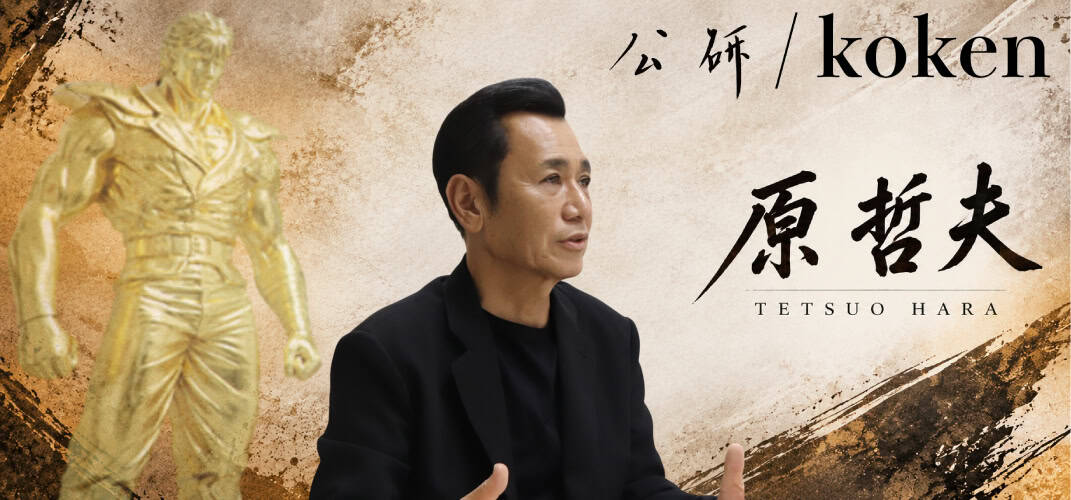
In July 2026, the journal Kōken (公研) dedicates the 676th installment of its series “My Way of Living” (私の生き方) to Tetsuo Hara. Over some twenty questions, Hara retraces his journey from childhood to Coamix: the yonkoma sent to Ishinomori, the humiliation at the Weekly Shōnen Jump editorial office, the cancellation of Tetsu no Don Quichotte, the birth of Hokuto no Ken from a passing idea by Horie, the eye disease, Hana no Keiji, the founding of Coamix, Bonolon, Italy, Frazetta, and what he calls love. The most comprehensive interview he has ever given about himself.
“My Way of Living,” by the author of Hokuto no Ken
A childhood spent drawing
Kōken. What sparked your passion for manga?
Hara. My father was a salaried worker. I watched him get up early, take the train, head off to the office, and I told myself I could never live like that. As for me, I had been drawing for as long as I could remember, even before my earliest memories. So I looked for a profession where drawing could sustain me, and around second grade, I decided I would become a mangaka.
Yet at that time, I didn’t read much manga. I mostly watched the anime adapted from them: I preferred animation, which moves, over manga, where the image is static. Then one day, by chance, a classmate gave me a manga, Osomatsu-kun by Fujio Akatsuka. I opened it to take a look. As I turned the pages, the drawings began to move before my eyes. That was when I understood, for the first time, what manga could do.
Kōken. When did you start drawing manga?
Hara. Seriously, around third grade. My mother had bought me a book, Fujiko Fujio’s Introduction to Manga, and it meant a great deal to me. For kids of that era who loved drawing, it was something of a bible.
At school, I barely paid attention: I spent all my time drawing, illustrations, manga. I was hopeless in class, but in exchange I had wild ideas. In manga and tokusatsu, almost every week a new monster with a carefully crafted design would make its entrance. I concluded that a mangaka had to be able to invent one per week, and I spent my days imagining designs and drawing them.
Kōken. When did you start submitting work to contests?
Hara. In middle school. Shōtarō Ishinomori ran a column in Shōnen Big Comic where you could submit yonkoma, four-panel manga. That’s where I made my first submissions. To learn how to construct a story (the introduction, the development, the twist, the punchline) nothing beats the four-panel exercise. When a strip was selected, it came back with a comment, something like “here’s what’s good about Hara’s manga.” I was overjoyed. I still remember it.
I had the chance to meet Ishinomori a few years after my debut. I was so intimidated that I didn’t dare mention those four-panel strips to him.
Kōken. You then entered the design department at Hongō private high school.
Hara. In high school, I was in the manga and gekiga club. But it was right in the middle of the Bruce Lee craze, so the older students set manga aside and started making amateur kung-fu films. I watched a lot of kung-fu movies too, but I thought that in a club that was still called a manga club, manga was what you should be doing. So I drew it. In fact, that interest in kung-fu later fed into the construction of the character Kenshiro in Hokuto no Ken.
The editor I met at Jump
Kōken. After high school, you made your debut in Weekly Shōnen Jump.
Hara. I had absolutely no desire to go to college. I wanted to learn manga first as an assistant. I started by applying to work with Takao Yaguchi, who was publishing Tsurikichi Sanpei in Weekly Shōnen Magazine. Rejected. I told myself I couldn’t leave it at that and, reluctantly, I answered the Jump’s call for assistants. It’s hard to imagine today, but back then it was Sunday and Magazine that dominated. Jump was trailing behind. Since they were focused on training young creators, they were constantly recruiting beginner assistants.
Before that, I had already submitted work to Jump during summer break in my first and second years of high school. The first time, eliminated. The second time, I made it to the final selection and was called in to the editorial office. They told me to draw something new and come back. I brought back unfinished pages, and they didn’t go easy on me. I remember the exact words: “This isn’t good at all. The creators of Kinnikuman, Yudetamago, are only a few years older than you and they’re already running a series.” I was so stung that I swore I would never call Jump again. But I ended up having to phone the editorial office, and an editor named Nobuhiko Horie picked up.
Kōken. Horie was your editor for a long time, from Hokuto no Ken to Hana no Keiji.
Hara. At that point, Horie was the new guy at the editorial office, so they had him manning the phone. And it was him, by chance, who happened to take my call. Looking back, that may have been the moment my destiny shifted.
Until then, I couldn’t manage to draw what I truly wanted. I couldn’t find a story tough enough to match my gekiga style, so I only submitted comedic manga. When I showed Horie my real style, that gekiga line, he loved it. We got fired up, we wanted to draw guys with real presence, and we hit it off immediately.
Then Horie gave me a piece of advice and a recommendation: “What really matters is learning under a creator who’s truly successful.” So I went to train under Yoshihiro Takahashi, the creator of Akutare Kyojin and Ginga: Nagareboshi Gin.
My first series was already dead
Kōken. After several stories, you launched Tetsu no Don Quichotte, a series about motocross. It ended after ten chapters.
Hara. In reality, the cancellation was decided as early as the second chapter. The reader survey had been bad for the first, bad again for the second, and when the second is bad, cancellation is practically a done deal. But nobody told me, and I kept drawing. At the sixth chapter, Horie dropped the bomb: “This manga is finished, let’s talk about the next one.” And he continued: “Hara, you said you wanted to draw a Chinese kung-fu manga. Next time, how about we do a story where people explode when you press points on the body, the keiraku hikō?”
I thought: what is he talking about? Pressing a vital point and making someone explode, what an absurd idea. My series was already doomed, with no prospects whatsoever, and he added: “And the signature line will be ‘You are already dead’!” (laughs)
That said, with Tetsu no Don Quichotte, I had probably been naive. I was only thinking about debuting, without really asking myself what I wanted to draw or what I was capable of drawing. So I made a firm decision: bet everything on the next project, and give up if that one failed too. It was in that frame of mind that I began building Hokuto no Ken.
Kōken. How did the project take shape?
Hara. Horie was thinking of an assassin story, understated, in the spirit of the TV series Hissatsu, where the target is killed with a single needle strike. On top of that, I forcefully grafted Bruce Lee elements, and the tone of Hokuto no Ken was set. In principle, when you kill by striking a vital point, you don’t need spectacular action. But I had promised myself to do everything I wanted to do, so I invented flashy techniques like the Hokuto Hyakuretsu Ken on my own initiative. The vital point was supposedly struck somewhere in the middle of the barrage. (laughs)
Horie, for his part, brought all sorts of ideas. “In China, the Big Dipper is considered the deity that governs death, so we’ll call the martial art Hokuto Ken.” But I thought Hokuto Ken didn’t sound right. I borrowed from the title of a Jackie Chan movie that was popular at the time, Hiryū Shinken, and named it Hokuto Shinken.
“Let’s go eat sushi,” or how I figured out we had a hit
Kōken. Hokuto no Ken is finally launched. What was your impression?
Hara. Before the series, two standalone stories of Hokuto no Ken were published. I had already failed with one series, so the editorial department didn’t have much confidence in me. But the two stories did well, no question about it, and the series was greenlit.
Before Tetsu no Don Quichotte, I had drawn a standalone story inspired by the film Mad Max 2, Mad Fighter, which had also been well received. I loved that world of apocalyptic violence, and I decided to put it front and center in the Hokuto no Ken series. However, Horie told me: “Hara, you’re slow at drawing, you need a scriptwriter.” That’s how Buronson came on board for the script.
From the failure of Tetsu no Don Quichotte, caused by the fact that I hadn’t fully committed to what I wanted to draw, I had drawn a rule: on Hokuto no Ken, I would only draw what I genuinely thought was great, from the bottom of my heart. Whether it was Buronson’s script or Horie’s editorial input, I only put into the work what I was truly convinced of. I never wanted to have regrets again.
Kōken. National success arrives. Did you see it coming?
Hara. Strangely enough, no. There was no Internet back then. And on my end, to keep myself grounded, I made it a rule never to ask about my ranking in the reader surveys.
But Horie’s mood told me everything. (laughs) He was usually so strict, yet he was oddly in a good mood. He would call me: “Bring me the pages.” I’d arrive at the editorial office, and he’d say: “How about we go eat sushi?” The following week, it was a fancy steak restaurant. After two or three weeks of this treatment, even I finally understood: oh, things are going well right now. It was obvious. (laughs)
At the time, Jump, Sunday, and Magazine were all hitting the wall of three million copies. Each one would climb into the upper two millions without ever breaking through the final barrier. People said you needed three mega-hit series to get there. Jump had Kinnikuman and Captain Tsubasa, and Hokuto no Ken was added to that. The three-million wall was shattered in no time, circulation climbed by two hundred thousand copies per week, and it eventually reached four million. During that period, it was often the anime that set fire to the original manga, but for Hokuto no Ken, I was told, the popularity was already enormous at the manga stage. You can understand why Horie was in a good mood.
Working relationships and the eye disease
Kōken. Maintaining a weekly pace with such dense artwork must have been grueling.
Hara. Horie told me to plan for about three years. At that scale, I could manage: I went for it. And to be honest, drawing Hokuto no Ken was a true joy.
However, I had to give up any private life, and relationships with my assistants gave me a lot of trouble. I was twenty-two, just a kid, and some of the people who came to assist me were older than me. When I was slow on a page, they’d let me know, and the atmosphere would get a little heavy. (laughs)
I’ve never been comfortable around people, and I would have liked to draw my manga all by myself. But a series means deadlines to meet, no exceptions. I took that as part of the learning process, and I worked while living with the assistants, meals and sleep included.
Kōken. You also suffered from an eye disease during the series.
Hara. Since I was about eighteen, before my debut, I felt that something was wrong with my eyes. It was keratoconus, a rare disease: to put it simply, the cornea deforms and points forward. My vision dropped tremendously, and drawing became agony. I had headaches and nausea. And since my eye could no longer focus, I couldn’t place the line where I was aiming. I tried contact lenses, but my eyes rejected them.
I went from hospital to hospital looking for a treatment, and I was told that a corneal transplant wouldn’t change much. So I lived about thirty years with this disease. Physically, it was hell.
In 2024, I finally decided to go through with the transplant. The operation was a success, and my visual acuity went from 0.02 to 0.2. I can see better today than when I had a series in Jump. Thank you to the advances in medicine.
“Historical stories don’t work in a boys’ magazine”
Kōken. In 1988, Hokuto no Ken ends after five years. You could have stopped there.
Hara. That was my intention: at the end of Hokuto no Ken, I would quit the profession. I couldn’t see anything else I would have wanted to draw. But I couldn’t do it. Most of the income had gone to taxes, and I had almost nothing left. I realized just how tough this profession is.
That’s when Horie came to me with a proposal to adapt a historical novel. “I read five hundred historical novels for you before coming!” Five hundred, I thought he was exaggerating a little. (laughs) When I heard the words “historical novel,” I immediately pictured jidaigeki actors in kamishimo with powdered faces, a world I didn’t know how to draw. But what Horie was putting in my hands was Ichimuan Fūryūki by Keiichirō Ryū, and that novel is what gave rise to Hana no Keiji : Kumo no Kanata ni. The main character, Maeda Keiji, a kabukimono, that eccentric figure, interested me. And the muscular bodies I wanted to draw went very well with the kimonos and armor of the Sengoku era, where Japanese and Western motifs intermingle. I immediately felt it was doable.
Kōken. Historical narratives no doubt posed different challenges than contemporary ones.
Hara. In the boys’ magazines of the time, there was a kind of curse: jidaigeki doesn’t work. So I found myself defying it. On top of that, in a Jump that promotes “friendship, effort, victory,” showing not only the winner but also the aesthetic of the defeated was unusual. I still half believed in it, telling myself it would eventually work out. But no matter what I did, I never managed to land first or second place in the reader surveys like in the days of Hokuto no Ken. On good days, I was seventh. The series lasted three and a half years, and staying at rock bottom for all that time was painful.
And then Maeda Keiji is a character known for his smile. But I had only drawn rugged men, Kenshiro, Raoh, and I didn’t know how to draw a man who looks good smiling. At the beginning of the series, I was often asked to redo my pages. I kept thinking to myself, “I don’t know how to do this,” but I tried anyway. Hana no Keiji is a work I drew from start to finish with that kind of torment.
Kōken. Hana no Keiji still gives the impression of a very self-assured work, though.
Hara. The torments never stopped, that’s true, but this series taught me the spirit of bushidō, and it continues to influence my life. In particular, the Hagakure, that collection of precepts and samurai tales that Ryū also read, dictated by Yamamoto Tsunetomo and written down by Tashiro Tsuramoto, is an important book in my life.
It contains an attitude called jōjū shinimi, “living permanently as though already dead.” I understood it this way: kill yourself, live as a dead person, and that is precisely what brings life. It all happens in thought, of course. But the Hagakure recommends, every morning upon waking, before doing anything at all, giving yourself death in your imagination, by bow or by sword. I understood that the person who is already dead has an unshakeable heart: a dead person fears nothing anymore. And when you are cornered, it is by leaping into the fire yourself that you find a way out. That, too, I learned from the Hagakure. This spirit of jōjū shinimi has been my guiding principle since my thirties.
Kōken. You have produced many historical narratives since then. Is there a character you would like to portray today?
Hara. No, not really. My role is to take the subjects Horie finds, arrange them into readable manga, and serve them to readers. All I need to know is how to draw in a way that makes the subject exciting to read. If you like, I’m a cook. I receive ingredients, I cook them, I serve them to the customers. And the longer you cook, the better you get at it, so that eventually you can make something good out of any ingredient.
Starting a company, ready to risk everything
Kōken. Coamix was founded in 2000, centered around you and Horie. Did the initiative come from Horie?
Hara. It was probably me who came up with the idea. (laughs) It was the time when everyone was talking about Horiemon, Takafumi Horie. Under his influence, I decided to start a company.
I was going through a difficult period as a mangaka at the time. After Hokuto no ken, Cyber Blue had flopped, and Hana no Keiji had ended with modest success, nothing more. I was only thirty-three, and the future worried me. That’s when Horiemon burst onto the scene like a comet. I thought an extraordinary man had just appeared. That pushed me to study business management, and little by little, the desire to start a company grew.
The heart of the matter is that I never had any head for business. Smooth talkers would make me give in. They would come to me and say: “Mr. Hara, let us reprint Hokuto no Ken with our company. For the rights, half of half of half, does that work for you?” And I was on the verge of swallowing absurd conditions, one after another. I became frightened when I realized that even Hokuto no Ken, the most precious thing I had, I wasn’t able to protect it on my own.
I concluded that I shouldn’t keep fighting alone, but gather trustworthy people and form a team. The first person I told was Horie. As it happened, he was also going through a rough patch: he had left the editorial leadership of Weekly Shōnen Jump. I thought if I was going to bring him on board, now was the time.
What I say is always outlandish, so the business idea, he first dismissed it with a “what are you talking about?” Horiemon wave or not, Horie was forty-five, and starting over from scratch at that age must have been tough, physically and mentally. But I insisted, again and again: “Let’s do it. So what if we fail? As long as the two of us are here, we can keep making manga. Me drawing, you writing. That’s what we’ve always done, right?”
Horie finally said: “You won’t make it on your own. Let’s find other partners.” And he went to see Tsukasa Hōjō, the creator of City Hunter, and Ryūji Tsugihara, the creator of Yoroshiku Mechadoc. That’s how Horie is: at first, he doesn’t listen, then he comes around, and in the end he throws himself into it completely as if it were his own venture. That is how Coamix was founded. How time flies: twenty-six years already.
Bonolon, for all children
Kōken. You also produce Bonolon, an illustrated story for children, very different from your usual style.
Hara. When my children were born, I also thought about a lot of things. What fascinates toddlers, generally, is Disney or Anpanman. That bothered me a little. I’m a creator too, and I wanted to accompany children as they grow with characters I had made myself. I mentioned it to Horie, who had been thinking the same thing on his side. In that case, let’s make an illustrated story, and Bonolon was born. Horie is someone who, once committed, stays the course to the very end: Bonolon has been delivering new stories for over twenty years.
Kōken. Many readers in their twenties and thirties discovered your work through Bonolon, before Hokuto no Ken.
Hara. That’s exactly what I wanted: for children to grow up encountering my works.
At the time, with the fallout from the 2008 financial crisis among other things, people were starting to talk about “child poverty.” There was concern that the financial situation of families was creating a gap between children who receive a proper education and those who don’t, between those whose parents buy them books and those who have none.
“Can’t we do something that all children in the country can benefit from equally?” It was Seven Bank that answered this call. Thanks to their support, the free distribution of Bonolon in every Seven-Eleven across the country became a reality. The fact that it’s free says it all: Bonolon is not a venture made for money. We decided above all to convey an intention, “for the children.”
Da Vinci, Michelangelo, Hara Tetsuo
Kōken. You recently donated a self-portrait to the Uffizi Gallery in Italy.
Hara. I had no idea, but apparently Hokuto no Ken is extremely popular in Italy. When I went there last year, the Italian fans gave me an incredibly warm welcome. And Italy resembles Japan in many ways. The warm character of the people, the somewhat gloomy and often rainy weather, all of it reminded me of Japan, I’m not quite sure why.
Italy is also the country where the works of the Renaissance masters, Leonardo da Vinci and Michelangelo, remain. Last year, in the church where my exhibition was held, precious Renaissance pieces on loan from the Uffizi Gallery were hung alongside my drawings. My drawings were treated on equal footing with the works of Baccio Bandinelli, an artist active mainly in Florence during the Renaissance, whose name Giorgio Vasari recorded in his Lives of the Artists. It seems they found a kinship with my drawings, in terms of the beauty of the body. The thing is, in Italy, there is no boundary between art and manga. Manga is considered a full-fledged art form there.
Incidentally, Coamix now has an Italian employee, originally from Rome, who is also a passionate fan of Hokuto no Ken. He had been doing volunteer work related to manga in Italy and knew a lot of people. The Uffizi affair, as well as the meeting last January with Prime Minister Giorgia Meloni, are thanks to him.
Kōken. Coming all the way from Italy to a Japanese publisher shows a strong commitment.
Hara. To join the team, you have to love Hokuto no Ken from the bottom of your heart, otherwise it doesn’t work. I’ve entrusted work to many people, and when you entrust it to someone who truly loves Hokuto no Ken, the passion is on a completely different level. It’s no exaggeration to say that if Hokuto no Ken is still popular today, it’s thanks to them.
A drawing that makes you jump the moment you open the page
Kōken. Which manga artists left the greatest impression on you, in terms of drawing?
Hara. I’m from the gekiga boom generation, so gekiga artists left an enormous impression on me. The ones that come to mind right away: Ryōichi Ikegami, Takumi Nagayasu, Noboru Kawasaki. Outside of gekiga, Tetsuya Chiba and Shōtarō Ishinomori. But the first one I loved was Fujio Akatsuka. It was thanks to him that I discovered what comedic manga can do: I laughed until I was rolling on the floor, until I cried. Making people laugh to the point of tears is the mark of his genius.
There are many others. In those days, there was no shortage of legends. And of course, the authors of Tokiwa-sō left their mark on me as well.
Kōken. Your drawing gives bodies a presence that seems ready to move.
Hara. I have never stopped seeking “a 2D drawing that looks like it’s in 3D.” A drawing that, the instant the reader opens the page, startles them into recoiling.
And I saw it with my own eyes, in real life. It was during the Hokuto no Ken serialization, on a train. Back then, commuters would all unfold their manga magazines in the train car. There were bound to be young people reading Jump, so I went to peek over their shoulders, discreetly. It turned out they were reading Hokuto no Ken. One of them turns the page and lets out a “whoa!” of surprise. Then he turns to his friend, all excited: “Hey, did you read that?” Behind them, I silently clenched my fist: “Yes!” I was so happy. That said, nobody in that train car would have believed that a kid like me was the author. (laughs)
Aiming for a distortion that looks real
Kōken. Foreign illustrators also left a strong impression on you.
Hara. I had learned that Ryōichi Ikegami had been influenced by an American illustrator, Neal Adams. I went looking for one of his books at a foreign bookstore, and they didn’t have any. I was browsing the shelves to leave with something else, and by chance, I came across Frank Frazetta. It clicked: this is it. What’s powerful about him is that his muscles aren’t bodybuilder muscles. They’re muscles that fight, battlefield muscles. I wanted to draw muscles like those.
Kōken. Frazetta refused to copy photographs. He threw a mental image in motion onto the canvas.
Hara. Yes. Like him, I think drawing exactly like a photograph has no point. That’s why my drawings are realistic, but they are manga. In other words, distortion. Except I’m not aiming for the distortion of comedic manga: I’m aiming for a distortion that looks real, like live-action footage. A distortion made realistic, if you will.
In Hokuto no Ken, for example, you see gigantic enemies appear, impossible if you think about it physically. They’re human beings, and they’re two or three times the size of Kenshiro. But that serves to emphasize their power and their villainy. Ignoring scale is already a distortion. And when you push distortion within a realistic drawing, you perhaps arrive, in the end, at the drawing of Frazetta.
Kōken. The horses in your series, Kokuoh in Hokuto no Ken and Matsukaze in Hana no Keiji, are reminiscent of Frazetta’s Death Dealer.
Hara. Absolutely. It was by looking at Frazetta’s horses that I figured out how to draw mine. As a general rule, I use the paintings of painters as my reference. For the horse, I don’t draw by observing the actual animal: I analyze the horse as a painter has painted it. I start from an image filtered through someone who has captured the essence of the horse, then I look at real horses, photographs, I compare, and I search for my own approach. That is still, in a way, a work of distortion.
Horie is a father
Kōken. Frazetta kept his body in shape and played sports. What about you?
Hara. In elementary school, because of manga, I took up judo and kendo. But I wasn’t good at sports, and I gave up after that.
Once I became a professional manga artist, though, I learned the hard way what physical fitness really means. During the Hokuto no Ken era especially, my body broke down all over. You can’t draw manga without recharging your batteries. So starting in my thirties, I began going to the gym and paying attention to my health.
And I also appear in the media, so I feel I need to take care of my image. When I met the fashion designer Giorgio Armani, while he was still alive, I learned from him that you have to pay attention to every last detail so that your appearance doesn’t tarnish the image fans have of you. Since then, I make sure I never look sloppy.
Kōken. What does Horie represent to you?
Hara. A father. From my perspective, Horie is on a whole other level. Thanks to him, I was able to correct what was wrong with me early on. What we’d call a mentor today. That said, my manga also helped him achieve great success, so in that sense, you could say we both got something out of it.
In the beginning, Horie was extremely tough. I can’t even count how many pages he made me redo. But I didn’t break. I wanted him to feel that I wasn’t like the others, and I gave everything I had for that. Today, we run the same company together, so I think on that front, I put up a pretty good fight.
Kōken. Do you socialize with other manga authors?
Hara. Not that much. But since his wife and mine get along very well, I see Hirohiko Araki, the author of JoJo’s Bizarre Adventure, fairly often. Even now, we have dinner together about twice a year. When I’m the one who writes to Araki, the reply is slow to come. When it’s my wife, the reply comes right away. (laughs)
People often say that manga artists don’t get along very well with each other. But as soon as someone makes the connection, the relationship holds. If I’m still close to Araki, it’s thanks to my wife.
Love is giri ninjō
Kōken. Love runs through Hokuto no Ken as well as Hana no Keiji. What is love, to you?
Hara. Giri ninjō, obviously: duty and heart. I believe that’s what lies at the core of Japanese values, and always has. It has taken different forms across different eras, and it eventually found its way into entertainment, manga, anime. Hokuto no Ken, which portrays it head-on, swept the entire country. These precious values from our elders, I believe they pass on to the children of the next generation through manga and anime, without anyone even realizing it.
Kōken. To wrap up, what is the hardest part of this profession? And the most rewarding?
Hara. The hardest part is when your manga doesn’t connect with readers. And then falling ill, wanting to draw but having a body that won’t let you anymore.
The most rewarding, on the other hand, is when readers enjoy my work. When people tell me what they thought of it, I’m truly happy. And that feeling of being connected to the world through your work is something beautiful. When I’m invited abroad, I see that there are readers all over the world who love my manga, and that I’m of some use to them. There is no greater joy than that. I have to keep working to give them even more.
Sources
- Kōken (公研), July 2026 issue, series “私の生き方” (676th installment), “『北斗の拳』作者が辿る「わが生涯」【原哲夫】”. Full Japanese text. Editorial copy.
Quotes translated and entry compiled by Hokuto Chronicles from the original publication. First published on September 6, 2026, updated on October 23, 2026. © 2026 Hokuto Chronicles. Any reuse, even partial or reworded, must credit Hokuto Chronicles with a link to this page.