

After more than 40 years off the screen, the return of Hokuto no Ken as an anime series was one of the most anticipated events in the manga and anime world. Since the launch of Hokuto no Ken – Fist of the North Star on April 10, 2026 on Prime Video, opinions have multiplied around the world, and to say the least, they have not lived up to expectations… A global overview of critical opinions and reactions from around the world, five episodes after launch.
What Tetsuo Hara Himself Thinks About It
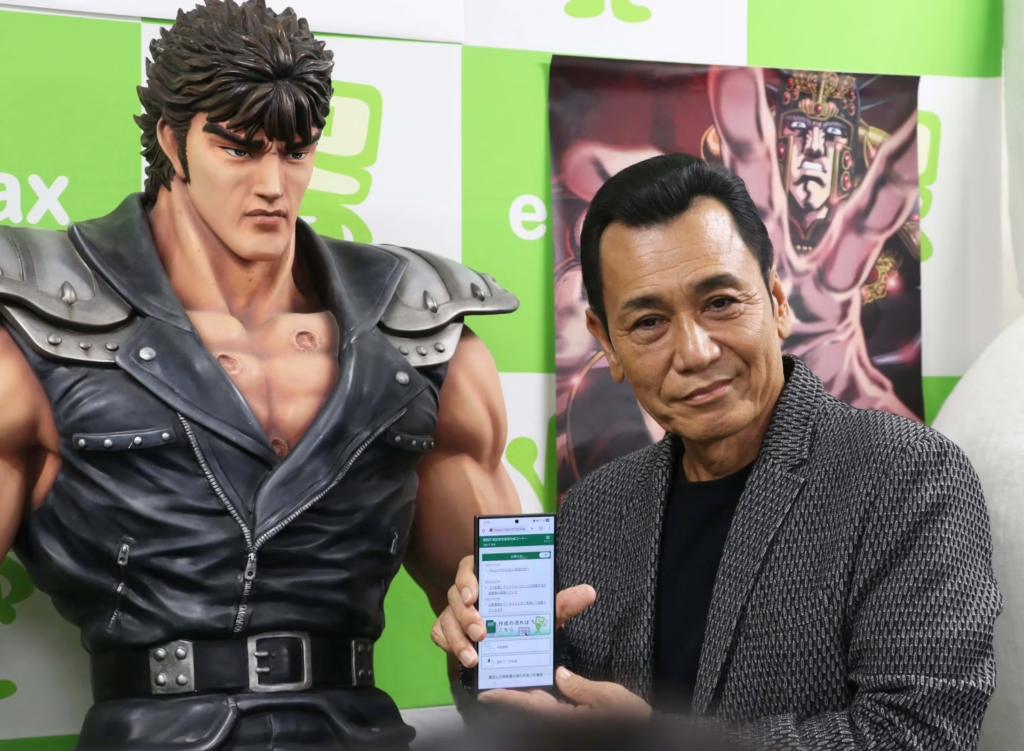
Before even addressing outside criticism, we need to pause on the most significant statement of all, the one from the original manga’s artist. In January 2026, invited by the Musashino tax office to promote smartphone tax filing, Tetsuo Hara discussed the anime in response to a journalist’s question. His statement is unambiguous: “I am not directly involved in the project. The director changed during production and someone else is handling it now. I am very curious to see the direction this new director will take, but I must admit I am also quite worried.” He concluded by asking the audience to “not expect too much at the beginning” and to “overlook the initial part” before judging the whole. An unusual statement for an author discussing his own franchise, which immediately fueled discussions about the series’ production conditions. Squalo Densetsu from 199X Generazione Hokuto also recalls that Hara had already refused to talk about the anime during his appearance at Lucca Comics in November 2025.
The Japanese Reception: The Cast Saves the Day
In Japan, the reception of the anime is generally more forgiving than in the rest of the world, not because of the CGI, but thanks to the voice cast. Kenshiro is voiced by Takeuchi Shunsuke, Raoh by Kusunoki Taiten, and the entire main cast lives up to the challenge. Discussions on Japanese forums and social media converge on one observation: the original dubbing saves the experience where the animation drags it down. In Japan, the series fulfills its commercial role as a promotional showcase for the franchise aimed at new generations.


The English-Speaking Critics: Very Critical of the CGI
On the English-speaking side, the verdict is mixed but generally harsh regarding the visuals. Anime News Network, whose critics covered the first episode in their Spring 2026 Preview Guide, sum up the problem in a few lines: the series clearly lacks a team of experts “firing on all cylinders,” the facial animations are too stiff for the characters to express anything believable, and the English dub is bluntly called “one of the biggest jokes in the industry,” to be avoided at all costs according to them. The comparison with the 2016 Berserk anime, infamously known for reigniting the debate over CGI in Japanese animation, came up consistently in the first few weeks.
Screen Rant takes a more nuanced and generous tone, noting that the series “defies expectations” after a catastrophic first trailer. According to them, the emotional dimension of the story, particularly the characterization of Kenshiro, works better than expected, and the series accomplishes what it was supposed to do narratively. Their conclusion: “The Fist of the North Star reboot does exactly what was expected of it.” A notable caveat, however, shared across all English-speaking reviews: the CGI remains a major obstacle that continues to push away potential viewers, despite the series’ genuine narrative qualities.
The Italian Critics: 199X Generazione Hokuto
This is arguably the most comprehensive and well-documented analysis available outside of Japan. In a lengthy article published on April 29, 2026, Squalo Densetsu from 199X Generazione Hokuto, our partner and one of the most serious HNK references in Europe, delivers a harsh but rigorously argued verdict.
On the CGI first, the assessment is damning: the series suffers from the same visual inconsistencies from one episode to the next as the 1984 Toei anime it is supposed to surpass, despite incomparably larger production budgets. The comparison with Guilty Gear Strive Dual Rulers (2025), which achieves a far more convincing 2D/3D fusion, illustrates what could have been done with the right resources and the right studio. Sony, which produced hits like Demon Slayer and Jujutsu Kaisen through Mappa and Ufotable, would according to him have been the ideal partner for this project.
On the narrative, the most developed point of his critique concerns Episode 5 and the final duel between Kenshiro and Shin. The writers introduced techniques visually borrowed from the Arc System Works fighting game, which, in his view, betrays what is essential about Kenshiro: he is the heir of death, a warrior whose power never needed scripted progression. Introducing this power-scaling logic borrowed from video games creates canon inconsistencies that those familiar with the work will have a hard time ignoring.
On the soundtrack, the judgment is more balanced: Yuki Hayashi delivers music that effectively “accompanies” without trying to stand on its own, which is both its limitation and its strength; it gives full space to the Japanese cast without competing with the nostalgia of the 1984 anime’s original soundtrack.
On the Italian version, he points out questionable adaptation choices, episode titles that betray the original meaning, and technique names whose translation choices immediately drew reactions from the community, symptoms of a standardized low-cost translation process, likely done from English rather than directly from Japanese.
The French Reception: A Fanbase Split in Two
On the specialized press side, Unification France published a harsh review of the first two episodes, pointing out a character design “far from living up to everything that has been done in other versions,” direction that is “sometimes inspired” but unable to compensate for “all the bad choices that ruin the atmosphere,” and a series that is too talkative, betraying “Ken’s wonderful silence.” Their verdict on the French dub is unequivocal: “the worst version ever produced,” with the explicit recommendation to watch the series with Japanese audio and subtitles.
On AlloCiné, viewer comments illustrate the classic divide within the French-speaking fanbase. On one side, the disappointed, summed up by this representative comment: “The graphics aren’t serious, it’s soulless, the dubbing is a disaster, nothing works, I’m going back to watch the 80s Club Dorothée version.” On the other side, fans who know the work in depth and recognize the narrative effort: “The art direction may be surprising, but once you take these parameters into account, the soul of the manga is respected. Kenshiro is back.”
The French dub, produced by Transperfect Media from an English base rather than directly from the Japanese, suffers from the same linguistic flattening as its Italian counterpart. The stylistic richness of the original dialogue is lost in a standardized translation process that fails to distinguish Kenshiro from any generic modern action shonen character.
What the Ratings Say
On IMDb, the series holds a 6.8/10 rating at the time of writing, a score that faithfully reflects the mixed but not catastrophic reception of the series. For comparison, the original 1984 anime hovers around 7.8/10 on the same platform. MyAnimeList, traditionally harsher on CGI productions, places the series in a similar range. These numbers confirm the paradox of this anime: neither the critical success the producers hoped for, nor the commercial disaster the most pessimistic fans feared after the first trailer.
What We Can Take Away from It
The worldwide reception of the 2026 anime is a mirror of a production whose narrative ambitions, namely returning to the original manga, serving the source material, and delivering a Kenshiro faithful to Buronson and Hara, clash with technical and budgetary choices that divide audiences. The Japanese cast is unanimously praised. The CGI by 7 Studio, despite notable improvements between the first trailer and the aired episodes, remains the main point of contention. The question that remains, midway through the Shin arc, is whether the series will be able, in the long run and with the narratively richer arcs ahead, to convince even its most ardent detractors. Tetsuo Hara himself asked for “patience,” which is perhaps the best summary of the situation.
Sources
199X Generazione Hokuto – Full analysis by Squalo Densetsu (April 29, 2026)
Anime News Network – Spring 2026 Preview Guide
Screen Rant – 2026 anime review
Unification France – Review of episodes 1 and 2 (April 15, 2026)
AlloCiné – Viewer reviews
IMDb – Ratings and user reviews
Hokuto no Ken 2026 official anime website