

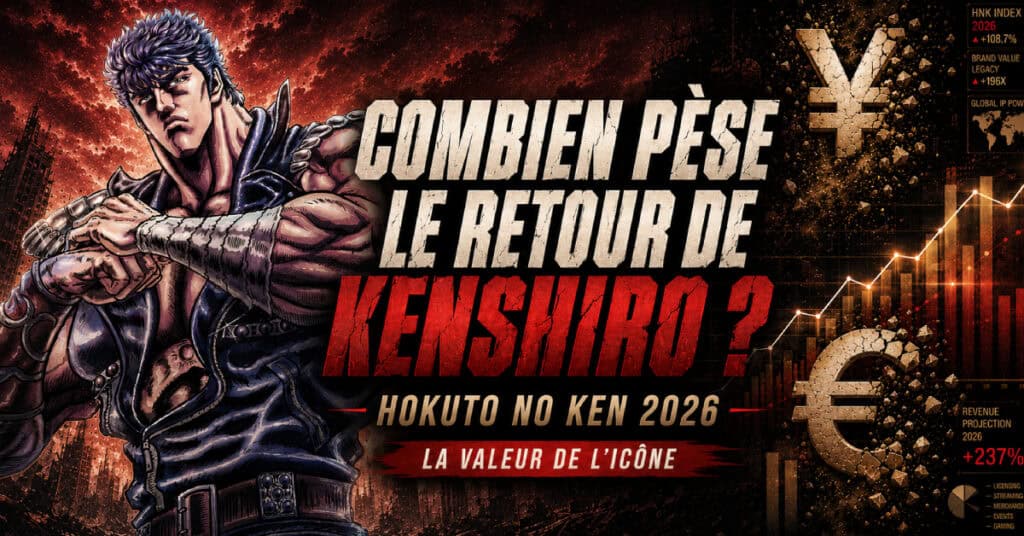
The specialized Japanese site Entame Value Post has just published an interesting analysis on the economic value of the new anime Hokuto no Ken – Fist of the North Star 2026. The angle is unprecedented: beyond a simple fan’s perspective, the analysis breaks down how much money this adaptation can generate, and for which stakeholders. We went through their work to highlight the key takeaways, adding our own perspective as fans following the series week after week.
⚠️ Take this with a grain of salt. All figures presented are estimates, based on known industry standards. The actual contracts between studios, platforms, and production committees are never made public. Consider this as an analytical framework, not as absolute truth.
Hokuto no Ken, a dormant asset that is waking up

The assessment from Entame Value Post is straightforward: Hokuto no Ken is not a new anime, it is a dormant brand being reactivated. Since 1983, the franchise has generated revenue in every imaginable sector: manga, anime, films, video games, figures, pachinko, clothing, events. The new anime is not just a novelty, it is what can relaunch all of these activities at the same time.
A Japanese anime is never funded by a single company. It is a consortium (the “production committee”) where the publisher, TV network, streaming platform, merchandise manufacturer, and other partners each contribute a share and receive a fraction of the revenues corresponding to their domain. If the anime is a hit, the entire ecosystem benefits.
Production cost: between 1.8 and 3.6 million euros for the season
By industry standards, a TV anime episode today costs between 25 and 45 million yen (approximately $1,000 to $1,000) to produce. For a full 12-episode season, that comes to $1.8 to $1.6 million. This range is confirmed by the Japanese studio CreativeFreaks, which documents the same bracket for the current industry.
That said, some nuance is needed for Hokuto no Ken 2026. Prestige productions on major streaming platforms (Demon Slayer, Jujutsu Kaisen) reach $1,000 to $1,000 per episode. The CEO of studio ARCH even mentions up to 300 million yen per episode (approximately $1.9 million) for the very high end. With its heavy CGI and international Prime Video partnership, Hokuto no Ken 2026 likely falls in the upper range, if not above it.
Prime Video rights: between 18 and 36 million euros
This is where the numbers get interesting. Entame Value Post estimates the distribution rights paid by Prime Video and international platforms at between 3 and 6 billion yen, or $1 to $1 million.
To put the scale in perspective: this is what a platform pays for the right to stream the anime to its subscribers. The “rent” that Prime Video pays to add the Hokuto no Ken license to its catalog. And the more international recognition a work has, the higher the rent goes. Hokuto no Ken has a valuable asset: its immediate brand recognition, with no advertising campaign needed.
For context, the analysis firm Vitrina indicates that Netflix often pays $1 to $1 million per exclusive original series. The global overseas anime streaming market was worth $1.7 billion in 2023 according to Bernstein (Wall Street), with Prime Video investing to catch up with Netflix and Crunchyroll. Entame Value Post’s range is therefore plausible for a license with this level of worldwide recognition.

That said, this range of $1 to $1 million seems ambitious. The actual value will depend on the number of episodes and the international performance of the distribution.
The Blu-ray market: niche but profitable
Blu-ray may seem to be in decline in the streaming era, but it remains an economic driver for cult licenses. The target audience is no longer people who want to “watch the anime,” but those who want to own a physical item. Collector’s box sets, booklets with production notes, exclusive bonuses: the disc becomes a collectible piece.
Entame Value Post estimates potential sales at between 7,000 and 12,000 box sets at 22,000 yen (~$1), generating between $1,000 and $1.6 million in revenue. The article rightly notes that for fans from the 80s, buying this kind of box set is like “buying back their childhood a second time.”
That said, some nuance is needed. The Japanese anime Blu-ray market is in continuous decline according to Anime News Network. For Hokuto no Ken 2026, the range remains plausible, provided that nostalgic collectors show up. A reasonable bet, not a certainty. The real commercial potential likely lies more in limited-run premium collector’s editions than in standard box sets.
Goodies: the true heart of the business
This is probably the most interesting section. Hokuto no Ken is a license that is “easy to turn into merchandise,” and that is a major economic asset. The series is full of immediately recognizable symbols that can be turned into products: Kenshiro’s seven scars, iconic lines (“Omae wa mou shindeiru”), the silhouette of Raoh on Kokuoh-go.
The article estimates first-year merchandise revenue at between 1.5 and 5 billion yen, or $1 to $1 million. The upper range is achievable in the case of international partnerships or limited-edition premium figures.
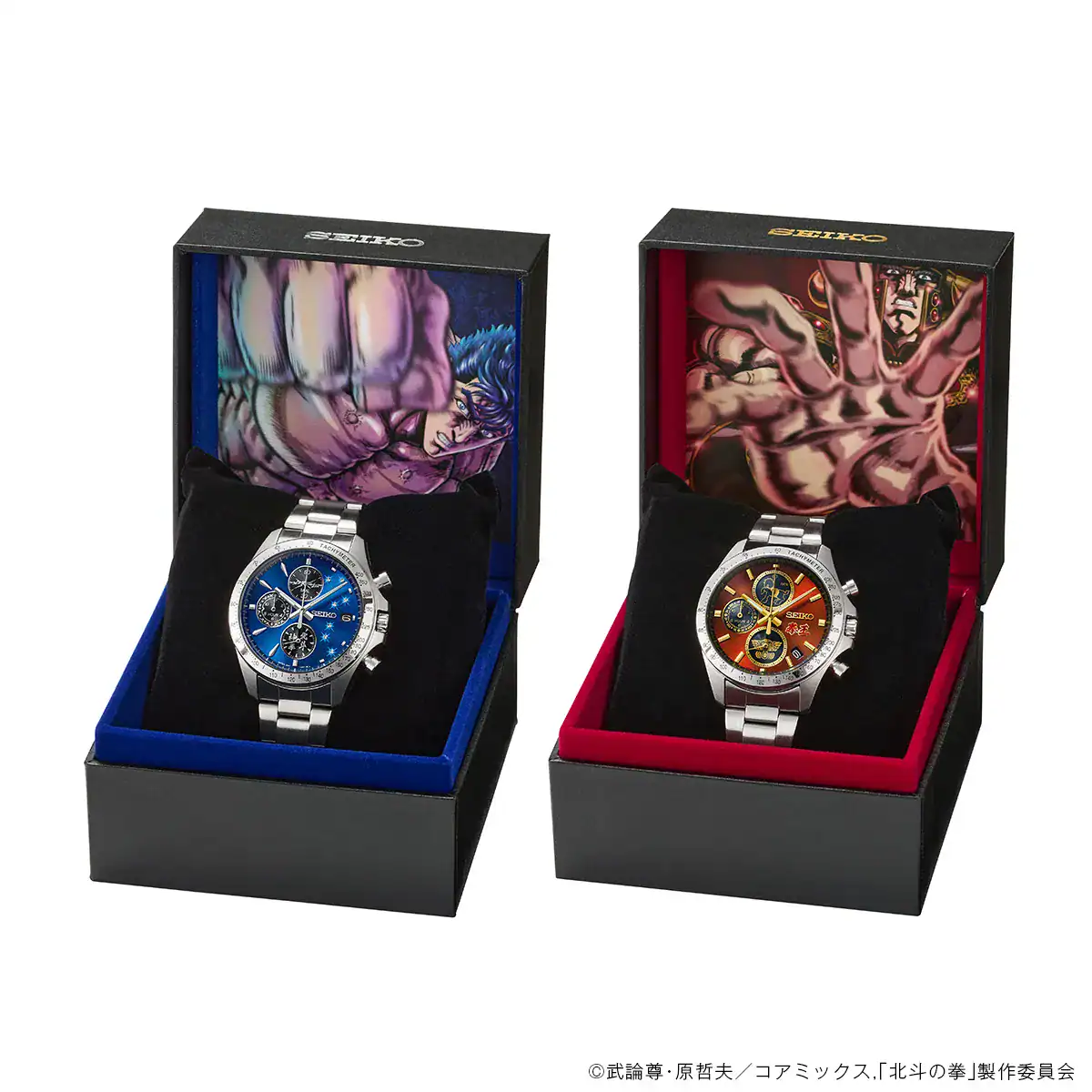
This is probably the most credible of the three estimates. Hokuto no Ken is an extremely strong license for figures, watches, clothing, and collectibles, and recent releases (Seiko, SpiceSeed, Medicos, Prime 1 Studio) confirm this at every price point.


The total: 42 to 90 million euros for the first year
By adding up all revenue sources (distribution, Blu-ray, merchandise, events, manga spinoff effects), Entame Value Post arrives at an overall estimate:
- Conservative scenario: approximately 7 billion yen, or ~$1 million over 12 months
- Optimistic scenario: over 15 billion yen, or ~$1 million or more
An asset to watch, not a flash in the pan
In conclusion, Entame Value Post considers Hokuto no Ken 2026 to be an asset worth watching. The license has everything it needs to generate sustainable revenue: immediate brand recognition, broad product coverage, and a loyal collector fanbase. The indicators to watch over the coming months: staying power in the Prime Video rankings, the volume of discussion on social media, and digital manga sales.
Our reading of the phenomenon
This analysis has the merit of putting numbers on what we observe, week after week. Hokuto no Ken 2026 is not just an anime, it is an economic event. And what we document on this site points in the same direction as the analysis.
In just a few weeks, we have seen the arrival of: the ROUND1 collaboration across 98 stores over three months, the Seiko watches at 65,780 yen, the SpiceSeed Antique Gold statue of Yuda at 54,780 yen, the Workman collab with its mass-market T-shirts at 980 yen, the capsule toys, the Medicos reissues. The revival of the license is not a hypothesis, it is an observable reality.
The only real downside is the uncertainty about the longevity of the phenomenon. Many licenses have had reactivation peaks around a new anime, only to fall back into a lull two or three years later. The question for Hokuto no Ken is not “is it working” (yes, it is), but “will it last,” especially once the first season is over and waiting for a potential continuation.
Main source: Entame Value Post – Analysis of the investment value of the Hokuto no Ken anime (May 2026)
Additional sources consulted for weighting:
- CreativeFreaks – Japanese animation studio, production cost ranges
- Anime Corner – interview with Nao Hirasawa, CEO of ARCH
- Vitrina – analysis of streaming rights pricing
- Bernstein / CBR – overseas anime streaming market size
- Anime News Network – Japanese Blu-ray/DVD figures for 2023
- CBR / Oricon – weekly Blu-ray sales 2024