

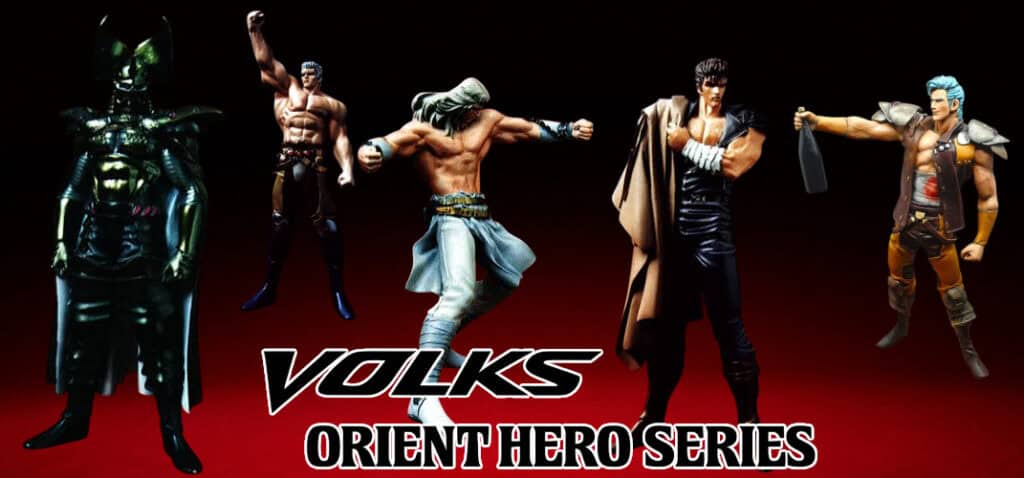
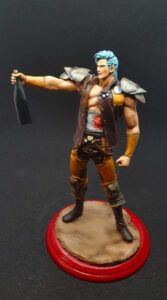
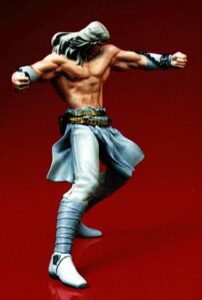
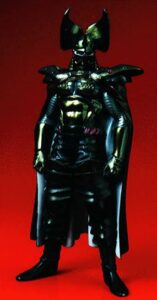
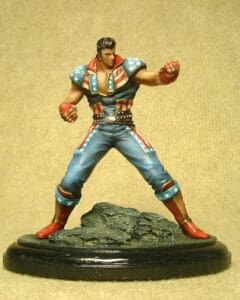
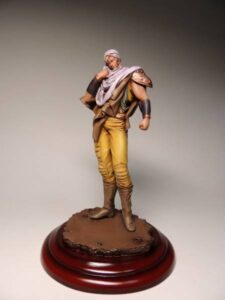
In the late 1990s, publisher Volks added Hokuto no Ken to its prestigious Orient Hero Series, its in-house garage kit collection launched in 1985. These are resin kits to assemble and paint yourself, sculpted by Koji Onishi at the Heavy Gauge workshop, sold directly via mail order from Kyoto.
Details
A chapter in a legendary collection
The Orient Hero Series is not a line exclusive to Hokuto no Ken, but a vast collection that has been giving shape since 1985 to the heroes and iconic figures of Japanese pop culture, from monster movies to special-effects shows to animation. The warriors of Hokuto no Ken join a catalog that includes hundreds of references. While Volks publishes and markets the line, the sculpting of the Hokuto pieces is the work of Koji Onishi, who crafts them at his own workshop, Heavy Gauge, an independent studio founded in Osaka in 1989. The distribution channel is that of the garage kit era: direct sales via phone order through Volks headquarters in Kyoto, kits shipped in raw resin, unassembled and unpainted, intended for experienced modelers.
A cast across two scales
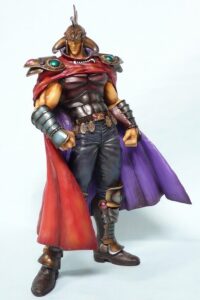
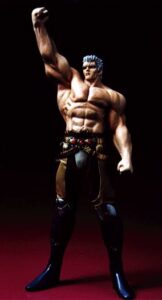
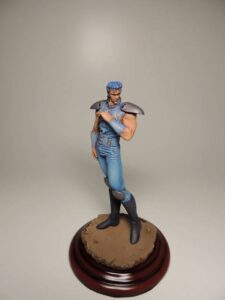
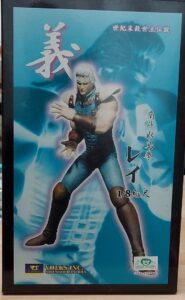
The series spans two scales. Small 1/10 kits serve as entry-level products, priced around 1,500 to 1,800 yen. The large display pieces, at 1/8 scale, go up to 7,800 or even 8,500 yen. The cast brings together around ten characters: Kenshiro in two versions, Raoh in two, Rei, Toki, Juza, Kaioh, Falco, Ein, and Bat.
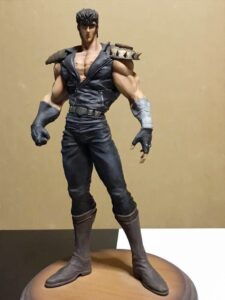
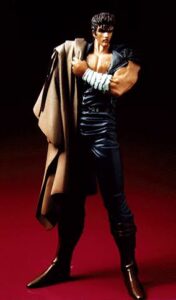
The press of the summer of 2000 sharpens the picture. The 1/8 Kenshiro, at 7,800 yen, takes on the massive late-serialization build, the 1/8 Rei, at the same price, comes in a white-hair version, and Raoh tops out at 8,500 yen. On the 1/10 side, the Kenshiro with his coat slung over his shoulder echoes the first episode for 1,500 yen, Raoh strikes the King of Hokuto’s final pose at 1,800 yen, and Toki, Kaioh, Rei, Falco, Ein and Bat range from 1,500 to 1,800 yen. At that date, the kits could still be ordered by phone from the Kyoto headquarters.

Finding them today
These kits circulate on Yahoo Auctions, Mercari, and at Suruga-ya, often in the form of raw, unassembled resin, at prices that remain modest for most references, ranging from a few thousand yen apiece. Compiling an exhaustive list of variants remains difficult, given how many print runs and finishes these vintage resin kits went through.
Sources
- Figure Oh No.34, World Photo Press, July 2000, page 18.