


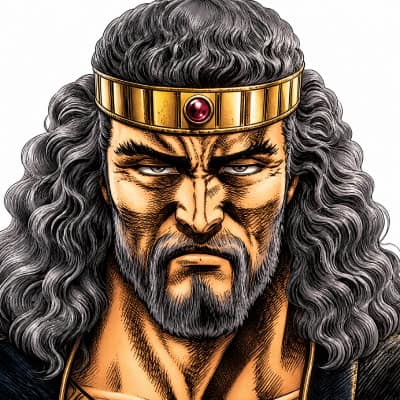
Details
- Name
- Koryū (コウリュウ)
- First appearance
- Hokuto no Ken ch.85 / anime ep.70
- Appears in
- Hokuto no Ken (manga, anime)
- Status
- Secondary character
- Role
- Former rival of Ryuken for the succession of Hokuto Shinken, nicknamed the "Tiger of Hokuto," hermit retired in the mountains
- Martial art
- Hokuto Shinken
- Signature techniques
- Shichisei Massatsu
- Seiyū 1984
- Hidekatsu Shibata
Kōryū
Kōryū (コウリュウ) is a former master of Hokuto Shinken and the historical rival of Ryuken. Nicknamed the Tiger of Hokuto in contrast to the Dragon of Hokuto that Ryuken embodies, he belongs to the previous generation of candidates for the succession. To avoid the tragedy of a fratricide imposed by the rule of Isshi Sōden (only one successor per generation), Kōryū retreats to the mountains and leads an ascetic life, until the day Raoh comes to challenge him.
The Tiger and the Dragon of Hokuto
Kōryū and Ryuken train together in Hokuto Shinken and both reach an exceptional level. Their final confrontation to determine the 63rd successor threatens to turn tragic, as the millennial tradition of Hokuto dictates that only one chosen one may receive mastery of the art: the defeated have their fists destroyed or their memory erased to prevent any misuse of this assassination technique.
Aware of the consequences of a fight to the death between brothers in arms, Kōryū renounces his claim and yields the succession to Ryuken. This decision saves the Hokuto lineage, but takes nothing away from his technical mastery: Kōryū retains the full repertoire as well as a deep spiritual understanding of the art.
Ascetic retreat
To ensure that his knowledge would die with him, Kōryū retreated into the mountains and lived as an ascetic. He refused any transmission, fearing the creation of parallel heirs who would come to rival the official successor. This discipline forged him a reputation as a sage among martial arts practitioners, and his name continued to circulate in Hokuto circles long after his retreat.
In reality, Kōryū was not alone: he had founded a family far from the world and raised two sons, Zeus and Aus, whom he never trained in Hokuto Shinken, precisely to avoid perpetuating the risk of a succession dispute.
Raoh's challenge
After his first bloody battle against Kenshiro, which left him severely wounded, Raoh seeks to gauge his recovery. He chooses Kōryū as his opponent, both to measure his own power and to eliminate this older generation that could threaten his reign. The Ken-Oh forces the hermit out of his seclusion and imposes a duel upon him.
Kōryū fights reluctantly. Realizing that Raoh has already surpassed the level of the former masters, he stakes everything on a final gamble and attempts to use the Shichisei Massatsu (七星抹殺, the Erasure of the Seven Stars), a suicide attack designed to seal away the Ken-Oh's terrifying power forever, even at the cost of his own life.
Death of Kōryū
The technique fails. Raoh shatters Kōryū's hands with a single punch, destroying the Shichisei Massatsu before it can reach completion. The old master is then struck to death by Ken-Oh, who gives him no chance.
After the fight, his two sons Zeus and Aus attempt to avenge their father by rushing at Raoh with metal bars. Not knowing Hokuto Shinken, they pose no threat to the conqueror. Raoh acknowledges their filial courage and spares their lives: the existence of this hidden family finally explains why Kōryū was so determined to prevent the spread of Hokuto Shinken outside the main lineage.
Mastery of Hokuto Shinken
Kōryū retains, despite his advanced age and retirement, a complete mastery of Hokuto Shinken inherited from the same master as Ryuken. His speed, precision and knowledge of the Keiraku Hikō allow him to briefly hold his own against Raoh even though the latter has just crushed his first great rivals.
His approach to Hokuto Shinken relies more on discipline, experience and spiritual understanding than on brute force, which stands in stark contrast to Raoh's conquering philosophy. The Shichisei Massatsu, a suicide technique he unveils in his final battle, exemplifies this path: sealing a martial monster rather than destroying him.