

Before becoming the best-selling manga in the history of Weekly Shonen Jump, Hokuto no Ken nearly never existed in the form we know today. The pre-serialization history of Hokuto no Ken is a story of fortunate coincidences, of a meeting between a talented artist, a strong-willed scriptwriter, and a visionary editor who got his hands dirty from start to finish. Here is a look back at the genesis of a legendary manga.
Tetsuo Hara before Hokuto no Ken
It all begins with editor Horie Nobuhiko, a young editor at Weekly Shonen Jump, who had been following the career of newcomer Tetsuo Hara since his very first steps. Hara’s first manga, Tetsu no Don Quixote, was canceled after ten episodes due to insufficient popularity. But Horie saw in him the potential for something far more ambitious and refused to let him go.
Hara had long wanted to draw a manga about martial arts. It was Horie who became directly involved in developing the central concept. One day, while leafing through a Chinese medicine book in a secondhand bookstore in the Jinbocho district of Tokyo, he came across the anecdote of a medical student who had accidentally worsened an eye problem by overstimulating an acupressure point. From this idea was born the concept of Hokuto Shinken, the art of striking the body’s vital points to destroy it from the inside. It was also Horie who formulated the first version of the phrase “you are already dead.” The one-shot was entirely written and drawn by Tetsuo Hara alone, without Buronson.
The two one-shots in Fresh Jump
This first one-shot was published in Fresh Jump in April 1983. The hero’s name is Kasumi Kenshiro, the story takes place in contemporary Japan, and the signature phrase is still “anata mou shinderu yo” rather than the definitive “omae wa mou shinde iru.” But the essential ingredients are already in place: the violent art style and the atmosphere of a lone man standing against injustice.
The result was immediate and spectacular: the one-shot finished first in the reader survey, a feat all the more remarkable given that it was placed in the last position of the magazine. A second one-shot, Hokuto no Ken II, was published in June 1983 in the same magazine and also ranked first. These two stories were later collected in the second tankōbon volume of Tetsu no Don Quixote.
The meeting with Buronson
Faced with these two consecutive first-place finishes, the editor-in-chief of Weekly Shonen Jump gave the green light for serialization in the main magazine. But Horie knew that Tetsuo Hara alone could not keep up with the demanding weekly pace of Jump while maintaining the graphic quality that was his strength. A scriptwriter was needed.
This is where Buronson enters the picture, a writer known for his hard-hitting action manga including Doberman Deka. His contribution would prove decisive: he categorically rejected the contemporary setting of the original one-shot. He proposed anchoring the story in a post-apocalyptic world where modern weapons no longer exist, leaving all the space for martial arts. It was Buronson who invented the 199X setting and the nuclear war that destroyed civilization, inspired in part by Mad Max and Blade Runner.
The creative trio was then complete: Buronson on script, Tetsuo Hara on art, and Horie as editor, involved down to the very last panel. On the final page of the last chapter, all three names appear equally in the credits, a fact rare enough in the industry to be worth highlighting. Horie remained the series’ dedicated editor until the end of serialization, never handing off to anyone else.
Five years at the top of Weekly Shonen Jump
Serialization began in issue 41 of 1983 of Weekly Shonen Jump, on September 13, 1983. From the second episode onward, the series placed first in reader surveys and remained there for three consecutive years, a record in the magazine’s history. Horie, aware of Tetsuo Hara’s tendency to get carried away by praise, deliberately chose never to share these results with him throughout the entire run of the serialization.
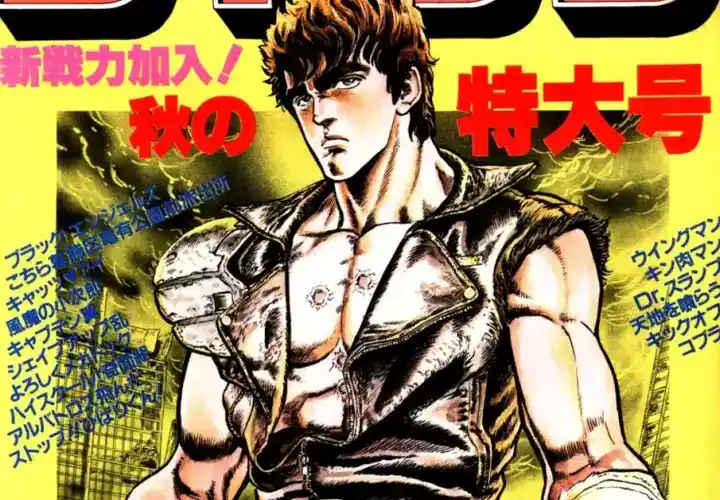
The impact on sales was immediate and massive. By the end of 1984, Weekly Shonen Jump crossed the four-million weekly copies mark, eventually reaching six million at its peak. The series is considered one of the main driving forces behind this surge. The special issue All About the Man, published on September 5, 1986, was entirely dedicated to the series, featuring reprints of the pilot, author interviews, and complete character biographies.
The series concluded in issue 35 of 1988, after 245 chapters and one special chapter. The entire work was compiled into 27 volumes in the Jump Comics collection, published between 1984 and 1989. To this day, the manga has surpassed 100 million copies sold worldwide across all editions, making it one of the best-selling series in the history of shōnen manga.
The French editions of Hokuto no Ken
The manga has had several lives in France. J’ai Lu published a first edition starting in August 1999, followed by Kazé/Asuka in 2008. Then came the Ultime edition, now out of print and resold at high prices by third-party sellers.
Since 2022, Crunchyroll has offered the Extreme Edition in 18 volumes, considered the definitive edition with a polished layout, reworked covers, and pages revised by Tetsuo Hara himself. It is the version we recommend for discovering or rediscovering the series today. This edition is available in bookstores and on specialized retail sites.
Sources: Coamix (official), Wikipedia FR, Hokuto Fandom Wiki
Comments are closed.