

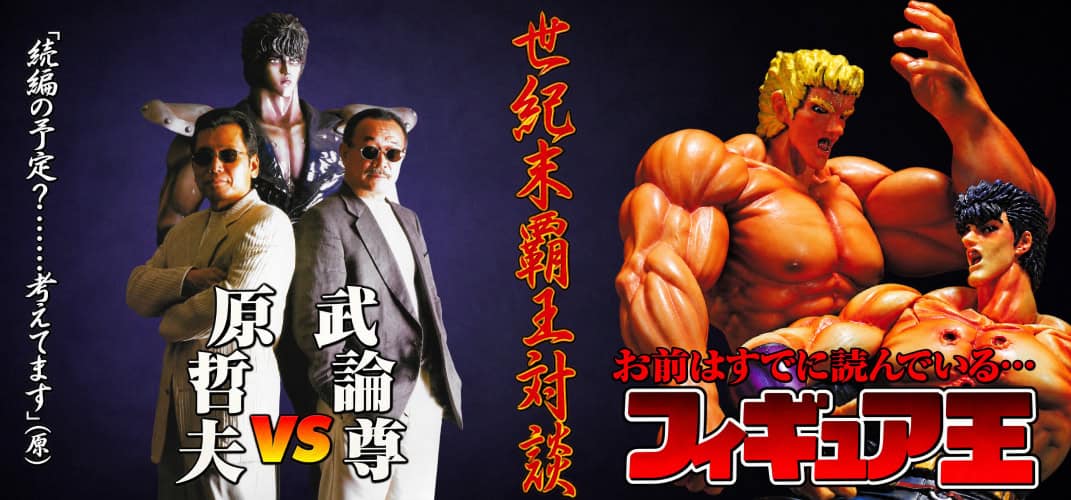
Cross interview of the kings of the end of the century, Buronson VS Hara Tetsuo
Details
- Date
- May 26, 2000
- Source
- Figure Oh #34
- Type
- Press
- Original language
- Japanese
- Interviewer
- Anzai Leo
- Featuring
- Buronson, Tetsuo Hara
- Translation
- Hokuto Chronicles
Thus began the legend (こうして伝説は始まった!)
Figure Oh. Hokuto no Ken is currently enjoying tremendous success in the figurine sector, and that is precisely why we wanted to interview you today. It had been a long time since you last got together like this?
Buronson. No, we saw each other the other day for a similar kind of interview. But before that, during the series, we didn’t see each other even once.
Figure Oh. Meaning that each of you had to do things as he saw fit on his own?
Buronson. No, it was the editor who kept us from meeting.
Hara. There was an intermediary between us.
Buronson. To prevent me from rubbing off on Hara. (general laughter)
Figure Oh. Hokuto no Ken originally started from a manga by Hara?
Hara. Yes. A one-shot.
Figure Oh. Can you go back over the circumstances?
Hara. At first I wanted to draw fighting, because I loved Bruce Lee. I drew two of them.
Buronson. And since there was talk of making it a series, several scriptwriters were approached, and it eventually reached me. For me, it fell out of the sky. (laughs)
Figure Oh. What did you think when you first read it?
Buronson. Hmm, at the beginning it was a student. And since he was killing people left and right, we figured that wouldn’t work, and that we should shift the story into a near future. That’s probably the foundation of its success. If we had continued with the original scenario as it was, characters like these (he points to the figurines) would never have appeared.
Hara. Yes.
Buronson. In a contemporary story, the opponents would have been students or ordinary outlaws. In that sense, I believe it was the setting of the story that succeeded.
Figure Oh. Today, we would like to hear from you while looking at the Hokuto no Ken figurines.
Buronson. Me, I’ve forgotten everything. (laughs) The first one is the Shin of Southern Cross. And Shin, at the beginning, we never thought he would be the one behind Ken’s seven scars. We created that as the story went along.
Figure Oh. At the time, you didn’t have the luxury of thinking all of that through calmly.
Buronson. Yes. Why he was pursuing someone, there was nothing behind it. It was a simple road movie. You create an enemy, then you wonder what exactly he’s pursuing, so let’s go with a woman. My way of creating is constant patching, I fix things after the fact.
Figure Oh. That’s how Yuria appeared. And what do you say about Kenshiro?
Hara. This figurine is based on the anime’s design, so… let’s say it’s fine.
Figure Oh. At the time, you weren’t thinking in terms of volume?
Hara. I was thinking in terms of volume. It’s just that the drawing couldn’t keep up.
Buronson. It was around volume 5 that the manga really started to move as a whole. At the beginning, it was trial and error, fumbling around.
Hara. Not having the series canceled. My first wish was that.
Figure Oh. The four siblings, does that come from the name? Ken-shirō, the “fourth son”? (The suffix -shirō, 四郎, literally means “fourth son” in Japanese masculine given names, like -tarō for the eldest or -jirō for the second)
Buronson. Yes. Up to Jagi, it came easily. Then I was told there were two left, but since nothing had been decided, the instruction was to leave them as silhouettes. One massive, one slender. Everything started from there.
Figure Oh. Besides Ken, the strongest character is Raoh. He wasn’t planned from the start?
Buronson. No. (without hesitation) The eldest, just one instruction: make him massive.
Hara. He’s a character created by Buronson. He wasn’t mine.
Figure Oh. Was there a model behind Raoh?
Buronson. No. Just an image: a huge guy on a huge horse, that would be nice.
Figure Oh. In a commentary from the collected volumes, Buronson supposedly told Hara to give Raoh a grand entrance.
Hara. No, that was a joke. (laughs)
Buronson. The character wasn’t set. That’s why we had the horse appear first. Hoof prints like elephant feet. What is that? Then the horse appears, and the man riding on it.
Figure Oh. Raoh is truly very tall.
Hara. Height is what you see with the eyes of the heart. If the horse looks so large, that’s also an image seen through those eyes. The scale, I don’t think it’s accurate.
Figure Oh. Here is precisely the box set of Raoh and Kokuoh.
Hara. I had them at the studio, but I gave them to other artists. Everyone wanted them. The new ones are well made, I think. This one is one of the first, isn’t it?
Buronson. On the first ones, the head kept popping off. (laughs) The DX version released later is good, though.
Figure Oh. In the line, Kenshiro and Rei make up the first wave, Jagi and Raoh the second.
Buronson. That one is well made (he looks at Jagi).
Hara. Souther, for example, you can see they really studied the original. I only did about one illustration of him, and it wasn’t even used on the volumes. Just one in color, and yet they went and tracked down every little detail…
Buronson. Which ones sell?
Figure Oh. Kenshiro, Raoh, then Rei, I’d say.
Buronson. Same as the popularity poll.
Figure Oh. Is there a character you feel is missing?
Buronson. There are no women.
Hara. No Yuria. And Rin and Bat. Fudô of the Mountain, too…
Buronson. Me, the one I liked was the prison warden.
Figure Oh. Was there a real-life image behind Governor Uighur?
Buronson. No, none at all. There was this prison, and I thought a character like that would be interesting. As for the design, that’s Hara’s image.
Hara. Buronson let me do as I pleased. The one that comes closest to my image is this DX version.
Figure Oh. The first Kenshiro owes something to Spawn, let’s say, it’s a nod to its dark, unwholesome side.
Hara. Oh really? Spawn was very well done; it’s thanks to that figure that people started making this kind of thing. I also want to release my own figures, through my own company.
Buronson. That one is impressive (He looks at the life-size Kenshiro).
Figure Oh. That’s the life-size Kenshiro. Kaiyodo made it without authorization and got reprimanded by the rights holder. A piece with a story behind it. (laughs)
Buronson. If they produced it for sale, that would be something. There would be buyers, for sure.
A string of torments born from obsessive perfectionism (こだわりからくる苦悩の連続!)
Figure Oh. I thought the story would end with Raoh’s death.
Hara. I think that’s where it ends.
Buronson. Beyond that, there was nothing left. I was exhausted.
Hara. Originally, the idea was to finish in three years. Three years, up to Raoh’s death. Then, out of nowhere, the editor-in-chief above us said, “Resurrect Yuria!”
Buronson. When I said there was no way to continue, I was told that all we had to do was resurrect her, bring out brothers in droves. All sorts of “advice.”
Hara. And so, in one year, we brought the story up to the Gosha Sei of Nanto.
Figure Oh. Didn’t you rebel against that advice, didn’t you say it was out of the question?
Buronson. Well, I probably could have said so, but…
Hara. Our position is weak.
Buronson. And on my end, the money had me blinded. (laughs)
Figure Oh. And the editorial department, since it was selling, had no intention of letting you stop.
Buronson. Of course, the collected volumes were selling a million copies each.
Hara. Around three and a half years into the series, there was the popularity poll tally for Weekly Shōnen Jump; we had held first place for two full years.
Buronson. If they had given me two months after Raoh’s death, it would have been fine. But it picked right back up the following week. No break. For me, that was tough. I had to create something new.
Figure Oh. The Central Imperial Capital, then the Land of Shura.
Buronson. We were constantly rushing. Since Raoh’s death, the entire story that follows, characters included, has been wiped from my memory.
Hara. The idea was to end it with the first fight. It got extended, and it ended with the second.
Figure Oh. It was supposed to stop at the first?
Hara. That’s when that whole situation came up, so we made it a fight with no winner and extended it by a year.
Buronson. That’s when we killed Rei. We did the fight with no winner and relaunched.
Figure Oh. You readily kill off the good characters, one after another. Personally, I loved Rei.
Buronson. It’s simple: when a good character dies, popularity goes up. A bit of pandering, let’s say. (laughs)
Hara. Nobody warns me about these things, so I draw with all my attachment. He schemes. And that’s why the reader never sees it coming.
Figure Oh. So they don’t tell you, this character will die in a few issues?
Hara. That’s right.
Buronson. Even if I wanted to say it, I haven’t built out the continuation yet at that point either.
Hara. I just don’t know, that’s all.
Figure Oh. If you know a character is going to die, your drawing changes.
Hara. Yes, it would end up showing.
Buronson. That’s why the editor kept us from meeting. Together, we would have talked about what comes next. For example, if Hara says he’d like such and such a thing, I’d steer the story toward that. You inevitably get pulled along. The editor eliminated that and let me create on my own, as I saw fit.
Figure Oh. I see. And the death star, the Shichōsei, was that your idea?
Buronson. That was my editor. I had asked him if he had any ideas, and he had one on hand. And it became: those who see it are doomed.
Figure Oh. The dead coming back to life, a common device in Shōnen Jump, you didn’t use it?
Hara. For me, having resurrected Yuria is a burden. When I was told to bring her back, I strongly resisted.
Buronson. Apart from her, we didn’t do it.
Hara. No. Toki, Rei, all the characters beloved by the public, we were told to resurrect them. But if you resurrect people, everything becomes erasable, and the weight of a person’s death is diminished.
Figure Oh. The cruelty of the images was often talked about, especially when the TV series aired.
Hara. Personally, I thought I was drawing in a way that didn’t emphasize the cruelty too much. The anime, on the other hand… it ended up as mush.
Buronson. That too, we checked and double-checked. No blood, no red. We must have said it a hundred times, and yet.
Hara. The manga is in black and white, so it’s fine.
Buronson. The anime is in color, so the blood is bright red. We asked them to change it to blue, or replace it with shattering glass. I followed it on-site, and despite everything, there are still scenes that are hard to watch. The line between the two is razor-thin. Some people didn’t understand that, and later, artists started imitating Hara’s style while pushing the cruelty further and further. I thought those people wouldn’t last, and sure enough, they all disappeared. Without exception.
Figure Oh. Do you ever base characters on real people?
Hara. There are movies, illustrations. I used to look at collections by Frazetta, Neal Adams, so there’s an influence from American comics. Kokuoh too, that’s Frazetta’s horse. (laughs)
Buronson. The comics influence is there. Conan, the whole range of tough guys.
Hara. Kenshiro, at first, has a normal body, and when he gets angry his clothes tear apart. That already existed in comics.
Figure Oh. The Incredible Hulk…
Hara. That’s it, that’s it.
Figure Oh. People often tell you it looks like Mad Max.
Buronson. The setting, yes.
Hara. There’s some Syd Mead in there too. Blade Runner, the films from that era, are very much present. Bruce Lee as well. And in places, Sylvester Stallone.
Figure Oh. Kenshiro had his Stallone periods.
Hara. It’s because I was drawing while soaking up whatever was in the air at the time.
Figure Oh. And the sunglasses?
Hara. That was probably from Stallone’s Cobra.
Buronson. He wore sunglasses?
Hara. For the look, I drew freely.
Figure Oh. It seems Ein is your favorite?
Hara. Him, I based on Apollo from Stallone’s Rocky. Not Apollo himself, his costume. The outfit in the colors of the American flag, I was wondering how to use it.
Figure Oh. Which character are you most attached to?
Hara. All of them. But first and foremost, Kenshiro.
Figure Oh. As a reader, seeing strong characters die so quickly was something I regretted.
Hara. At the time, ideas were plentiful, so seeing them go didn’t cost me that much.
Figure Oh. And for you, Buronson?
Buronson. The villains of the moment. The main character is passive; he hardly ever takes the initiative.
Hara. Reading your scripts, I got the impression that Raoh was the one you put the most of yourself into.
Buronson. Because to me, he’s the strongest. Everyone fights, the story moves forward, but above them all, there’s this colossus waiting.
Figure Oh. Your aesthetic of manhood.
Hara. Toki, Raoh, as they came through in your scripts, they made you want to develop them further.
Buronson. Rei, Souther, Shu have the elegance of the moment of death. The characters who had a beautiful death, I remember them well. Well, I’m a fraud. (laughs) Deep down, I don’t feel anything. I just think, this way, they’ll cry.
Figure Oh. So you do it with full awareness? (laughs)
Buronson. Yes.
Figure Oh. And Raoh’s famous last line, my life bears not a single shadow of regret…
Buronson. Pretty good, right? (laughs)
Figure Oh. Very good indeed.
Buronson. I don’t mean a word of it. (laughs)
Hara. As for me, I drew it with all my heart. So the feeling of cheating wouldn’t show through. (laughs)
Buronson. Me, personality-wise, I’m Jagi.
Figure Oh. Isn’t that just modesty?
Buronson. Because I’m constantly swaying toward desire and money.
Hara. Not at all. He’s just shy.
Figure Oh. Among the great deaths, there’s Souther’s. The three Hokuto brothers reunited, and the cross-shaped Mausoleum drawn with such depth it took your breath away.
Buronson. That was more beautiful than Raoh. Shu walking while carrying his own tombstone, I loved writing that.
Figure Oh. Shu dies saying he can finally see Ken’s face.
Buronson. It’s Christ’s Golgotha. When I write a good script, the artwork isn’t the same anymore. A good story comes through in the artwork. Raoh’s end, the Souther scene we were talking about. When I write in agony, the result is decent, nothing more.
Figure Oh. You think, maybe it’s my fault? (laughs)
Hara. Each of us on our own side, yes.
Buronson. When things are going well, my handwriting is huge. When things are going badly, it’s small.
Figure Oh. Did you meet your deadlines?
Buronson. I was never late, not even once.
Hara. I’m the slow one. You can’t work as a team with a slow scriptwriter.
Their views on three-dimensional merchandise (立体物への見解!)
Figure Oh. And now, our exclusive. An action figure with unparalleled articulation, to be released under the name Hokuto no Ken 200X. Take a look at it and tell us what you think.
Buronson. Here, the color is removed on purpose?
Figure Oh. No, it’s still a product in development. Your illustrations have purple as the dominant color, right? They wanted to carry that over into the product, apparently. The poses are limited, but you can almost fully recreate the scene where Kenshiro and Raoh strike each other; that’s the selling point. No action figure until now has been this easy to pose.
Hara. It’s the year 2000; it would be embarrassing not to be able to do at least this much. You have to make progress. But being able to pose it like this is nice.
Figure Oh. And the face?
Hara. Not bad, very advanced even. I hadn’t heard about this at all…
Buronson. Is it made using a computer?
Figure Oh. No, everything is done by hand. The system is called mono shaft drive, and nothing in it goes through a computer. It’s hand-to-hand combat with modeling clay. You cut the joints through trial and error: it doesn’t work, that doesn’t work either, you think it over, you start again. And what works by chance becomes the rule.
Buronson. Even so, the movements are remarkably refined. Impressive.
Figure Oh. Until now, you couldn’t shift the center of gravity to strike a pose. This time, the idea was to be able to reproduce poses that look good, even if it means limiting the range of motion. That’s the spirit in which they designed it, apparently.
Buronson. Other manga artists are going to see this and get inspired by it again. Look, it moves like this.
Hara. I want this one.
Figure Oh. When you draw, do you rely on references?
Hara. In my youth, there were no action figures you could pose like this… There was pretty much only GI Joe.
Figure Oh. What the big manufacturers don’t put out, what people expect from them but never get, they decided to make it themselves. That’s the mindset, apparently.
Hara. McFarlane, the one behind Spawn, it’s the same. There are things that don’t move forward unless you do them yourself.
Figure Oh. What if you got into toys, like McFarlane? With your original, Japanese characters, that would be great.
Hara. As a matter of fact, I’ll soon be able to do that.
The premonition of a new legend to be created (新伝説創造の予感!)
Figure Oh. What is the secret behind the popularity that Hokuto no Ken still enjoys today?
Hara. It still reads very well. I get caught up in it myself. And it tickles what boys want most: having that coolness…
Buronson. It’s strength, I think. Strong with bare fists.
Figure Oh. Manliness, or rather something like a masculine ideal?
Hara. Yes, that’s what boys aspire to, no doubt. You want to beat the toughest boss. And yet, you find yourself bowing your head. As an adult too, there’s always someone more powerful above you, someone you can’t do anything against. And then there are the scumbags, the ones who do terrible things. To bring them down… or rather, what you truly admire deep down is the person who takes on the strong. Kenshiro, that’s what he does, he takes on the strong. Picking on the weak is just pathetic.
Buronson. That’s true.
Hara. With muscles like those, you think to yourself that you’d love to land a good punch.
Buronson. The popular characters all die while taking on the strong. They never fight someone weaker than themselves.
Hara. And on top of that feeling, Buronson’s drama came together. That’s how something good was born.
Figure Oh. And the ending, when did you start thinking about it?
Buronson. Ah… I never thought about anything in advance. But there was probably no other ending than that one.
Hara. I’m from the Taiyō ni hoero! generation, so I believed that main characters all died at the end. So I was drawing with the image that Kenshiro would die at the end.
Figure Oh. But he didn’t die.
Hara. Well, I figured that dying had maybe become old-fashioned, on the contrary, and that it might be better if he didn’t die.
Buronson. For the most part, Horie and I [editor’s note: the managing editor of the series at the time] had done it thinking there would be a Part 2 a few years later. I remember the very last scene, we brought it back to the very beginning. Like, we’ll pick it up again.
Hara. Personally, ever since childhood, I’ve thought that a main character gains something by dying. Like Yūsaku Matsuda dies.
Figure Oh. Jeepan, then.
Hara. Yes, dying for nothing. Shōken, he dies while urinating. That kind of thing appealed to me.
Figure Oh. And for you, Buronson, did the image of Kenshiro dying ever exist?
Buronson. No.
Figure Oh. Not even when thinking about a sequel, not even as an image?
Buronson. It’s true we could have had him die stupidly, over nothing, that was an option. But then five years of work would have gone up in smoke just like that. I kept thinking we had no right to botch his death. And that if he had to die, it needed to be a grand death.
Hara. Kenshiro also killed an enormous number of people, so for me, he shouldn’t be allowed to stay alive. It’s a kind of rule, and I have this need within me to follow the logic through to the end.
Figure Oh. But they convinced you. (laughs)
Hara. Yes. But well, I figured it was fine that way. At that point, I couldn’t have cared less. (laughs) I wanted to drop everything… They kept telling me: “Just one more month and it’ll be five years, and then we’ll take you to Hawaii.” I had no desire whatsoever to go to Hawaii. Just let it be over, that’s all I was asking for.
Figure Oh. When you ask manga artists about their series endings, they all say they were dying to stop.
Hara. It’s every week. After five years…
Buronson. And without missing a single issue… I write in about two days, but for Hara, it takes him the entire week. Almost no rest at all, right?
Hara. About half a day per week.
Figure Oh. To wrap up, the question of a sequel. The readers are surely waiting for one.
Buronson. I don’t have the energy for that yet. Getting back into it means “do or die.” Writing a story that goes further than this one, just thinking about it, the suffering comes before everything else.
Hara. It would kill you.
Buronson. Because we can’t afford to write something that falls flat. I know that if we do it, it’ll work. Probably. But I don’t want to do it on the cheap.
Figure Oh. Don’t they reach out to you?
Buronson. From Jump, not a single request since the end. It seems like they seriously hold a grudge against me.
Figure Oh. Because you don’t obey.
Hara. Grown-up matters, and we got shown the door.
Figure Oh. And you, Hara?
Hara. Me… I do think about a sequel.
Figure Oh. Oh! Hokuto no Ken, Part Two, then.
Hara. No. I haven’t talked to Buronson about it yet, but with a different title, and keeping only the Hokuto Shinken. A killing technique, that comes in handy in many ways. With just that, we could maybe go into a different world. Someone of Kenshiro’s bloodline…
Figure Oh. A spin-off, then.
Hara. Well, I haven’t talked to Buronson about it, it’s a project of my own making, so I can’t say anything specific yet.
Figure Oh. And you, Buronson?
Buronson. The thing is, the person in charge is no longer here. The one who understood this work better than anyone. If he got involved, then yes, there would be something. But creating without Horie, I think that would be tough.
Figure Oh. It’s true that you made it together. But aside from Hokuto no Ken, creating a new work, just the two of you, what do you say about that?
Buronson. In any case, the Jump editorial department doesn’t contact us anymore.
Hara. Buronson doesn’t seem to want to work himself to death anymore, and honestly, neither do I.
Buronson. Ultimately, if we did something in the same vein again, we’d have to do better than this. And that’s what’s hard, the obligation to do better.
Hara. A Part Two that works, that’s never been seen in manga.
Buronson. People will buy it out of a kind of nostalgia, probably. But nostalgia alone is boring. If we surpass the original, the old one starts selling again too. But if the second part fails, it can happen that the old one gets disowned along with it. It’s almost a matter of life or death.
Figure Oh. And if the request came from Hara?
Buronson. Well, it’ll depend on my situation. If I’m out of money, I’ll do it, despite everything I’m saying. (laughs) You’ve got to eat. I talk big, but I flip for money in no time at all…
Figure Oh. We look forward to the sequel with great anticipation. Please do work yourselves to death for us, one more time.
Buronson. If the stock market crashes, maybe I’ll get to it. (laughs)
Recorded on May 26, 2000, at the Tokyo Hilton Hotel.