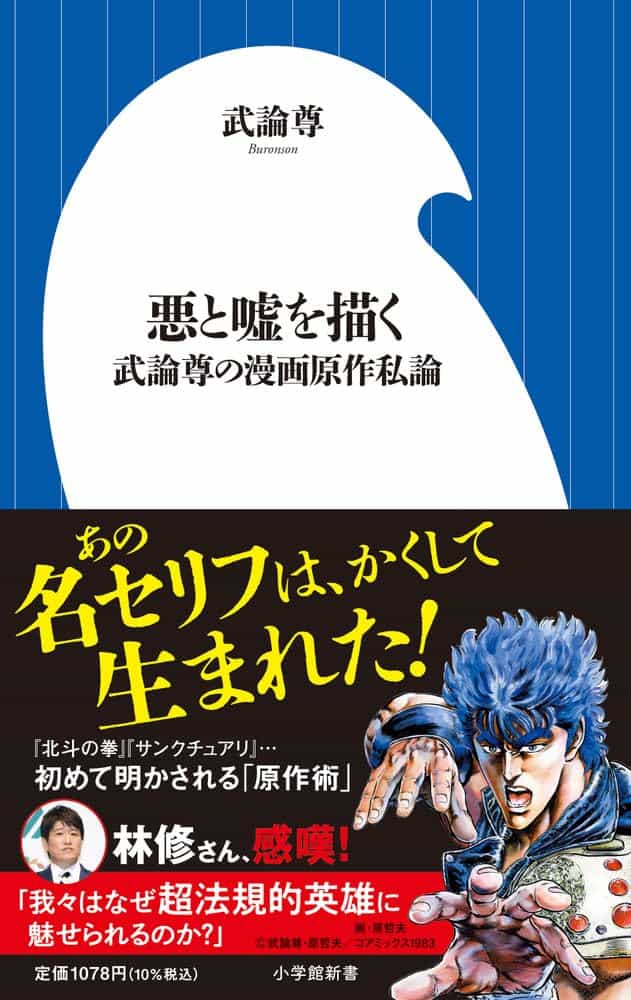


Forty years after Hokuto no Ken first began publication, Buronson released his first essay devoted to his method as a scriptwriter: “Drawing Evil and Lies, My Personal Philosophy of Manga Scriptwriting”, published by Shogakukan in January 2026 in the Shogakukan Shinsho collection.
Official Presentation
The back cover sums up the project in a single sentence: “This is how those legendary lines came to be.” Buronson looks back on his encounter with mangaka Motomiya Hiroshi, his beginnings as a scriptwriter discovered by the legendary editor-in-chief of Jump, the staging techniques developed on Doberman Deka, and the secrets behind the creation of Hokuto no Ken. 50 years of career examined in detail, a first.
The book features a preface by Hayashi Osamu, the famous TV personality and presenter, a self-proclaimed big fan of Hokuto No Ken. He states: “‘The villain determines the success or failure of a work’, ‘a character is defined by his lines’, the author’s clear philosophy impressed me first. But the book goes further. Although he claims it is not a guide to becoming a manga scriptwriter, it is filled with wisdom for succeeding in life.”
Table of Contents and Technical Details
- Preface
- The Profession of Scriptwriter
- My Method ① “How to Draw Out Tears”
- My Method ② A Character Is Defined by His Lines
- My Method ③ Depicting “Evil”
- How I Became “Buronson”
- The Manga Techniques Developed on Doberman Deka
- The Era of Hokuto no Ken and the Weekly Jump
- Epilogue: My Thoughts on the Manga School
- Afterword “The Trajectory of Popular Manga” (Buronson / Fumimura Shō)
Publisher: Shogakukan / Collection: Shogakukan Shinsho no. 507 / Date: April 2026 / Price: 1,078 ¥ (approximately 6 €) / ISBN: 9784098255078
Sources: Amazon Japan, Hanmoto (publisher)
A Book Unlike Any Other
Buronson warns from the outset, this is not a manual for becoming a manga scriptwriter. The book is rather a testimony, the vision of a 78-year-old man looking back on forty years of creation, collaborations, successes, and regrets.
The Most Striking Revelations
The first striking piece of information is that Buronson inadvertently lost, or in some cases simply destroyed, all of his original manuscripts. Not by accident but by deliberate choice, he assigns no sentimental value to drafts and intermediate work stages. Only the version the reader holds in their hands matters. This statement takes on a particular dimension in 2026, at a time when original manga manuscripts are reaching record prices at auction.
Regarding his method, he defines himself as “the slave of his work,” the value of a creation does not belong to him, it is measured solely through the reader’s gaze. This radical stance, which he directly connects to the culture of Weekly Shōnen Jump, retrospectively explains why Hokuto no Ken was crafted with such narrative efficiency. To illustrate this idea, Buronson uses a striking metaphor: he prefers the popular dish that everyone finds delicious without needing it explained, over the outrageously expensive gourmet menu whose value you have to convince the customer of. It is not up to him to decide whether his work is worth something; it is the silent reader who gives it value.
On the question of how one becomes a manga scriptwriter, Buronson is categorical: there is no method. His own emergence in the profession came through a series of coincidences and absurd situations, not through vocation. As if all great Japanese manga scriptwriters were born out of constraint rather than a deliberate plan. What matters is the accumulation of experiences that give depth to words and characters. Technique can be learned, but the human density that makes a dialogue unforgettable cannot be taught.
On Hokuto no Ken, Buronson rejects the term “masterpiece”, for him, it is a work that escaped its author to live its own life, independently of his original intentions. He revisits the genesis of the series, his relationship with Tetsuo Hara, the tensions of creating under weekly pressure, and the way the ending imposed itself on him more than he decided it.
For fans of the spin-off Hokuto no Ken: Seikimatsu Drama Satsuei Den, an unexpected revelation is given in the book. Buronson reveals the substance of his exchanges with his editor after the conclusion of the Raoh arc. These conversations, transcribed with precision, were reportedly directly reused in the spin-off’s script, proof that nothing is wasted in the HNK universe, not even what happens behind the scenes.
The book’s final anecdote is perhaps the most revealing: to the journalists’ repeated question, “you don’t seem to have any regrets,” Buronson responds “I have plenty.” Not as an admission of weakness, but as a driving force. Regrets, shortcomings, the things he was unable to write, that is precisely where stories are born.
A Reference Document
This book is the first time Buronson has delivered such a comprehensive synthesis of his vision of creation. It provides direct access to the thinking of the man who co-created the universe, his narrative choices, his regrets, his conception of “evil” as a central dramatic mechanism. Available in Japanese from Shogakukan.
Unfortunately for us French-speaking fans, the book is not available in French… But to delve deeper into Buronson’s philosophy and the secrets behind the creation of Hokuto no Ken, you can check out our full feature on this book.