


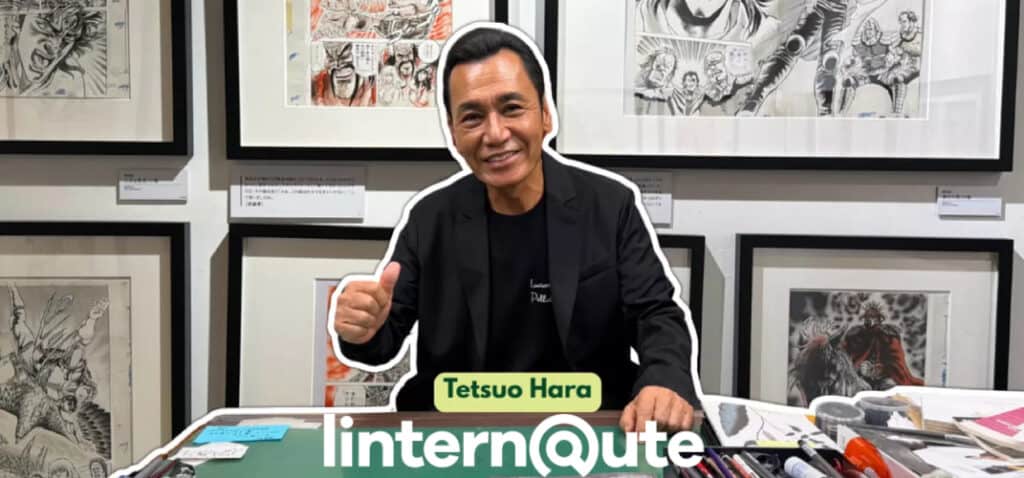
Tetsuo Hara welcomed French news site L’Internaute to his Coamix offices in Tokyo. The long interview, by Valentin Paquot, was published on October 16. Hara looks back on a forty-year career, from his debut to the arrival of artificial intelligence. He speaks candidly and with plenty of humor, even admitting he chose drawing because he hated getting up early.
Souther, born from A Clockwork Orange
For Kenshiro, Hara first names Bruce Lee and Yūsaku Matsuda, two figures he had carried with him since high school. Then came Mel Gibson in Mad Max 2, which he saw just before his debut. He also mentions a lesser-known influence: Malcolm McDowell in A Clockwork Orange, with his striking eye makeup. That, he says, is where Souther came from.
As for Raoh, a reader’s letter once criticized his hairstyle when he first takes off his helmet. Hara had Rutger Hauer’s white hair in Blade Runner in mind. He found the result unconvincing and reworked it. To him, the marks on Raoh’s forehead were never wrinkles: they were a red glow, inspired by the kumadori makeup of kabuki. Black and white simply could not convey it.
In the shadow of Frank Frazetta
American illustrator Frank Frazetta has stayed with him since he was 15 or 16. Hara says he drew the scenes between Souther and Shû with particular passion, steeped in that influence. Raoh’s death, standing with his fist raised to the sky, was an image he had in mind from the very beginning.
He also talks about growing up on gekiga and his admiration for Ryōichi Ikegami. His one great regret: never making a fully colored version of Hokuto no Ken, his original dream. At 65, he has let it go.
Scripts, Horie and AI
Hara reflects on working with writers, starting with Buronson. His conviction: responsibility for the finished work rests with the artist. He describes his relationship with Nobuhiko Horie as “almost a symbiosis.” He also says he uses ChatGPT to spark ideas, even though most of its suggestions are unusable.
It is rare to get to read such a long interview with Tetsuo Hara in French, and it does justice to both the man and his work. Our thanks to Valentin Paquot and L’Internaute for this wonderful interview.