


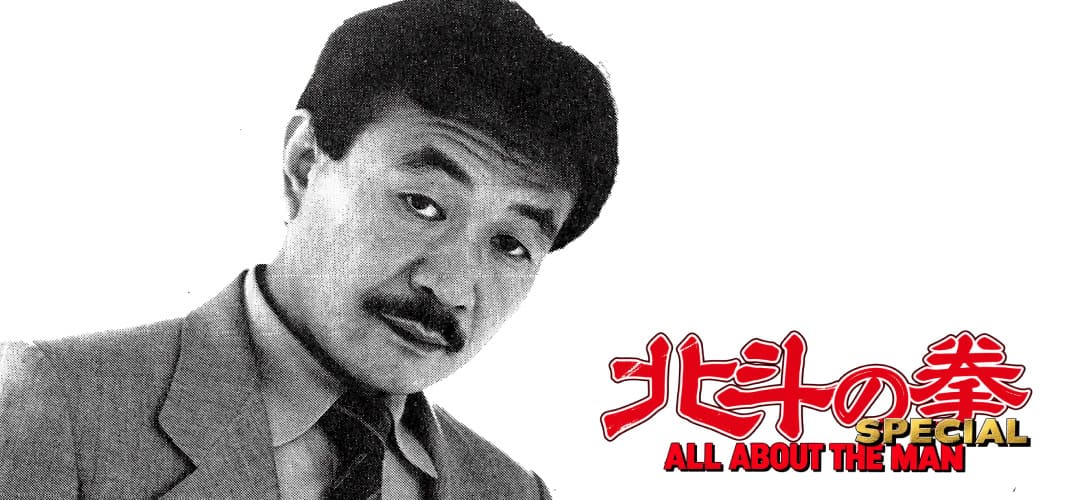
“Every character who dies is a waste”: Buronson in 1986, during the serialization (All About The Man)
Details
- Date
- September 5, 1986
- Type
- Book / databook
- Interviewer
- Weekly Shōnen Jump editorial staff (uncredited)
- Featuring
- Buronson
- Translation
- Hokuto Chronicles
In 1986, while the series was still running, the Weekly Shōnen Jump published a special large-format issue entirely dedicated to Hokuto no Ken, All About The Man. The issue devotes a portrait page to each of the two authors. Buronson‘s, on page 29, is followed on page 30 by a twenty-question interview conducted by the editorial staff, covering what he wanted to convey, his characters, his work with Tetsuo Hara and the toll the series has taken. Tetsuo Hara‘s interview, two pages later, follows a very similar questionnaire. Translated by us.
“Every character who dies is a waste”
Jump. To start, tell us what you wanted to show in Hokuto no Ken.
Buronson. I don’t think about complicated things. It’s more about how I feel… Well, if you put it rationally, it’s that men like that exist too. An image of the man you dream of being, something like that.
Jump. Since you’ve been working on the series, have there been any amusing anecdotes?
Buronson. It’s not exactly amusing, but the younger brother of someone who came to interview me had gone a bit off the rails, and ever since he read Hokuto no Ken, he thinks before he acts, apparently.[1]
Jump. Hearing that kind of story must make you happy, I imagine?
Buronson. Yes. It does make you happy, of course.
Jump. Other than Kenshiro, which characters do you like?
Buronson. I like all of them. All of them except Kenshiro. Kenshiro is too perfect, whereas the other characters all have a side that isn’t perfect, right? Those characters, I like them more, on a human level.
Jump. Which characters were easy to develop, and which were difficult?
Buronson. The easiest is Raoh. Because he’s straightforward. Characters who just keep pushing forward are easy to develop. Conversely, the most difficult is the hero. Because there are constraints.
Jump. Which characters would you have liked to develop further?
Buronson. Huey of the Wind, for example. Among the Five Stars of the Nanto, every time one of them dies, it’s a waste.
Jump. What scene in Hokuto no Ken left the strongest impression on you?
Buronson. Raoh’s arrival, probably.
Jump. Before the weekly series, there was in Fresh Jump the original Hokuto no Ken by Tetsuo Hara, reprinted in this issue. What do you think of that work?
Buronson. I read it once the weekly series had been decided on. To be blunt, I was anxiously wondering how long it would stay popular. What makes it interesting is the martial arts concept, right? The day readers get tired of it, it’s over. Well, the direction changed after about six months.
Jump. And Hara?
Buronson. He’s a remarkable author. His work is striking, and he’s a newcomer who will go down in manga history, I believe.
Jump. Is there a gap between the script and what it becomes once it’s drawn?
Buronson. Most of the time, it’s better once drawn than at the text stage. So, to keep up, I write something even stronger. It’s a fight, in the best sense of the word.
Jump. And the characters?
Buronson. Sometimes a minor character turns out really well. I’ve changed my plans before to give one a real role. That’s what you call a story driven by the art.
Jump. And Hara?
Buronson. What worries me is his physical condition. As for talent, I have no concerns. Well, let’s just say we’ll take it easy, the two of us.
“I can finally talk about my own work”
Jump. Which authors or works do you take as models?
Buronson. Hiroshi Motomiya, Tetsuya Chiba, people like that.
Jump. What holds your attention the most right now?
Buronson. Sylvester Stallone’s films, Spielberg’s films. Because I like entertaining works.
Jump. Since you started writing Hokuto no Ken, do you feel you’ve changed?
Buronson. My physical condition. And I’ve worn myself down a lot mentally. Because you can never take a break. But I eventually came to feel that I’d become a real author.
Jump. What do you mean?
Buronson. Because it was a success, plain and simple. I take satisfaction from it, and it gave me confidence. I can finally talk about my own work.
Jump. In the future, apart from Hokuto no Ken, are there projects you’d like to pursue with Hara?
Buronson. Yes. About two. We’ve come to understand what’s good about each other.
Jump. Can you tell us about those two ideas?
Buronson. Not right now. I can’t talk about them. In any case, Hokuto no Ken still has a long way to go, so I don’t think they’ll come out for several years.
Jump. To wrap up, if you survived a nuclear war, what would you be doing?
Buronson. A thief, probably. I’d like to be one of those who leads a group to maintain order, but in reality, you know. I think people inevitably end up on one side or the other. That’s why in Hokuto no Ken, I showed both sides. But today, if I stick to just that, it gets repetitive, so I push myself. Repetitiveness is scary.
Jump. And in that world, if you met Kenshiro, what would you do?
Buronson. I’d follow him. Because I built Kenshiro as a character everyone wants to follow. If I myself didn’t, that would be a lie.[2]
Reading note
The two subheadings on the page, including the one used at the top of this entry, are from the editorial staff, who drew them from two of Buronson’s answers. The portrait page also bears a first-person title, “Raoh aspired to the imperial throne and supremacy, and he died for love. His fury, I loved it” (帝王・覇王をめざして愛ゆえに死したラオウの激情を、おれは愛した). This is a phrase crafted by the editorial staff and does not appear in the interview. The profile box on the portrait page, which is attributable to the magazine rather than to Buronson, introduces him under his real name, Yoshiyuki Okamura, born June 16, 1947, in Nagano Prefecture, who enlisted in 1963 in the Air Self-Defense Force cadet corps, made his debut with Pink Punch Miyabi and achieved great success with Doberman Deka in 1975, with Shinji Hiramatsu as artist, and who also publishes under the pen name Shō Fumimura.
- ↑ In this answer, Buronson recounts a story someone told him (んだって), hence the “apparently.”
- ↑ The two interviews in the issue end on the same question, and both authors give the same answer: they would follow Kenshiro.
Sources
- Hokuto no Ken Special: All About The Man (週刊少年ジャンプ特別編集 北斗の拳SPECIAL ALL ABOUT THE MAN), large-format special issue of Weekly Shōnen Jump, Shueisha, issue dated September 5, 1986, portrait p. 29 and interview p. 30 (publication entry). Editorial office copy.
Quotes translated and entry compiled by Hokuto Chronicles from the original publication. First published on October 20, 2026, updated on October 23, 2026. © 2026 Hokuto Chronicles. Any reuse, even partial or reworded, must credit Hokuto Chronicles with a link to this page.