


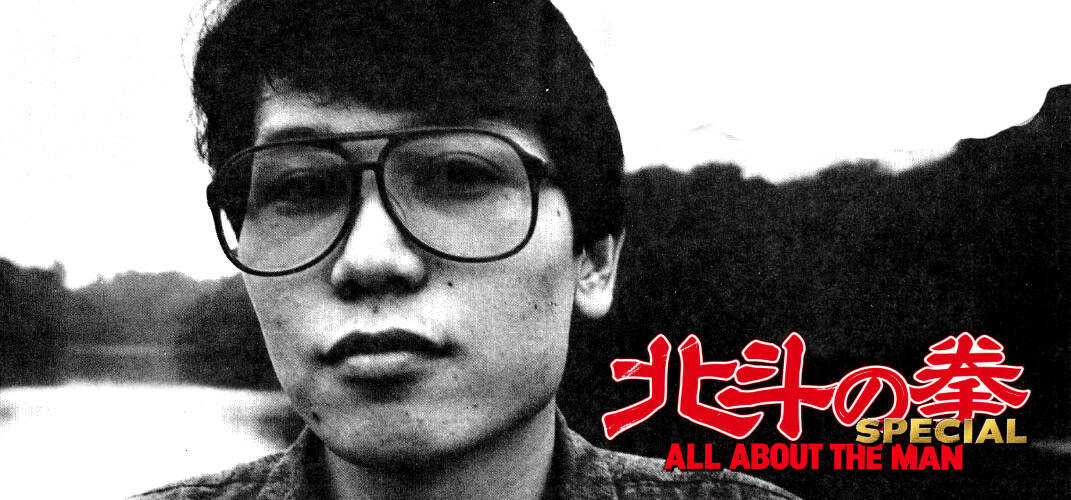
“The bearing of men who fight”: Tetsuo Hara in 1986, during the serialization (All About The Man)
Details
- Date
- September 5, 1986
- Type
- Book / databook
- Interviewer
- Weekly Shōnen Jump editorial staff (uncredited)
- Featuring
- Tetsuo Hara
- Translation
- Hokuto Chronicles
In 1986, while the series was still running, the Weekly Shōnen Jump published a special large-format issue entirely dedicated to Hokuto no Ken, All About The Man. The issue devotes a portrait page to each of the two authors. Tetsuo Hara‘s, on page 31, is followed on page 32 by a short interview with twenty-two questions, conducted by the editorial staff, about what he wanted to draw, his characters, his influences and the state of his stamina as the series enters its second part. Buronson‘s interview, two pages earlier, follows a very similar questionnaire. Translated by us.
“What I wanted to draw is the bearing of men who fight”
Jump. To begin with, what did you want to draw with Hokuto no Ken?
Hara. Let me think… The bearing of men who fight.
Jump. Since the series began, have there been any fun anecdotes?
Hara. Nothing in particular. Drawing is always grueling.
Jump. Aside from Kenshiro, which character do you like?
Hara. Shû. With him, I felt like I broke away from the heroic roles I had been drawing up to that point. And from a story perspective too, it worked well.
Jump. Are there characters that are easy to draw, and others that are difficult?
Hara. It depends on how I’m feeling at the time. None of them are particularly easy.
Jump. Hokuto no Ken features all sorts of martial arts. Which one do you prefer?
Hara. Rei‘s, the Nanto Suichōken. Visually too, it worked well.
Jump. The scene from Hokuto no Ken that left the strongest impression on you?
Hara. Around the tenth chapter, Shin‘s arc.[1] It was the first turning point. You always remember moments like those.
Jump. Before the weekly series, there was an original Hokuto no Ken by your hand in Fresh Jump, reprinted in this issue. What memory do you have of it?
Hara. I thought I was going to lose my mind. I had no assistant. Well, for the finishing touches, someone gave me a hand. Since it was well received, everything turned out fine, but if it hadn’t been, it would have been a disaster.
Jump. You then worked with Buronson. What did that change?
Hara. The story gained weight, and scope too. It was very good.
Jump. Does Buronson make requests regarding the art?
Hara. Almost never.
Jump. What do you like about your art, what is its strong point?
Hara. Realism, perhaps. I draw densely, and I strive to convey an impression of reality.
Jump. And the action scenes?
Hara. I’m careful not to be too cruel. If the reader is left with a bad aftertaste, I don’t like that. Sukatto, sukatto![2] That’s why I draw the villains as monsters. What’s being killed isn’t a human, it’s a monster. That’s the idea.
Jump. Between the villains and the heroic roles, which do you enjoy drawing the most?
Hara. Both. Nothing but heroic roles gets tiresome. Nothing but villains, same thing. With both, the balance is right.
Jump. Are there people or works you take as models?
Hara. Let me think… If film directors count, George Lucas and Spielberg.
Jump. Do you like cinema?
Hara. Yes. Fundamentally, I love the visual. To the point of wanting to make manga entirely in four colors too. My ideal is a manga that feels like cinema, but that you enjoy more simply than cinema.
Jump. What holds your attention the most right now?
Hara. The films of Sylvester Stallone and Arnold Schwarzenegger.
Jump. Do you go to the movies often?
Hara. Yes, fairly often. If a film is good, I’ll go see it regardless of genre.
Jump. And on the manga side, who do you follow?
Hara. Jirō Taniguchi, Ryōichi Ikegami.
Jump. Aside from Hokuto no Ken, is there something you’d like to draw?
Hara. Yes. A war story, for example. About Vietnam. And a historical story. Not the kind of thing you see on television, more something like Kurosawa’s Ran.[3] With characters like Kenshiro everywhere. Kenshiro is a character capable of that, I believe. Oh, and also a near-future story, even closer to the present than Hokuto no Ken.
Jump. And in those works too, would the theme be the fight of men?
Hara. Yes.
Jump. Hokuto no Ken has entered its second part. What do you have to say about it?
Hara. Things I want to do, I have plenty, and on that front I have no worries. But my body is falling apart, it can’t keep up anymore, and that troubles me.[3] When your physical condition collapses, it shows in the work. When I reread the old collected volumes, how can I put it… my soul is in them. The me of that moment is in them.
Jump. To wrap up, if you survived a nuclear war, what would you be doing?
Hara. I’d be drawing it as a manga. For sure.
Jump. And if you ran into Kenshiro?
Hara. I’d follow him.
Reading note
The two subheadings on the page, including the one used at the top of this entry, are from the editors, who turned two of Hara’s answers into titles. The profile box on the portrait page, which comes from the issue itself and not from Hara, introduces him as born on September 2, 1961 in Tokyo, a graduate of Hongō High School, a former assistant to Yoshihiro Takahashi, winner of the 33rd Fresh Jump Award in 1982 for “Super Challenger,” with “Mad Fighter” as his debut work.
- ↑ The clarification “the Shin passage” is printed in parentheses in the answer and is part of the published text.
- ↑ “Sukatto” (スカッと) is a common Japanese onomatopoeia for a clean sense of relief, the feeling of being refreshed or freed of a weight. By repeating it, Hara names the effect he wants to have on the reader, a frank, untroubled pleasure, the opposite of the bad aftertaste he mentions just before. That is why he draws the villains as monsters, because their deaths should bring relief, not discomfort.
- ↑ Two answers find an echo forty years later in the Kōken interview: the historical epic he dreamed of “like Kurosawa’s Ran” rather than like television jidaigeki, and the body that can no longer keep up, here attested in the moment, in the middle of the series.
Sources
- Hokuto no Ken Special: All About The Man (週刊少年ジャンプ特別編集 北斗の拳SPECIAL ALL ABOUT THE MAN), a special large-format issue of Weekly Shōnen Jump, Shueisha, issue dated September 5, 1986, portrait p. 31 and interview p. 32 (publication entry). Editorial office copy.
Quotes translated and entry compiled by Hokuto Chronicles from the original publication. First published on October 20, 2026, updated on October 22, 2026. © 2026 Hokuto Chronicles. Any reuse, even partial or reworded, must credit Hokuto Chronicles with a link to this page.