


“I wanted a battle cry that surpasses Bruce Lee’s”: Tetsuo Hara in 2006, before Raoh Den Junai no Shō (Data File Ōgi Hidensho)
Details
- Date
- 2006
- Type
- Book / databook
- Interviewer
- The book’s editorial staff, Shiranui Pro (uncredited)
- Featuring
- Tetsuo Hara
- Translation
- Hokuto Chronicles
In 2006, the Hokuto no Ken Data File Ōgi Hidensho, a databook produced by Shiranui Pro for Futabasha, follows its interview with Buronson with a shorter one with Tetsuo Hara, focused on the film Raoh Den Junai no Shō, then in production. He explains why he entrusted the design of Reina, the character created for the film, to Tsukasa Hōjō, discusses working with the cast, reflects on the appeal of the series and addresses the pressure of drawing ever-stronger opponents. Translated by us.
“Reina has become a beauty very much in Hōjō’s style”
Question. How did you come to entrust the design of Reina, an original character for the film, to Tsukasa Hōjō?
Hara. The women Hōjō draws are simply charming. When I draw a woman, I try to make her sexy, whereas he knows how to draw delicate women. I talked to him about it, and he agreed. And since this time there’s a love story involving Raoh, I wasn’t sure a very sensual character would be appropriate.
Question. What did you think when you saw the Reina drawn by Hōjō?
Hara. An Asian-type beauty, very much in his style. I also found it interesting that it was like a guest actor, brought in from outside. And since the chief director, Masaki Satō, will harmonize the drawings for the animation, I’m not worried. She’ll end up blending into the whole, and I’m looking forward to seeing that.
Question. Who decided on Reina’s personality and the rest?
Hara. It was Horie, the executive producer, who decided that. Our job is to draw and build the characters, nothing more. Keeping the overall vision is Horie’s role, and he keeps a firm hold on it. It’s one and the same work, done as a team. And since I’ve known Horie for a long time and we think more or less the same way, there’s really no problem.
Question. So you understand each other perfectly.
Hara. If everyone’s intentions don’t align, the work lacks that extra something. When both sides feel the same things, one plus one can make three, or even five. Coamix and North Stars Pictures were originally companies created precisely in that spirit. It’s neither me alone nor Horie alone. Each of us brings the best of what he has, and together we make a work.
Question. Would you like to collaborate with someone on a future project?
Hara. If the result is good this time, I think I’ll ask him to collaborate again. But for now, nothing has been decided. That said, I feel like we’re already a team, so if I ask him, I think he’d accept anytime. And I’d also like to draw in one of Hōjō’s works. For example, he could use a male character I drew in his City Hunter. In animation, I think that’s doable.
“I wanted a battle cry that surpasses Bruce Lee’s”
Question. How was the cast for the film decided?
Hara. For Kenshiro, it was Hiroshi Abe from the start, and for Kō Shibasaki, it came together without difficulty, but for Raoh, the decision took time and gave us trouble.
Question. What did you feel when you actually heard their voices?
Hara. It was so good I was surprised. Abe’s Kenshiro has charm. Nothing sounded off, to the point where I thought maybe Kenshiro really does have that voice. It made me very happy. Abe is a modest person who always strives to improve. When a passage seemed a little odd to me, he had already noticed it himself and was correcting it. That’s remarkable.
Question. Did you ask him for anything on your end?
Hara. At the beginning, I asked him for an “atataa” that would be a new battle cry surpassing Bruce Lee’s, and he rose to the challenge.[1] At first, the “ta” sounds in “atata” came out like “to, to, to,” as if he were pitching forward, but it improved with every take. It feels like a new Kenshiro is about to be born, and I can’t wait.
Question. And Kō Shibasaki in the role of Reina?
Hara. Her Reina was also spot-on, it was great. She was very motivated and said she wanted to do the narration too. I thought, why not just let her do it.
Question. Takashi Ukaji seems like a good fit for Raoh.
Hara. Ukaji fits Raoh perfectly, so I hope he finds a truly authentic voice. Even when you’re just talking with him casually, he’s impressive. No matter how much he tries to keep a low profile, his stature as a man comes through. I hope he unleashes what he’s been keeping buried until now. He was motivated too. He said he might come to the recording session in a tracksuit (laughs).[2] I’m looking forward to seeing that as well.
“I’d like people to discover another world, the world of the love story”
Question. In your view, where does the appeal of Hokuto no Ken lie?
Hara. The dream of boys, a certain way of living as a man, I’d say. The series shows what everyone wanted as a child: to become a man who can stand up to the little bully who rules the playground. And the characters had depth. Looking back, I realize I was able to draw a wide variety of characters.
Question. Drawing that many characters must have been demanding.
Hara. We had to prepare powerful opponents worthy of Kenshiro, so drawing the enemies put a lot of pressure on me. Each newcomer also had to surpass the previous one. When Shin dies and Rei appears, Rei has to be a character who surpasses Shin. And I made sure the villains didn’t remain mere villains. I always thought about their way of life too. My characters generally die after about ten weeks, so I always felt like I hadn’t drawn them enough. That’s why I’m attached to them.
Question. In this film, are there things you would have liked to develop further?
Hara. For the film to work as a single piece, with its four-part structure, the story of Souther had to be condensed.[3] And by adding the story of Souther and his master, you ended up with two love stories, which made it heavy. But what matters most this time is the love story between Reina and Raoh, so I think it’s fine the way it is. The core doesn’t change, and experiencing a story you’ve already read with a different flavor can be enjoyable, I believe.
Question. To wrap up, a message for the fans.
Hara. This film also tells a love story about Raoh, so I think people will be able to see it a little differently from what they knew. I’m looking forward to it too. On our end, we kept at it right up to the last minute. I would really love for you to come see it in theaters.
Editors’ notes
- Tsukasa Hōjō: a mangaka from Fukuoka Prefecture, known notably for Cat’s Eye and City Hunter. One of those who carried the golden age of Weekly Shōnen Jump, renowned for his way of drawing delicate women. He has known Hara for a long time.
- City Hunter: a hard-boiled comedy serialized in Weekly Shōnen Jump from 1985 to 1991, whose hero, Ryō Saeba, takes on investigations and bodyguard missions. Adapted into an anime series and feature films.
- The master: Ōgai, Souther’s predecessor as head of the Nanto Hōōken, who raised him. He died by Souther’s fist.
Reading note
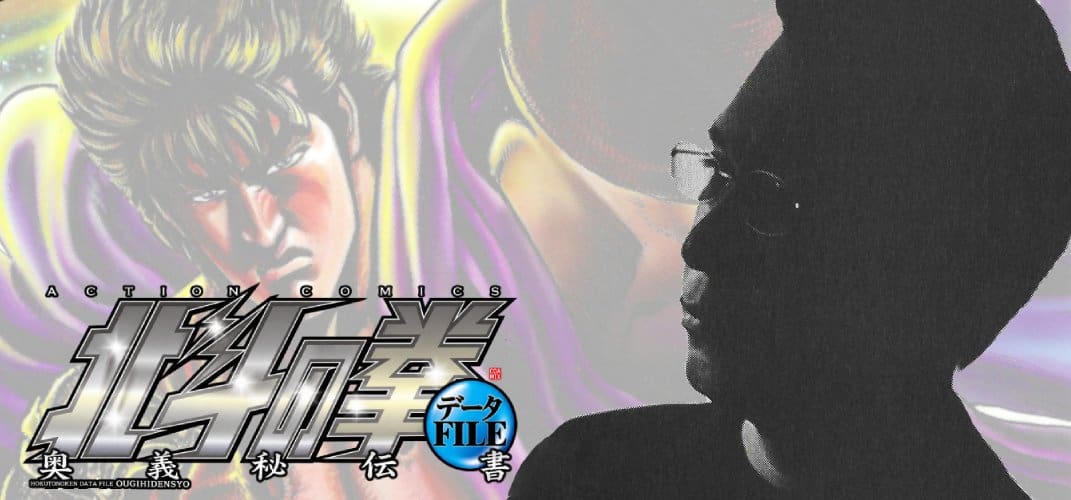
The questions are unsigned. The volume’s colophon credits the text to 橋本学 (noNPolicy). The two subheadings, used here as section titles, the three notes and the profile sidebar are from the editorial staff. The sidebar presents Hara as born in 1961, debuting in 1982 with Mad Fighter, author of the 1983 hit Hokuto no Ken, and at the time publishing Souten no Ken in Shinchosha’s Weekly Comic Bunch. The page title describes Hara as 原作者, “original author,” the same word used for Buronson in the previous interview: the volume uses it in the broad sense of creator of the original work. The interview never names the film, referring to it as “the film” (劇場版) or “this time” (今回). Hara speaks about it in the future tense and invites people to come see it in theaters: the interview was conducted before the release. The volume does not date it. Its colophon is dated April 30, 2006.
- ↑ The “cry” translates 怪鳥音, the cry let out while striking that is associated with Bruce Lee.
- ↑ The line about the tracksuit (ジャージ着てやろうかな) is something Takashi Ukaji said, reported by Hara.
- ↑ The “four-part structure” translates 起承転結, a classic scheme of composition.
Sources
- Hokuto no Ken Data File Ōgi Hidensho (北斗の拳 データFILE 奥義秘伝書), Shiranui Pro, Futabasha, Action Comics imprint, colophon dated April 30, 2006, “SPECIAL INTERVIEW No.2,” pp. 58-59 (book entry). Editorial copy.
Quotes translated and entry compiled by Hokuto Chronicles from the original publication. First published on October 22, 2026. © 2026 Hokuto Chronicles. Any reuse, even partial or reworded, must credit Hokuto Chronicles with a link to this page.