


“It was Raoh’s death that was the culmination of Hokuto no Ken”: Buronson in 2006, twenty years later (Data File Ōgi Hidensho)
Details
- Date
- 2006
- Type
- Book / databook
- Interviewer
- The book’s editorial staff, Shiranui Pro (uncredited)
- Featuring
- Buronson
- Translation
- Hokuto Chronicles
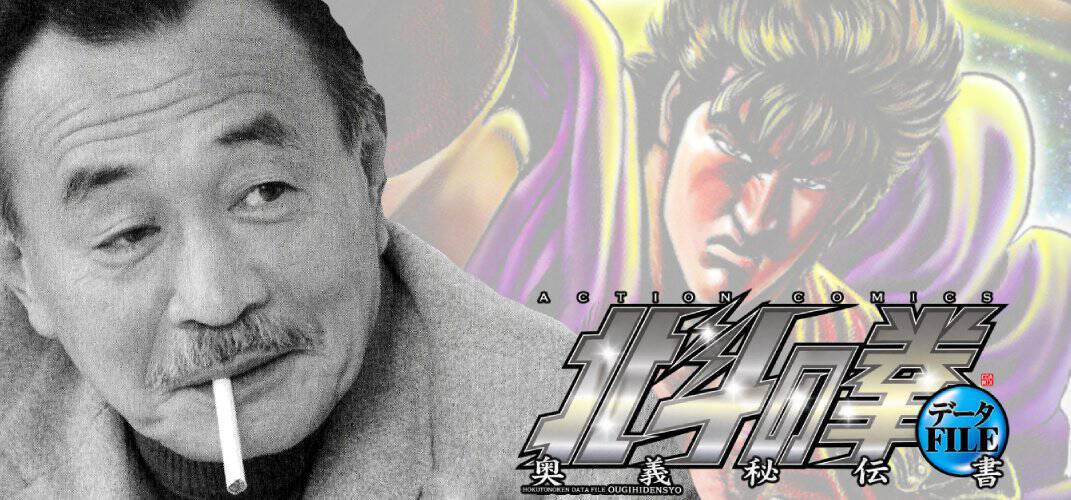
In 2006, nearly twenty years after the end of the serialization, the Hokuto no Ken Data File Ōgi Hidensho, a databook produced by Shiranui Pro for Futabasha, opens its chapter “The Men Who Created Hokuto” (北斗を創った男たち) with a lengthy interview with Buronson, the scriptwriter of Hokuto no Ken. Over six pages, he looks back on the birth of the series and the choice of a post-nuclear war world, the crafting of character and technique names, his favorite villains, the second chapter that cost him so much effort, and the death of Raoh, which he considers the true culmination of the work. The interviews with Tetsuo Hara and Nobuhiko Horie follow in the same chapter. Translated by us.
“It is because the world is empty that Hokuto no Ken came to life”
Question. Tell us how you came to write Hokuto no Ken.
Buronson. Hokuto no Ken first appeared as two original one-shots by Hara. When the weekly serialization was decided, the thinking was that Hara would put all his energy into the art, that he wouldn’t be able to manage if he also had to think up the story, and that it would therefore be better to assign him a scriptwriter. There were several other candidates, but I’m the one who ended up being chosen, apparently, who knows why (laughs).[1]
Question. The concept of the one-shots resembled that of Hissatsu Shigotonin, the period drama series.
Buronson. Yes, a kind of executioner in a school setting, a story about a fixer, if you will. When I was entrusted with the script, the first thing I thought about was what makes martial arts captivating. What appealed to me the most was the line “You are already dead” and the allure of Hokuto Shinken. Then I figured that to make the most of that allure, I needed a setting where physical strength and fighting prowess could be showcased. Seen from that angle, a contemporary setting is a bit bland. To bring out physical strength, I thought there was really only prehistory or the near future. But with prehistory, you end up in a world of brute force and nothing else (laughs). At the time, there was a movie called Mad Max, and I thought, that’s the world. So I started by building a post-nuclear war world where you can only rely on the strength of your own arms.
Question. So Mad Max left a strong impression on you?
Buronson. Yes, it left a strong impression. The vastness of Australia, and the fact that you could make such a thrilling movie with so little money.
Question. The budget did look modest, it’s true.
Buronson. And yet it was thrilling, it was a real shock. In a contemporary setting, it would have been an ordinary story, but it worked because it takes place in the desert, at an indeterminate time. That idea stuck with me, that a world like that could exist. I think Mad Max succeeded because its setting was unique. In a contemporary setting, it never would have worked. Hokuto no Ken too would have been difficult in a contemporary setting. I also considered using Blade Runner as a reference. But that film takes place in the near future, before the nuclear war. That universe could have worked too, but drawing the buildings and everything else is difficult. So we figured it was better to have nothing at all.
Question. And in an empty world, you can do spectacular things.
Buronson. Hara had a Bruce Lee-type hero in mind. Changing the course of an era through martial arts and physical strength was only possible in a world where you don’t know what country the story takes place in.
“Don’t make the hero talk, have him act with his back turned”
Question. Let’s change the subject. The character names are remarkable. How did you come up with them?
Buronson. By instinct. To find a name, I would start by writing it in kanji, then tinker from there. Jagi comes from the 邪 in 邪悪, evil. Toki comes from the image of the extinct bird.[2] That’s how I went about it.
Question. Interesting. And Raoh, for example?
Buronson. Raoh is the 羅 from shura and the 王 from king. I would start from the weight and power of the kanji, then convert the name to katakana.
Question. Were there names that gave you trouble?
Buronson. When the characters multiplied, yes. By the time I got to the Five Stars of the Nanto, I was starting to run out of ideas (laughs). Shûren, Huey, I think I managed pretty well in the end (laughs).
Question. But they turned out very well. And besides the character names, the names of martial arts and techniques are equally remarkable.
Buronson. For that, all I needed was a Kōjien. I just put together complicated characters, nothing more (laughs).
Question. Among the technique names, the Danko Sōsai Ken (断己相殺拳) of Nanto Suichōken really struck me. You can feel a terrible determination in it (laughs).
Buronson. Yes. But I don’t remember at all how I came up with it (laughs). Those names aren’t really based on much.
Question. When you were looking for a technique name, did you start from a specific image?
Buronson. Somewhat, yes. Hokuto is a massive fist, the idea of hardness (剛). Nanto is the idea of a razor, of sharpness. I kept that in mind when designing the techniques. For Nanto, names that cut, and for Hokuto, names that give an impression of weight and power.
Question. Nanto Seiken techniques bear the names of birds. What was the intention behind that?
Buronson. Because Nanto evokes suppleness. I wanted something soft and elegant. Hence the bird, swift and graceful.
Question. Put that way, it’s convincing. Let’s move on to the characters’ appearances. At the beginning of the serialization, Kenshiro seems influenced by Bruce Lee.
Buronson. Yes, I think Hara had the image of Bruce Lee in mind.
Question. And yours?
Buronson. Hmm. Bruce Lee is a bit thin, isn’t he? I imagined him a bit more muscular. At first, he looked like Bruce Lee, but as the enemies get stronger, he bulks up, doesn’t he?
Question. Did the image Hara had in mind change as well?
Buronson. Yes, I think it changed for him too. The poses during the highlight moments always remained those of Bruce Lee, but for the rest, I believe the image became more powerful.
Question. Kenshiro speaks very little. Where does that trait come from?
Buronson. The hero’s lines are tough (laughs). A hero doesn’t talk, especially the ones I create. I’m bad at building a hero (laughs). So he ends up taciturn. He stays silent, he acts with his back turned, and everything moves around him. A hero with real presence always ends up silent. The one who picks a fight is a thug. Since he only acts when someone comes to provoke him, he’s inevitably taciturn. And that way, all you have to do is come up with one killer line for him.
Question. The line “You are already dead” is iconic in that regard.
Buronson. Exactly. Hara had used it in the one-shots, and I kept thinking we absolutely had to keep it. It was the best thing about Hokuto Shinken, and I felt we should never mess with it. For Hara as well as for Horie, I believe Hokuto no Ken was first and foremost that line.
“If you don’t go so far as to write what the villains think, the characters are of no interest”
Question. Much of the appeal of Hokuto no Ken lies in the characters other than Kenshiro. Let’s talk about the supporting characters. First, Rin and Bat. Why did you create them?
Buronson. Each episode of the series was a gamble to win, so I wasn’t thinking much about what came next. In an episode designed as a self-contained story, I introduced Rin and Bat to move the story forward and to represent the weak. And to show that the power of Hokuto Shinken isn’t only for killing but can also save, I made Rin mute. Normally, Rin and Bat should have disappeared with that episode, but since the series continued, we decided they would follow Kenshiro. We needed characters to move the story forward.
Question. They explain the situation in Kenshiro’s place.
Buronson. That’s why I kept them with him. Originally, they were only there to wrap up a story in a single episode.
Question. Let’s move on to the villains. In the early parts, many of them have real charm, Colonel, Jackal and the others.
Buronson. Yes. But if I had kept going like that with the good-punishes-evil formula, it would have been over in two years (laughs). No matter how many powerful bad guys you bring out, it doesn’t go any further. So I introduced villains who carry a personal tragedy, like Souther. Souther is, in a sense, the strongest opponent against Hokuto. After that, the only thing left was a confrontation between people of the same school, meaning the brotherly feud with Raoh. But from the moment we decided that Toki, who had fought against Raoh, might actually be the strongest, I think we were able to give the work more weight and depth.
Question. Raoh takes on an enormous presence. From a certain point, you feel an attachment to him that threatens to overshadow Kenshiro. What about that?
Buronson. The thing is, with the good guy, you can always guess what he’s going to do.[3] He does nothing wrong, he doesn’t kill. But a villain who has his own philosophy and believes in it with absolute conviction, when you write him, he has real presence, because everything he says, he truly means. As a result, he took up more and more space in my mind. I really enjoyed writing him.
Question. Raoh is a character who rushes toward his own downfall, a type that has existed in Japan for a long time.
Buronson. At heart, it’s his strength that leads him down a solitary path, if you will. He has that fierce pride that makes him charge ahead even when he knows how it will end. A character like that is easy to write, so he grows in stature, and Toki and Kenshiro, drawn along by him, grew as well.
Question. It’s Raoh’s existence that makes Toki’s life so terrible.
Buronson. Yes. The one Raoh feared the most was Toki. When two masters understand each other on a certain level, the story is easier to write, isn’t it?
Question. Besides Raoh, other villains have convictions, Kaioh for example. Were you attached to him?
Buronson. Minor villains don’t need a backstory. But a somewhat important villain without a backstory becomes a mere puppet. To make him a flesh-and-blood evil, he needs a past, otherwise he has no depth. If Kenshiro fights a hollow puppet, Kenshiro becomes a puppet himself. But against an evil that has its own philosophy, Kenshiro has a real reason to fight. So no matter the villain, if you don’t go so far as to write what he thinks, he is of no interest. Every villain must have his own rationale, his philosophy of evil. Even a goal like “I’m traveling so I can eat!” is enough.
Question. Wanting to eat is an honest goal, too.
Buronson. If he says “I’m being a villain so I can eat,” the character has more substance than someone who simply kills. Otherwise it’s boring, so I deliberately gave them a goal.
Question. Jûza stands out particularly in the work. Were you attached to him?
Buronson. Jûza, the man who lives like a cloud. He’s far more popular than I ever expected. Probably because he dies in no time at all (laughs). A short and intense life, something manly.
Question. He does have real presence, that’s true. Nobody can live like that (laughs). And that’s precisely why people admire him.
Buronson. Yes. The Five Stars all sacrifice themselves. When you think about it, Kenshiro is a freeloader. Everyone dies for him.
Question. Calling Kenshiro a freeloader, that’s really something (laughs).
Buronson. People save him without him even realizing it. That said, that’s what a hero is.
Question. What about the female characters? Yuria, for example.
Buronson. Yuria is passive from start to finish. Aside from the moment I had her fight as the last general of Nanto, I only ever wrote her as a woman with a sad destiny, crying. Looking back, I told myself I was bad at writing women (laughs).
Question. Not at all. Seen through a man’s eyes, Yuria is an ideal feminine figure.
Buronson. A sacred woman, whom no one can touch. When you think about it, between Kenshiro and Yuria, it’s a love story between two virgins (laughs). That’s where the sacredness comes from. No scoundrel could be allowed to touch her.
“Writing scoundrels who live sincerely was a real pleasure”
Question. Of all the characters you created, which is your favorite?
Buronson. Jagi. He has exactly my personality (laughs). Jagi and Amiba, I really see myself in them. I used to say Raoh, but everyone told me that comparing myself to Raoh was a stretch (laughs). Now, with Jagi and Amiba, everyone agrees, and so do I (big laughs).[4] When I bring it up around people, those two have a lot of fans.
Question. That’s for sure. Jagi and Amiba have particularly strong personalities.
Buronson. They’re sincere to the very end, like Raoh, but in the opposite direction. They’re ready for any kind of cowardice. In their own way, they’re really great characters (laughs).
Question. Wasn’t it hard to build Jagi and Amiba as characters?
Buronson. No, and Hara had fun with them too. I didn’t think they’d become such memorable characters (laughs). Hara must have loved them. For Jagi, I’m the one who asked that he wear a helmet clamped around his face. And Hara gave me back an extraordinary character. I thought to myself that Hara had really gotten into it.
Question. His absurd lines are excellent too.
Buronson. “Say my name!” for example (laughs). When he hates someone, he hates them to the bitter end. He’s a small man consumed by humiliation. He has two powerful older brothers, and on top of that, the youngest brother he wanted to bully turns out to be terrifyingly strong. Naturally, that makes you twisted. And right now, whenever Jagi comes up in conversation, it hits the mark. It’s definitely because the people interviewing me see Jagi in me (laughs). They never see Raoh in me.
Question. Oh, come on (laughs).
Buronson. It’s true that I enjoyed writing him. Raoh too, I enjoyed writing. The good guys always have the same lines, so it’s not very fun. Even Toki, his lines are too beautiful, don’t you think? They’re self-evident, so it’s not very fun. On the other hand, guys like Raoh or Jagi, who fully embrace their philosophy of evil, it’s fun to give them dialogue. Anything goes. When one of them says “I don’t like this,” he truly doesn’t like it (laughs).
Question. Amiba was already popular back during the serialization.
Buronson. No, Amiba’s popularity came later. At first, people hated him, they found him despicable. But on rereading, there’s something funny about him. People love petty men (laughs). The sneaky ones.
Question. The line phrased as a question by the leader of the clan Kiba, “My family is dead, so you can give me your life, right?” is irresistible too.
Buronson. It’s absurd, isn’t it? (laughs) Absurd, but at first glance, it seems logical.
Question. It sounds like you took pleasure in creating the villains.
Buronson. Everyone carries a bit of pettiness inside, don’t they? And if I know how to write it, it’s because I know that kind of small man very well (laughs).
“I was writing without myself being able to predict what would happen the following week”
Question. Let’s move on to the construction of the story. What gave you the most trouble?
Buronson. I always had trouble, because I never thought about what came next. The second chapter was harder than the first. If we botched the second one, it would become just another martial arts story. I rewrote it several times, nearly falling out with Horie, my editor. Nothing was working, and I ended up writing the story of the old man with the seeds, old man Misumi, with Kenshiro sowing the seeds at the end. Once that scene existed, I told myself it could work.
Question. So the direction of the story only became clear with the second chapter.
Buronson. Yes. While writing that chapter, I asked myself for the first time why he was traveling, what the reason for his journey was. I thought about what came next and turned it into a story where he sets out in search of a woman. At that point, neither Yuria nor Shin existed in my mind yet.
Question. So at first you had only found the purpose of the journey.
Buronson. Yes. Starting from the third chapter, the hero began pursuing the woman who had been taken from him. Then various characters appeared, and by the end it became a story about fighting the one who had taken his woman. That’s when a powerful rival appeared for the first time, Shin… Actually, all of that was added after the fact (laughs). Like, Kenshiro had seven scars on his chest, so let’s say Shin gave them to him.
Question. That everything ended up fitting together after the fact is remarkable. By the way, Rei also seemed like an enemy at first, then he becomes an ally.
Buronson. Yes. When the Shin storyline ended and I had to write a new one, I thought there was nothing strange about someone else traveling like Kenshiro. That’s how he was born. It’s a kind of road movie. Rin and Bat appear as his interpreters, then Shin. Then Rei, then Jagi, and from that point I was starting to run out of stories. Since Kenshiro’s name contains “shirō,” the fourth son, I decided he had three older brothers. I had used Jagi as the third son, so there had to be two left. I asked that they be shown as silhouettes first. The story didn’t exist yet.
Question. You poured your heart and soul into each episode, week after week.
Buronson. Exactly. And in the end, everything connected just like that.
Question. For those who read the series as it was being published, the end of each episode was a shock.
Buronson. Of course, nobody could predict what came next. I myself didn’t know what would happen the following week (laughs). At the end of each episode, I’d wonder what I was going to do next time, telling myself, last time I left a cliffhanger like that… That’s how it was. So the readers had no chance of guessing (laughs).
“It was Raoh’s death that was the culmination of Hokuto no Ken”
Question. Raoh’s death is a major turning point. His famous line “I have no regrets in my life!!” left a lasting impression. Did it come to you easily?
Buronson. That one is my own line.[5] It reflects what I was feeling, that after writing Hokuto no Ken, I had no regrets about the work. When I wrote it, I truly felt I had made it. As if the spotlight had just landed on me (laughs).
Question. It really was a shock. Many people still remember it very vividly.
Buronson. Yes. I think Hara felt the same way. Like, well, I’m done drawing. We both thought Hokuto no Ken ended there. So when we were asked to continue with the next part without even a week’s break, I was stunned (laughs). Starting a new part from one week to the next! Impossible to write (big laughs). Usually, they give you six months to catch your breath. Instead, they tell me there’s a new part starting the following week, and I don’t know what to do. I had already given everything, there was no winding myself up again. That’s why I don’t remember the rest very well.
Question. In a sense, Raoh’s death was the end of the work.
Buronson. Hara and I both felt a sense of accomplishment when Raoh died. I couldn’t say that for me it was over, that would be unfair to the readers of what followed. But there was definitely a break at Raoh’s death. After that, I kept doing my best. But the motivation wasn’t the same anymore. I regret that. But there were the readers, and I told myself I had to do something, so I held on.
Question. Up until Raoh’s death, which episodes gave you the most trouble, or are closest to your heart?
Buronson. As a writer, what really took a toll on me was the second chapter. Then, the moment I realized that after Shin, just bringing out strong guys and stringing fights together would never be enough, and I started searching for what form his path as successor should take. That led to Hokuto versus Nanto, and Souther came easily, as I recall. The endpoint became the succession conflict, and I felt that before reaching the fight against the elder brothers, I would hit my limits.
Question. Was the construction of the story going well?
Buronson. Yes. It was working, I was able to write up to the confrontation with Raoh, and for about a year the story came effortlessly. And with the relationships between the successors of Hokuto Shinken in the mix, I think the narrative gained depth. Until I came up with the confrontation with Raoh, I felt a bit like I was writing on a tightrope.
Question. What did you feel when the serialization finally came to an end?
Buronson. Above all, a sense of having fulfilled my task. To be honest, I felt that you, too, had had your fill of Hokuto no Ken. Like, have mercy, let me breathe (laughs).
Question. In what state of mind did you begin the second part?
Buronson. Do my best for the time being, run as long as I can run. By volume twenty-seven, honestly, I felt everyone had read more than enough. Having held on that long, having been able to see it through to the end, I think Hara felt it too.
Question. Hokuto no Ken has a density worth dozens of volumes of other manga, and that’s why it’s still popular.
Buronson. That’s a blessing. If it’s still popular, it’s because as long as nuclear war doesn’t happen, the present never catches up to that near-future era, and the story doesn’t age. And then, at its core, there’s the way men and women live, universal things that don’t change when the times do. The setting doesn’t change, and what people truly think deep down doesn’t change either. That’s why, I believe, the years go by and people keep loving the work.
Question. To conclude, do you have a wish regarding how new generations should read Hokuto no Ken?
Buronson. What I always say is that it bothers me when people categorize Hokuto no Ken as a violent manga. That’s not our intention. Violence is certainly an element of the work, but I’d like people to perceive the human sadness hidden within it, and the way men and women live. Not the appeal of martial arts and violence, but the sadness and human strength that underpin the work: I’d like people to grasp them, one way or another. That is my wish as an author.
Editors’ notes
- Hokuto no Ken, the two short stories: published in 1983 in the April and June special issues (増刊) of Shōnen Jump. The story takes place in the contemporary era, where Kenshiro Kasumi (霞拳四郎), successor of Hokuto Shinken, fights evil.
- Mad Max: released in 1979, directed by George Miller. A fast-paced action film about the revenge of Max, played by Mel Gibson. The stunts are its main attraction, and it is said that someone died during filming. Two sequels followed.
- Blade Runner: released in 1982, based on Philip K. Dick, directed by Ridley Scott. A science fiction film in which Deckard, the “blade runner” played by Harrison Ford, hunts down replicants from Mars. Poorly received at release, it now has many admirers for its innovative themes and its vision of the near future. A director’s cut was released in 1992.
- Bruce Lee: born in 1940, actor and martial artist. Noticed in the American television series The Green Hornet, he became an overnight star with Fist of Fury. He died suddenly in 1973, at the age of thirty-two. His energetic face and lean body captivated audiences and influenced many fighters. His distinctive cry, “Atchô,” is nicknamed the cry of the strange bird (怪鳥音).
Reading note
The questions are unsigned in the interview. The volume’s colophon credits the texts to 橋本学 (noNPolicy), without specifying who conducted the interviews. The six subheadings, reproduced here as section titles, and the four notes are by the editorial staff, as is the profile box, which introduces Buronson under his real name, Yoshiyuki Okamura, born in 1947, a scriptwriter since 1972, author of Doberman Deka and Hokuto no Ken, also active under the pen name Shō Fumimura. The volume does not date the interview. Its colophon is dated April 30, 2006.
- ↑ Buronson says he was chosen “apparently” (らしい). He does not know it firsthand.
- ↑ Toki’s name is written in katakana, but it refers to the Japanese crested ibis (朱鷺, toki), the “extinct bird” (絶滅した鳥) Buronson mentions. In Japan, the species had disappeared from the wild by 1981, when the last birds were captured for captive breeding.
- ↑ “The good guy” translates ベビーフェイス, a wrestling term for the heroic character.
- ↑ His answer about his favorite characters has changed. In 1986, he said he liked them all except Kenshiro (All About The Man). Here he says he used to answer Raoh and now answers Jagi and Amiba.
- ↑ When he calls Raoh’s last line “my own line” (俺自身のセリフ), he means that it matches what he felt about the work, not that he wrote it with himself in mind.
Sources
- Hokuto no Ken Data File Ōgi Hidensho (北斗の拳 データFILE 奥義秘伝書), Shiranui Pro, Futabasha, Action Comics imprint, colophon dated April 30, 2006, “SPECIAL INTERVIEW No.1”, pp. 52-57 (book entry). Editorial copy.
Quotes translated and entry compiled by Hokuto Chronicles from the original publication. First published on October 22, 2026, updated on October 23, 2026. © 2026 Hokuto Chronicles. Any reuse, even partial or reworded, must credit Hokuto Chronicles with a link to this page.