


Details
- Name
- Ōka (桜花)
- First appearance
- Hokuto no Ken (Shura flashback arc)
- Appears in
- Hokuto no Ken (manga, anime 1984)
- Status
- Flashback
- Role
- Ancestor of the Hokuto Sōke, mother of Ryūō, elder sister of Shume
Ōka
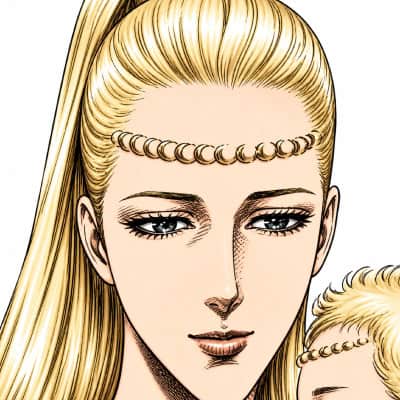
Ouka (オウカ) is a woman of the Hokuto Sōke lineage who lived approximately two thousand years before the events of Hokuto no Ken. The eldest of the main family and older sister of Shume, she is the mother of Ryuō. Her sacrifice atop a cliff constitutes one of the most important mythological origins of the saga: it seals the birth of Hokuto Shinken and the founding of the single-successor rule that would govern the art for 1800 years.
The crisis of the Hokuto Sōke
In the 2nd century AD, upon the death of Emperor Liú Hóng (劉宏) in 189 AD according to the chronology established by 199X Generazione Hokuto, China plunged into a period of permanent civil wars. The tutelary priests of the Hokuto Sōke feared that their two-thousand-year-old art, having become too well known and now countered by numerous opposing defensive techniques, would no longer suffice to protect the world. They decided that a sole successor had to be chosen and tasked with founding a new invincible assassination art.
The problem: at that time, the main bloodline no longer had any adult male heir. The last two direct descendants of the Hokuto Sōke were the sisters Shume and Ouka, both from the house of Liu (劉).
Simultaneous birth of Ryuō and Shuken
The two sisters give birth to a son on the same day: Ouka bears Ryuō (龍王), while Shume, already consumed by an incurable illness, brings Shuken into the world. Too weakened to nurse her own son, Shume entrusts the feeding of the newborn to her sister Ouka, who thus becomes her nephew's wet nurse as much as her own son's mother.
This double birth poses an insoluble dilemma for the priests: only one of the two children can become successor, lest the art of Hokuto be fragmented forever. Unwilling to render the verdict themselves, they decide to leave it to the gods.
The Trial of the Kōtendai
The two infants are carried to the summit of the Kōtendai (降天台), a sacred plateau whose surroundings are infested with wild wolves. The verdict of the heavens is simple: the child who survives the night will become the legitimate heir of Hokuto and the founder of the new art.
Dying but driven by absolute love for her son, Shume secretly sneaks onto the plateau to take back Shuken and remove him from the trial, abandoning Ryuō alone to the wolves. The priests kill the wolves to spare Ryuō, then catch up with Shume before she can flee with her son. They then decide that the succession will go to Ryuō, the only child who remained faithful to the trial.
Ouka's voluntary sacrifice
Moved to tears by the strength of the maternal love her dying sister has just shown by risking her exhausted body to save her son, Ouka makes a decision that will seal the destiny of Hokuto. She declares that the succession will not go to her own son Ryuō but to her nephew Shuken, and that to prove it she offers her own life as a pledge.
Under the gaze of the guardian priests and her sister, Ouka throws herself from the top of the cliff. This spontaneous sacrifice, carried out to redeem her sister's forbidden act and preserve the lives of both children, deeply moves the priests. They interpret this double demonstration of maternal love as the certain sign that heaven has chosen Shuken, the child protected in turn by his mother and by his aunt, as the founder of the new art.
Origins of the Hokuto Shinken and birth of a rule
Recognizing the celestial will, the priests consecrate Shuken as heir to the Hokuto. Once grown, he would travel across war-torn China to perfect his art, and would ultimately found the Hokuto Shinken, the deadly art destined to become the seal of the lineage for the next 1,800 years. His cousin Ryuō would in turn found the Hokuto Ryūken, a rival art built on the same foundations but marked from the very beginning by the lack of maternal love, a burden that his descendants Kaioh, Raoh and Toki would carry in their turn.
So that no tragedy comparable to that of Ouka and Shume would ever repeat itself, the priests decreed that the Hokuto Shinken would henceforth be passed down to only one successor per generation, and that the defeated brothers would have to accept this designation without contestation. This rule, the Isshi Sōden (一子相伝), would remain the founding pillar of the lineage up to the era of Ryuken and his four adopted sons.
Ouka's sacrifice, although nearly two millennia prior to the events of the series, thus subtly looms over the entirety of Hokuto no Ken: it is from her act, and from the love of two sisters for their children, that the very tradition Kenshiro would embody as the 64th successor was born.