


Details
- Name
- Shume (シュメ)
- First appearance
- Hokuto no Ken (late mentions - gaiden and canon material)
- Appears in
- Hokuto no Ken (mentions, flashbacks)
- Status
- Historical character
- Role
- Ouka's younger sister, mother of Shuken (founder of Hokuto Shinken), mythological figure of the Hokuto Sōke
- Martial art
- None
Shume
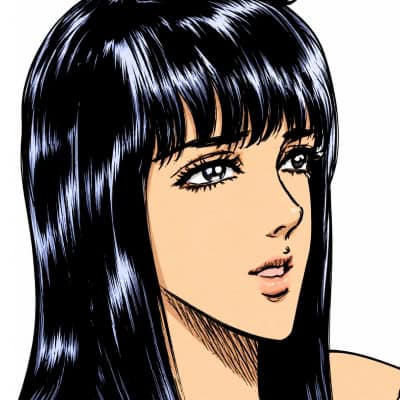
Shume (シュメ) is a woman of the Hokuto Sōke lineage who lived approximately two thousand years ago. Younger sister of Ouka and mother of the future Shuken, founder of Hokuto Shinken, she plays a central role in the origin myth of the lineage. Dying at the time of the Kōtendai trial, her desperate act to save her son moved her sister Ouka to the point of sacrifice and definitively shaped the destiny of the Hokuto lineage for the 1800 years that followed.
A descendant of the Hokuto Sōke
At the end of the 2nd century AD, after the death of Emperor Liú Hóng (劉宏) in 189 AD according to the chronology of 199X Generazione Hokuto, the Hokuto Sōke, the martial dynasty that had protected the Tentei for two thousand years, has only two direct heiresses remaining: Ouka and her younger sister Shume, both from the house of Liu (劉). With the dispersion of imperial authority and the emergence of rival martial arts capable of defeating the Hokuto Sōke no Ken, the tutelary priests of the lineage make the most momentous decision in their history: to entrust the founding of a new assassin art to a single male heir, capable of surpassing all rival schools.
Shume is then pregnant. She gives birth on the same day as her sister Ouka, and this simultaneous double birth upsets the priests' plan: there are now two male heirs, Shuken for Shume and Ryuō for Ouka.
A dying mother
At the time she gives birth to Shuken, Shume is already suffering from an incurable illness that leaves her with little time to live. Her exhausted body can no longer produce milk to feed her newborn: it is her sister Ouka, in good health after her own delivery, who takes on the nursing of Shuken alongside that of Ryuō.
This detail, seemingly insignificant, seals the destiny of the two cousins from birth: Shuken and Ryuō share the same nursing milk, and the latter becomes as much a son of Ouka as a cousin. This closeness partly explains the depth of the decision Ouka would make shortly after.
The trial of the Kōtendai
To avoid having to choose between the two infants themselves, the guardian priests of the Hokuto Sōke apply a celestial verdict. The two babies are placed at the top of the Kōtendai (降天台, "plateau descending from heaven"), a sacred plateau whose surroundings are frequented by starving wolves. Heaven must decide which of the two will survive: that one will become the founder of the new art.
Shume, despite her extreme weakness, cannot bring herself to accept this. When night falls, consumed by fever and sustained only by her maternal love, she sneaks onto the plateau, takes her son Shuken in her arms and attempts to descend, abandoning Ryuō to the wolves. She is caught before she can escape by the priests and by her own sister Ouka, who had been alerted to the infant's absence.
Ouka's confession and sacrifice
Confronted by her sister, Shume then confesses the truth she had been keeping to herself: her illness is terminal, and she will not live to see her son grow up. Her last wish is to know, before she dies, that Shuken will indeed be the successor. This confession shakes Ouka so deeply that she immediately makes the most drastic decision: she declares before the priests that Shuken will be the founder, and offers her own life as a pledge by throwing herself off the top of the cliff.
The tutelary priests, profoundly moved by this twofold testimony of maternal love, recognize in Shuken the child twice protected by the love of two women and accept his designation as the founder of the new art. Ryuō, saved from the wolves at the last moment by the priests, is kept alive but confined to a subordinate role, which will plant the seed of the later rivalry between Hokuto Shinken and Hokuto Ryūken.
Legacy
The exact moment of Shume's death after this episode is unknown, but her illness leaves her only a few months to live. Her son Shuken will grow up with the awareness of having been doubly chosen by the love of his mother and his aunt. This idea will nurture his understanding of Hokuto Shinken as an art in service of life as much as death, and he will devote his entire existence to it, traveling across China to integrate the best foreign techniques, until his encounter with the Yuezhi people and his learning of Seito Gekken (西斗月拳).
So that no mother would ever have to relive the ordeal endured by Shume and Ouka, the priests decree that Hokuto Shinken shall henceforth be transmitted to only one successor per generation: the rule of Isshi Sōden (一子相伝, "transmission to a single son"). This juridical and spiritual discipline, born from Shume's suffering, will govern the lineage all the way to Ryuken and his four adopted sons, including Kenshiro, the 64th successor.
A mythological figure of Hokuto
Although Shume never directly appears in the main events of Hokuto no Ken and remains confined to the founding narratives, her figure looms over the entire saga. The motif of the mother sacrificed for her child, which is replayed through the mother of Raoh, Toki and Kenshiro in the fire of Taiseiden, or again through the twins Rin and Rui in the second part, finds its earliest origin in Shume's act atop the Kōtendai.
This dimension as a mythological matrix makes Shume, despite her brief and indirect role, one of the most important founding figures in the entire universe of Hokuto no Ken.