


“Make them cry and you win”: Buronson, Tetsuo Hara and Nobuhiko Horie talk about Hokuto, late 1999 (Kyūkyoku Kaisetsusho PART2)
Details
- Date
- December 1999
- Source
- Hokuto no Ken 2000 Kyūkyoku Kaisetsusho PART2 (北斗の拳2000 究極解説書PART2), Home-sha, 1999, pp. 37-41
- Nature
- Joint interview
- Type
- Book / databook
- Interviewer
- The book’s editorial staff, TEAM MUSCLE (uncredited)
- Featuring
- Buronson, Nobuhiko Horie, Tetsuo Hara
- Translation
- Hokuto Chronicles
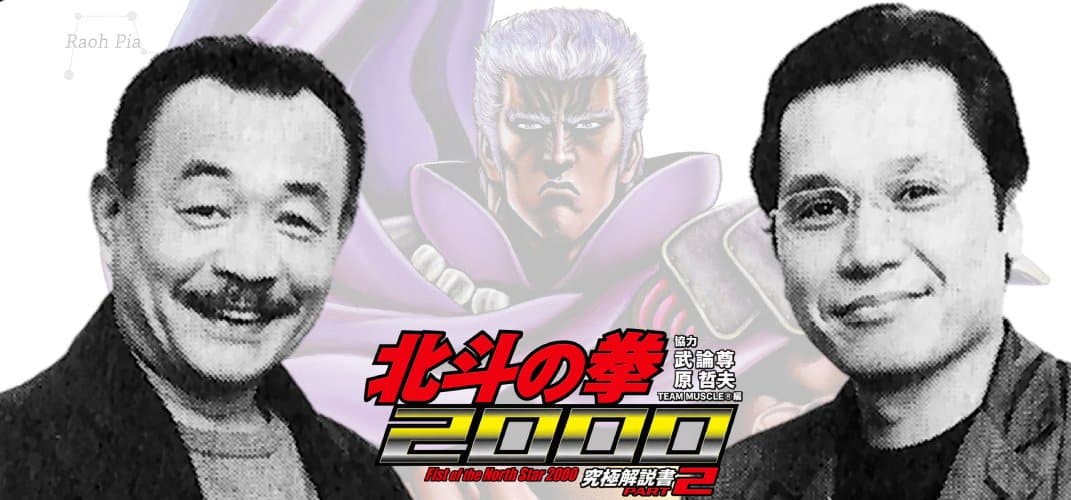
In late 1999, for the second volume of its Hokuto no Ken guide, Hokuto no Ken 2000 Kyūkyoku Kaisetsusho PART2, the TEAM MUSCLE editorial staff brings together Buronson and Tetsuo Hara for an “end-of-the-century dialogue,” “Talking about Hokuto” (北斗を語る。). The introduction presents it as the first interview of this kind between the two authors. They are joined by Nobuhiko Horie, their editorial supervisor at the time of serialization in Weekly Shōnen Jump. Over five pages, they look back on the birth of the series, how the scripts were made, the lines and names, the pressure points, the deaths of characters and the evenings spent figuring out what came next. Translated by us.
Question. How was the Hokuto series born?
Horie. We wanted to turn Hara’s idea of Hokuto Shinken into a series by pairing him with a scriptwriter. Hara said it would be best to have someone who understood the heart of naniwabushi, so it could only be Buronson.[1]
Buronson. The idea was good, so we decided to develop it. At first, it turned into a simple road movie, with no goal. I never thought about what came next. I bet everything on that week’s episode. When I wrote the beginning, we didn’t even know why Kenshiro was traveling. (laughs) Traveling for no reason didn’t work, so Shin and Yuria came along. Everything was added after the fact. The best part is when we said, his name is Kenshiro, so let’s give him three big brothers. (laughs)[2] Their builds hadn’t been decided, so we just drew two placeholder silhouettes, a huge one for Raoh and a thin one for Toki.
Horie. That was the rule back then. Whatever you could come up with right away, you did right away. Preparing a highlight three episodes ahead was a luxury we didn’t have.
Buronson. By the time you’d waited three episodes, your popularity would have collapsed. At the slightest letup, we’d plummet.
Hara. The thought of letting up never even crossed my mind. My life was on the line.
“I went to the trouble of writing weird screams, and they’d get corrected”
Question. Hokuto Shinken and all the ideas in this gripping story, where did they come from?
Hara. During the previous series, Tetsu no Donquijote, I said I’d like to draw Bruce Lee someday. Horie went and researched keiraku hikō and all sorts of other things, and he’d come out with stuff like, you know, a human body can explode. (laughs)
Buronson. What mattered was whether the episode had a good killer line, nothing else. If a good line landed just right, you’d won. “You are already dead,” for example. When a line that sharp came out of nowhere, I could feel the episode would hold up.
Horie. In the end, what Buronson brought in his scripts was human drama: the quarrels between brothers.
Buronson. Without that, it would have been nothing but a dark near-future story of people killing each other. We had a principle: make them cry and you win. And besides, the readers laughed quite a bit, too.
Horie. The tears, that was Buronson…
Hara. And the laughs, that was me. (laughs)
Buronson. That stuff is so over the top you end up laughing. It turns into a gag.
Hara. But I wasn’t drawing that seriously either. (laughs) A lot of people have parodied it, but I myself was drawing it as a gag…
Buronson. “Hidebu,” anyway, is just a typo.[3]
Hara. No, you’re wrong about that. I write those myself, on purpose. (laughs)
Horie. Hara’s handwriting was so messy that we couldn’t read what he had put down. At first, I too thought he had made a mistake. (laughs)
Hara. I think I was already writing them back during Tetsu no Donquijote, but they’d get corrected. I went to the trouble of writing weird screams that set the mood, and they’d get corrected. (laughs)
Question. How were the scripts written?
Buronson. Each week was like a complete story. There absolutely had to be a highlight in every episode.
Hara. And Buronson’s scripts are easy to draw. You can turn them into manga as they are. When reading them, you sometimes think, huh? But once it’s drawn, it works well. That’s a talent of its own. (laughs)
Horie. Buronson’s scripts leave just enough room for the artist to have fun.
Buronson. I build the images in my head first, and all I do is put them into words. There’s an image somewhere inside me, and I want to see it too. If the image doesn’t come, I can’t write the script.
Hara. Scriptwriters who think in images are rare. Most only provide sequences, an outline, steps.
Buronson. I had in my head, in images, the desert expanses from the movie Mad Max. That’s why it was easy to write. A motorcycle appearing in the distance, for example: I’d think how great that would look on the page, and all I had to do was write it.
Horie. As a result, from the very first read of the script, you could tell which drawing, once nailed, would be enough to carry the episode.
Buronson. Some episodes hold on a single drawing. The scene where they saw off a head sticking out of the ground, for example. (laughs) Drawn realistically, it would be revolting, but here, you can only laugh. That kind of passage is always something Hara adds for fun.
Hara. That’s because the script already provided all the drama, the dialogue, everything that makes you cry.
Buronson. What made me realize I no longer needed to write out the action was the scene where prison warden Uighur unleashes his whips from the horns on his helmet. In my script, there was only one. Hara drew dozens of them. When I saw that, I was blown away. I thought, I can’t compete with this, his version is a hundred times more powerful. (laughs)
Hara. But without a foundation, it’s impossible to rework anything. Back then, images were flooding into my mind too. Even the comedic moments only work because of the visuals.
Buronson. I put a lot of care into names. A name has its own impact. With a name like “the city where demons howl,” the scene of the howling wind comes naturally.
Hara. Names really matter. From the name alone, the images come to you in a completely different way.
Buronson. Ultimately, a script is an image. Its role, I believe, is to give the artist a strong image. Give a strong image, and see whether a striking line of dialogue bursts out all at once: that’s what it all comes down to.
Horie. With Buronson’s scripts, just by reading the dialogue, you could understand the story.
Buronson. My stories don’t explain anything. The first rule is that it has to be interesting, period.
“The death of a hero with style is a high point, so it’s easy to write”
Question. Any scenes that stayed with you?
Horie. The story of Shû, at the Holy Emperor’s cross mausoleum, I loved that one.
Buronson. That one, I was writing it with Horie, and we kept saying, this is Golgotha! Stories where someone dies are surprisingly easy. The death of a hero with style is the greatest high point, so it’s easy to write. And just before that, the scene where we don’t show Rei dying, only the blood flowing. Rei has a huge number of fans. With those episodes, we knew how to give characters a good death. You think it would be a shame to kill him off, and then, well, the time has come. (laughs) But Rei, we kept him around for a while.
Horie. If that heavy-handed pathos works so well, it’s also thanks to Hara’s artwork.
Buronson. His lines are thick and bold, so even the most overwrought naniwabushi fits right in. If it were drawn with thin lines, I don’t think people would cry nearly as much.
“To make the hero come alive, you need to pit him against a towering enemy”
Question. Do the pressure points, the hikō, actually exist?
Buronson. For the pressure points, I had a single book of points intended for acupuncturists, just one, and that was it. For the rest, a kanji dictionary. We’d pick characters that sounded right and combine them. But almost all of them are real points, distorted, of course. “Losing one’s memory,” for example, isn’t that far off. When you think about it, the appeal of Hokuto Shinken counts for a lot, doesn’t it? With an ordinary martial art, it would be far less interesting.
Horie. Kenshiro is actually cruel. He strikes a pressure point, tells the guy “confess and I’ll save you,” and once the guy confesses, he drops a “see ya” and walks away. (laughs)
Buronson. But to be able to do that, it all depends on how despicable you make the opponent. The reader has to think, that guy deserves to be taken out. That’s the foundation.
Horie. And then there was Buronson’s iron rule: a villain has to have style.[4] Even more style than the hero.
Buronson. Raoh, like all the others, has his own way of living. When you can feel the path that led him to where he is, his death also has style. A kind of aesthetics of evil. Kenshiro, on the other hand, only reacts. The hero always ends up as Ken Takakura. He’s taciturn and can only play off reactions. In any case, that’s easier to write. So you need to have formidable villains lined up. To make the hero come alive, you need to pit him against a towering enemy. Ultimately, it’s the antagonist who requires the most care. A work that has found its rival has already won.
Horie. That’s the point Buronson cares about the most.
Buronson. I put care into everything, right down to the horse. A horse as huge as an elephant, one only Raoh can ride. A mount alone changes the impression completely.
Hara. Thanks to that, the images of the characters came easily.
Horie. And Hara would deliver artwork that went beyond anything we had imagined.
“Hokuto is the work I poured my entire twenties into”
Question. What were the hardest moments during the series?
Horie. The things we cobbled together in a rush to get through, looking back, turned out to be amazing ideas. Even when we wondered what could possibly happen next, we always ended up finding an explanation that held together.
Buronson. Writing a hollow script serves no purpose, and of course, Horie would never have approved it.
Horie. When I’d reread the script several times going “hmm?”…
Buronson. All right, I get it, where is it? And I’d rewrite. (laughs) When I turned in a script, I already more or less knew what was wrong with it, because I wasn’t happy with it myself. I’d hope Horie wouldn’t notice and would take it as is, but he never fell for it. (laughs)
Horie. While I’m still wondering whether I should say something, Buronson blurts out on his own, all right, I get it!
Buronson. Then we’d ask ourselves what to do. Sometimes we’d hit a wall, sometimes it would all break open at once. If you get hung up on details, you’re done for. As soon as you get into the details, everything turns into expository dialogue. So when the story wandered off into some weird alley, Horie and I would say, let’s go get a drink! And while drinking, while talking it over, we’d eventually see that there was a path, over there. As soon as another path appears, everything changes all at once.
Hara. So you really went through a lot. (laughs)
Buronson. You bet. Horie and I sometimes dug ourselves in too deep, unable to find our way back out of the alley. Then we’d quibble over trivial things, and nothing would move forward. But if you open a gap in a completely different direction, the path clears up all at once. Let’s end this storyline here, bring out a new character and throw him into the fray, for example.
Horie. Or we’d keep the frontal attack but shift the angle of the light a little.
Buronson. There were about three per year, those scripts I’d turn in full of confidence, thinking, this one, neither Horie nor Hara will find anything wrong with it! And those were usually the episodes where a good character dies. The problem is what comes after the death. Things get stuck when you can’t see which direction to go. One story ends and you have to launch the next one: that’s where I struggled the most. Anyway, Hokuto taught me a lot, in every sense.
Hara. Hokuto is the work I poured my entire twenties into. I had nothing else.
The memories blossom, and the two authors seem far from having exhausted their stories. Once the interview is over, the enthusiasm doesn’t fade, and in the lively nightlife districts, the off-the-record version of the Hokuto tales unfolds until morning…
Editors’ notes
- Hokuto no Ken ran in Weekly Shōnen Jump from issue 41 of 1983 (Shōwa 58) to issue 35 of 1988 (Shōwa 63).
- Tetsu no Donquijote: Hara’s first series in Jump. Both volumes are available in Jump Super Comics.
- Hidebu: regarding the origin of the death cries of the villains, details are given in Hara’s afterword in volume 15 of the pocket edition (bunko).
- Mad Max: an Australian film by George Miller, starring Mel Gibson, released in 1979. An action and science fiction film set in the near future, which also served as a model for the world of Hokuto.
- Hikō: in Eastern medicine, these are points called keiketsu (経穴), of which there are said to be 708 across the entire body. See page 72 of the volume.
- In the character popularity poll from Seikimatsu Haō Retsuden, the previous volume, Raoh ranks second, just behind Kenshiro, and Souther places seventh. The stylish villains are fan favorites.
- As an anecdote, Ken Takakura’s first starring film was, surprisingly, an action film, Denkō karate-uchi (電光空手打ち).
Reading note
The questions are not attributed. They come from the book’s editorial staff. The four subheadings, reprinted here as section titles, are from the layout, which drew them from two of Buronson’s answers and two of Hara’s answers. The closing, in italics above, is also from the editorial staff, as is the introductory blurb, which our introduction summarizes, and the seven notes, which the layout references with numbered asterisks. The layout accompanies the interview with two sidebars listing the major works of each author, and two panels presented as Buronson’s favorite scenes: Kenshiro coldly sawing off a head sticking out of the ground, and the whips bursting from the helmet of prison warden Uighur. Photographs by Hiroki Sakuraba (桜庭宏紀, reading to be confirmed).
- ↑ Naniwabushi (浪花節), also called rōkyoku (浪曲), is an art of sung storytelling accompanied by the shamisen. It was very popular in Japan from the Meiji era to the early Shōwa era. Its stories pit duty (義理) against human feeling (人情), stage loyalty and sacrifice, and aim to make the audience cry. By extension, the word refers to a sensibility made of good feelings and tears, often with a hint of mockery. This is the sense Horie has in mind when he says that Hara wanted someone who “understood the heart of naniwabushi” (浪花節の心がわかる). Buronson keeps the same nuance when he speaks of an “overwrought” naniwabushi (クサい). In his view, this naniwabushi works thanks to Hara’s thick lines and would make people cry less with a fine line. Buronson’s motto “Make them cry and you win” (泣かせたら勝ち) comes from the same idea.
- ↑ Kenshiro’s name is written 拳四郎 in kanji, and 四郎 (Shirō) is a traditional given name for a fourth son. This is the name Buronson takes literally when he recounts the decision to give Kenshiro three older brothers.
- ↑ Buronson jokingly claims that the cry is nothing but a typo, and Hara immediately denies it.
- ↑ The “iron rule” translates 鉄則. Horie uses the word to present one of Buronson’s principles, “a villain has to have style” (悪党はカッコよくなきゃダメ), to the point of outshining the hero. Buronson justifies it later in the interview. Kenshiro only ever reacts, so he has to be pitted against “a towering enemy” (でっかい敵) to come alive. Note 6 of the book shows the effect of this rule on readers. In the popularity poll of the Seikimatsu Haō Retsuden, the previous volume, Raoh comes second, a few votes behind Kenshiro, and Souther ranks seventh.
Sources
- Hokuto no Ken 2000 Kyūkyoku Kaisetsusho PART2 (北斗の拳2000 究極解説書PART2), TEAM MUSCLE, Home-sha and Shueisha, colophon dated December 18, 1999, pp. 37-41 (book entry). Editorial copy.
Quotes translated and entry compiled by Hokuto Chronicles from the original publication. First published on October 21, 2026, updated on October 23, 2026. © 2026 Hokuto Chronicles. Any reuse, even partial or reworded, must credit Hokuto Chronicles with a link to this page.