

Details
- Title
- Hokuto no Ken (北斗の拳)
- Type
- Pilote
- Author(s)
- Tetsuo Hara (scénario et dessin)
- Publisher
- Shueisha
- Start date
- Avril 1983
Gallery
 3View all images
Hokuto no Ken (pilote)
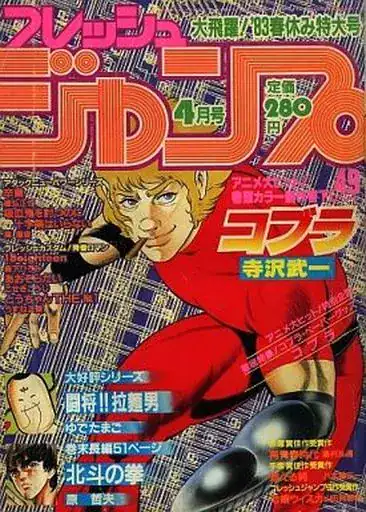
Hokuto no Ken (北斗の拳) is a one-shot by Tetsuo Hara, published in the April 1983 issue of Shueisha's Fresh Jump. The first of two short stories preceding the serialization, it lays the foundations in a contemporary Japan setting for what would become, a few months later, the Hokuto no Ken series. Its hero, Kasumi Kenshiro, avenges the woman he loves by confronting a criminal organization with his family's deadly art, Hokuto Shinken. Published at the back of the magazine, the story took first place in the reader survey and triggered the commissioning of a second installment, then the serialization in Weekly Shonen Jump.
Synopsis
Kenshiro leads an ordinary life between training at the family dojo and his fiancée Yuki, until the evening she witnesses the murder of her next-door neighbor. An inconvenient witness to a political scheme, she is eliminated in turn, and it is over the phone that Kenshiro hears her death in real time. To avenge her, he will have to employ the assassination art his father passed down to him.
Hokuto no Ken without the post-apocalyptic world
In the courtyard of a dojo surrounded by buildings, Kenshiro fells a fighting bull with a single blow before the eyes of his fiancée, Yuki. His father passed down to him Hokuto Shinken, a deadly art that destroys the body from within by striking secret pressure points, but the young man still doubts whether such a discipline has any place in a world at peace. The answer comes swiftly. Having witnessed the murder of his neighbor, an upright politician assassinated on contract, Yuki is in turn silenced. Kenshiro listens helplessly to her death over the phone, until the sound of chewing reveals the killer's identity: the colossus Gōda, whom he had encountered on the day of the politician's murder. When he returns home, the organization is already waiting for him. His father is shot while protecting him, and a police force in the criminals' pocket arrests both men for a murder they did not commit. From their cell, his father identifies by the nature of the wounds the school responsible for this murder: Taizanji Kenpō, a martial art originating from Mount Tai and the sole mortal rival of Hokuto Shinken, now in the service of the powerful.
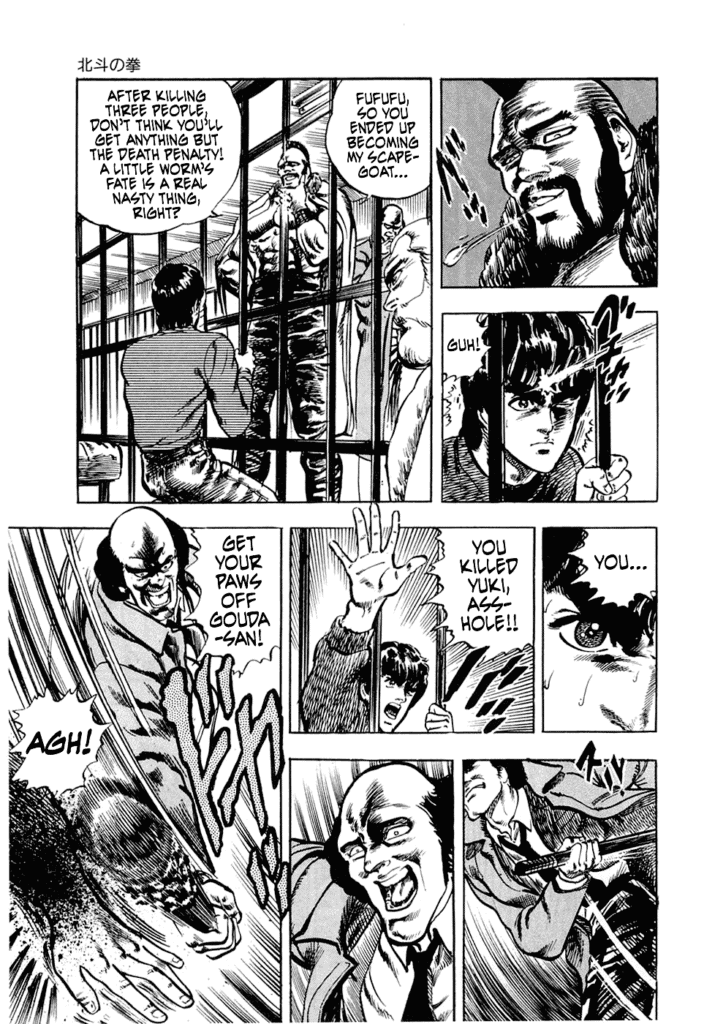
Humiliated in the visiting room by Gōda and Yazaki, the Taizanji emissary who has infiltrated the police chief's circle, Kenshiro finally bends the bars of his cell to escape. His father lets him go, convinced that Hokuto Shinken was created for situations like this. In the office where the conspirators are celebrating their victory, Yazaki is neutralized by a strike to a secret pressure point before being obliterated under a rain of blows. Facing Gōda, Kenshiro explodes the colossus's hand with a mere flick, concentrates his energy to the point of bursting his jacket, then unleashes the seventy percent of power the human body never uses. Gōda believes he has won, but ultimately succumbs to the delayed effects of the Hokuto Sōryūha. The police chief remains. Kenshiro tells him he will leave the room without turning around, on the condition that the man refrains from firing, then places his index finger on the man's forehead. The man immediately betrays his promise and takes aim. Without even turning around, Kenshiro then reveals that the technique had already been delivered: he is already dead. The story ends with Kenshiro departing alongside his father, now convinced that this world still harbors too many criminals for Hokuto Shinken to die with him.
From trial run to serialization
After the end of Tetsu no Donquijote, Tetsuo Hara and his editor Nobuhiko Horie set out on a new martial arts project. Depending on the source, the idea came either from Hara, who wanted to draw Chinese kenpō, or from Horie, who was looking for a subject suited to his author's art style. The story was published at the back of the magazine in the April 1983 issue of Fresh Jump and took first place in the reader survey, a rare result for a story published at the back of the magazine, which immediately earned the commission of a second installment, published in the June issue. Given this double success, the editor-in-chief of Weekly Shonen Jump, Shigeo Nishimura, approved serialization in the main magazine. It began in issue 41 of 1983, with Buronson as scriptwriter, the weekly pace being deemed unsustainable for Hara alone.
Reading the one-shot holds a surprise. Indeed, most of the series' conceptual toolkit is already in place. The secret meridians of the body, the doctrine that the human body uses only 30% of its power, the delayed death, Kenshiro's long battle cry, the jacket that tears apart under concentration, all of it is there, down to a prototype form of the series' most famous line, placed as the story's closing punch. The differences are all the more striking: a contemporary setting, transmission from father to son within the same family, and a rival school that is not Nanto but Taizanji Kenpō, a brotherhood of assassins from Mount Tai. The opening page, lastly, traces Hokuto Shinken back to the China of the Three Kingdoms, 1,800 years ago. Hara would reprise this opening almost identically in Souten no Ken, nearly twenty years later, and his hero would also bear the family name Kasumi.
Éditions
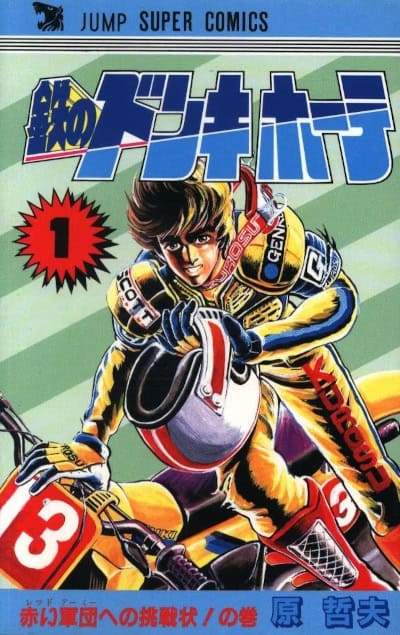
The story was published in the April 1983 issue of Fresh Jump, a Shueisha magazine. It is collected at the end of the first volume of Tetsu no Donquijote, published in 1983 in the Jump Super Comics collection, which it shares with the one-shot Mad Fighter. The 1996 Jump Super Ace reissue, featuring new covers drawn by Tetsuo Hara, also includes it, along with an afterword by the author. No French edition has been released.