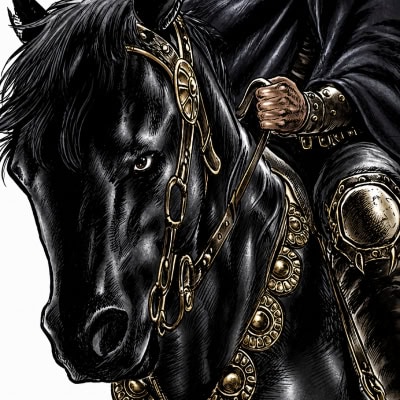
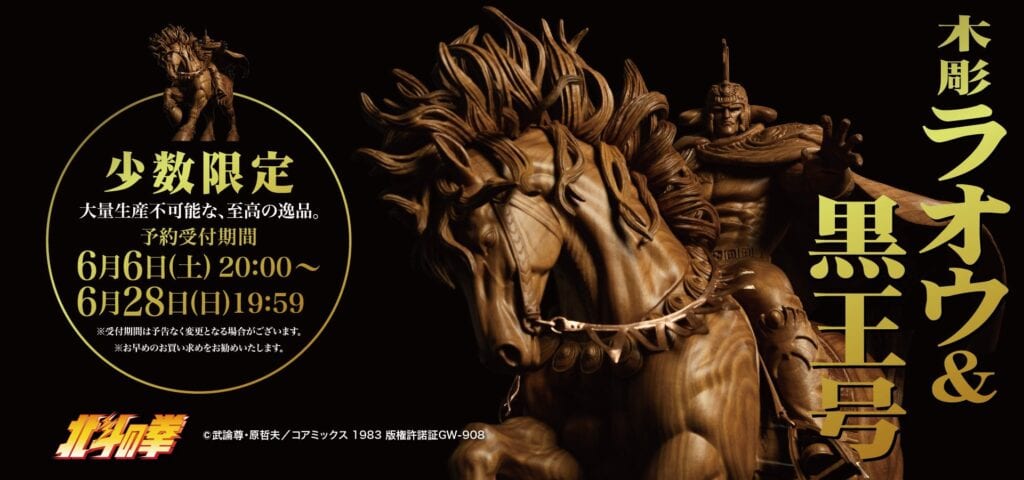
Kokuō (黒王), whose name means Black King, is the gigantic steed of Raoh and one of the most iconic mounts in Hokuto no Ken. His stature, compared by survivors to that of an elephant, and the silhouette of Raoh perched on his back are inspired by the painting Death Dealer by Frank Frazetta. A symbol of Ken-Oh's power, Kokuō accepts only very few riders and ultimately accompanies Kenshiro after his master's death.
The Ken-Oh's mount
Kokuō is a black horse of extraordinary size, capable of trampling armor and soldiers without slowing its stride. Raoh uses him on the battlefield to crush enemies he deems unworthy of dying by his fists, and the mere silhouette of the Raoh-Kokuō pair is enough to spread panic across the devastated lands.
The animal possesses uncommon intelligence and willpower. He rejects or tramples nearly every man who attempts to approach him. Only five riders manage to mount him over the course of the series: Raoh, Jūza, Kenshiro, Shōza and Bat.
First encounter with Kenshiro
The first encounter between Kokuō and Kenshiro occurs at the village of Mamiya, when Raoh appears on horseback to challenge the successor of Hokuto. Kokuō attempts to trample Kenshiro, but the latter holds his ground and delivers a blow to his muzzle of such violence that Raoh is forced to dismount. It is the first time that a man other than the King of Fists manages to stop Kokuō.
The bond with Jūza
During the Nanto Goshasei arc, Jūza of the Clouds steals Kokuō from the very heart of Raoh's headquarters. Deprived of his mount, Ken-Oh is immobilized: out of pride, he cannot advance any further until he has recovered his horse. Jūza only seeks to buy time so that Kenshiro can find Yuria, and returns Kokuō of his own accord before the decisive duel.
Upon Jūza's death, Kokuō himself covers the body of the Cloud warrior with earth, granting him a dignified burial. Raoh then acknowledges that Jūza was the only man, besides himself, to have ever ridden the Black King.
Kenshiro's legacy
After Raoh's death, Kokuō recognizes Kenshiro as his new master and accompanies him during the second part of the series. At this time, the horse wears a patch over his left eye: chapter 136½ reveals that he lost it during a bloody battle alongside Shōza against the warlord Daruja, a sacrifice that drove Kenshiro to come out of retirement.
When Kenshiro crosses the ocean to the land of Shura, he leaves Kokuō behind. Later, Bat rides the Black King to join Kenshiro with reinforcements from the Hokuto Army and Rihaku.
Death of Kokuō
After several years at Kenshiro's side, Kokuō passes away peacefully during a violent storm. The same tempest strips Kenshiro of his memory, as he is struck by lightning. The silent passing of the Black King closes the era of the great Hokuto conflicts and the generation of legendary masters.
Origins in Ten no Haoh
The spin-off manga Hokuto no Ken: Raoh Gaiden Ten no Haoh develops the encounter between Raoh and Kokuō. Before serving Ken-Oh, Kokuō led a herd of wild horses settled in an isolated valley, where he trampled anyone who dared enter his territory. The strategist Gion lured a squadron from Raoh's armies into the valley, where they were decimated in a stampede.
Raoh, accompanied by Reina and Souga, entered the valley alone and witnessed Kokuō defending a foal attacked by two tigers. The foal was dying after the battle; Raoh put it out of its misery with a strike to a vital point, earning Kokuō's respect. The steed then joined Ken-Oh's armies, who added the honorific suffix Gō (号) to his name to signify his status as a personal mount.