

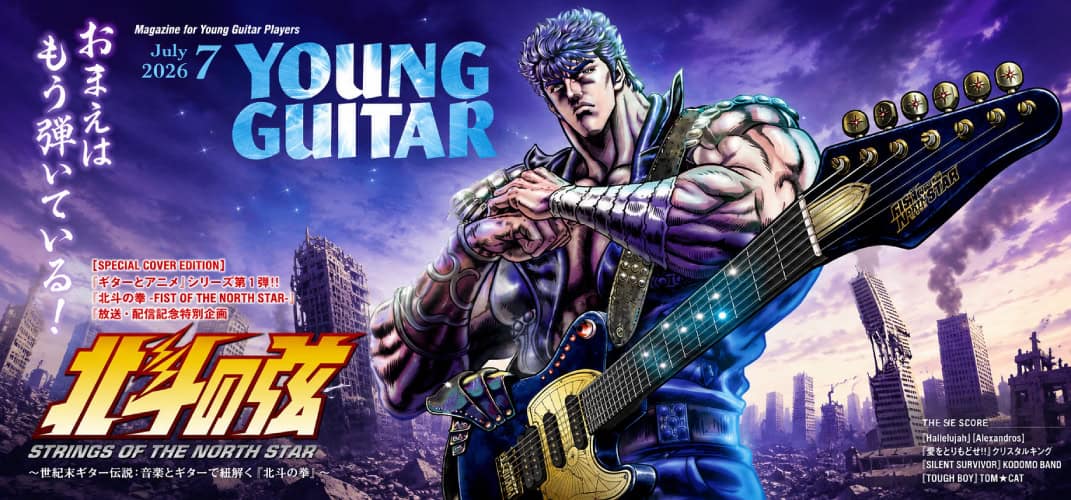
To launch its new editorial series “Guitar and Anime,” Young Guitar, the Japanese guitar magazine published by Shinko Music since 1969, chose Hokuto no Ken. The July 2026 issue (Vol. 934) opens with a special cover. Kenshiro, in an illustration based on the key visual of the new anime, crosses his arms over the neck of an electric guitar bearing the “Fist of the North Star” logo. A modified tagline, “Omae wa mō hiiteiru!,” meaning “You’re already playing,” sets the tone for the issue. This special feature, published to coincide with the broadcast of the new anime Hokuto no Ken -Fist of the North Star-, is called “Hokuto no Gen -Strings of the North Star-” (“The Strings of the Big Dipper”). It takes up nearly half the magazine, roughly a hundred pages, subtitled “The guitar legend of the end of the century, or rereading Hokuto no Ken through music and guitar.”
Let’s just say right away, the menu is hearty. The table of contents features five exclusive interviews with Toshl, composer Yuki Hayashi, producer Mikihiro Miyashita, as well as Monsieur Yoshizaki of Crystal King and Tsuyoshi Ujiki of Kodomo Band. There is also a fine tribute to TOM★CAT, a well-stocked discography guide, a roundtable bringing together musicians who are fans of the work, not to mention a completely over-the-top section that has fun reproducing the cries and sound effects of the anime on guitar. And to top it all off, four complete sheet music pieces spanning over forty years of opening themes.
We offer here a detailed analysis, chapter by chapter, following the order of the magazine, from the 2026 new adaptation all the way back to the legends of the 80s.
Preface
The opening page of the feature sets the scene: “In the year 199X, the world was engulfed in nuclear flames!!” Young Guitar reminds us that since 1983, the manga has sparked an unprecedented phenomenon, spanning anime, films, OVAs, video games, and pachinko and pachislot machines. In this end-of-century world dominated by violence and chaos, it is the way of life of these men carrying love and sorrow on their shoulders that made the work, the magazine writes, a cultural icon passed down across generations around the world. And within this universe, music has always been a pillar of the work’s identity, led by those “anthems” that are the opening themes, “Ai wo Torimodose!!” first and foremost.
The magazine then moves on to the franchise’s hottest news. Since April 2026, the new series Hokuto no Ken -Fist of the North Star- has been airing with “Hallelujah” by [Alexandros] as the opening and a cover of “Ai wo Torimodose!!” by Toshl as the ending, two powerful tracks that, the page promises, fire up listeners of the new generation as much as longtime fans. The editorial promise is clear: interview the artists behind the new anime as well as the legends of the classic series, gather never-before-heard testimonies about the birth of the “Hokuto sound,” and provide the sheet music so readers can go from theory to practice. It all concludes with a “Hokuto no Gen, omae wa mō hiiteiru!!,” a perfect encapsulation of the issue’s spirit, where musical expertise and love for the work are treated on equal footing.
Chapter 1: “Hallelujah,” the new anthem by [Alexandros]
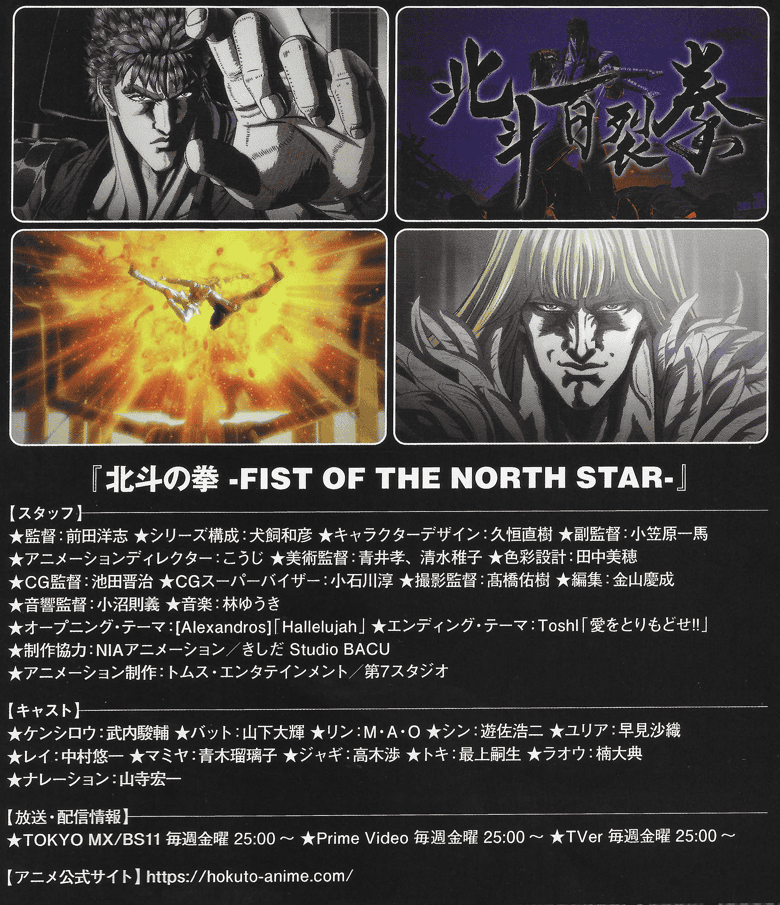
The feature opens with the new anime’s opening. “Hallelujah,” written and composed by Yohei Kawakami and arranged by the band (Polydor Records / RX RECORDS), was released digitally on April 6, 2026, four days before the first episode. Young Guitar doesn’t beat around the bush and calls it a new “hokuto shinkyoku,” literally a “divine song of the Hokuto,” the term the magazine uses throughout the issue to refer to the franchise’s anthems. The page also credits the full lineup: Yohei Kawakami (vocals, guitar), Masaki Shirai (guitar), Hiroyuki Isobe (bass, backing vocals), and Riad (drums).
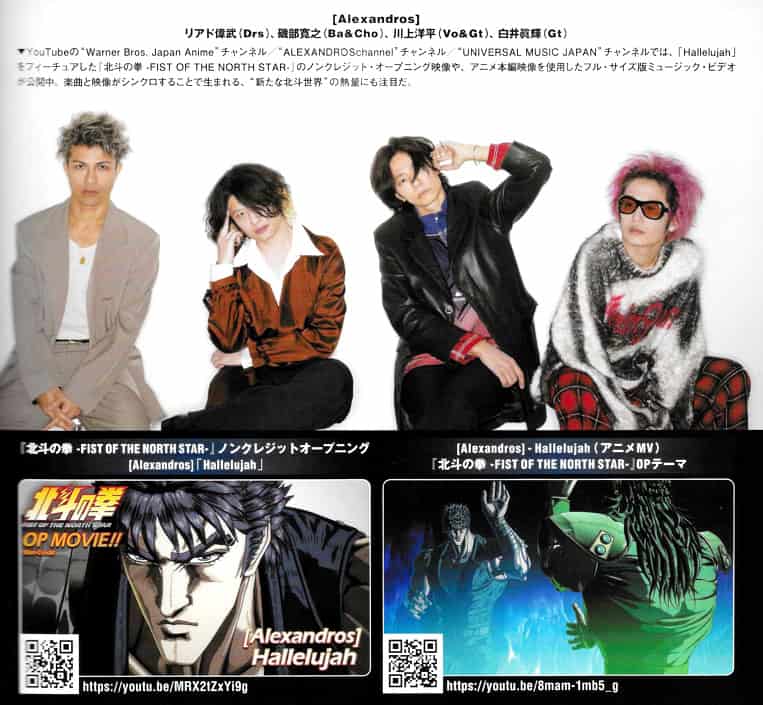
The magazine describes a track driven by a band running at full speed, whose lyrics blend English and Japanese to depict the loneliness and inner conflicts of a man living at the end of the century, but also his fierce determination to save those who cross his path. The guitar analysis highlights a layering of rhythm guitars, both electric and acoustic, edgy cutting, tense harmonics, and massive low-end phrases. The whole thing is compared, with the unflappable seriousness that characterizes this issue, to a barrage worthy of the Hokuto Hyakuretsu-ken that knocks the listener out cold. The page also reproduces the full lyrics and links to the official music videos and opening, which use footage from the anime. The magazine also invites readers to discover “the heat of a new Hokuto world” born from the synchronization of music and visuals. For guitarists, head to page 64 of the magazine, where the complete sheet music is published.
Chapter 2: Toshl, from childhood shock to the ending theme
The cover of “Ai wo Torimodose!!,” a matter of destiny
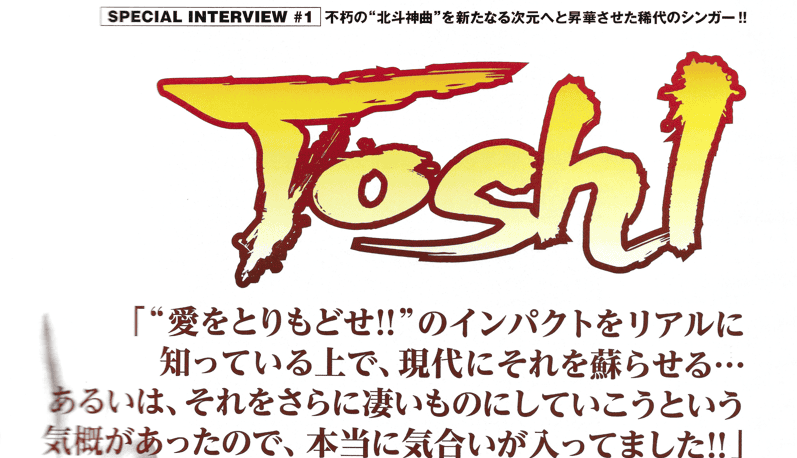
This is the first major piece of the issue, and a milestone for the magazine, as the X Japan vocalist had never appeared in Young Guitar before. The extensive interview revisits what was one of the pleasant surprises of spring 2026: the revelation, at the end of the first episode, that the ending of the new anime would be a cover of “Ai wo Torimodose!!” by Toshl. A cover endorsed by Monsieur Yoshizaki himself.
What we learn in the interview is that this collaboration was anything but a coincidence or a marketing stunt. Toshl has been an absolute fan of Crystal King since childhood. As a middle schooler, he was already covering “Daitokai” on piano, telling himself that this repertoire was made for him. In 2024, he had sung that same “Daitokai” as a duet with Kanji Ishimaru, taking Masayuki Tanaka’s part. This time, he performs both registers of the legendary duo on his own: Tanaka’s stratospheric highs and Monsieur Yoshizaki’s raspy timbre. When the offer was made, his reaction was immediate (“Finally!!”), and he told his record label that this song could only go to him.
The interview is packed with anecdotes. Toshl offers, for example, a fascinating reinterpretation of the famous “You wa Shock.” Listening to it again as an adult, he realized the phrase doesn’t say “you received a shock” but rather “you ARE the shock,” a nuance that, delivered right from the start in an ultra-high register, embodies the pure spirit of rock in his view. He also reveals that, as a child, he constantly imitated Kenshiro’s “Atatatata!” (voiced at the time by Akira Kamiya), and theorizes quite seriously that these imitations, combined with those of Bruce Lee, constituted his first vocal training. Rapid-firing ultra-high “atatatata” sounds amounted, without knowing it, to working his mid-range voice, eventually giving birth to the overpowering falsetto that became his signature, while the “Omae wa mō shindeiru,” delivered in a deep, full-chested resonance, forged the depth of his voice. In other words, Kenshiro alone encompasses both registers of Crystal King, and the interviewer playfully suggested that Toshl should audition for voice acting roles.
This theory makes perfect sense when Toshl talks about his childhood. Back then, admitting you liked anime was frowned upon; you had to say “the manga.” He would come home from elementary school around 5 PM to devour reruns: Lupin III, Uchū Senkan Yamato (his favorite anime, whose opening theme by Isao Sasaki he found incredible), Kyojin no Hoshi, and even Tōei’s magical girl series like Sally la petite sorcière or Akko-chan, whose theme songs he sang every one of. It’s precisely this background that explains his almost religious relationship with anison (a contraction of anime song, the repertoire of anime openings, endings, and insert songs), which he describes as the hardest genre to sing, the one where each person’s purest childhood memories lie dormant, and which must be approached with total respect.
Regarding the work itself, Toshl describes an extremely meticulous approach. “Biting,” almost aggressive verses to match the arrangement’s surge in tempo, a chorus conceived like a drone shot rising above Kenshiro, and a final shout where everything is unleashed. He also recounts having cried while watching the first episode upon hearing his own voice rise over the opening theme. The editor-in-chief of Young Guitar slips in a confidence along the way. When asked a few days earlier, Mr. Yoshizaki had judged this cover with a “That was the best!” delivered without hesitation, praising a version of “You wa Shock” superior to all past covers and an original key that seems tailor-made for Toshl.
“IM A SINGER VOL.4” and the Kanazawa Festival

The interview then spills over into the singer’s current activities, particularly the cover album IM A SINGER VOL.4, released on July 1, 2026 through Universal. The fourth volume in the series, this time the album is entirely dedicated to anison, a territory Toshl had previously described as “a forbidden zone,” given his immense respect for the repertoire. The album notably includes “Ai wo Torimodose!!,” as well as a cover of “Guren no Yumiya,” featuring HISASHI from GLAY on guitar. The choice of guitarist came about in a manner straight out of a manga: Toshl passed along the message that “the only cool guitarist who loves anime and can play this is HISASHI,” and the latter replied: “The only one who can play this is me.” The album also includes “Moonlight Densetsu” and “Tamashii no Refrain,” along with two original tracks, “Unmei no Senkō” and its answer song “Kirameki wa Kaze,” born from a year spent meditating on gratitude and on the fortune of simply being able to live, eat, and make music.
To choose the cover songs, Toshl describes a rather unconventional method: he watched anime on the stationary bike at his gym. On several occasions, he ended up pedaling for a full hour without realizing it, completely absorbed by the episodes. A rather unexpected way to put together the repertoire for an anison album.
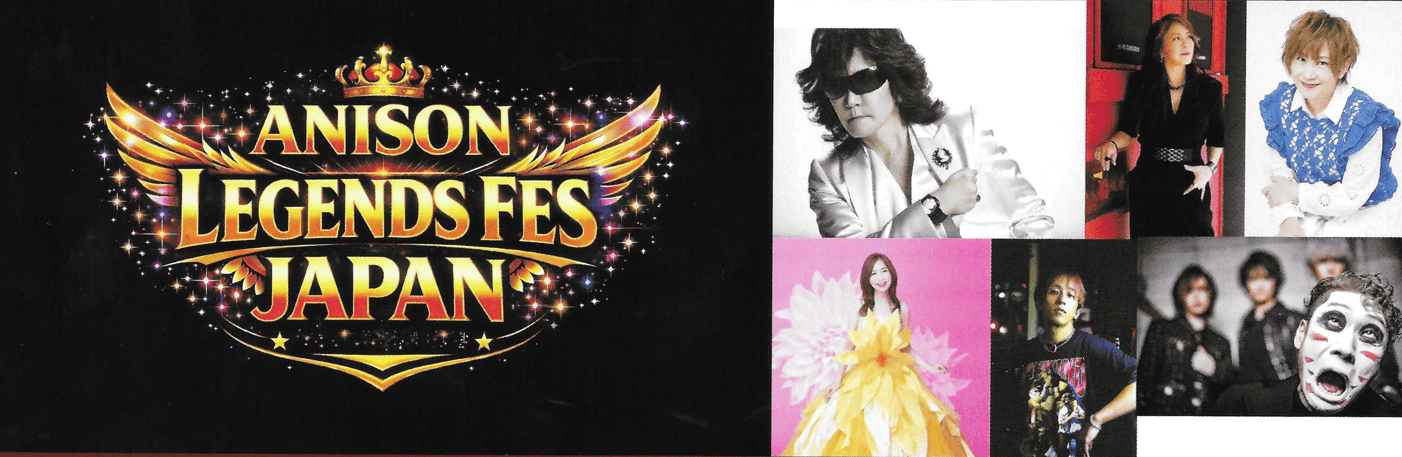
On July 4, 2026, Toshl produces his own festival, the “ANISON LEGENDS FES JAPAN,” at the Concert Hall of the Ongakudō of Ishikawa in Kanazawa, his creative home base, where his studio and painting workshop are located. The idea had been germinating since his participation, about eight years ago, in Akiko Wada’s anniversary festival at the Budokan, where he had been deeply moved watching from backstage as dozens of artists and technicians built something together in an outpouring of love and gratitude. On the program: the Orchestra Ensemble Kanazawa as the opening act, a rock segment afterward, an outdoor cosplay walk with, as a backdrop, support for the reconstruction of Noto. The announced lineup brings together Maki Ohguro, Rica Matsumoto, Hiroko Moriguchi, KENJI03 (BACK-ON), and Golden Bomber, under the production of Ryūgen Toshi (Toshl’s full artist name), who promises unique collaborations with each of the guests.
Chapter 3: Yuki Hayashi, Setting the End of the Century to Music
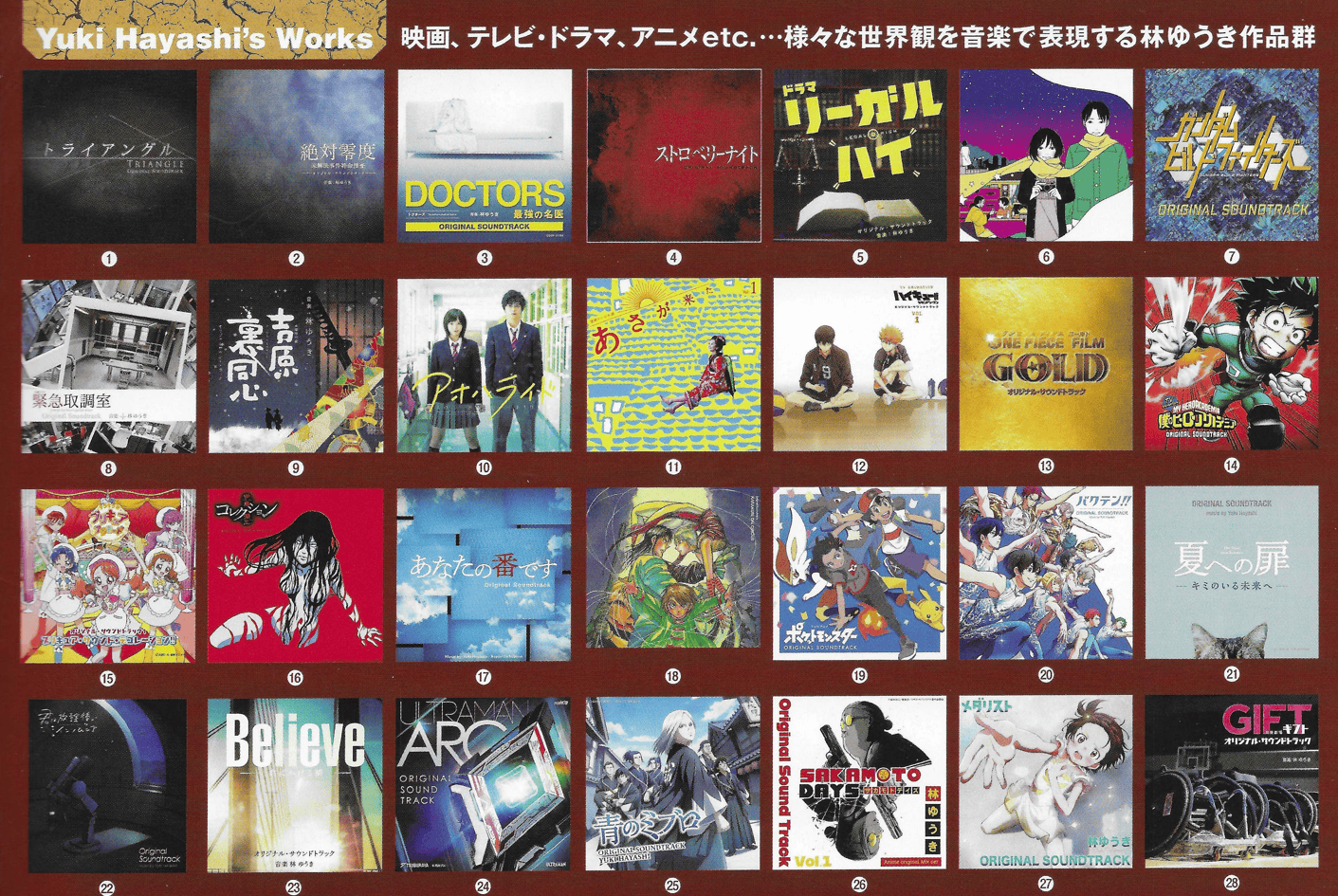
The second interview gives the floor to the composer of the new anime’s original soundtrack. Young Guitar takes the opportunity to trace a genealogy that meticulous fans will appreciate. The music for the 1984-1988 TV series was composed by Nozomi Aoki (Galaxy Express 999), the 1986 film was entrusted to arranger Katsuhisa Hattori, the “Shin Hokuto no Ken” OVAs (2003-2004) to Yasuharu Takanashi (Naruto Shippūden) accompanied by the wa-rock group Yaiba, and the “Shin Kyūseishu Densetsu” pentalogy (2006-2008) to Yuki Kajiura (Demon Slayer). In 2026, it is Yuki Hayashi, known for My Hero Academia, Haikyū!!, and the dramas Legal High and Asa ga Kita, who inherits the role.
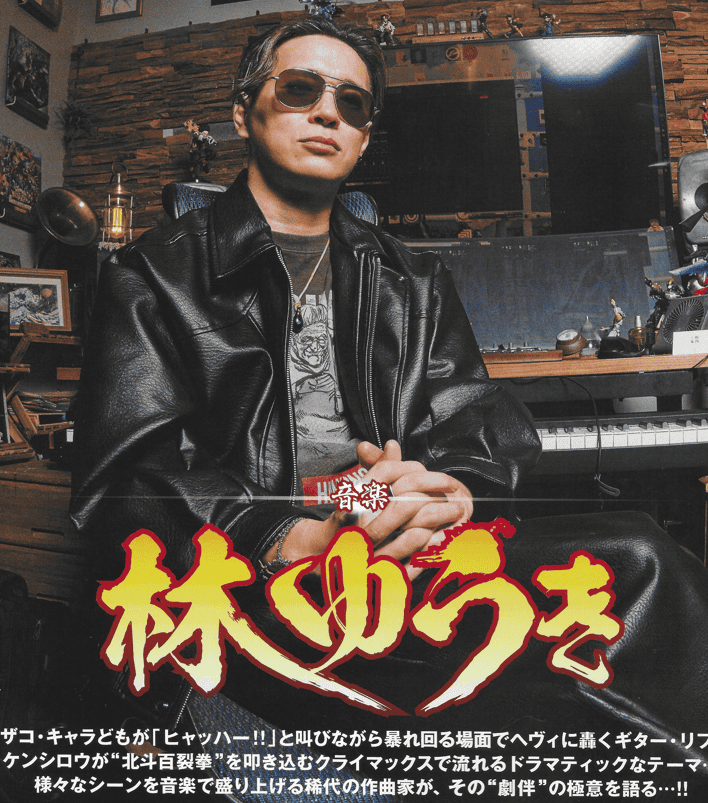
Amusingly, Hayashi confesses right away that he is not a rock connoisseur. He knows songs, but not “whose song is this” like a true fan of the genre, and he turns this gap into an asset. No complex, no paralyzing reverence, just the question that guided all his work and gives the interview its title: how do you translate into sound that feeling of the end of the century, that dystopian atmosphere that blankets the world of the work?
His answer is a true festival of orchestration ideas, which the magazine’s guitarists took care to analyze. Seven- and eight-string guitars with rough low tones to accompany massive bosses, twelve-string guitar doubled with acoustic or classical guitars and mandolin to bring a folk color to village and daily life scenes, dobro to evoke the earth, deliberately lo-fi tones on overdriven electric guitars, dystopian synthesizers and ethnic instruments: Hayashi multiplies textures to give each situation its own sonic identity. He even allows himself a touch of fantasy, since Hokuto Shinken is, after all, a legendary assassination art 1,800 years old.
He also details his working method. The main theme, over six minutes long, is divided into clearly identified sections to make it easier to select musical passages. On top of that, there is an “ambiance menu” established scene by scene by sound director Noriyoshi Onuma, from which Hayashi composes. A sidebar also lists the standout tracks from the first episode, from the “zako theme” in a Hyahha style, with its heavy riffs, growls, and unsettling vibrato bar effects, to the main theme performed on cello, which erupts at the moment of the Hokuto Hyakuretsu-ken against Zeed. The magazine notes, however, that these names correspond to the labels in the musical menu and not to the official track titles.
Hayashi is also the arranger of the ending sung by Toshl, a role whose weight he fully appreciated (“me, arrange THAT!?”) even before knowing who would be singing. He recounts the first video meeting with a disarmingly humble Toshl, then the in-person encounter where he says he felt “an aura, a fighting spirit worthy of Raoh.” His arrangement speeds up the tempo, adds massive orchestration, and exists in two versions: one with a long intro designed to flow from the final scene of the episode, the other launching straight into the vocals. Hayashi slips in an anecdote about the recording session along the way. Toshl recorded the ending practically in one go, in a single take barely interrupted by a break, and his rare retakes were not corrections of mistakes but desires to re-sing certain passages differently. Hayashi, for his part, listened while simply thinking “this is insane.” On the studio side, guitars are handled by his longtime collaborators Tetsuro Tōyama and Yuta Watanabe, joined by Masaomi Shiroishi. The intro of the ending, with its strikingly sharp sound, reportedly bears the mark of Watanabe, who supposedly played it “in a Hyahha! spirit” according to Hayashi, the whole thing approved in the studio with a simple exchange of “is that it?”, “that’s awesome!” Hayashi recounts, laughing, the joy of the fifty-something musicians upon discovering they were going to record “Ai wo Torimodose!!”, the trumpeter blowing like never before. A detail that adds all the charm to the interview: Hayashi himself can barely strum three chords on a guitar. His parting words to readers, on the other hand, are perfect. “Omae wa mō kiiteiru…!!”, meaning “you are already listening.”
Chapter 4: Mikihiro Miyashita, the metalhead producer watching over Ken
Third interview, and undoubtedly the richest in information for fans of the franchise: Mikihiro Miyashita, producer of the new anime at COAMIX, a veteran of Hokuto projects. He also works on the animated spin-off Hokuto no Ken, Ken-ō-gun Zako-tachi no Banka, whose second part premiered on July 6, 2026.
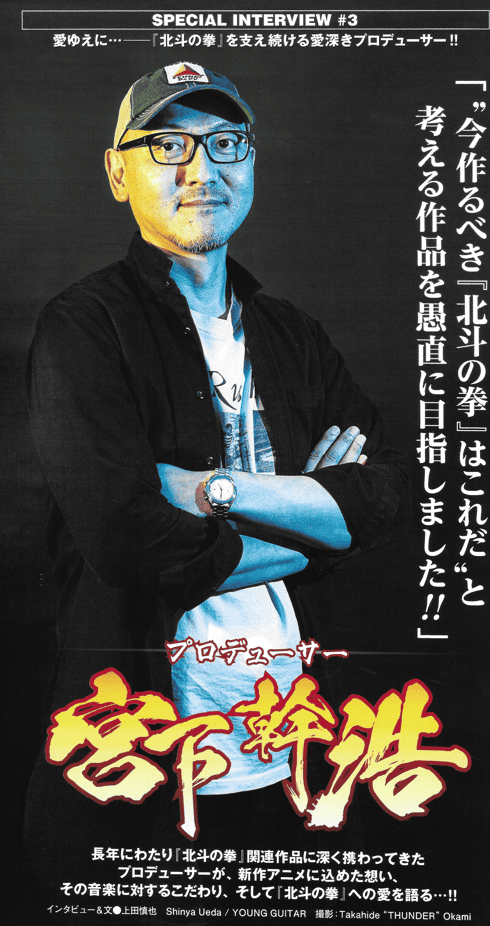
Miyashita traces the genesis of the project. The announcement of the new anime took place on September 13, 2023, “Hokuto no Ken Day” and the 40th anniversary of the manga, after a teaser launched as early as the 35th anniversary with the song “202X” written by Tomoyasu Hotei, which hinted that “something would happen in 202X.” The stated ambition is to attract a younger audience. He notes, somewhat bitterly, that today’s 20 to 30-year-olds often only know Hokuto no Ken through pachinko machines. They can say “Hidebu!!” or “Abeshi!!” without knowing which scenes those cries come from. Hence the guiding principle of this “Reiwa-era Hokuto renaissance”: maximum fidelity to the gekiga style of the original manga, running completely counter to the aesthetic standards of current animation, driven by a mindset summed up in one phrase. The previous films and OVAs “could have gone further,” so this time, the entire team works with the conviction that they can still do better.
On the music, the interview confirms that the choice of [Alexandros] has much to do with Yohei Kawakami’s vocals, built for high notes worthy of “Ai wo Torimodose!!” Miyashita adds an interesting detail: “Alexandros” originally means, in Greek, “he who protects the people.” Hard to dream of a better etymology for the opening of a story about a savior. Another revelation: the opening sequence was built around the music. The demo of “Hallelujah” was given to the director, who storyboarded over it, resulting in that perfect synchronization, notably the shot where Yuria turns in jolts, synced to the guitar’s cutting. As for the ending, the decision to “keep” “Ai wo Torimodose!!” for the close dates back to pre-production, with an openly stated goal: to catch fans of the original series off guard. And Miyashita adds, mischievously, that in the streaming era where everyone skips the ending credits, “that, we won’t allow you to do!”
The man also turns out to be a dyed-in-the-wool metalhead. A fan of Megadeth and Rush, an ally of sound director Onuma (also a metalhead) with whom he fought to have the guitar prominently featured in key scenes, while refraining from imposing his prog leanings, which didn’t fit the universe. Asked which song he would choose for the credits if a Hokuto movie came out and he had full rights, he answers without hesitation Megadeth, “Hangar 18” or “Peace Sells,” keeping Judas Priest and their “Painkiller” in reserve. We also learn that he worked for a long time as a student in a rock t-shirt shop in Nagoya, that as a teenager he approached Duff McKagan of Guns N’ Roses in an arcade for an autograph, and that he “stomped his feet in frustration” in his movie theater upon hearing “Sweet Child O’ Mine” in the Gundam Hathaway film.
But the most moving passage concerns the casting, about which Miyashita specifies that all the main roles were assigned through auditions, over multiple rounds of selection among a very large number of candidates. The new Kenshiro is voiced by Shunsuke Takeuchi, whom Miyashita had encountered… as a high schooler, during a recording session for a Sōten no Ken pachinko machine, where he had asked him to deliver an “atatatata” (the bewildered teenager’s response: “E-Excuse me!?”). Years later, Takeuchi won the audition, ultimately approved by Tetsuo Hara himself. Miyashita describes a young man barely over twenty, crushed by pressure among veterans, rejecting his own takes (“that’s not IT, the atatatata!”) and practicing rapid-fire “atatatata!” even in the restroom during breaks. And above all, this scene. Akira Kamiya, the original Kenshiro, kept informed of the audition, met his successor and simply told him “give it everything.” Miyashita calls it “the isshi sōden moment of the voice acting world,” the transmission from master to sole heir, just like that of Hokuto Shinken. Hard to find a more beautiful image.
The article closes with a sidebar presenting the manga, the “golden pyramid of action manga” boasting over 100 million cumulative copies, and a complete technical sheet for the new anime, a treasure trove for fans.
Chapter 5: Mr. Yoshizaki, forty years of “You wa Shock”
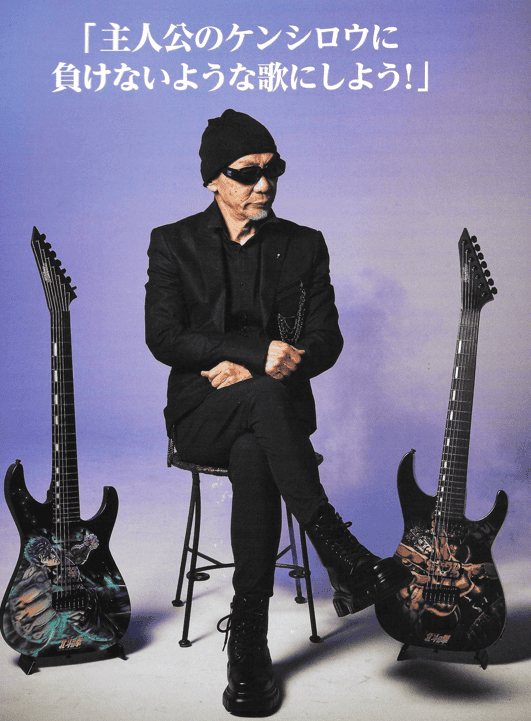
Let’s move on to the legends, and what an introduction. Mr. Yoshizaki, founder of Crystal King, 78 years old, opens the interview with a confession that says everything about the unusual nature of this issue. In 55 years of career, this is the first time a specialized music magazine has interviewed him. Back in the days of “Daitokai,” he was invited to celebrity magazines like Myōjō or Heibon and to manga magazines for young girls like Shōjo Friend. “But I don’t play guitar… will that be okay?” he jokes. The opening page of his interview is worth a look on its own, with two custom guitars featuring Hokuto no Ken artwork displayed in all their glory, a Kenshiro model and a Raoh model. The cover illustration is by Hitoshi Nishimura (nishimura graphics).
The story behind the birth of “Ai wo Torimodose!!” is a piece of history. In 1984, after the success of volume 1 of the manga and the launch of the anime project, the request came through Canyon Records. The group was taken aback. At the time, anime songs were a genre apart, written by professionals and sung by “anison singers,” so why them, a band that composes and performs its own songs? But Crystal King had been forged in the clubs of Sasebo, near the American naval base, delighting GIs with covers of Led Zeppelin and Deep Purple. “If it makes people happy, I’ll sing anything.” The entire band then immersed themselves in the manga volumes and the storyboards of the anime in production that had been given to them, and the verdict was clear. Beneath the violence, there was love, friendship, humanism. Deal!
What follows is a fascinating dive into the making of the song. The lyrics came first, written by pianist Kimiharu Nakamura, who showed up with this incredible text opening with “You wa Shock.” Yoshizaki himself draws a parallel between this mix of English and Japanese and the style of Carol, Eikichi Yazawa’s band, a sense of linguistic “chanpon” that hits hard with simple words. Guitarist Michio Yamashita, reached by phone for the occasion, recounts that the image leaped out at him upon reading the first verse and that the music was written almost instantly. Yoshizaki himself reveals that he tightened the phrasing of the verse on his own initiative, finding the initial arrangement too drawn out, a micro-change that gave the whole song more density. He embraces the band’s “impact first” DNA. “Daitokai” had been composed out of revenge, after a maddening defeat at the Yamaha Popcon contest in 1978, with the idea of placing Tanaka’s ultra-high note right at the intro to knock out the listener from the very first listen. “Ai wo Torimodose!!” applies the same formula, with a shared directive with Tanaka: make a song that doesn’t lose to Kenshiro. A notable anecdote: the show’s producer found the singing “a bit too intense.” Yoshizaki held firm, while conceding today with a burst of laughter that listening back, “we might overdo it a little.” Another surprise: the published mix wasn’t the one the band knew. The brass they had placed in the foreground had been pushed behind the vocals. Fury at the time, gratitude today, because it’s that “everything for the vocals” mix that made the song immortal.
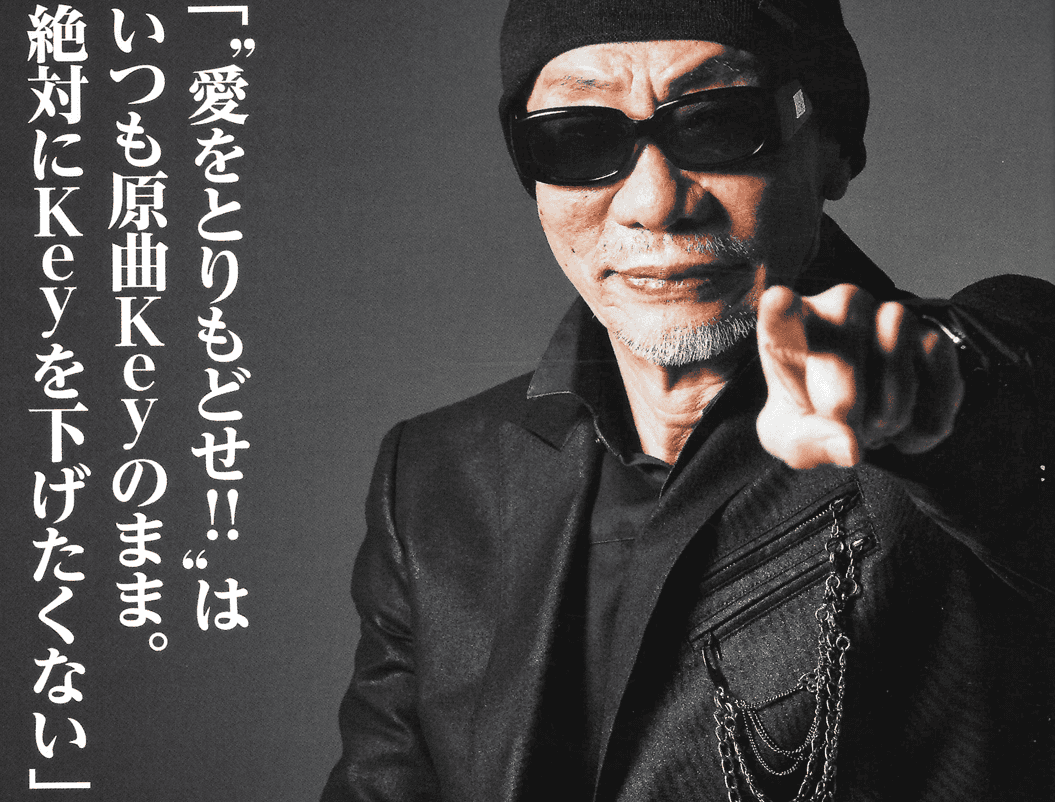
The interview also covers “Yuria… Eien ni,” a ballad composed on synth by Hiromi Imakyūrei, a daunting piece for singers (pushing the limits of both Tanaka’s and Yoshizaki’s ranges), with prog accents that Young Guitar compares to Asia or Kansas. We learn that Yamashita recorded both tracks on his blue Yamaha SG, the Masayoshi Takanaka model. Then comes the song’s incredible second life. The 2003 Sammy pachislot (over 600,000 machines sold, a record for the time according to the magazine) relaunched the song, followed by the 2004 re-recordings, the first recordings where Yoshizaki sings the entire song alone, always in the original key, a non-negotiable point (“changing the key means changing the nuance of the singing”), then a phone ringtone ranked 5th in the annual all-categories chart, and finally the 2006 “MOVIE ver.” for the film Raoh Den, Junai no Shō, which he considers the definitive form of the song. Strings in the intro, brass brought up, in other words the song as the band had dreamed it in 1984, with guitarist Yoshio Nomura as a special guest. Worth noting: a revelation that will raise some eyebrows. The pentalogy films were initially NOT supposed to contain “Ai wo Torimodose!!” It was the young staff members who protested (“without it, it’s not Hokuto no Ken!”) and imposed the song after heated debates.
What follows is an overview of covers, from the single “NO REGRETS / Ai wo Torimodose!! (King & Queen Version)” with SHOW-YA in 2017 to THE ALFEE’s version on the 35th anniversary album in 2019, not to mention a full page listing remixes and covers from around the world, which we will revisit in the discography chapter. And of course, the word on Toshl, already mentioned above, which amounts to an endorsement. Yoshizaki measures the journey his song has taken by describing his concerts today, where three generations sometimes come together: grandchildren, parents, and grandparents united to shout “You wa Shock” in one voice. The journalist also lingers on that singular ultra-high note, laden with slightly overdriven harmonics that give it all its charm, and Yoshizaki responds with a theory worth noting. According to him, singers with naturally deep voices can conquer the high range through hard work, the proof being himself, a devotee of falsetto since his amateur years.
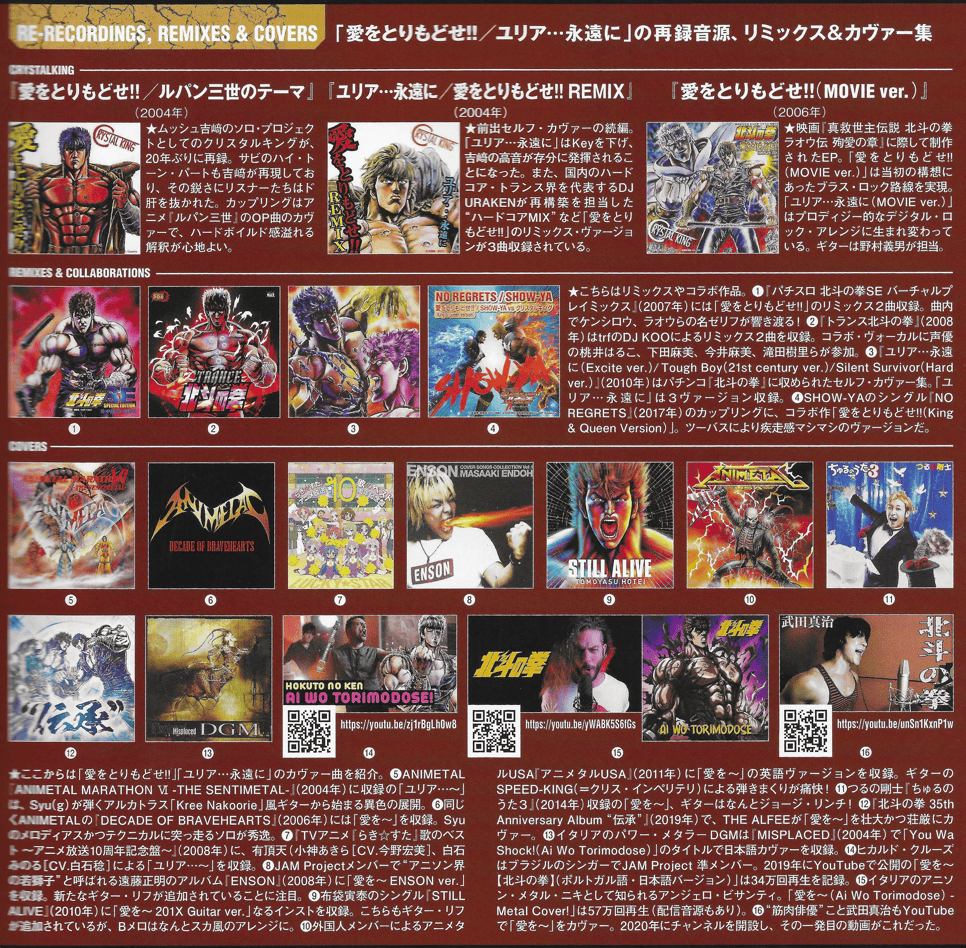
The interview concludes with a Yoshizaki at the top of his game. Still two concerts a month since 1987 at the Friday live house in Yokohama, a company founded on May 16, 1986 that is just celebrating its 40th anniversary, an amused lucidity about his age (“I’m an advanced senior of 78 years old, you know”), a parallel with the Rolling Stones, whose album “FOREIGN TONGUES” came out on July 10, and this conclusion that sums up the man. If an offer came from abroad, he would go anywhere. “It would be fun to shout ‘You wa Shock’ on the other side of the ocean.” Young Guitar slips in that the song has fans even in the highest Italian circles, with President of the Council Giorgia Meloni being cited as a big fan of the series.
Chapter 6: Tsuyoshi Ujiki, the Discreet Successor of the Anthem
Fifth interview, and undoubtedly the richest in revelations for anyone interested in behind-the-scenes stories. Tsuyoshi Ujiki, singer-guitarist of Kodomo Band, who will celebrate his 70th birthday next year, is presented as the “second-generation successor” of the Hokuto no Ken anthem. His band contributed four songs to the franchise: “HEART OF MADNESS” and “PURPLE EYES” for the March 1986 film, then “SILENT SURVIVOR” and “DRY YOUR TEARS” for the fourth part of the TV series (episodes 83 to 109), the one featuring the final confrontation between Kenshiro and Raoh.
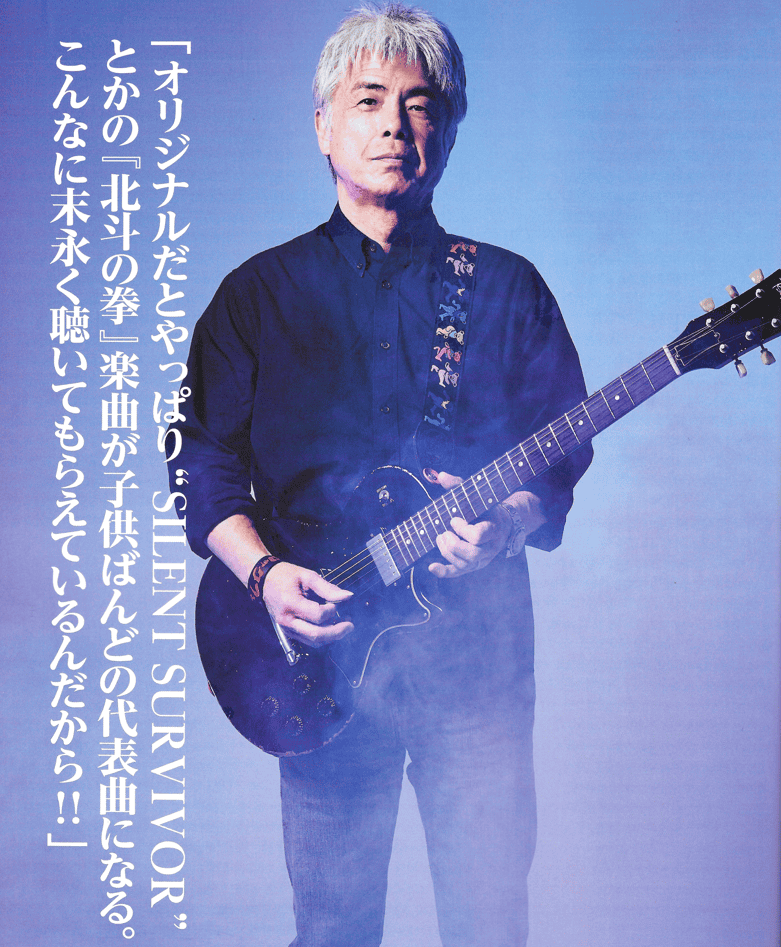
The interview first retraces the group’s eventful journey: beginnings at Canyon, a move to Epic Sony marked by an American venture that never took off, then an independent period of self-production, selling records by hand at concert venues, before a return to Canyon in 1986. It was in this context that the Hokuto no Ken offer came along, transmitted via Fujipacific, as the distributor wanted an artist different from Crystal King, who was already attached to the TV series, for the film. Ujiki himself knew nothing about the franchise, even though he had a reputation as a voracious manga reader. He read everything in one go and recounts his surprise at the power of the artwork and the twists in the story, at a time when Raoh was still portrayed as a pure antagonist. The decisive turning point was a visit from the legendary Tōei Dōga producer, Yoshio Takami (credited as producer of the 1986 film), who came in person to plead his case with memorable passion. This is not a TV episode, this is cinema, a real theatrical release, and it needs songs that measure up. Faced with such enthusiasm, complete with screenings of the film narrated aloud at full volume (“here, what Kenshiro feels…”), it was impossible to refuse. The producer was so thrilled with the result that he asked the group to continue with the TV series.
The interview sheds light on a little-known aspect. These songs were essentially a solo effort by Ujiki, with a drum machine, in the very early days of programming, and a philosophy he sums up in a single phrase highlighted by the magazine. These tracks were created by asking “what they needed to be in relation to the work,” not for the stage or to flatter the group’s fans. The paradoxical result: Kodomo Band fans gave the tracks a cool reception (“you’re going pop?”), the group rarely played them live… and when Ujiki recently brought them back on stage, the audience went wild. Hence the headline of his profile, stated with understated satisfaction: “Since people are still listening to them so long after, it is indeed ‘SILENT SURVIVOR’ and the Hokuto songs, original tracks, that have become the signature titles of Kodomo Band.”
A sidebar details the four songs with elegant writing. The guitar “that sobs” in “HEART OF MADNESS,” the whispered ballad “PURPLE EYES” that mirrors the feelings of Kenshiro and Yuria, the harmonics intro of “SILENT SURVIVOR” with its hammered “DO SURVIVE” chorus and its compact solo blending wah and vibrato, and the classically-tinged solo by Hiroshi Sugihara that gives “DRY YOUR TEARS” all its charm. The lineup is the four members from that era: Tsuyoshi Ujiki, Hiroshi Sugihara, Seiji Katsu, and Yū Yamato. On the heels of these singles, the group would go on to record the album “NO GIMMICK” in New York, captured mostly in live takes.
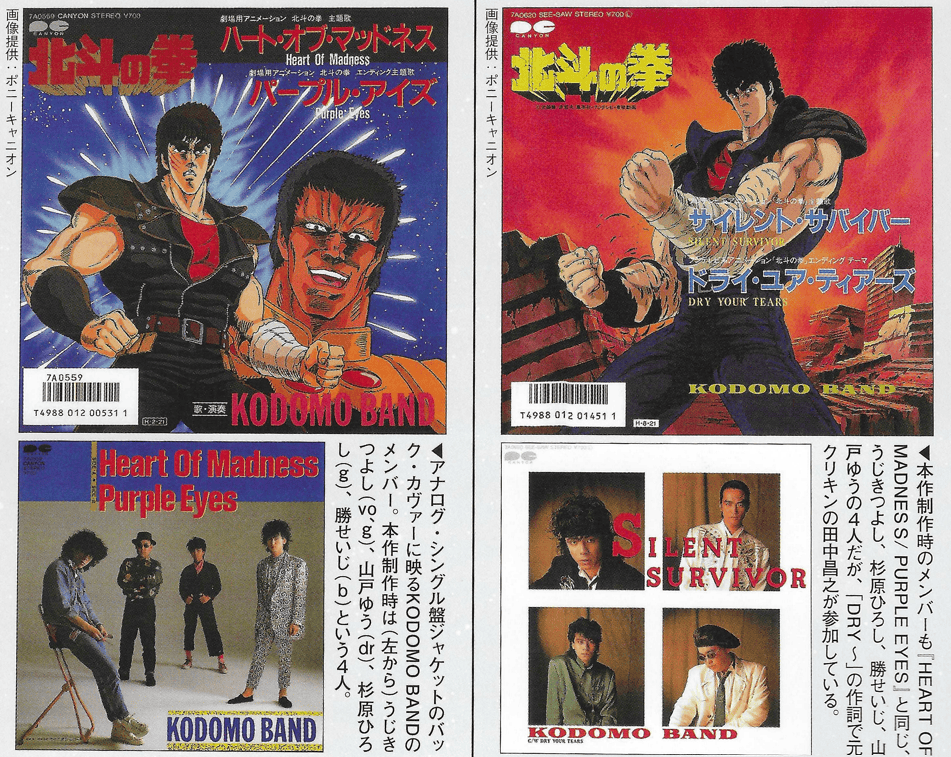
Two more gems. The first: Masayuki Tanaka, Crystal King’s powerhouse vocalist, co-wrote the lyrics to “DRY YOUR TEARS,” an unexpected bridge between the two generations of anthems. The second: the guitar on “TOUGH BOY” is played by Ujiki himself. He handled the sound production on the TOM★CAT single, and the magazine suggests that the hard rock direction of the track likely owes a great deal to his intentions.
Chapter 7: TOM★CAT and “Tough Boy,” the Anthem of 199X
No interview for TOM★CAT, but a two-page feature that does justice to the opening theme of Hokuto no Ken 2 (broadcast from March 1987 to February 1988). The magazine traces the group’s career, from winning the grand prize at Yamaha’s 28th Popcon contest with “Furare Kibun de Rock’n’Roll” and their 1984 debut, up to this sixth single, “TOUGH BOY / LOVE SONG,” released on March 21, 1987, whose A-side remains one of the most beloved “hokuto shinkyoku.”
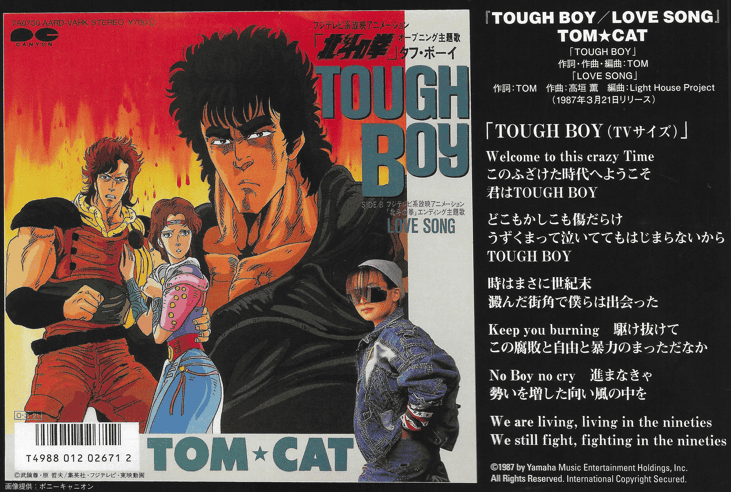
The analysis lingers on the hard rock riff that hits right after the text “Seikimatsu Kyūseishu Densetsu” appears against a black background, while Kenshiro walks toward a surreal setting sun, an opening etched into the collective memory. Young Guitar awards it a superlative of its own: the most hard rock guitar in the entire Hokuto repertoire, a guitar played, as we have seen, by Tsuyoshi Ujiki. Two treasures await purists. First, the gorgeous lead guitar of the track exists only on the full version; the 90-second TV edit lacks it entirely. Second, the lyrics differ between the two versions, with the original’s “We are living, living in the eighties” becoming “nineties” on television. As for “LOVE SONG,” the ending theme, it plays the perfect counterpoint: clean arpeggios, TOM’s tender vocals, a guitar “that weeps,” culminating in the final shot of the credits where the sun rises over the devastated lands before a close-up on the smile of Rin, a marriage of imagery and melody that offered hope and emotion to viewers. Both tracks have since seen several self-covers and reissues, up to a vinyl picture disc in 2023.
Chapter 8: The Hokuto Record Collection
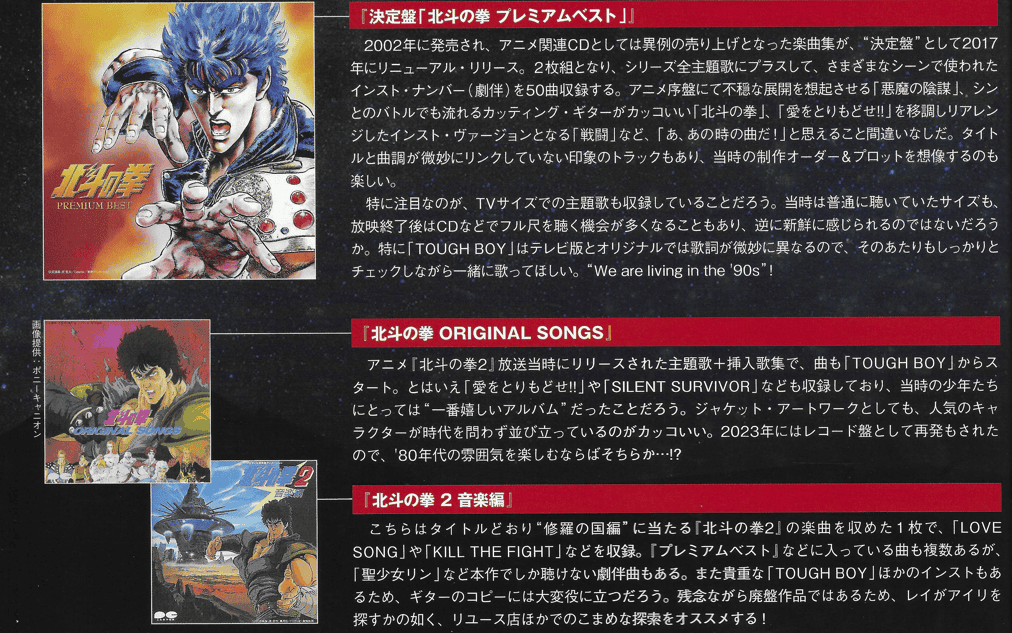
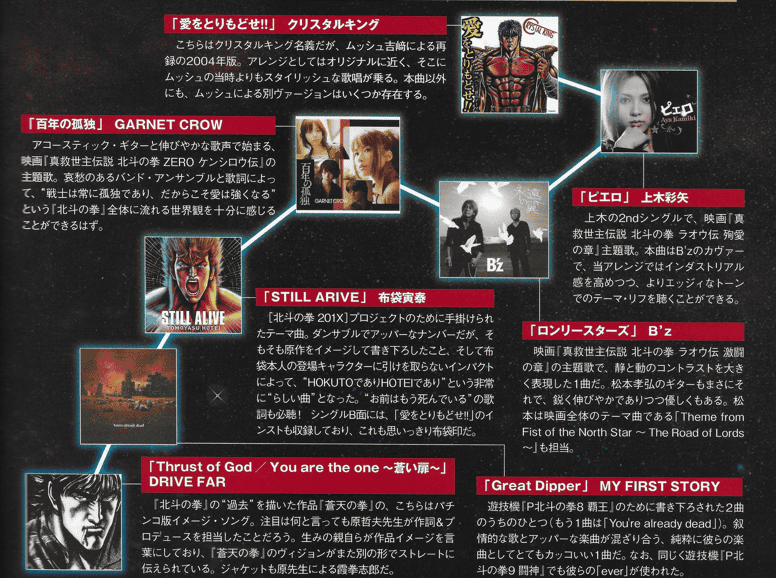
Subtitled with a magnificent “Not a single bad track in my music,” a twist on Raoh’s “not a single regret in my life,” the “Hokuto’s Music Selected Guide” spans four decades of records, from original-era albums to anniversary compilations. Featured are the essentials: the “Premium Best” and its 50 tracks including the precious TV versions of the theme songs, the “ORIGINAL SONGS” reissued on vinyl in 2023, and the “Hokuto no Ken 2 Ongaku-hen,” long out of print, which the magazine advises hunting down in secondhand shops “with the determination of Rei searching for Airi.” The singles roundup has its share of surprises, from “Thrust of God” by DRIVE FAR, for which Tetsuo Hara personally wrote the lyrics and supervised the project, right down to the jacket drawn by his own hand, to “Lonely Stars” by B’z, to “STILL ALIVE” by Hotei with its “omae wa mō shindeiru” slipped into the lyrics.
The guide also ventures into the realm of games and machines, where an absolute gem lies hidden: “Kiba,” a duet recorded for the CR Sōten no Ken pachinko OST featuring Marty Friedman (ex-Megadeth) on guitar and Andrew W.K. on vocals. The 35th anniversary tribute album, “Densho” (2019), rounds out the picture with covers by THE ALFEE, MIYAVI, BiSH, and SILENT SIREN, plus Hotei’s “202X,” built on Raoh’s final cry, with a music video where Raoh himself plays the drums. A final page lists international covers of “Ai wo Torimodose!!,” from Animetal USA with Chris Impellitteri to Italy’s DGM to the Luso-Japanese version by Brazilian artist Ricardo Cruz. The point is made: the anthem belongs to the world’s cultural heritage.
Chapter 9: Hokuto no Utage, the Fans Take the Stage
A change of scenery for the “Special Talk Session,” published under the title “Hokuto no Utage 2nd Round.” On February 9, 2026, at the Silver Elephant in Kichijōji (Tokyo), eight professional musicians dressed as Hokuto no Ken characters gave a concert entirely devoted to the openings AND background music from the 80s TV series, a project launched even before the new anime was announced (“destiny,” smiled its instigator). Leading the troupe, ISAO, a virtuoso of the 8-string guitar, self-proclaimed “64th successor of Hokuto Shingen,” costumed as Kenshiro. Around him, Danchō, the vocalist of the visual kei metal band NoGoD, Saori Hoshino on violin as Yuria, Jun Hasegawa from the prog band GERARD on bass, who was also one of the musicians accompanying Toshl’s early solo career (full circle), TAKA on drums as a soldier of Ken-Ō’s guard, and three keyboardists and trumpeters rounding out the lineup as Souther, Hyō, and Rin.
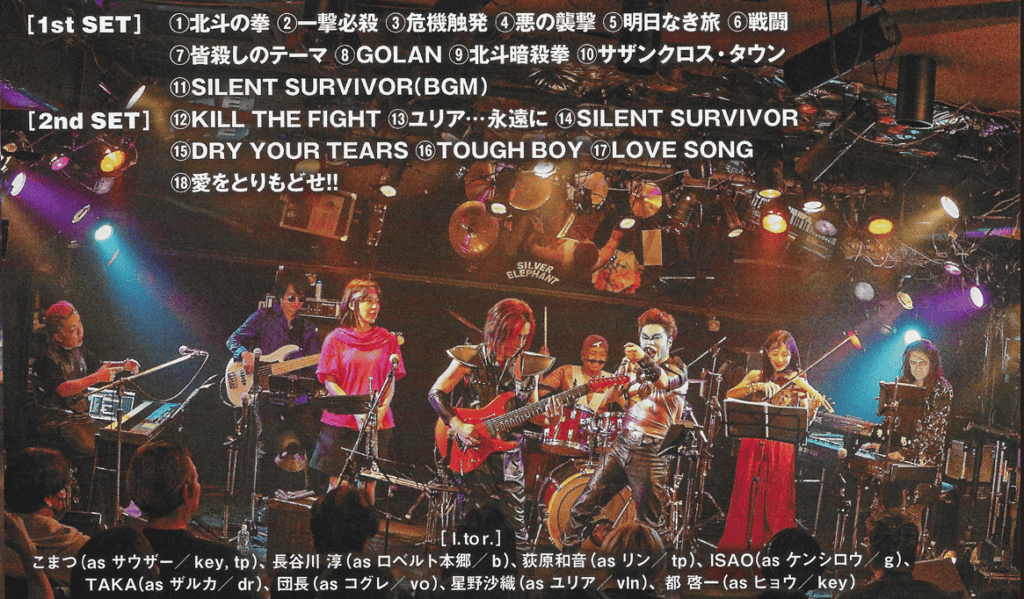
The concert was divided into two sets, the first dedicated to the BGM of the series, the second to the songs, culminating in a final “Ai wo Torimodose!!” sung by the entire venue, with projections of the original opening sequences in the background. The roundtable is packed with details: a single five-hour rehearsal from scores entirely transcribed by ISAO, trumpets played live because the BGM of the era used real ones too, and a tacit ban on any improvisation, summed up by keyboardist Keiichi Miyako, “everyone’s love for Hokuto no Ken was too strong to allow ad-libs.” And this confession from ISAO that captures the spirit of the project: what makes him cry in Hokuto no Ken isn’t the opening themes, it’s the insert songs and the BGM. Hence this concert, for which a second edition is already being considered.
Chapter 10: “Abeshi!!” on Guitar
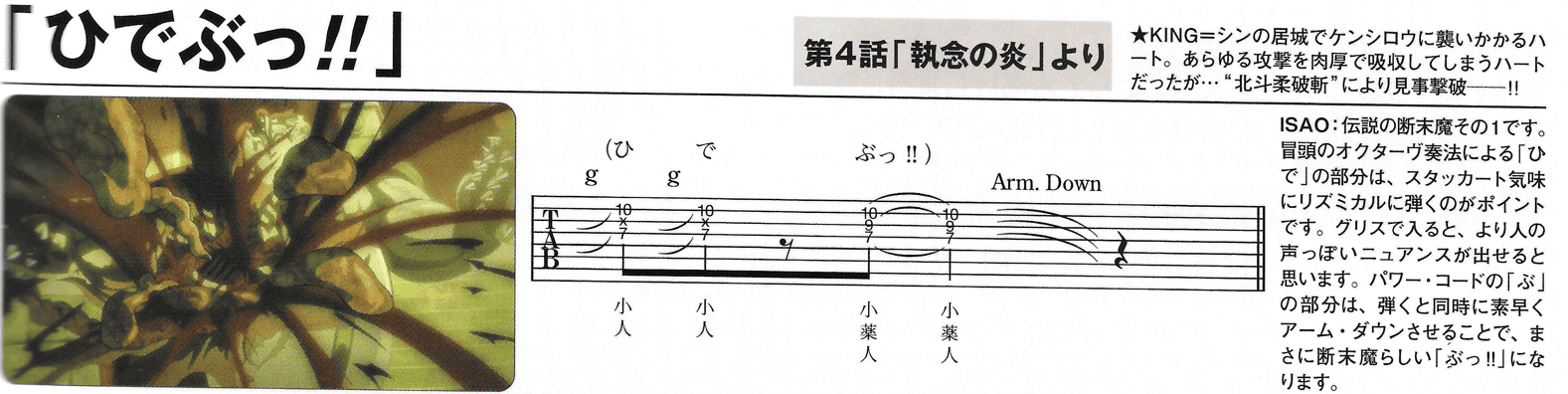
We shift into unabashed zaniness, and this is perhaps the most “Young Guitar” section of the entire issue. Over four pages, ISAO takes on a challenge no one had imagined: reproducing with an electric guitar, complete with tablature, the voices and sound effects from the new anime. Nearly all the examples come from the first episode, “Kokoro no Sakebi” (“A Cry from the Heart“).
The lineup is staggering. The “Hyahhahha, mizu daa!!” of the Zeed raiders. The sound of pressure points, presented in two versions. The “healing” version is played on the neck pickup, with a soft attack “like Kenshiro gently touching Rin’s shitō,” and a tender vibrato using the tremolo bar. ISAO adds a performance direction that makes all the difference: play while thinking that “the cry of the heart calls forth words,” echoing the scene where Rin regains her voice. The “attack” version, on the other hand, relies on combined harmonics of formidable difficulty. “Hokuto Shinken has 1,800 years of history; you don’t master it in a day!” he warns.
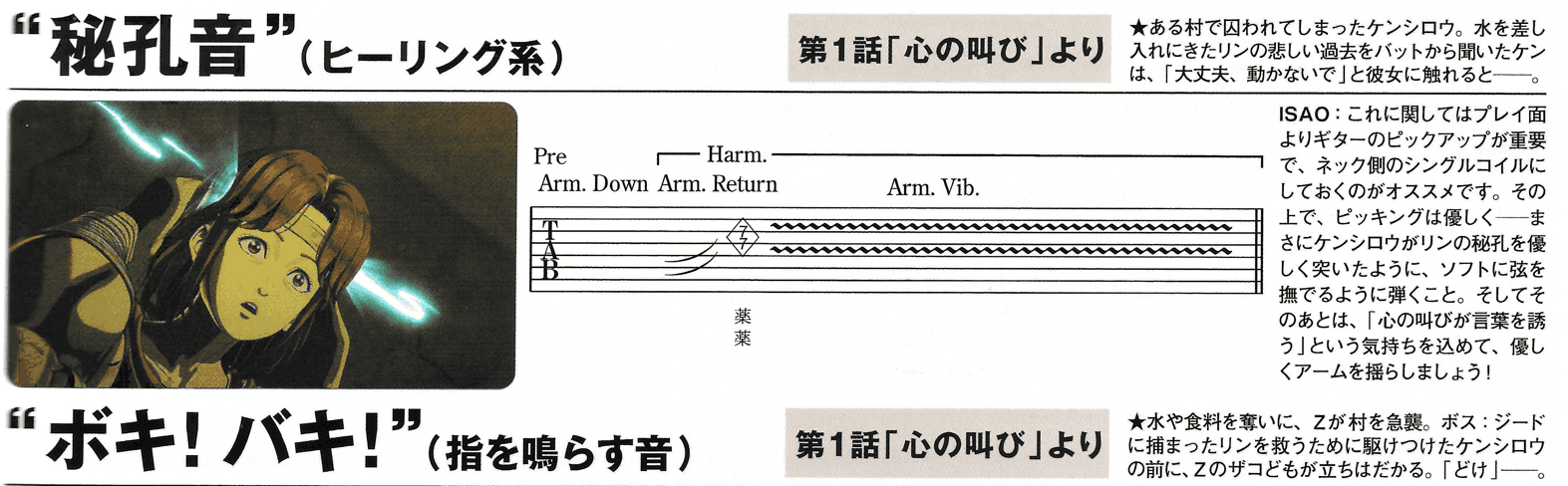
The list continues with the finger-cracking “Boki! Baki!,” which requires a 7 or 8-string guitar and a pitch shifter tuned downward, then the “Hoatā!!,” which, according to ISAO, rivals the attack sound for the top spot in difficulty. Next comes the legendary “Atatatata!” of the Hokuto Hyakuretsu-ken, whose entire secret lies in a chaotic alternation of muted and open notes. Without this indication, ISAO admits, the score would look like someone playing the guitar normally. Then there’s the dull thud of punches and, of course, the “Omae wa mō shindeiru,” played note by note on the 7th string, with the instruction to attack it while truly intending to say “omae wa.”
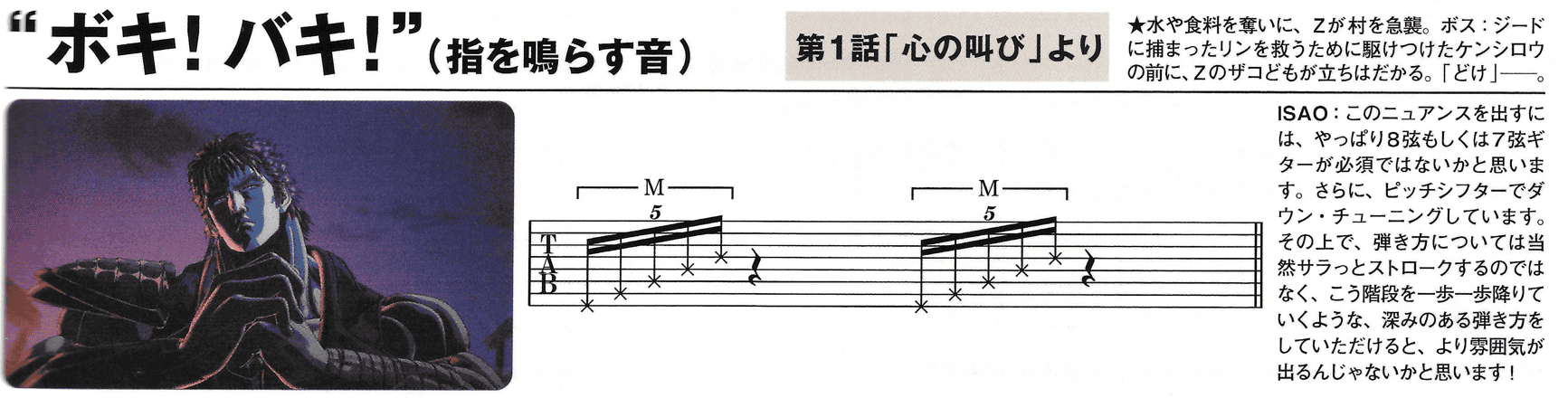
The showstopper is the legendary death cries, each one sourced to its episode. “Hidebu!!” (episode 4, Heart), “Tawaba!!” (episode 7, the mad sergeant of GOLAN), “Abeshi!!” (episode 9, the Jackal gang, whose strangeness comes, we learn, from a dissonant bend a half-step below unison), and the “Shaō!!” of Rei unleashing the Nanto Suichō-ken (episode 11). The magazine specifies that most examples are designed for the 8-string guitar but can be adapted for 6-string with tuning adjustments and tricks, and above all that the spirit of the section is not about perfect replication: everyone is invited to freely experiment with their own “Hokuto sound” using the tablature and the demonstration video published on the magazine’s website.
The scores: forty years of openings to play yourself
The feature concludes in grand fashion with nearly forty pages of fully annotated scores, complete with detailed analyses. “Hallelujah” by [Alexandros], “Ai wo Torimodose!!” by Crystal King, “SILENT SURVIVOR” by KODOMO BAND, and “TOUGH BOY” by TOM★CAT. Four openings, over forty years separating the first from the last, and a clear invitation: after reading how these songs were born, pick up your guitar and bring them to life. For a sheet music magazine, the historic core business of Young Guitar, it’s hard to think of a more fitting conclusion.
Why is this special issue essential?
Because there is simply nothing else like it. In forty years of existence, the music of Hokuto no Ken had never received editorial coverage of this scope, with such lengthy interviews, conducted by music journalists who ask the right technical questions AND know the franchise inside and out.
Firsthand accounts you won’t find anywhere else. Mr. Yoshizaki had never told the specialized music press the story behind the making of “Ai wo Torimodose!!” The lyrics arriving before the music, the tightened phrasing by his own hand, the mix altered without his knowledge, the original key defended tooth and nail for forty years. Tsuyoshi Ujiki reveals in black and white that he plays the guitar on “TOUGH BOY.” Miyashita recounts the passing of the torch between Akira Kamiya and Shunsuke Takeuchi. Toshl theorizes the link between his childhood imitations of Kenshiro and his vocal technique. Any one of these pieces of information, taken on its own, would be worth an article. Here, they are all brought together in a single issue.
A bridge between generations, too. The structure of the feature, from the new anime back to the legends, is not simply a reversed chronological choice. It embodies the transmission that is the thematic heart of Hokuto no Ken itself. Toshl covers Crystal King with Yoshizaki’s blessing. Hayashi has “Ai wo Torimodose!!” recorded by studio musicians who watched the anime as children. Kamiya gives his seal of approval to Takeuchi. Hasegawa, who accompanied Toshl at the start of his solo career, now performs the 1984 BGM as part of a troupe costumed as characters from the series. The entire issue functions as a collective isshi sōden.
An unabashedly fan-driven creation, finally. From the cover tagline to the wordplay scattered throughout the issue (Hayashi’s “Omae wa mō kiiteiru,” the roundtable’s “Oretachi wa mō hiiteiru”), from the discography guide that advises hunting for records “like Rei searching for Airi” to the tablature of “Abeshi!!,” Young Guitar made this issue with a love for the work that seeps through every page, without ever sacrificing the rigor that has defined its reputation since 1969. That is exactly the balance one expects from a tribute.
“Hokuto no Gen” is much more than an opportunistic editorial move riding the wave of the new anime. It is, to this day, the definitive document on forty years of Hokuto no Ken music, bringing together voices that had never spoken together before, and some that had never spoken at all. Whether you are a guitarist or not, a fan from the very beginning or a newcomer who arrived through the 2026 series, this issue tells a universal story: that of a handful of songs born in the 80s, which became monuments that three generations pass down today like a millennia-old martial art.
The magazine is only available in Japanese and obviously has no chance of being translated; that is the norm for Japanese music press. For obvious rights-related reasons, we are unable to share a translation of the interviews. But if this feature has made you want to go further, the issue can be easily imported through the usual Japanese online stores (CDJapan, Amazon JP, HMV…), and videos, including ISAO’s “Abeshi!! on guitar” demonstration, can be viewed for free on the magazine’s official website.
Publisher: Shinko Music Entertainment / Young Guitar, July 2026 issue (Vol. 58, No. 13, issue 934) / Released June 10, 2026 in Japan / Cover: Kenshiro © Buronson & Tetsuo Hara / COAMIX, “Hokuto no Ken” Production Committee, cover illustration by Hitoshi Nishimura (nishimura graphics)
Sources: Young Guitar July 2026 (Shinko Music), youngguitar.jp, hokuto-anime.com, anilege.jp
Comments are closed.