

Article from May 10, 2026 / Updated August 18, 2026. This feature has been revised and expanded following a complete re-reading of the Japanese text, page by page. Quotations are translated by our team.
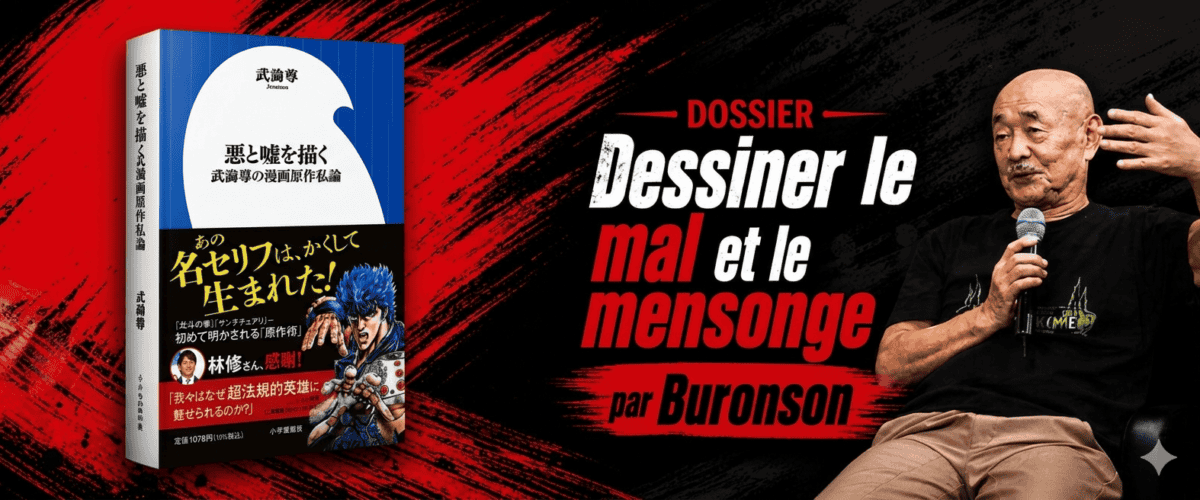
Forty years after the launch of Fist of the North Star, Buronson looks back on half a century of career in a book published by Shogakukan and built from interviews collected and edited by Dairin Kakehata: Depicting Evil and Lies: A Personal View on the Craft of Manga Scriptwriting (悪と嘘を描く 武論尊の漫画原作私論).
Currently available only in Japanese and without an official translation, this book is nonetheless a true goldmine that would greatly deserve an international release. We offer here a detailed analysis of this work, which should appeal as much to Fist of the North Star enthusiasts as to admirers of Buronson’s craft.
Preface
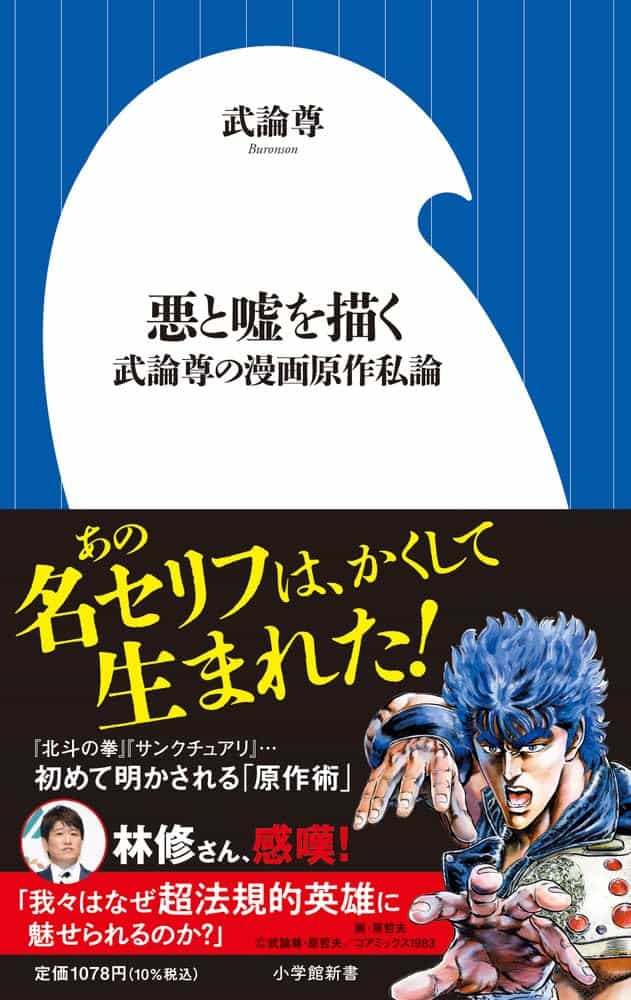
Buronson opens his book with a question that his longtime readers often ask him. With such considerable success, the manuscripts from that era must surely be carefully preserved, mustn’t they? His answer is immediate: nothing remains. He never checked with Horie Nobuhiko, his editor at the time, but he easily imagines the pages covered in red corrections ending up in the editorial wastebasket once the final proof was sent to print. These documents would no doubt fetch a fortune at auction, but he is perfectly indifferent to that. All that matters to him is the finished work the one that is read and endures.
A little further on, when asked to define his profession, Buronson offers his own vision of the scriptwriter’s role. He works as part of a team and never signs alone that is what fundamentally sets him apart from the novelist, who presents a personal work to the world. He considers himself a simple cog within a vast commercial machine, nothing more than an employee among others. He pushes the reflection even further. In the world of manga, he explains, it is the readers who decide the life or death of a series, and neither the artist nor the scriptwriter can escape that reality. What follows is a candid admission that sets the tone for the entire book. Trained at Shōnen Jump, where reader surveys served as the final verdict, Buronson states that he never had the luxury of conceiving the work that would have personally satisfied him. And, approaching his eighties, that concern still does not preoccupy him. For more than half a century, a single question has guided him: how to create a success.
Buronson recounts his career as a series of rolls of the dice. The first is his encounter with Motomiya Hiroshi, then still unknown, within the Japan Self-Defense Forces, where he had enlisted after middle school to escape poverty. The second comes with Nishimura Shigeo, future editor-in-chief of Shōnen Jump, who advised him to stop drifting and try writing a script instead. The third is his partnership with Hiramatsu Shinji and the success of Doberuman Deka, which opened the doors of the magazine to him. The last is perhaps the most striking, and it concerns Fist of the North Star. Buronson was not the editorial team’s first choice. Another scriptwriter had been considered before him, and the layout of the first chapter had already been submitted when that writer was ultimately passed over. Buronson was then brought in as a replacement, as he himself puts it, and that is how his name came to be associated with a work that has since become historic. Each of those dice played a decisive role. Had any one of them fallen differently, the scriptwriter Buronson would never have existed.
The book’s title has its origins in an exchange that Buronson recounts with amusement. An editor, whom he describes as a peculiar type, comes to propose a work devoted to his theory of screenwriting. Out of laziness, he explains, he first tries to decline the offer, objecting that he has no desire to launch into grand considerations on the subject. His interlocutor then replies that a personal reflection would do just as well. Buronson admits to having been won over by this pirouette, and it is precisely this notion of a private, personal perspective that appears today in the book’s subtitle. This anecdote also allows him to clarify what this profession has meant to him. Being a screenwriter was above all a means of living and earning a living, nothing more. He occasionally speaks of vocation, but not in the sense of a profession he had always dreamed of. The truth, he writes, is much simpler: he had no other choice.
The preface closes with two wishes and a warning. Buronson first hopes that those who have held his manga in their hands will read this book while laughing, whether wholeheartedly, half-heartedly, or even spitefully, it doesn’t matter. He also hopes that young people aspiring to a career in manga will find in it material to better understand the reality of this profession. The warning comes last, in the very final sentence before his signature. “Only, do not take this as a universal manual for success. Whoever expects such content from it will never produce any success.”
Chapter 1 – The manga screenwriter’s profession
Buronson published his first screenplay in a magazine in 1972. He opens this chapter with a reflection on his profession. According to him, computing and then artificial intelligence have progressively hollowed out many professions of their substance. Writing screenplays for manga has, until now, escaped this phenomenon. Even so, he notes, it is not an activity one can pursue carelessly. A screenwriter must constantly prove their worth and justify their place in the creative process.
When asked to sum up his profession in a single word, Buronson replies with a straightforward formula. The screenwriter is in service of the work. It is not a platform, but a job. To illustrate his point, he draws on a culinary comparison. On one side, a three-star restaurant so popular that its twenty-thousand-yen set menu cannot be reserved, where the chef confidently asserts that his meat is excellent. On the other, right next door, a modest neighborhood Chinese restaurant serving fried rice for seven hundred and eighty yen. His preference goes to the latter, he explains. Not out of social resentment, he is careful to specify, but because in his view, it is not up to the chef to decide whether a dish is good.
This conviction has its roots in the Shōnen Jump of his early days, at a time when the magazine, outpaced by its competitors, constantly had to discover new talent. The editorial team was then betting on young, still-unknown artists, supported by editors who came, for the most part, from the literary world. Buronson notes that Kajiwara Ikki, a major figure in screenwriting at that time, came from a comparable background, that of a man of letters who had turned to sports manga screenplays more out of necessity than vocation. He himself, he admits, had received no particular training. He was simply asked to write stories on manuscript paper, and he found himself a screenwriter almost by chance, without ever having truly decided it. He even adds that he did not particularly enjoy writing. As for becoming an artist, the idea never appealed to him. He considers himself rather fortunate to be able to receive royalties simply by inventing stories.
This chapter contains the episode that, according to Buronson, put him back on track, and the reality is harsher than the legend. After the success of Doberuman Deka, he admits he let it go to his head. The royalties suddenly rolling in, the nights spent in bars, an attitude that gradually changed toward editors. He admits he got drunk on his own success. One evening, at the sushi restaurant he frequented regularly with Chiba Akio, the latter fixed him with a stare and said, “Bū. You’ve been pathetic lately.” The effect was immediate. Buronson describes receiving those words like a bucket of ice water over the head, instantly sobering him up. The remark was no small thing. Chiba Akio, younger brother of Chiba Tetsuya, was a senior figure he deeply respected and who had even fed him in his studio during his lean years. He had just learned that Buronson was taking taxis all the way down to Atami simply to party.
His position on pride, which gives its title to an entire section of the book, flows directly from this experience. A screenwriter has no need for it. He contrasts his way of working with that of Kajiwara Ikki, whose reputation was that he refused to let a single character of his text be changed. For Buronson, when you know that a correction can improve a story, opposing it in the name of pride makes no sense. In his work, he did not seek perfection, which he considered out of reach, but instead aimed for a passing grade of seventy out of a hundred. It is also for this reason that he always prepared several plot ideas, in order to increase his chances of hitting that mark.
Two editors gave him reading recommendations, and Buronson reports them without embellishment. Nagano Tadasu, the magazine’s first editor-in-chief, repeatedly told Okamura, his real name that he should read Shiga Naoya and love literature enough to become a poet. Nishimura Shigeo, for his part, recommended The Brothers Karamazov, asserting that everything a screenwriter could ever need was contained within it. Buronson recounts buying the paperback edition of the novel, only to abandon it halfway through, unable to keep track of those endless names transcribed in katakana. But what he takes from those recommendations today goes far beyond the anecdote. If those two men urged such reading on him, it was not so that he might learn manga through manga, but so that he might observe the world around him. Writing a screenplay, he concludes, mobilizes the whole person, and no manual can ever replace that experience.
On the digital age, Buronson offers a very pragmatic analysis. The level of draftsmanship has improved considerably, to the point where young people of fifteen or twenty-five are now capable of producing work worthy of professionals. Yet he observes that those who draw well do not always know how to tell a story with the same mastery, and that it is difficult for a young author to portray depths they have never known. He then borrows a comparison from baseball. Some pitchers can hurl the ball at a hundred and sixty kilometers per hour and still get hit, because speed alone is not enough against a professional. Someone who focuses on the means rather than the objective, retiring the batter ends up failing. Buronson draws a simple conclusion from this. It is precisely because the quality of draftsmanship has improved so greatly that the ability to construct a story has become even more valuable.
One final image illuminates his vision of manga and, more broadly, his entire body of work. A manga is a mirror held up to the reader, into which they project their emotions and sometimes a part of themselves. If the screenwriter imposes his own personality or message too forcefully onto it, that mirror clouds over and the reader loses their freedom of interpretation. This is also what he tells young artists who come to him confiding that they have nothing particularly distinctive about them. It is not necessary to be an exceptional individual to create a significant work. An ordinary man can write an enormous success; Fist of the North Star, he reminds us, is proof of that.
Chapter 2 – My technique no. 1: the way of the “tearmaker”
It all starts with a remark by Horie Nobuhiko, made shortly after the script for Fist of the North Star was entrusted to Buronson. He knows how to write naniwabushi (浪花節, a sung narrative accompanied by shamisen, very popular in pre-war Japan, where duty and emotion bring tears to the eyes), and that is precisely why he was sought out. The reasoning is simple. To depict a devastated and merciless world dominated by violence, a deeply human sentiment must run in the background; without it, all that remains is a manga where the strong crush the weak. At the same time, Buronson knows that editor-in-chief Nishimura is worried about the arrival of a series so rich in violent scenes. He therefore needs to build a story capable of reassuring the editorial team. From this necessity two essential elements of his writing will emerge: the sadness that inhabits Kenshiro and the way in which characters meet their deaths.
He then reviews the various goals an author can pursue. Making people laugh, entertain, surprise, enthuse, or provoke thought are all legitimate approaches. Yet making people cry is the most difficult challenge for a screenwriter. In passing, Buronson revisits a persistent misconception. The famous motto of friendship, effort, and victory was never officially decreed by the editorial team of Shōnen Jump. It corresponded above all to Nagano Tadasu’s vision of a successful manga, before naturally asserting itself over time. Buronson states that he never worked with that idea in mind and believes his works bear little trace of it. Lazy by nature, he writes with humor, he could hardly see himself devoting his energy to depicting effort. By his own account, had he built his stories around that slogan, he would have produced nothing more than a simple crowd-pleaser.
The idea that ultimately structures the entire series then emerges, and Buronson is particularly candid about its origins. The launch of Fist of the North Star having been rushed, he had not had time to reflect deeply on what would form its core. It was only once the series was underway that he understood what was truly at stake. His explanation rests on an essential distinction. Kenshiro does not merely survive, he is kept alive by the sacrifices of others. Two scenes embody this idea. In his childhood, Kenshiro faces Shû and is defeated. According to the rule in force, the loser must be executed. To save his life, Shû gouges out his own eyes with his fist and accepts the price of doing so. Later, before the nuclear shelter where only two places remain, Toki pushes Kenshiro and Yuria inside before exposing himself to the nuclear fallout. Buronson recounts that some attentive readers challenged this scene, pointing out that a shelter designed to hold several hundred people could very well have accommodated one more. He readily acknowledges this implausibility, but reminds us that it was not the essential point. His objective was to make Kenshiro a man whose existence rests on the sacrifices consented to by others. It is this debt that gives its full meaning to Kenshiro’s declaration about the blood of his greatest enemies, those he could also call his friends who helped shape him.
This is where what Buronson considers one of his essential themes appears: self-sacrifice. Life is the most precious thing a human being possesses, and it is when a character accepts sacrificing it for something greater than themselves that they truly begin to shine. He immediately adds a nuance, however, that lends greater force to his point. Dying for a cause, he writes, is not something one encounters in everyday life, and he states that he is himself convinced he would be incapable of it. It is precisely for this reason that he sought, in his narratives, values capable of outweighing a human existence. This quest led him to pay particular attention to the death of each of his characters, whether it be Shû pierced by Souther‘s lance or Fudô collapsing upright beneath a rain of arrows. Buronson accompanies this method with a warning, however. Used clumsily, such a device can ruin a work. The moment making people cry becomes a visible objective, the reader perceives the artifice. And, he adds, children are often even more capable of detecting it than adults.
Buronson then turns his attention to readers, to whom he readily acknowledges a kind of superiority. Someone who has paid for their magazine often reads the work with more attention than the person who wrote it. He also admits that for a long time he was unable to answer a seemingly simple question: what is Fist of the North Star really about? The formulation that convinced him most did not come from him, but from another person whose name he does not reveal: the greatest fraternal quarrel in history. He also mentions Hayashi Osamu, a Japanese literature teacher turned television personality. He says the series left him with one particular stylistic device: the accumulation of three terms or three ideas, as seen in the ternary lines often associated with Souther or Raoh. Hayashi Osamu also proposed, on the occasion of the work’s thirtieth anniversary, an interpretation of Raoh’s death that Buronson is happy to adopt. According to this reading, Raoh had long been waiting for the man capable of defeating him. When he saw his brother grow stronger than himself, he finally found the one he had been searching for, and it is from this realization that his final line was born.
A second commentator appears, and his analysis is arguably the most unexpected in the entire book. He is the critic Kure Tomofusa, born the same year as Buronson. In 1991, he published a text in which he explained that he was no longer quite at the age to embrace Shōnen Jump series, while nonetheless finding Fist of the North Star remarkably interesting. His interpretation traces back to the origins of modern criminal law. What touches readers in the work, he writes, is a nostalgia for a fundamental right that modern justice has made to disappear: the right to take revenge. Buronson admits he was deeply surprised by this reading and acknowledges he had never considered his work from that angle. If one were to truly speak of revenge, he argues, it would be more applicable to Doberuman Deka. He concludes, however, that fiction’s very function is to allow what reality forbids.
There remains the question that keeps coming up: how do you make a reader cry? Buronson answers that there is no direct method for achieving it. He then mentions what he calls a well-known trick of the trade: put a woman, a child, or an animal on the page. He considers this approach rather easy, even a little cheap, while acknowledging its effectiveness. He also admits to having used it himself in Doberuman Deka. But that kind of device wears thin quickly. He closes with a more personal confession. When he goes to the cinema, he prefers to go alone so that no one sees him cry. And when a film manages to move him to tears, he feels something close to relief, because it proves to him that he is still capable of writing stories.
Chapter 3 – My Technique #2: A Character Is Defined by Their Lines
This chapter turns to the most concrete aspects of the craft, beginning with work rhythm. During the Fist of the North Star years, Buronson was running several series simultaneously, under his own name as well as under the name Fumimura Shō, and was delivering more than ten scripts a month across genres that were sometimes very far removed from one another. He describes grueling days, marvels himself at having managed to sustain such a pace, and believes that not devoting himself exclusively to Fist of the North Star was probably beneficial to the work. From this experience he draws a simple rule. To surprise the reader and make them want to discover the next installment, every episode must have its yamaba, its climactic peak, as well as its miseba, the passage intended to leave a lasting impression, even when the story’s true climax is still a long way off.
Before writing a single line of dialogue, there is what Buronson calls the chart: the architect’s blueprint on which the entire story rests. He presents a concrete example through the foundations of Fist of the North Star, summed up in five points: the story takes place in the near future after civilization has been destroyed by nuclear war; the hero is a traveler whose quest must be explained; he is searching for the woman he loves; that woman, Yuria, has been taken from him; and finally, her abductor is a formidable adversary named Shin, a practitioner of Nanto Seiken against Kenshiro’s Hokuto Shinken. Buronson then extends the architectural metaphor. When the foundations are imprecise, everything built on top of them ends up crooked, and the finest roof will never compensate for a flawed structure. Even so, he refuses to conclude that one must spend months thinking before starting. Long deliberation does not guarantee a good idea. Finding the right starting point is above all a matter of intuition, inspiration, and instinct.
Buronson discusses his career with a rather rare frankness. Although he considers himself to have achieved considerable success, he estimates his own batting average at one hit for every ten at-bats. In other words, nine out of ten works did not find the commercial success he had hoped for. He draws a very concrete lesson from this. One must not fear failure, and it is better to have the courage to abandon a doomed project than to persist with it pointlessly. But before reaching that point, everything often comes down to the first chapter. In the case of Fist of the North Star, the decisive element was the choice of setting. Buronson had proposed a near future marked by the collapse of civilization, and Horie Nobuhiko had immediately embraced the idea. Had the latter hesitated, he explains, the series would probably have remained in the contemporary Japan of Tetsuo Hara‘s one-shot. An unleashed Kenshiro in the streets of Kabukicho would have made for nothing more than a comedy manga. Between a masterpiece and an ordinary work, Buronson concludes, there is sometimes only the thickness of a sheet of paper.
The title of this chapter is born from the meeting of two ideas. Koike Kazuo, one of Buronson’s great elders, maintained that in manga, everything rested on the characters. Buronson added what matters most to him, the line of dialogue and from this combination his own formula was born. A character is his lines. To illustrate this, he cites three lines from the series, spoken respectively by Kenshiro, Rei and Raoh. The first is enough to make his reasoning clear: “You don’t announce your name to someone who is about to die!!” When a character can be immediately identified through his words alone, he explains, it means the script has achieved its goal. A work in which the dialogue alone reveals the personality of those who speak it is a work that succeeds.
He is then asked the same question time and again. How does one come up with lines like that? Buronson’s answer is arguably one of the most interesting in the chapter. If he himself knew the recipe, he writes, he would very much like to know it. There is no method. In the trade, people sometimes say that god has descended, but no one is able to explain how an idea suddenly goes from nothing to something. No course of study can produce a memorable line, any more than general culture alone can. Vocabulary is certainly a valuable weapon, but the accumulation of learned words is not enough. As for expressions borrowed and never used in one’s own life, they will never truly bring a character to life. The essential thing, therefore, is not to produce a brilliant maxim. What matters is imagining what that specific character would say in that specific situation. For Buronson, a scriptwriter’s true instinct lies in his ability to find the word or phrase that alone sums up an entire character’s way of being and living.
An observation on how the profession has evolved brings everything to a close. The Shōnen Jump series of the 1980s each had their own identity and competed with one another through clearly distinct styles. Since then, the industry has grown more mature, the technical level has risen, but the pursuit of efficiency and the logic of minimal risk have advanced as well. This evolution has had a direct consequence. Works end up resembling one another, starting with their heroes, since by seeking to limit risks, authors and editors naturally tend to reproduce what already works. Buronson recounts in this connection a reflection by Horie Nobuhiko. As the general level rose, authors’ flaws became less visible. Editors then began to prioritize efficiency above all else, demanding an immediately engaging nēmu rather than identifying each author’s individual strengths and weaknesses in order to support their development. Aware that this discourse may come across as that of an old-timer lamenting his era, Buronson nevertheless states he will repeat it until the end of his life. A manga conceived primarily to avoid failure is a manga with no future.
Chapter 4 – My Technique #3: Depicting “Evil”
The first section states his thesis plainly. It is the villain who determines the success or failure of a work. His reasoning comes down to a few words: “All scriptwriters think about creating an appealing protagonist and making him live intensely within the work. But a story can never become compelling if only the protagonist is scrambling about in it.” To support his argument, Buronson cites Darth Vader, the killer Lecter in Hannibal, and Samuel Norton, the corrupt prison warden from The Shawshank Redemption. He then leaves the realm of fiction to discuss professional wrestling, sumo, and even politics. Everywhere, he observes, the same mechanism is at work. When a figure of evil is solidly constructed, it gives strength to the narrative and raises the tension.
The question that structures the entire chapter then emerges. What is an evil that deserves death? For Buronson, this is not an abstract reflection. Since he was going to write stories featuring executions and killings, he necessarily had to provide his own answer. To develop this idea, he returns to Dirty Harry, a film he drew direct inspiration from when creating the hero of Doberuman Deka. Kanō Jōji was born from this influence and from the figure of a police officer who carries out his mission without much concern for the limits imposed by the law. Buronson notes, however, that the viewer’s acceptance of Harry’s brutality does not rest solely on the character himself. It rests above all on the way the film presents the person who is its target. Scorpio, inspired by the crimes of the Zodiac Killer, accumulates atrocities and ultimately ends up being released on a procedural technicality. Gradually, the narrative leads the audience to wish that someone would put a definitive end to his actions.
He then broadens his reflection. For Buronson, evil is not a monolithic notion, and he refuses to ignore the gray areas surrounding it. Certain practices may be perceived as necessary or tolerated depending on the era and society. He notes, for instance, that Japan long turned a blind eye to activities such as gambling and prostitution. He also points out that Doberuman Deka was itself denounced in its day as a bad manga by certain parent-teacher associations. This observation leads him to a simple conclusion. Since a narrative progresses by pitting its hero against a series of adversaries, the author must have clearly defined what he considers evil to be.
Where one might expect a theoretical reflection, the book suddenly shifts into personal account. On March 11, 2011, Buronson is staying in a small country house on the Ibaraki coast when he is directly affected by the earthquake and its consequences. Shortly afterward, a friend of his generation comes to share an idea with him. The Fukushima plant has exploded and, since most of their lives are now behind them, unlike those of children, they might just as well go there and throw themselves into the contaminated sea in an attempt to contain the disaster. Buronson recounts having told him not to worry, that he hadn’t kept him on the team. Behind this joke, however, he underscores a deep conviction. That kind of man truly exists, men capable of acting without any concern for their own survival.
Finally, there is the passage most often cited in connection with this book: his famous scale of evil levels. Buronson invites the reader, however, to consider it for what it truly is. He is not attempting to develop a universal theory of the antagonist, but is reflecting from the particular case of Doberuman Deka, a series built on self-contained stories in which every episode sees the guilty party punished. Over time, however, this pattern risks becoming repetitive. To avoid this fatigue, he explains, it is necessary to diversify and rank the forms of evil. If the villains of the series were to be roughly divided into five levels, he continues, the following classification would emerge.
- Level 5, the worst. The brutal man who directly targets women and children.
- Level 4. The one who makes no effort to understand the suffering and sorrow of others.
- Level 3. The egocentric, cowardly, and petty individual who ensnares others through cunning.
- Level 2. The one who became involved in evil for a selfish reason of his own.
- Level 1. The one who plays the villain, or who is forced into that role.
This scale is not, however, intended to classify characters according to a fixed ranking. Its primary purpose is to calibrate the narrative. The more despicable the villain, the more necessary it becomes to intensify the hero’s actions and the emotional weight of the story. Conversely, when an adversary benefits from mitigating circumstances or a degree of humanity, his resolution calls for greater nuance. In such cases, Buronson explains, neither killing him to close on a happy note nor letting him live in order to preserve a certain emotional resonance constitutes an obvious solution. Every situation demands its own balance. He adds, finally, that the works impressing him today in terms of antagonists no longer come from Japan, but from Korea. There he observes a remarkable talent for crafting memorable villains, a phenomenon he attributes less to a matter of technique or artistry than to the society that produces them.
What follows is an admission that few authors would probably be willing to make. After years of exploring the depths of evil in his stories, Buronson ended up consulting a psychiatrist. The doctor addressed him by his real surname before explaining that he could break down if he felt the need, that a disruption of the nervous system is not fatal, and that he had no reason to force himself. Buronson admits that he had believed he was naturally suited to this work. Yet he had to face the facts. Pushing the exploration of evil to its limits eventually wears a man down. This is undoubtedly one of the most personal passages in the book. Where the reader might have expected a lesson in screenwriting technique, Buronson instead chooses to reveal his own fragility.
An entire section is then devoted to Raoh. Buronson explains that, in Fist of the North Star, he essentially distinguishes two categories of villains: on one side, thugs lacking any real depth of thought, and on the other, the major figures reserved for a decisive confrontation with Kenshiro. He also notes that the construction of the brotherhood developed gradually over the course of the series, and that Raoh was born from that evolution. His character embodies the idea of evil perceived as necessary in a world plunged into chaos. In his view, only strength allows one to survive, and to survive means to dominate others. Raoh lived by this conviction, never fully managing to understand love or sorrow. Buronson closes with a more universal reflection. If the reader has recognized within him a part of their own Raoh, then the work has succeeded in bringing to the surface a weakness we all carry within ourselves.
From this reflection flows the chapter’s broader thesis. Everyone would like to live freely following their desires while playing, in society, the role of the upright person. If yakuza films continue to attract wide audiences, it is because they give shape to a wish that many dare not express. What interests him, he writes, is what appears when individuals stop holding themselves back. Discovering that hidden face of the human being is what keeps a screenwriter alive. Evil is therefore not merely a dramatic device it is a means of accessing a deeper truth about humanity.
When he addresses artificial intelligence, his tone proves far more serene than one might expect. A machine incapable of going beyond data from the past cannot be creative. It may combine existing elements to produce something that appears new, but it can never create the work that will truly define its era. Buronson even turns this argument against human beings themselves. An editor who judges a project solely on the basis of past commercial precedents is also behaving like a poor artificial intelligence. His verdict is unequivocal. Anyone who relies on a tool available to everyone to do their job is not cut out for this profession. And if he were to address such illustrators, screenwriters, or editors, Kenshiro would no doubt tell them: “You are already dead.” A final sentence sums up his entire thinking. There is no convenient shortcut for depicting the human being.
Chapter 5 – How I Became “Buronson”
The most autobiographical chapter in the book opens with a professional observation. In the collective imagination, certain professions embody success: member of parliament, company director, doctor, or lawyer. The manga screenwriter, however, never appears on that list. There is no recognized diploma, no competitive examination, no clearly mapped-out path to get there. One thing nonetheless seems certain to Buronson. Nobody truly decides to become a manga screenwriter. He himself ended up in this profession because he one day found himself in a situation where he had little other choice. Kajiwara Ikki and Koike Kazuo took equally roundabout paths before arriving there. From this observation, he draws what he considers the one truly indispensable quality: having lived enough. That experience must still be extended through books, films, and everything that allows one to better understand human beings.
Buronson, whose real name is Okamura Yoshiyuki, was born in 1947 in a mountain village in the Minamisaku district, now part of the city of Saku. He grew up in a farming family of six children, of whom he was the youngest. The poverty of that era, he recounts, can be measured in very concrete figures. The family’s rice paddies covered approximately five thousand square meters. After a month of work carried out by the entire family, the income barely reached one thousand yen, five hundred of which went to the children. He clarifies that this was not pocket money. Each person simply worked to allow the family to get by.
From this period dates what is surely the most painful memory in the entire book, an episode that Buronson says he has never forgotten despite the seventy years that have passed. His father’s one evening drink was his only pleasure. When there was neither alcohol nor money left, he would hand an empty bottle to his youngest son and ask him to go to the store. At the sake shop, the owner would each time look embarrassed. He knew perfectly well that the Okamuras had no way to pay, but he could not bring himself to send away a child who had come with an empty bottle in his hands. So he would pour a little shōchū into it, put the cap back on, heave a sigh, and say a few words of compassion to the boy, calling him by his nickname. Yet it is not the material hardship that stays with him most from this scene. It is precisely those words of pity that, he writes, wounded him deeply.
Around the same time, he goes to see a film with his meager savings, and the memory has never left him. It is The Boy with the Trumpet, by Sekikawa Hideo, released in 1955. The story features a run-down rural school, an enthusiastic young music teacher, and a boy who discovers the trumpet and then devotes himself to it body and soul. His father, unable to understand this passion, eventually smashes the instrument because the noise irritates him. In a driving rain, the child flees with his twisted trumpet, discovers that a landslide has blocked the railway line as a train approaches, and blows with all his might to sound the alarm. Buronson writes that no film has ever made him cry so much. He now believes this is probably because he recognized himself in that boy. His attraction to works capable of moving people to tears may have its roots in that experience.
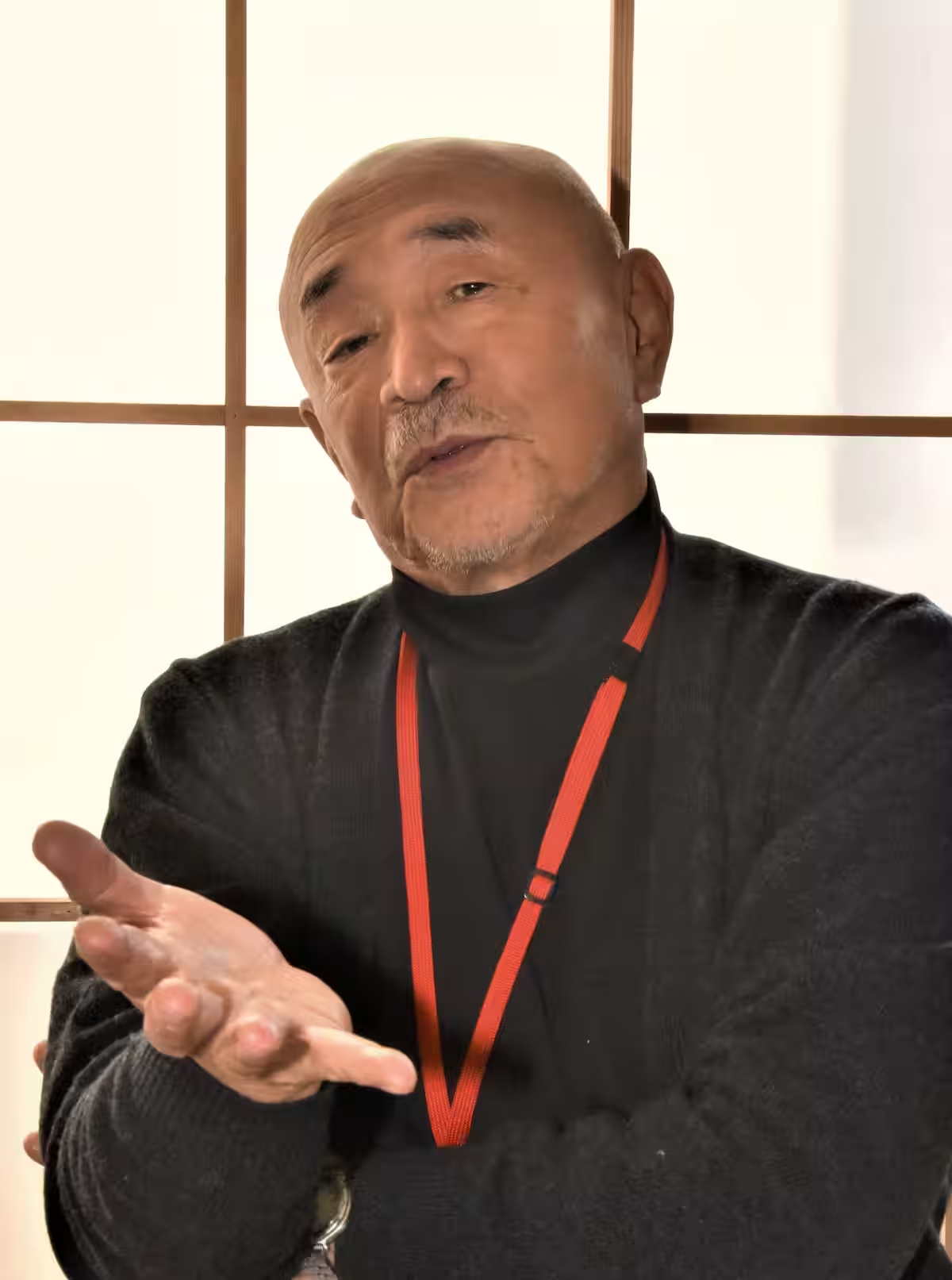
His father dies while he is in his final year of elementary school. Upon leaving middle school, Buronson makes a decision that will shape the rest of his life: to join the Self-Defense Forces. His motivation is simple to escape poverty. His brothers offer to fund his studies so that he can at least continue through high school, but he refuses. He wants to leave the countryside and earn his own living. Assigned to the air force as a cadet at the Kumagaya base, he attends an ordinary high school in the mornings before training in the afternoons. Of around a hundred recruits, some twenty drop out in the first year alone. He will stay for seven years. He now describes this period as a joyful prison and acknowledges everything he owes to it. Without those years spent in the Self-Defense Forces, he writes, he could never have created Phantom Burai or Migi Muke Hidari!.
It is during this period that he meets Motomiya Hiroshi, assigned to the same contingent and the same unit, who would later become one of the key figures behind the rise of Shōnen Jump. Buronson describes him as a small man with a piercing gaze, a former gang leader. One day, Motomiya challenges him to wrestle on a vacant lot. Despite his lighter build, he proves far stronger, to the point that Buronson chooses to stop the fight when he realizes he is going to lose. He would in fact be beaten a second time, in the long jump the only discipline in which he had never previously known defeat. After that, he recounts, they never faced each other again. Buronson observes that one does not generally join the army at fifteen when everything is going well in one’s life. Often it takes no more than a look in someone’s eyes to understand what brought them there. In his case as in Motomiya’s, the answer was the same: poverty.
One anecdote illustrates better than any lengthy speech what Buronson means. Motomiya loved canned peaches and continued buying them long after he had become a successful manga artist to the point of ranking among the country’s highest taxpayers. He always ate them with their syrup. One day he explained that his family had been poor and that, as a child, his greatest dream had been to eat an entire can of peaches all by himself. Buronson writes that he understood in that moment just how deeply childhood continues to shape a man throughout his life. Motomiya eventually leaves the army after a year and a half of service and confides to him, as he is about to go, that he is thinking of becoming a manga artist an ambition he had never mentioned to him before.
Four years after his enlistment, by which time he had become a sergeant, Buronson was posted to the radar base on Mount Sefuri, in Saga Prefecture, where he took part in tracking unidentified aircraft. On March 31, 1970, nine members of the Japanese Red Army faction hijacked Japan Airlines Flight Yodo-go and demanded to be taken to North Korea. Buronson received orders to track the aircraft’s progress, at a base gripped by extreme tension. This would be his final mission. In passing, he reflects on his generation that of the student movements of the late 1960s for which he admits he never felt the slightest sympathy. These young people struck him as privileged individuals who could spend their time arguing, drinking, and playing guitar. He is careful to note, however, that this was the judgment of the man he was then: a young soldier whose primary concern was simply fighting poverty.
He left the military after seven years of service, increasingly unable to bear taking orders from superiors younger than himself. Several months of odd jobs followed, during which he briefly considered joining the militia founded by Mishima Yukio. The idea occupied his mind enough that he even calculated the membership number he would have received: the ninth. In November 1970, Buronson was working in a warehouse in Ichigaya precisely where the events were about to unfold. Puzzled by the arrival of numerous police cars from early in the afternoon, he went outside to see what was happening and caught sight of a man deep in conversation with police officers at the garrison entrance: Ishihara Shintarō. He learned the rest by watching the news. The shock was such that he was left speechless. He realized then that had he joined that organization carelessly a few months earlier, he might very well have found himself among those who took part in the assault.
The real turning point came with a phone call in 1971. On the other end of the line was Motomiya, who had by then become a successful author. After asking what Buronson was doing with his days and concluding that the answer was not much, he told him he was short-staffed at his studio. That was how Buronson came to join Motomiya Production. Since he could not draw and had no particular technical skills, his duties were varied. He gathered research materials during the day and accompanied the team to dinner banquets in the evenings. With humor, he describes himself as the studio’s general dogsbody and unofficial party organizer. At the end of 1971, Motomiya was preparing a historical work that required extensive research. Rather than accumulating information haphazardly, Buronson identified the key figures of Miyamoto Musashi’s era and drew up a clear chronology for each, written by hand and readable at a glance. This work earned him his first words of praise from editor Nishimura Shigeo. The following year, Nishimura suggested he try his hand at writing a script. Buronson had no illusions about the reasons behind this proposal, however. Nishimura expected nothing from a man who had left school at middle school age and lacked any academic background. He was chiefly looking to keep him away from Motomiya, whose work Shūeisha did not wish to see disrupted.
It was also around this time that his pen name appeared. It is often said that people thought he resembled Charles Bronson, but Buronson is keen to add nuance to that anecdote. In reality, it was he himself who, after seeing Adieu l’ami in 1968, kept telling those around him that he looked like the actor, until the idea eventually stuck. At the studio, his colleagues already affectionately nicknamed him Bū-chan. His pen name was born from that combination of habits and jokes, before becoming the name by which he would be known to everyone.
Buronson then turns to the question that truly interests him. Setting aside the element of luck, why did he manage to become a scriptwriter? He offers three explanations. The first is imagination, which he believes he developed through poverty. Imagining stories costs nothing, he writes, and those who grow up in deprivation sometimes end up building an inner world of remarkable richness. On this subject, he recalls a piece of advice given by an editor at Kōdansha. When inspiration ran dry, the editor would recommend riding the entire Yamanote Line, observing the passengers, and inventing their lives. Buronson has tried the exercise himself. He admits he probably looked like a strange character staring at people on the train, but the habit has stayed with him. He adds one important qualification, however: the method only works when it is grounded in reality. And it is often in the most ordinary people that the best stories are found. An unremarkable couple, even a slightly dull-looking one, strikes him as far richer in narrative possibilities than a particularly striking pair.
The second reason is his capacity to step back. It is impossible, he writes, to make a living in this profession while ignoring what readers expect. He also points out that Shōnen Jump operated according to a very strong editorial line, where an author’s opinion carried little weight against the editorial staff’s decisions. Far from taking offense, he considered this situation natural. His formula is unambiguous. A recognized work is above all a work that has met with success, independently of any discussion about its intrinsic quality. The third reason is respect for others, and it is perhaps the one that best illuminates his way of working. He drew from it a rule he applied throughout his career: never give direct instructions to the artist, and even limit such exchanges as much as possible. With Tetsuo Hara, for example, they would only meet on the occasion of large receptions organized by publishers. When some were surprised that they spoke so little to each other, Buronson would reply that the essence of their dialogue lay elsewhere. The script he sent, the pages that came back to him, then the response he provided through the story this back-and-forth constituted for him the true conversation between a writer and his artist.
Chapter 6 – “Doberuman Deka”, the founding work
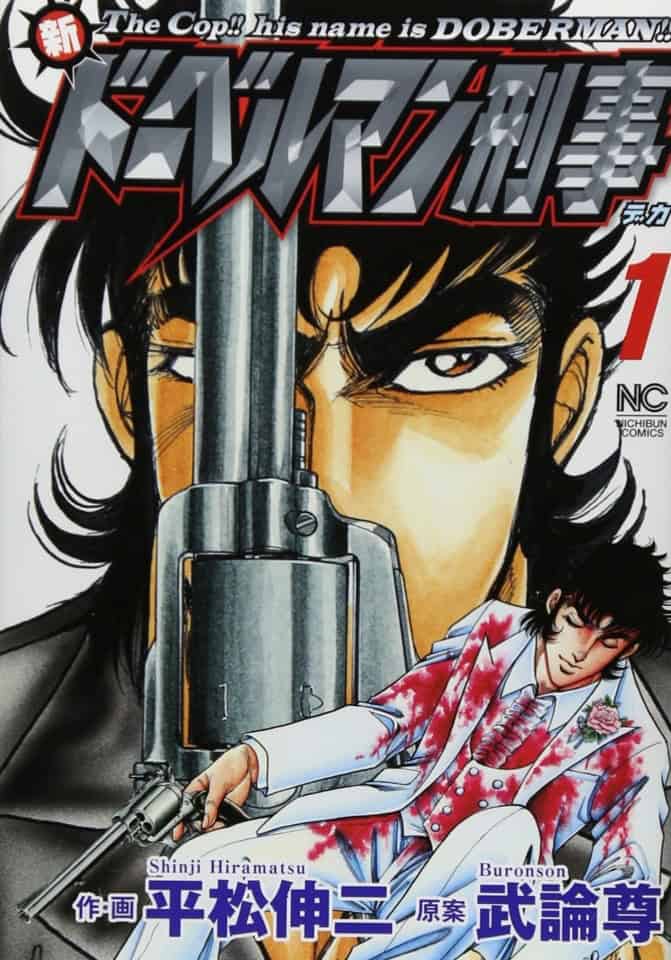
Serialized in Shōnen Jump from 1975 to 1979, Doberuman Deka is the work that introduced Buronson to the general public and allowed Hiramatsu Shinji to become a popular author. Its origins, however, come down to a simple set of circumstances. Gotō Hiroki approached Buronson with a problem to solve. Five weeks of publication in the magazine needed to be filled, and to do so he would need to work with a nineteen-year-old artist from Okayama who was not yet able to handle the writing side as well. The editorial staff wanted a story based on punitive justice, but Gotō rejected one by one every proposal submitted to him. Backed into a corner, Buronson finally put forward his last idea: a police officer armed with the most powerful revolver in the world, inspired by the hero of Dirty Harry. He notes that had this been rejected too, he would have abandoned the project. Gotō ultimately accepted, perhaps, Buronson suggests, because he was won over by his confidence.
He also acknowledges the calculated element behind this success. He never asked himself whether a manga aimed at boys could pile up so many deaths, counting on a Shōnen Jump that was then young and determined to catch up with its competitors, where anything that seemed interesting had its place. The first chapter ranked second in the reader survey, and the five weeks originally planned immediately became an ongoing series. The decision was made without the authors having anticipated what would follow, or even having had the opportunity to refuse. Buronson knew the workings of the house well. In the days when he worked at Motomiya’s, a series was expected to end after ten chapters. An exhausted author had even written the word “end” in the final panel before disappearing. Nishimura had simply whited out the word and ordered the series to continue.
What Buronson sought to express in this series can be summed up in a single formula: taking the opposite stance on good and justice. If a situation requires sacrificing one man to save a hundred others, real society will condemn such an act, while fiction allows this kind of choice to be explored. He pushes the example further. Three members of the same family escape a shipwreck and reach a lifeboat with only two places left. The child naturally takes a seat, leaving the father and mother to face their fate. Buronson thinks he would trample the woman to board first, while immediately acknowledging that he has no idea what he would actually do in such a situation. What interests him is not the answer, but the question itself. Certain situations, he believes, can only be resolved at the cost of a sacrifice.
The series nearly came to an end with its very first chapter, though not for the reason one might imagine. In that opening episode, the hero kills a criminal who had escaped from a psychiatric hospital. An association protested, arguing that this portrayal conveyed a discriminatory image of people suffering from mental illness and presented them as a danger to society. Gotō asked Buronson to accompany him to the meeting organized on the matter, while deciding that Hiramatsu would not attend, on the grounds that his entire career was still ahead of him. He also asked Buronson to remain silent during the meeting. Buronson today acknowledges his mistake without attempting to justify himself. Using mental illness as a narrative element without genuinely understanding the subject was a fault, as much on his part as on the editorial team’s.
What follows is the episode the association had asked never to be made public. Since Buronson remains silent during the meeting, a woman eventually asks whether he is indeed the scriptwriter, and which school he graduated from. He simply replies that he did not continue his education beyond middle school. She retorts that this probably explains why he is only capable of writing that kind of story. Buronson recounts having clenched his fist inwardly. The very person denouncing discrimination had just committed another form of it, this time based on level of education. Immediately realizing her blunder, the woman falls silent. A long silence settles, before the association’s representatives suggest leaving things there, on the condition that nothing from the discussion leave the room. That is how the series escapes a premature cancellation. With hindsight, Buronson clarifies that he has at times depicted the darkest aspects of human nature, beyond notions of good and evil, but that he never intended to discriminate against anyone. He does regret, however, having approached the subject with such ignorance and clumsiness.
In 1976, Buronson set out on a reporting trip to Okinawa with Gotō and Hiramatsu for a lightning visit lasting only one night. For men of his generation, Okinawa is a land marked by the wounds of history, and he remembers being deeply shocked as a child when he learned that in 1958 the soil brought back from Kōshien by Shuri High School players had been thrown into the sea in the name of plant protection legislation. The stay lived up to every expectation. They visited American installations, talked with local residents, and discovered realities that would directly feed into the rest of the series: weapons, drugs, and clandestine networks. From this experience an entire story arc would even emerge. But the trip also served another purpose, one the two older men had not revealed to Hiramatsu. Having gone straight from high school to Tokyo, he had been thrust almost immediately into the pages of a major magazine. Buronson and Gotō felt he had not yet lived enough. Their conviction came down to a simple idea: to depict the adult world, one must be an adult oneself.
His working method rested on a daily habit. Every morning, Buronson would go through the newspapers and cut out articles that caught his attention, convinced that imagination depends above all on the quantity of reality one accumulates within oneself. He gives a specific example. In 1977, several cola bottles poisoned with cyanide were left in telephone booths, causing the deaths of three people in a case that was never solved. Setting aside theories of revenge or financial gain, Buronson saw in it instead a reflection of urban loneliness. From this, he imagined a character: a young man who had come from the provinces, with no friends or ties, who steals cyanide from the workshop where he works in order to prove to himself that he still exists and retains some connection with the world. From this interpretation, an entire episode of the series would be born.
The success of Doberuman Deka can also be measured in figures. In 1977, Shōnen Jump crossed the two-million-copies-sold mark, while Buronson’s annual income exceeded ten million yen. By way of comparison, a recent university graduate was earning around one hundred thousand yen per month at the time. He is quick, however, to recall the other side of the coin: the lack of time to enjoy that money and the constant pressure imposed by publication deadlines. He also touches on Hiramatsu’s situation and a judgment that Gotō reportedly delivered to him without mincing words. According to Gotō, a manga artist working from someone else’s script is only half-trained for as long as he does not create his own stories. Buronson does not share this view. For him, the success of a manga rests above all with the artist, and it is therefore the artist who should receive the recognition, the glory, and the public’s esteem first and foremost.
The adventure came to an end in the autumn of 1979, over dinner. Nishimura, who had by then become editor-in-chief, invited Buronson to a fugu restaurant. Before even stepping inside, Buronson understood the true purpose of the meeting. He drained his beer in one go, remembers it was excellent, then listened as Nishimura simply told him it was time to bring the series to a close. Contrary to what one might imagine, he felt no shock. In fact, a certain sense of relief prevailed. After four years of weekly publication, the accumulated fatigue was such that the desire to take a breath outweighed the sadness of seeing a work come to an end.
What remained was to give Kanō Jōji a proper conclusion. To do so, Buronson called Chiba Tetsuya to ask permission to draw inspiration from the final scene of Ashita no Joe. Chiba agreed. In Doberuman Deka, Kanō Jōji, now married to his colleague, is attacked by an extremist commando on the very day of his wedding. Dressed in a white tuxedo, weapon in hand, he meets his death before being reduced to white ashes. Buronson notes that Hiramatsu was also a passionate admirer of Ashita no Joe. When a writer and an artist share the same emotional connection to a work, he explains, it becomes difficult to take any other path, even at the risk of being accused of imitation.
Chapter 7 – The Era of Hokuto no Ken and Shōnen Jump
Buronson begins by explaining why this chapter took forty years to write. He has never turned down interviews and has recounted certain episodes of this adventure on numerous occasions, but he had never yet taken the time to take stock of it. A writer is defined above all, in his view, by the works he leaves behind, and commenting on one’s own work oneself is almost in poor taste. That role belongs to the readers. While Fist of the North Star is unquestionably his most famous work, he notes that he has never considered it his masterpiece. That, he states, is still yet to come. If he ultimately agrees to revisit this period in detail, it is first because a portion of today’s audience did not experience the serialization at the time, but also, he frankly admits, because his editor insisted with great persistence. To sum up his relationship with the work, Buronson uses a family analogy. Fist of the North Star is for him a prodigious son, born of unassuming parents, who became fully independent and continues today to give back to his aging parents what he received from them.
The genesis of Hokuto no Ken begins with an episode that few readers outside Japan are aware of. After the end of Doberuman Deka, Buronson felt the need to travel far away and signed up for a week-long organized trip to Angkor Wat. The excursion was expensive and, at the time, still very rarely visited. Once there, he discovered a country deeply scarred by war. Along the roads, he glimpsed shattered skulls. His armed guide forbade him from straying off the paths due to mines still in the ground. The statues were in ruins, vegetation had reclaimed the land, and the bones bore witness to a particularly violent recent past. Buronson writes that he had before his eyes the image of a society from which civilization had vanished, leaving violence to reign alone.
The second decisive element came from cinema. In 1981, he discovered Mad Max 2 and was struck full force by its vision of a world where warrior-like men clash over oil in a devastated landscape. He notes that Tetsuo Hara was also deeply affected by the film and had since harbored a desire to transpose such an imaginary world into a manga. The one-shot Hokuto no Ken was published in Fresh Jump in 1983, featuring a hero named Kenshirō Kasumi. Given its success, serialization was decided upon, and Horie Nobuhiko concluded that a writer was needed to sustain the quality of the artwork at a weekly pace. Buronson was not high on the list, if he was on it at all. The first candidate had gone as far as the nēmu, which the editorial team rejected. Horie could not afford to fail, as Hara’s first series had been cancelled after ten weeks. He mentioned it to Nishimura, who replied that Buronson would accept anything and would not make a fuss.
It is also at this point that the most famous line in the entire franchise was born, and its origin is not what one might generally imagine. When Horie brings him Tetsuo Hara’s one-shot, Buronson immediately notices two elements. First, the hero whose face reminds him of Bruce Lee. Then a particularly striking line, the one that tells the opponent he is already dead. This line therefore came from the artist himself. It makes a deep impression on Buronson, who immediately proposes a setting and a story. With one condition, however. If the hero is to practice a martial art, then the action cannot take place in contemporary Japan. He wants neither high school students nor a modern realistic setting. He envisions a world where firearms have disappeared, without reverting to an ancient era. It will therefore be the near future. He also requests complete freedom in building the initial universe. Horie accepts and sets him a goal: to sustain three years of serialization.
The timeline is then completely unreasonable. The one-shot is published in June 1983 and serialization must begin by autumn. In the space of three months, a writer must be found, a universe built, characters created, a theme defined, and a first chapter delivered in color. Determined to captivate readers immediately, Buronson writes an opening chapter of forty-six pages. Impressed, Nishimura decides to publish it in full as the magazine’s lead feature. Fist of the North Star thus begins in the issue dated September 26, 1983. Buronson recounts having understood very early on that the series had potential upon discovering one panel in particular: the atomic mushroom cloud accompanied by the caption “In 199x, the world was covered in atomic flames!!”. The first chapter ranks second in the reader survey. Yet the true test begins with the second episode.
It is at this point that a lesson Buronson would never forget comes into play. Horie believed that the second chapter was often more important than the first. A spectacular launch means nothing if the follow-up fails to deliver on the initial promise. The manuscript Buronson presents to him receives a noticeably reserved reception. The script is nonetheless passed on to the artist, the nēmu is completed, and then Horie suddenly requests a complete rewrite. The episode featured an old man who had spent six months gathering a few precious rice seeds in a world where food had nearly disappeared. As he tries to bring them back to his village, he is attacked. For Horie, something does not work. The reader does not truly grasp the efforts this old man made to obtain those seeds, and his death comes so easily that all emotion is lost. Furthermore, the story still does not explain why Kenshiro is wandering through this devastated world or what fuels his anger.
Buronson accepts the criticism, because he knows it is well-founded. He admits to having let that chapter through for lack of time, and his frustration stems not so much from the rewrite request itself as from the moment it comes, given that Tetsuo Hara has already begun inking the pages. He therefore goes back to his script, strengthens the hope those rice seeds represent, adds the old man’s line about a tomorrow that can be better than today, then has him struck down with a brutality that finally gives real meaning to Kenshiro’s anger. When Horie reads the new version, he goes through the manuscript to the very end, allows himself a smile, and declares that this time the result is good. He then pauses on one line and reads it aloud: “Tomorrow… rather than today… I hadn’t seen a human being in so long…” Kenshiro echoes the words of the fallen old man. Buronson writes that in that moment he had the impression of seeing Kenshiro and Horie merge into a single person. He notes, however, that a third man paid the price for that decision. Tetsuo Hara had to redo nearly twenty pages almost from scratch, at the cost of several sleepless nights. Buronson reflects today that had Horie accepted the first version of the chapter, everyone would certainly have worked more comfortably. But the work itself would probably never have entered the history of manga.
The series reaches first place in the reader rankings as early as its fifth chapter, ahead of Kinnikuman, Captain Tsubasa, and Dr Slump, a position it would hold for two and a half years. Buronson is nonetheless keen to temper the idea of a perfectly controlled success. He never had the slightest head start on his work and spent the entire serialization focused solely on the next chapter. He even defends this way of working. At Shōnen Jump, he explains, planning too far ahead made little sense. A poor ranking could lead to radical changes, while an unexpected success often forced a complete rethinking of the original plans.
This leads him to make a confession that profoundly changes the perception of the work. At the outset, Kenshiro’s brothers simply did not exist. Raoh, Toki, and Jagi were conceived after the series had launched. The reasoning behind their creation is disarmingly simple. Since the hero is named Kenshiro, he must necessarily be the fourth son; he therefore needs three older brothers. The famous seven scars on his chest were also, originally, a purely aesthetic choice intended to strengthen his appearance. It was only later that Buronson realized the whole thing made sense if those wounds became the marks left by Shin.
From this experience, Buronson draws a parallel with life itself. No one goes through their existence constantly reflecting on its meaning. You simply move forward day after day, and it is only by looking back that you discover a coherence in that journey. The screenwriter’s work operates in the same way. Focused on the next deadline, he often only fully understands his work once it is complete. Unlike the novelist, who can construct and finalize an entire plot before publication, the serialized manga author must constantly contend with the public’s reactions. He adjusts his story as it progresses, corrects his course from one chapter to the next, and builds his work by moving forward. It is precisely in this permanent uncertainty, he concludes, that both the difficulty and the entire appeal of the craft reside.
On the question of credit, Buronson leaves no room for ambiguity. If Fist of the North Star became such a success, it was above all thanks to Tetsuo Hara’s artwork. He readily admits he would like to be able to attribute more credit to the script, but believes everyone agrees on one point. Without that artwork, the work would never have become what it did. And Hara’s talent was not limited to his mastery of drawing. He possessed an instinctive understanding of what the writer was trying to convey. Buronson cites a telling example that almost inverts the usual dynamic of collaboration. Jagi’s famous metal mask is a creation of Tetsuo Hara. It was upon discovering that page that the writer imagined the character’s story: a face destroyed during the struggle for succession of Hokuto Shinken, and a man condemned to live behind that mask. In the same way, the phrase evoking the city where demons weep came to him as he contemplated an illustration by Hara. This experience taught him that an image could give birth to words, in the manner of ancient Japanese painted scrolls where text came to accompany what was already shown. Buronson concludes by stating that Tetsuo Hara’s artwork has no equal. One may attempt to imitate it, but one cannot surpass it.
Two of Fist of the North Star’s most celebrated inventions are, moreover, not his doing. The idea of the pressure points that Kenshiro strikes to make his opponents explode came from Horie. He had read in a book on Eastern medicine that a beneficial point could become dangerous if excessive pressure were applied to it. As for the famous death cries that left such an impression on readers, they are largely a creation of Tetsuo Hara. Buronson admits with amusement that he occasionally tried to compete with his artist by slipping particularly extravagant onomatopoeia and cries into his scripts, but these were rarely kept. This experience reinforced a conviction he defends throughout the book. Demanding absolute fidelity to the script only adds unnecessary pressure on the artist. It is better to leave him a space for freedom and play, for it is often in that space that the best ideas are born.
Another common misconception is also addressed in this chapter, regarding Jagi. When asked which character is dearest to him, Buronson begins by recalling that he never projects himself onto the characters he writes. He admits, however, that Jagi is probably the one whose temperament most closely resembles his own, for a very personal reason. The last of six siblings and the fourth son in the family, he knows well the feeling of being trapped in an unfavorable power dynamic among brothers. That is precisely what moves him about Jagi. Against Raoh and Toki, he stands no chance, and he is not even capable of defeating his one younger brother. A cowardly, unhappy, and often unlucky character, he nonetheless carries within him a desire for recognition more intense than that of all the others. It is not his weakness that Buronson admires, but his tenacity. Despite failures and humiliations, Jagi always refuses to give up. This stubborn, weed-like persistence, he writes, sometimes resembles his own way of moving through life.
Then comes one of the most famous lines in the series, “I have no regrets about my existence!”, to which Buronson gives a far harsher interpretation than the one legend has preserved. He begins by stating a personal conviction. No one goes through life without regrets, and if someone claims otherwise, it may be because they have led an existence without any real depth. He himself says he is filled with many regrets, and it is precisely for this reason that the line retains all its power. He then explains why it came to him with such clarity. At that moment, he is convinced the series is drawing to a close. The three years originally planned have been fulfilled, and he sincerely believes he is concluding the adventure with Raoh. Buronson even writes that he had the feeling of dying alongside his character as he finished the work. This sense of having given everything he had to give slipped naturally into Raoh’s mouth, giving birth to what would become a legendary line.
Except the story does not end there. After handing in the script for what he believes to be the final chapter, Buronson hears Horie thank him, only to immediately bring up the following week. He then asks for three months off. The answer is no. Tetsuo Hara steps in and reminds them that the series had always been planned for three years. Buronson notes that the artist, after months spent locked at his drawing desk, could no longer even walk normally from the muscle he had lost. Both of them plead for the work to be brought to a conclusion. What makes this all the more striking is that these two authors, who were at that point earning considerable royalties, were begging to be allowed to stop. It gives some sense of the exhaustion they had reached.
The editorial team refuses nonetheless. Buronson then understands that Nishimura, whose decision Horie is carrying out, had given standing instructions never to let such a popular series end. He is careful to note, however, that Horie never sought to hide behind his superiors and always assumed that position in his own name. Buronson eventually accepts and begins to imagine a new direction for the story. And so the second part of Fist of the North Star is born. Ten years have passed, Kenshiro returns riding Raoh’s horse, and one of the animal’s eyes is now gone. A simple visual detail that, according to Buronson, is enough to convey everything those ten years had cost.
He then confesses what that period cost him personally. He suffered greatly, found no joy in creating, and believes his difficulty in revisiting this work may stem from an instinctive refusal to look back at that second part. Then he contradicts himself with elegance. Rereading it at his age, he finds the quality intact and Hara’s energy likewise, tells himself they were not bad, the two of them, and feels remorse toward who he was back then. The bill came due in 1992, four years after the series ended, during the serialization of Sanctuary with Ikegami Ryōichi. For the first time in his career, Buronson asks for a break mid-serialization, something that simply was not done at the time. Fifteen years in the business, a marriage and children carried along at a relentless pace without ever looking at his family, mental exhaustion, a great deal of alcohol, and the fear of ruining his health. He had not lost the ability to write, he clarifies he needed to purge what had settled at the bottom of him over the years. What he feared most was causing harm to Ikegami. Ikegami tells him he will rest too and not to worry. Buronson retreats for two months to a horse farm in Hokkaido, caring for horses and cutting grass, and comes back healed.
He closes this chapter with what Fist of the North Star truly taught him. Without this series, he writes, he would probably have disappeared from the profession like so many other scriptwriters unable to sell their stories. An artist almost always ends up finding work, but a writer no one wants often gets no second chance. The lesson he takes from it is one of duration. Young authors who achieve enormous success early on almost inevitably go through a difficult period afterward. That success becomes a kind of curse they struggle to break free from, until they are reduced to being known as the author of a single work. Buronson says he experienced this himself. Despite the results achieved by his later works, it was often difficult to have them recognized on their own terms, so long as the shadow of Fist of the North Star remained. He even considers himself fortunate to have been a scriptwriter rather than an artist. Because a scriptwriter can never fully succeed alone, he always has some form of escape available. Buronson acknowledges having used that possibility without the slightest hesitation, in order not to remain a prisoner of his past and to be able to keep working for many years to come.
Final Chapter – The 100-Hour Manga School
Buronson begins by dismantling a widely held assumption about himself. Contrary to what many imagine, he never harbored any ambition to found a professional school dedicated to manga. The origin of the project is far simpler. During an evening spent with old friends from his home region, he simply mentioned that he would like to do something for the city of Saku. The idea then took on a momentum that quickly escaped him.
He also points out that the school is not the first initiative he has put in place. The previous year, he had already donated four hundred million yen to the municipality to create a non-repayable scholarship fund for young people in the region. His goal was to help children whose financial situation risked compromising their access to higher education. Having enlisted in the self-defense forces at fifteen due to lack of means, Buronson himself never had the opportunity to pursue a university degree, nor did many of those who grew up around him. Since one does not choose the environment into which one is born, he wanted to offer others the opportunities he had been denied. He is careful to clarify, however, that this approach was not driven by any desire to appear generous. In his own words, without the experience of poverty during his childhood and without the gratitude he feels toward the people who helped him out of it, he would never have devoted the slightest effort to training or supporting younger generations, even had he possessed a far greater fortune.
Buronson’s 100-Hour Manga School opened its doors in 2018 and welcomed its eighth cohort in 2026. The program is built around twenty annual sessions totaling one hundred hours of instruction. By the end of 2025, the school had trained one hundred and twenty-seven students and seen thirty professional debuts in commercial media. Buronson insists on a point that often surprises his interlocutors: the courses are entirely free. Charging young candidates who do not necessarily have significant resources would amount to promising them a guaranteed result or a foolproof method, which he categorically refuses. He has never claimed to possess a recipe guaranteeing success.
When asked why he shares his experience at no charge, he answers with a culinary comparison. An old rāmen stall can reveal its secret broth recipe to anyone; that will never be enough to ensure a restaurant’s success. What matters is not the recipe itself, but the way each person makes it their own. His school follows the same logic. It offers the opportunity to hear from a seasoned professional and then to develop one’s own sensibility. This free access does not mean any leniency, however. Students must submit assignments and meet genuine standards of rigor. The school is aimed above all at those who seriously aspire to become professional manga creators.
To enrich this training, Buronson regularly invites major figures from the industry. Guests have included Adachi Mitsuru, Aoyama Gōshō, several editors from major serialization magazines, and Anno Hideaki, who gave a lecture in 2024. Despite this prestigious circle, his approach to teaching is the opposite of what one might expect. He states that he does not interfere with the content of the courses, believing that there are many ways to approach creation and that his own method is by no means universal. Each guest shares their experience, and each student is free to take from it whatever seems useful.
When asked about the students who genuinely progress, Buronson never speaks of talent. For him, the difference lies elsewhere. Those who advance are those who refuse to consider themselves finished and who keep their passion for the craft fully intact. A technically limited artist who is aware of their shortcomings will continue to grow, while one who already believes themselves accomplished risks ceasing to learn. Progress, he concludes, depends above all on humility and the will to keep moving forward.
Buronson situates his initiative within a broader continuity rather than as a personal endeavor. In 1977, Koike Kazuo had founded the Gekiga Sonjuku with the ambition of training a new generation of authors. The project drew sharp criticism at the time, often summed up by two arguments. For some, teaching the mechanics of storytelling meant handing future competitors the tools of one’s own undoing. For others, teaching was merely a refuge for authors who had become incapable of creating on their own. Koike nevertheless persevered and achieved remarkable results. Among the students of the first cohort was Takahashi Rumiko, while Gekiga Sonjuku alumni also include authors such as Itagaki Keisuke and Tetsuo Hara. For Buronson, this legacy demonstrates that it is possible to pass on experience without producing carbon copies, as each creator is called to follow their own path.

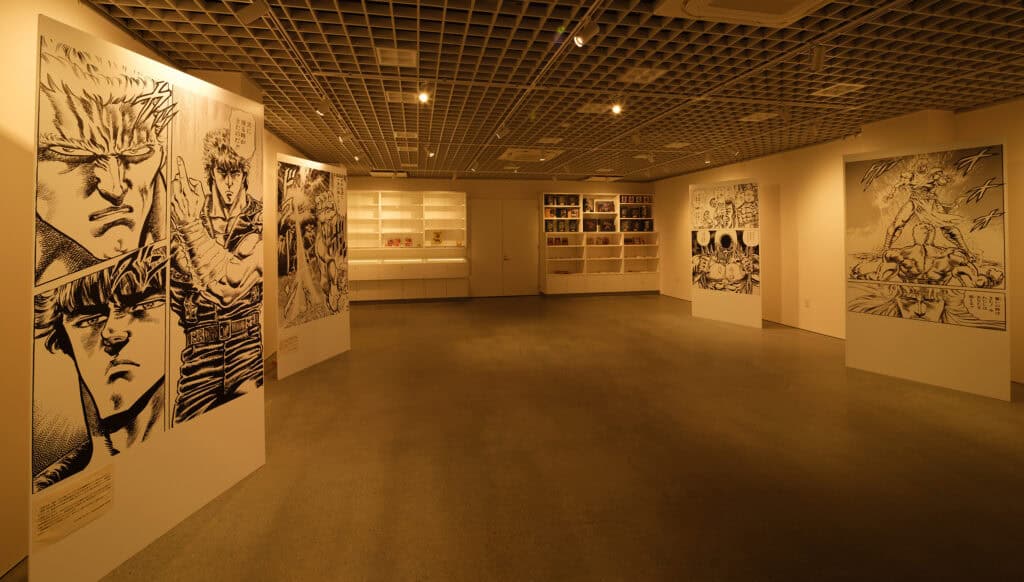
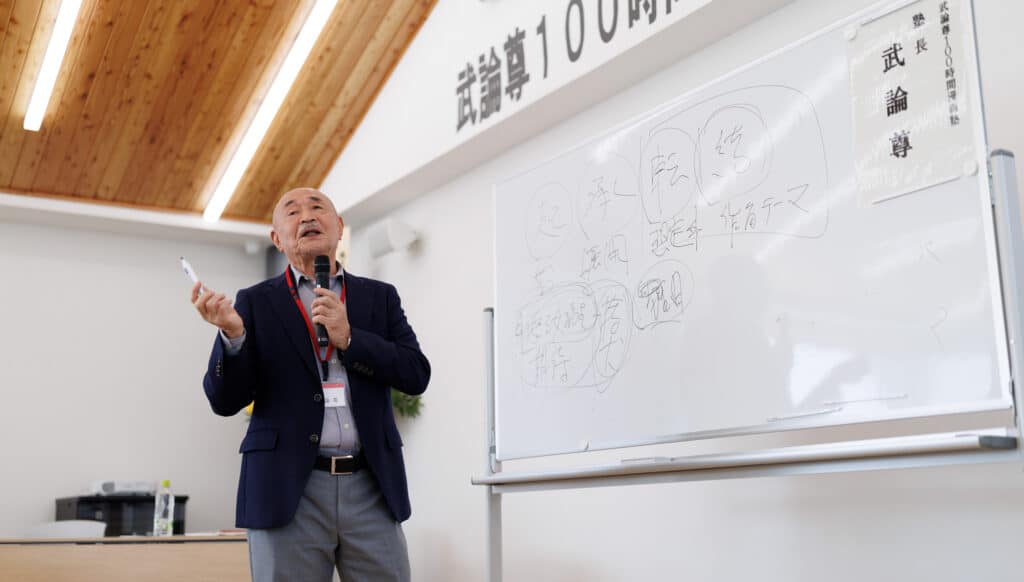
The school had until then occupied municipal premises, so Buronson decided to personally finance the construction of the Saku Manga-sha (さくまんが舎), inaugurated in 2024 near Sakudaira station. The building’s ground floor houses an exhibition space open to the public free of charge, while the classrooms are located on the upper floor. This permanent establishment gives the school a lasting foothold in the city of Saku, to which Buronson remains deeply attached.
He refuses, however, to take on the role of the retired old master. His last two series concluded in 2020 and 2023, and he freely admits that he currently has no project underway. The reason, he explains, is simple. No one is offering him a new series anymore. Some editors tell him with a smile that after a career like his, he could peacefully enjoy his retirement a remark that deeply irritates him. His reasoning goes beyond a simple matter of pride. If he were content to invoke his status as the writer of Fist of the North Star in order to give advice to young authors, people would inevitably end up asking what he is working on today. Having no answer to that question would mean, he believes, losing all legitimacy.
That is why he continues to approach publishers himself. He knows that his name alone is no longer enough to guarantee a project, and that it takes a certain audacity to go and pitch ideas to executives who are sometimes young enough to be his grandchildren. Being associated with Fist of the North Star fills him with gratitude, but being regarded as a man who belongs to the past is a label he categorically refuses to accept.
His view of the current state of the industry also surprises with its optimism. For years, talk of a publishing crisis has been a constant refrain, but Buronson believes manga is doing well. True, Shōnen Jump is far from its all-time record of 6.53 million copies reached in 1995, and its print run now hovers around one million copies. However, the rise of digital publishing has considerably expanded the market, and recent phenomena such as Demon Slayer demonstrate that it remains possible to achieve success on an exceptional scale. This reality reminds him of his own experience. When Doberuman Deka became a hit, his income multiplied more than tenfold in a very short time. At that point, he was still living in a modest six-tatami room with no bathroom. He uses that memory as an example to illustrate a simple conviction: despite the transformations in the industry, manga remains one of the few fields where a work capable of reaching its audience can still radically change its author’s destiny.
The chapter ultimately closes on one man, and it is neither Tetsuo Hara nor Horie Nobuhiko. Whenever he reflects on his school or his own journey, Buronson returns to Motomiya Hiroshi. Their meeting, at the age of fifteen, in the Self-Defense Forces, appears to him in retrospect as an event as improbable as it was decisive. Everything that followed was born from that encounter. Over the years, the two men became very busy authors and never seriously considered working together, each hesitant to make the first move. Yet Buronson says he spent his entire career with the feeling that Motomiya’s gaze was upon him. Among all his contemporaries, he is the only one from whom he could not have borne to hear that he was giving up.
Even today, as both of them approach their eighties, Motomiya continues to publish regularly. Buronson finds in this a constant source of motivation. As long as his old companion keeps moving forward, he feels he has no right to stop. To describe this relationship, he even borrows an expression dear to Fist of the North Star: that of the ultimate rival. A respected adversary whose very existence drives you to keep going.
Their shared history contains an episode that nobody talks about. Motomiya took a serious interest in politics, to the point of publishing a documentary series in Shōnen Jump from 1982 in which he depicted himself meeting party leaders, including a widely discussed interview with former Prime Minister Tanaka Kakuei. With the proportional voting system introduced in 1983 making independent candidacies difficult, he founded a Japanese Manga Party with fellow creators and asked Buronson to be second on the list. Buronson didn’t believe in it, until a newspaper reported the possibility of two seats. They withdrew, telling themselves that amateurs had no business in politics. The serialization of Hokuto no Ken began in the autumn of that same year. If Motomiya had insisted, Buronson concludes, he would have run, might have been elected, and would never have received the commission for Hokuto no Ken.
There remained the matter of his own death, a subject Buronson approaches with the mixture of bravado and melancholy that runs throughout the book. He notes that journalists now regularly ask him how he envisions his death. The reason seems obvious to him. They want to hear the man who staged so many memorable deaths speak about his own. To this question, he often answers that he would like to die in his bed beside a woman, before adding that he is only half joking. He adds with a hint of regret that his interlocutors invariably take this answer as a mere wisecrack.
His real answer lies elsewhere. To express it, he borrows Kenshiro’s words from the final pages of Fist of the North Star. “No need for a name on my grave!” and then “If I die, it will be on the battlefield!!”. Buronson admits he is still surprised to have been able to write such a line at such a young age. Unlike Raoh, he does not claim to be able to say one day that he will have no regrets. But he believes that continuing to struggle, to create, and to seek new stories until the very end will be the best proof that he has lived fully.
The afterword, and what it announces
The book closes with a few pages written in March 2026. Buronson reflects on the arrival of the new Hokuto no Ken anime, scheduled to air from 2026, and expresses his gratitude at seeing a new adaptation come to life more than forty years after the manga’s serialization began. For him, this exceptional longevity testifies to the strength of the work and the enduring attachment of its audience.
He also looks back on the careers of his two main companions along the way. Horie Nobuhiko continued to rise within Shōnen Jump, becoming editor-in-chief in the 1990s. Under his leadership, the magazine reached a historic record of 6.53 million copies distributed. Buronson notes, however, that this success was followed by a more bitter period. Sidelined from the world of manga within Shûeisha, Horie eventually left the publisher in 2000 to help found Coamix. He later established in his home region of Kumamoto an organization dedicated to training and supporting new talent, an initiative Buronson readily compares to the one he himself undertook in Saku.
Tetsuo Hara, for his part, has pursued a career marked by several major successes. After Hokuto no Ken, he went on to create Souten no Ken, with a screenplay by Horie Nobuhiko, and demonstrated the breadth of his talent with works such as Hana no Keiji. Through these final pages, Buronson celebrates not only his own career but that of an entire generation of creators who continued to build, each in their own way, long after the end of their most celebrated work.
Buronson closes by quoting Tetsuo Hara, and these few lines alone encapsulate the spirit of the entire book. On the occasion of the thirtieth anniversary of Hokuto no Ken, Hara declared his wish to make the series a work capable of spanning a century. Buronson does not consider this goal unrealistic. He then recalls another confession from the artist about the early days of the serialization. After the failure of his first series, Hara felt he had no way out and drew each chapter as if his life depended on it. For Buronson, this attitude perfectly captures the character of Kenshiro. Hara fought exactly like him, with no possibility of retreat and with the certainty that every battle was decisive.
His conclusion comes down to a simple formula. For Tetsuo Hara as for himself, Hokuto no Ken is not merely a successful manga. It is the sincere testament of a fight waged without compromise, the expression of everything they risked, endured, and gave during those years. More than a work, the series remains in their eyes proof that they truly lived.
Why is this book essential?
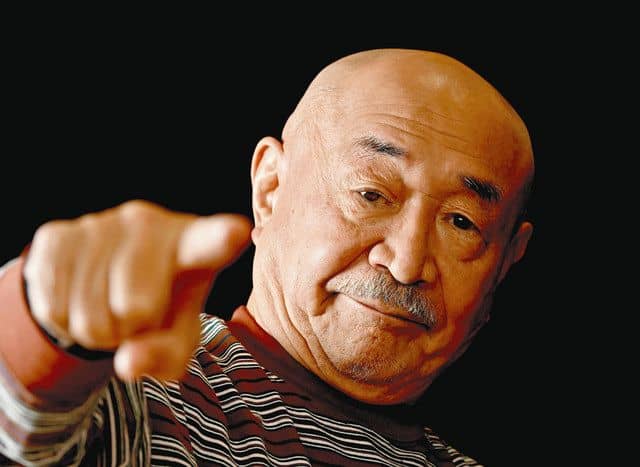
There are countless books devoted to manga, drawing, storytelling, or the mechanics of creation. This one belongs to a different category. Buronson himself acknowledges in his afterword that this book almost never came to be. The idea was not his, but came from a publisher who proposed it to him at a time when no one was entrusting him with new scripts anymore. He admits he accepted without any real enthusiasm, almost in spite of himself, driven more by his editor’s insistence than by any personal desire to recount his journey.
This admission illuminates the very nature of the book. Buronson has never cultivated the image of an author inclined toward confessions or introspective narratives. Throughout his career, he preferred to let his works speak for themselves rather than comment on his own life. That is precisely what gives this testimony its value. Behind the lessons on scriptwriting, the memories of drafting sessions, the anecdotes about Fist of the North Star, and the reflections on the craft, a man gradually emerges who accepts, for once, to open up. Not to build his own legend, but to pass on what decades of creation, success, failure, and encounters have taught him. At its core, this book is less a manual than a retrospective look at an entire life spent telling the stories of others.
What one finds in this book is rare. Buronson does not offer an academic theory of creation, but a way of thinking forged in the field, without filter or staging. He speaks as a man who has reached the heights of his profession while refusing to draw any moral authority from it. Throughout the book, the same idea recurs: the scriptwriter serves the work before serving himself. He readily describes himself as one cog among many, no more important than an ordinary employee, and believes that true judgment always belongs to the readers. This modesty runs through all his recollections, whether it concerns the deliberate distance he maintained from Tetsuo Hara during the serialization of Fist of the North Star, his insistence on the decisive role of the artist, or his conviction that the ability to efface oneself is one of the essential qualities of the profession.
This honesty extends even to the way he assesses his own career. Where others might construct a personal legend, Buronson sums up his journey with a baseball analogy and estimates his success rate at one hit in ten attempts. Nine out of ten projects failed commercially, and he draws neither bitterness nor excuses from that. This ratio is simply part of the job. In an era where everyone seeks to build their personal brand, enhance their image, and present themselves as an exception, this stance resonates almost as a counter-manifesto. Buronson celebrates neither individual genius nor success. He champions perseverance, hard work, humility, and the ability to keep going despite failure. This is no doubt what gives his testimony a reach that extends well beyond the world of manga alone.
Buronson warns from the very preface that this book is not a manual for success. Anyone looking for a guaranteed recipe to become a recognized author may, he suggests, miss the point entirely. Yet as the chapters unfold, a genuine working method emerges. It manifests in the chart drawn by hand before the first line of dialogue, in the necessity of giving each episode its yamaba and its miseba, in the conviction that a character is defined above all by their lines of dialogue, and in his scale of levels of evil, conceived not to classify antagonists but to measure the dramatic intensity of a story.
This method is never presented as a set of techniques detached from human reality. Quite the opposite, in fact. The further the book progresses, the more it reveals the personal cost of this work. Buronson mentions the psychiatrist he eventually consulted after spending years exploring the darkest aspects of human nature. He also speaks of the disruption to his nervous system during the serialization of Fist of the North Star, a direct consequence of a work schedule that had become unsustainable. Later, in 1992, he chose to withdraw for a time to a horse farm in Hokkaido to restore a balance that the creative process had severely tested. A more intimate truth gradually surfaces beneath the lessons on scriptwriting. Depicting evil, understanding human weaknesses and pushing them to their extreme consequences is not merely a matter of technique. It is an experience that ultimately weighs on the one who undertakes it. Buronson sums this up in a simple, understated phrase: digging all the way to the bottom of evil wears a man down.
His view of the present day avoids both nostalgia and doom-saying, which sets him apart from much of the discourse surrounding the industry. On one hand, Buronson voices very clear criticisms. The constant pursuit of flawlessness and marketing logic tend to homogenize works. Series increasingly resemble one another, main characters lose some of their distinctiveness, and artificially prolonged successes sometimes end up becoming a burden for their own creators. He also laments an evolution in editorial work. Where editors once sought to understand a particular artist’s strengths and weaknesses in order to support them, they now more readily demand a nēmu that is immediately effective and in line with market expectations.
Yet this criticism never leads to a narrative of decline. Buronson observes, on the contrary, that the manga market continues to grow thanks to digital publishing, and that new publishing phenomena regularly prove there is still room for works capable of leaving their mark on an era. His view of artificial intelligence follows the same logic. He does not regard it as an existential threat to creativity, arguing that a tool built on past works can only produce recombinations of what already exists. For him, true creation always springs from human experience, from intuition, or from a fresh way of looking at the world.
His response to these transformations is therefore neither complaint nor withdrawal. It takes a concrete form. Through the scholarship fund he established in Saku and the opening of a free manga school, Buronson’s primary aim is to multiply the opportunities for new talents to be discovered. Rather than mourning a vanished golden age, he prefers to create the conditions that will allow the next generation of creators to emerge.
What strikes one most, and what makes it impossible to read this book as a testament, is this: Buronson is not finished. He pushes back against the idea that he has nothing left to prove, refuses to be placed among the men of the past, says his masterpiece is still to come, and continues to bring his own projects to publishers young enough to be his grandchildren. When asked about his regrets, he answers that he has them, that he is full of them, and that this is precisely why he is human and why he can still write. Half a century of craft recounted without nostalgia or false modesty, by someone who speaks in the present tense.
One might be tempted to close by encouraging everyone to read this book. Unfortunately, that remains difficult for now. The work exists only in Japanese and no official translation has been announced to date. For obvious copyright reasons, it is equally impossible for us to share the translation produced for the purposes of this feature. If this exploration of Buronson’s thinking has left you wanting to go further, there is nevertheless one concrete step available. Interested readers can make their interest known to French-language and European publishers specializing in manga. A work of such richness, blending reflection on the creative process, the history of Shōnen Jump, the genesis of Fist of the North Star, and a retrospective look at more than half a century of career, more than deserves a place in French-language catalogs. Beyond its appeal to fans of Fist of the North Star, this book stands as one of the rare detailed accounts left by one of the most influential scriptwriters in manga history, which makes it a document whose publication in French would be entirely justified.
Publisher: Shogakukan / Collection: Shogakukan Shinsho n°507 / Date: April 2026 / Price: 1,078 ¥ (approximately €6) / ISBN: 9784098255078
Sources: Amazon Japan, Hanmoto (publisher)
Comments are closed.