

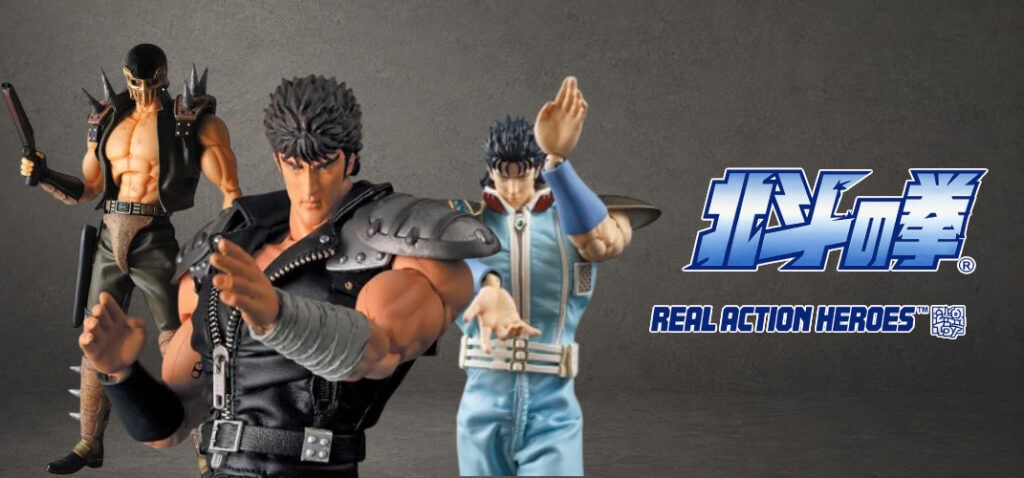
As every Friday, we revisit a line of Hokuto no Ken figures. This week, the spotlight is on four thirty-centimeter articulated dolls, dressed in real faux-leather clothing and sold for nearly twenty thousand yen each. Between 2008 and 2009, Medicom Toy and Kaiyodo joined forces around the license to create a line that has never been reissued since.
Medicom itself describes the operation as a “miraculous collaboration.” The phrase is marketing speak, but it rings true: the two companies are not in exactly the same business, and the line only exists because they agreed to pool their expertise.
The RAH301改 Massive prototype
It is often said that Medicom created a special body for Hokuto no Ken. That is an oversimplification. Three years earlier, in February 2005, the brand had already released a RAH301改 Massive under reference No.000, sold bare, without a dedicated character, for approximately 3,600 yen. The concept involved grafting musculature parts onto the RAH301改 skeleton, and the prototype was credited to PERFECT-STUDIO, with the muscular parts credited to Sawada Keisuke. The box contained a neutral soft vinyl head, open and closed hands, ankle rings to adjust height, and a display stand.
This Hokuto no Ken line is based on the Massive 3, the third generation of this body. The official description is clear: nearly all the parts were resculpted for the occasion. The distinction matters. Medicom did not create a muscular body specifically for the license; the brand already had this base and extensively reworked it to reproduce the extraordinary proportions of Tetsuo Hara‘s characters.
A skeleton known for its fragility
Japanese collectors regularly criticize the RAH301 for its fragility. An heir to the previous model, it features double-jointed elbows and knees as well as a new ankle joint. It gains considerably in mobility and realism, but at the cost of greater fragility. In other words, the flexibility that makes these figures appealing sometimes comes at the expense of durability.
The costumes by Akimoto Mieko
The official credits on the packaging help clarify the division of labor. Kaiyodo produces the base prototype. PERFECT-STUDIO then adapts it to 1/6 scale and develops the articulations. Finally, Akimoto Mieko crafts the costumes. Medicom systematically credits the clothing designers across the entire RAH line, such as Noda Yumiko on the Kamen Rider figures from the same period. This practice makes sense: on a clothed figure, the costume is not a mere accessory; it directly contributes to the silhouette and identity of the character. Here, the choice of faux leather even allows for reproducing the characteristic folds of the outfits drawn by Tetsuo Hara.
Kenshiro and Rei, spring 2008
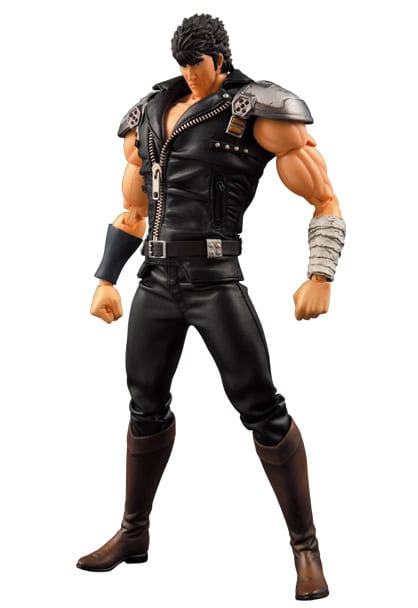
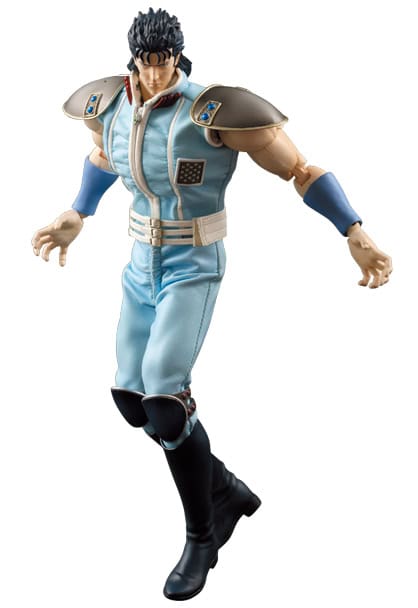
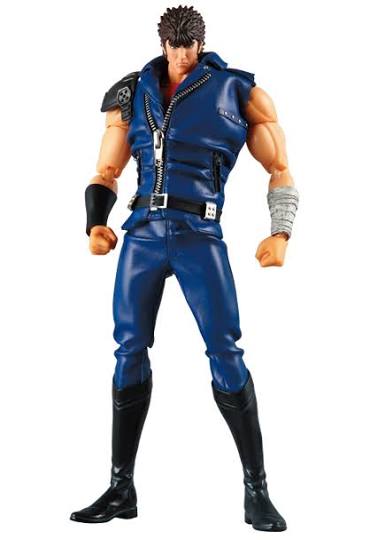
The series opens in April 2008 with Kenshiro, reference RAH333, at 18,900 yen. Five pairs of interchangeable hands cover the full range of combat poses. Rei follows in May, under reference RAH365 and at the same price. Two back-to-back releases, indicating a line launched with ambition.
The reference numbers also shed light on the place of these figures in the Medicom catalog. The RAH line now exceeds reference 780, and our four pieces occupy a narrow window between numbers 333 and 430, spanning just over one year of production.
Kenshiro 25th Anniversary Edition
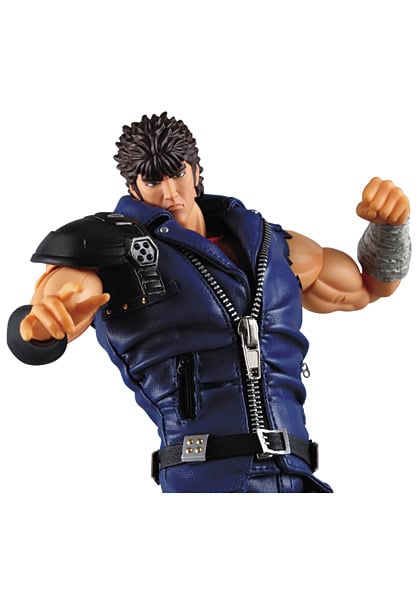
On August 3, 2008, a third reference appeared, outside the usual distribution channels. The RAH No.409 is an anniversary version of Kenshiro, released for the license’s twenty-fifth anniversary and sold at the summer Wonder Festival in Tokyo. The print run was limited to 600 copies, of which 200 were sold on-site and 400 online.
Six hundred pieces is very few, even for a convention exclusive, and this makes this Kenshiro by far the most difficult reference to obtain from the line.
Jagi brings up the rear
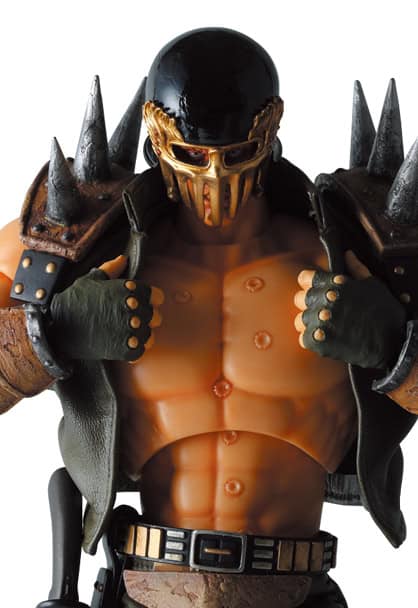
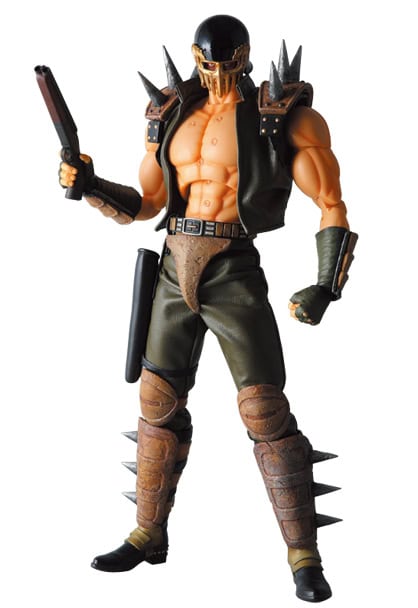
Jagi closes the series in May 2009, one year after the first two references. His official description opens with his catchphrase, “Say my name, go on!”, and the figure comes with his pump-action shotgun and removable helmet. His hands break from the pattern of previous releases: three on the left and four on the right instead of symmetrical pairs, including one designed to hold the weapon.
How to find them today?
All four references have been out of production for a long time and must be sought on the Japanese second-hand market. Three points should be checked before purchasing. First, the alternative hands, which are easy to lose and play a key role in price evaluation. Next, Jagi’s shotgun and helmet, for the same reason. Finally, the display stand, which is often missing from second-hand copies.
Then there is the question of the skeleton. Given the RAH301’s reputation, it is best to ask the seller whether the joints still hold poses properly and to handle with care a figure that may have remained in the same position for nearly twenty years. The costumes, on the other hand, hold up well; the faux leather of this line ages significantly better than the fabric of many clothed figures from the same era.
The details of all four references, along with their official visuals, are gathered on our page dedicated to the line.