

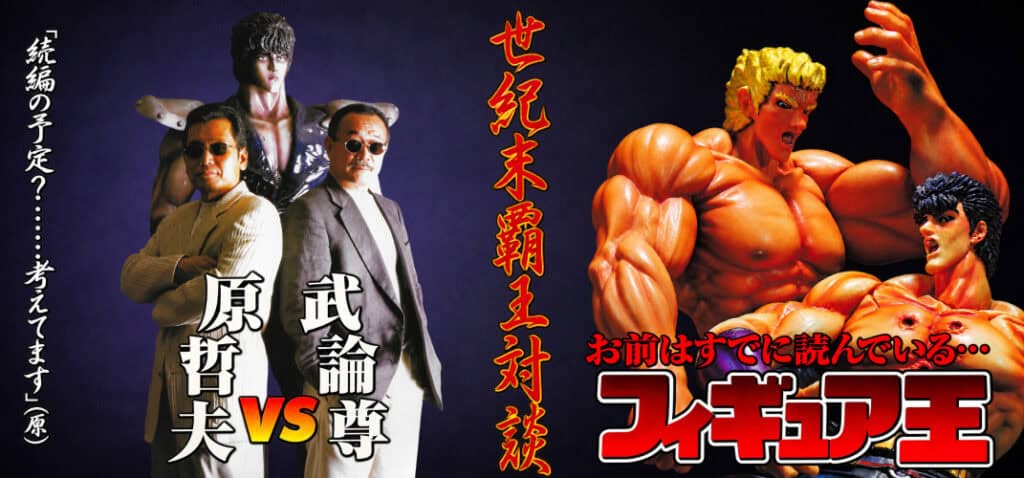
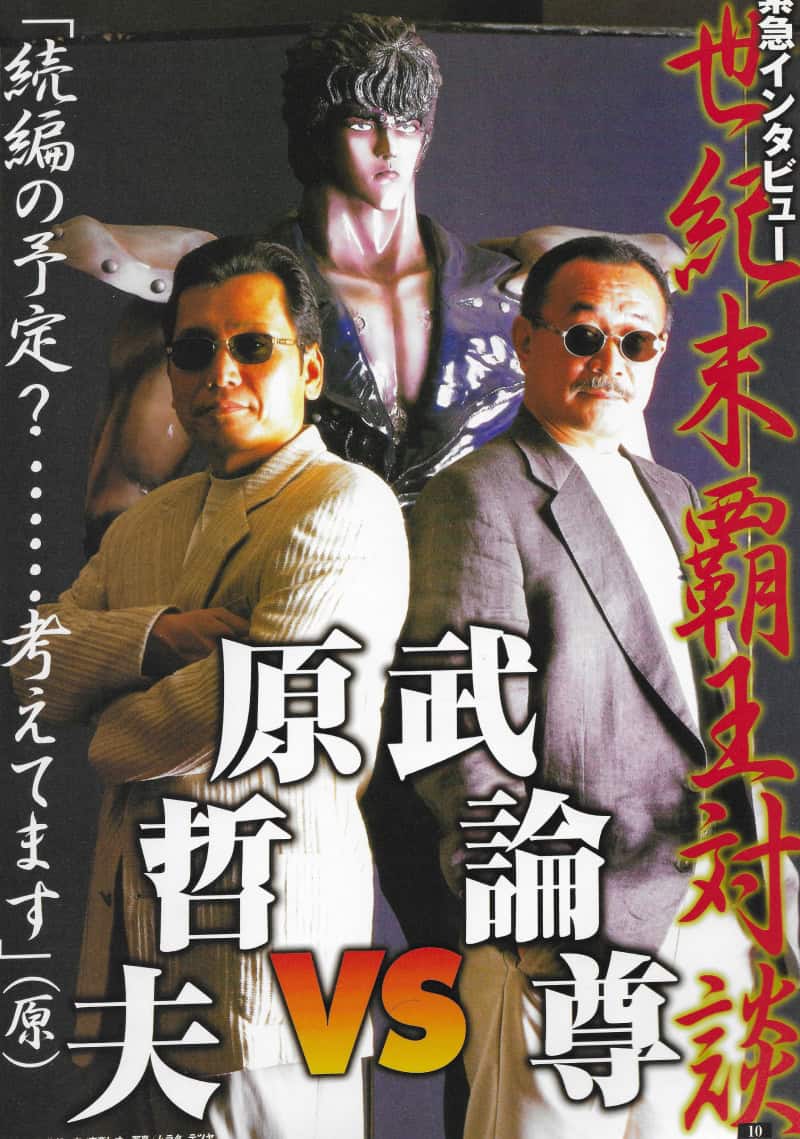
This week, we’re changing format. Instead of rediscovering a product line, we dive into the feature that Figure Oh magazine devoted to Hokuto no Ken in July 2000. At the heart of this special feature, an extensive interview. On May 26, in a lounge at the Tokyo Hilton Hotel, the editorial team set up a table covered with figures and seated Tetsuo Hara and Buronson on either side. The artist and the scriptwriter would spend the afternoon commenting on the figures based on their work.
A series created at a distance
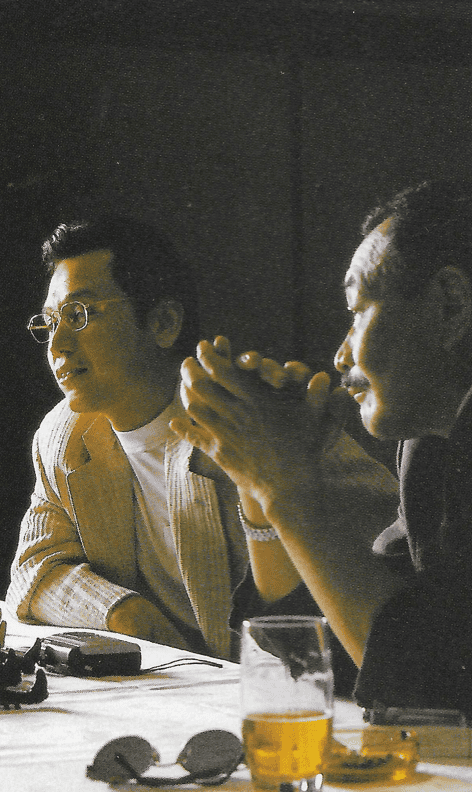
The first thing the interview reveals is that these two didn’t know each other well. According to Buronson, they never met during the five years of the series, as the editor had placed an intermediary between them. Buronson gives the reason in an amused tone.
Because they couldn’t let me rub off on Hara. (general laughter)
Buronson, Figure Oh no. 34, July 2000, p. 11.
Later, he explains how it worked. He never wrote anything in advance, he crafted the story week by week, and if he had known what Hara wanted to draw, he would have steered the narrative in that direction.
The editor didn’t keep them apart by accident; he wanted each of them to work without knowing what the other was preparing. Hara confirms this in his own way: he was never warned when a character was going to die, so he drew them with all his attachment, and that, he says, is why the reader never saw it coming.
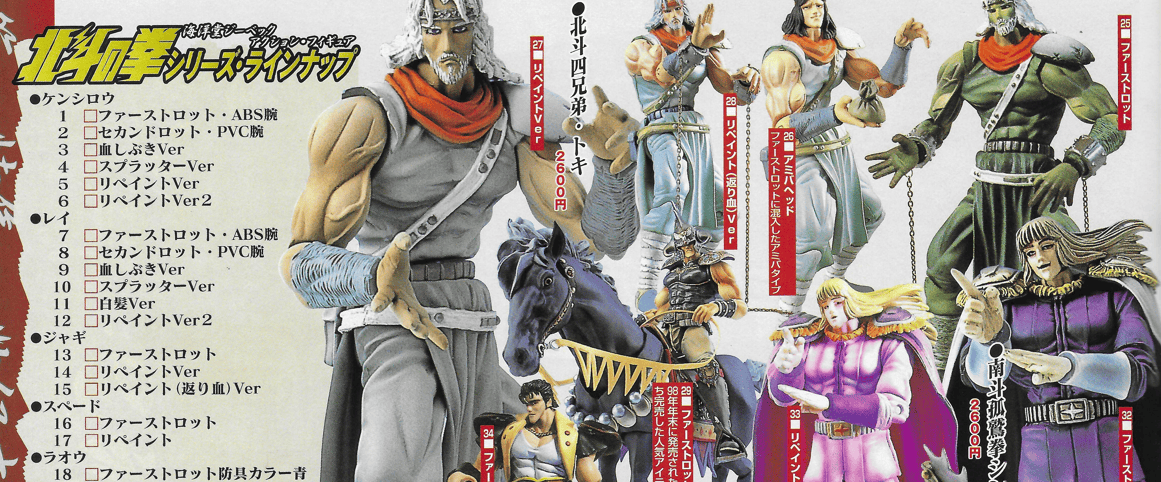
On the table, the Violence Action Figure line by Kaiyodo
The figures lined up in front of them are from the Violence Action Figure line by Kaiyodo, launched two years earlier. Buronson first admits he had no precise memory left of his work, then he recognizes Shin, the first true antagonist of the series.
Today, I’ve forgotten everything. (laughter) The first one is Shin, the one who gave Ken his seven scars. In the beginning, nobody planned to do that; it came along the way.
Buronson, Figure Oh no. 34, July 2000, p. 11.
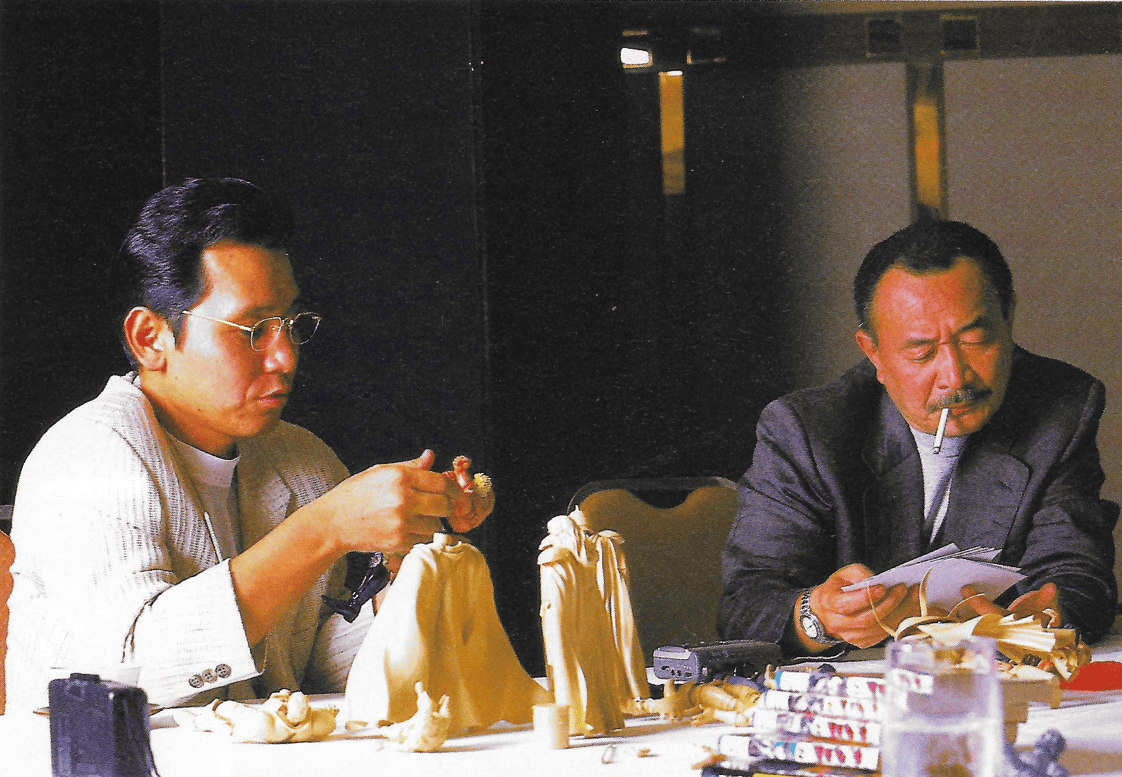
Hara looks at the Kenshiro figure and notes it was made based on the anime. The editorial team tells them the release order: Kenshiro and Rei in the first wave, Jagi and Raoh in the second, and Buronson immediately asks which ones sell. Kenshiro, Raoh, then Rei, they tell him.
Just like the popularity poll.
Buronson, Figure Oh no. 34, July 2000, p. 11.
The poll in question is the one that Weekly Shōnen Jump held among its readers during the serialization, and whose character rankings were published in the magazine.
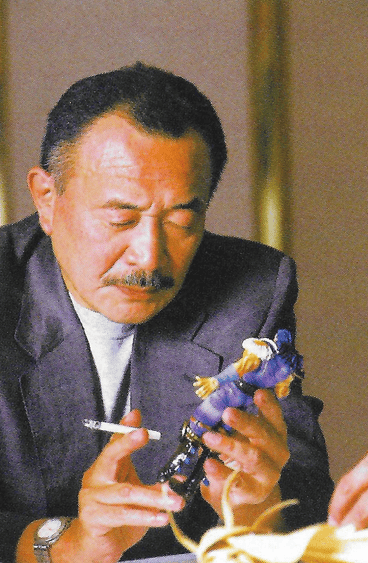
They then look for what’s missing. No women, Buronson remarks. No Yuria, Hara adds, nor Rin, nor Bat, nor Fudô (though the character is indeed present in the 199X line). Buronson, for his part, asks for Uighur, the warden of Cassandra prison, a character he was fond of. The idea was simple: a prison had just entered the story and it needed its jailer, the giant’s appearance being entirely from Hara’s imagination, as he had given him no specifics. The Raoh and Kokuoh box set passes through their hands. Hara had one at the studio and gave it away; everyone wanted it. Buronson remembers a flaw in the early versions.
On the first ones, the head kept popping off all the time. (laughter) The DX version released afterward is good, though.
Buronson, Figure Oh no. 34, July 2000, p. 11.
And then there’s Souther, on whom Hara pauses. This character, he had practically never drawn him outside the manga pages.
Souther, for example, you can see they really studied the original. I only did about one illustration of him, and it wasn’t even used on the volumes. Just one in color, and yet they went and captured even the smallest details…
Tetsuo Hara, Figure Oh no. 34, July 2000, p. 11.
Drawing in two dimensions but thinking in volume
Then the editorial team asks the question of volume. Was he thinking in three dimensions at the time? The answer comes in two sentences.
I was thinking in volume. It’s just that my drawing couldn’t keep up.
Tetsuo Hara, Figure Oh no. 34, July 2000, p. 11.
Then comes the question of Raoh, whom Buronson says he imagined without a model, from a single image: a huge man on a huge horse. The character didn’t exist yet when the horse entered the scene, hoofprints as wide as elephant feet, then the beast, then the rider. Hara, on the other hand, had nothing of the sort in mind. The editorial team expresses surprise at the character’s size.
The size is the one you see with the eyes of the heart. If the horse looks so big, it’s also an image seen through those eyes. The scale, I don’t think it’s accurate.
Tetsuo Hara, Figure Oh no. 34, July 2000, p. 11.
In other words, the artist himself warns that his proportions should not be taken literally. Every sculptor who has had to decide on Raoh’s size relative to Kenshiro has encountered this problem. It happens to be raised here by the one who created him.
Spawn, McFarlane, and a life-size Kenshiro
The editorial team mentions that the first Kenshiro by Kaiyodo owes something to Spawn. Hara doesn’t take offense; quite the opposite.
Oh really? Spawn was very well done; it’s thanks to him that people started making this kind of thing. I also want to release my own figures, through my own company.
Tetsuo Hara, Figure Oh no. 34, July 2000, p. 11.
The remark almost goes unnoticed in the flow of the conversation. It takes on a different significance when you know that Coamix opened its doors in June 2000, one month after this interview. Nobuhiko Horie, their former editorial manager, left Shueisha and founded the company with Hara, Tsukasa Hōjō, and Ryuji Tsugihara.
The room also features a life-size Kenshiro, which impresses Buronson. The editors tell its story: Kaiyodo made it without authorization and was called to order by the rights holder. Buronson estimates that if it were put up for sale, it would find a buyer. Later in the interview, Hara returns to the subject through a detour: in his youth, there were no poseable figures at all, there was hardly anything but GI Joe. And he cites Todd McFarlane, the creator of Spawn turned toy manufacturer, as an example of what doesn’t move forward unless you do it yourself. When invited to do the same with his own characters, he replies that he will soon be able to do so.
The 200X line previewed as an exclusive
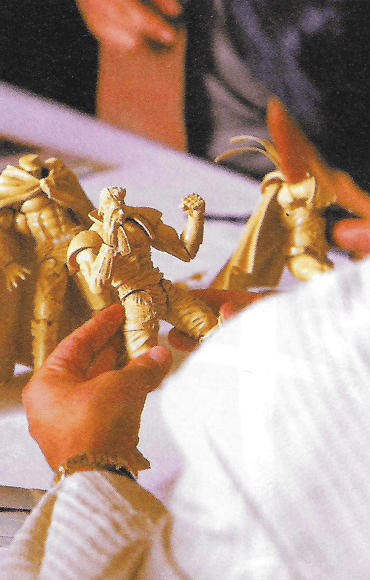
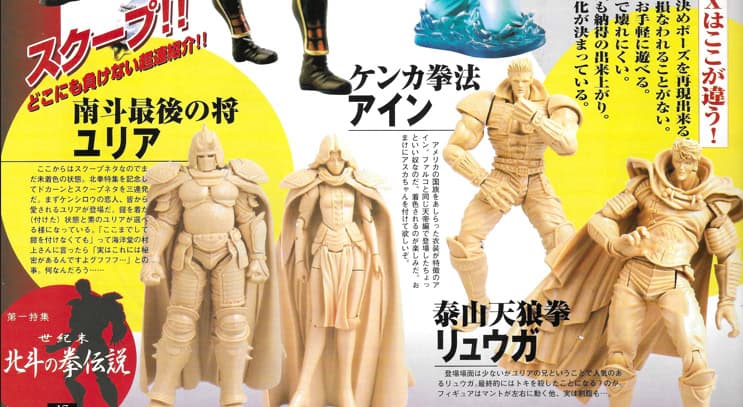
Then the editors bring out their exclusive. An object still in development, without final paint, articulated like no Hokuto no Ken figure had ever been before. Its name: Hokuto no Ken 200X. The articulation system is called mono shaft drive, it comes from Kaiyodo’s robots, and the selling point is simple: to almost entirely reproduce the exchange of blows between Kenshiro and Raoh. Hara discovers the object. He had not heard about it at all.
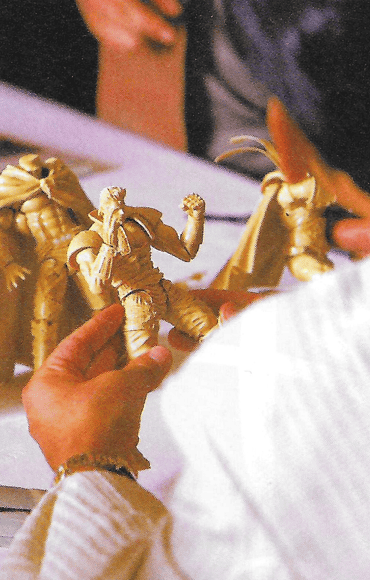
It’s the year 2000, it would be embarrassing not to be able to do at least this much. You have to make progress. But being able to pose it like this, that’s good.
Tetsuo Hara, Figure Oh no. 34, July 2000, p. 12.
Buronson asks if it was done through a computer. No, the editors reply, everything is done by hand, in a dedicated workshop, the joints are carved out by trial and error in modeling clay. Buronson predicts that other mangakas will see this and draw inspiration from it in turn. Hara, for his part, has already set his sights on one model.
That one, I want it.
Tetsuo Hara, Figure Oh no. 34, July 2000, p. 12.
The magazine then devotes three pages to this line. Among the six selling points it lists, the fifth takes up a single line: the result satisfies both Buronson and Hara. That is the interview we just read, turned into a commercial argument. We also learn who does the sculpting. Kenshiro and Raoh, the first two pieces, are entrusted to Yamaguchi Katsuhisa, the inventor of the articulated system, before the sculpting direction passes to Enoki Tomohide for the rest of the series. Shin and Heart are announced as the next releases.
What the interview announces for the future
The interview is not limited to the products, and it would be a shame to omit what it says about the rest. We learn that the series was supposed to end after three years, with the death of Raoh, and that the order to resurrect Yuria came from above, against the wishes of both authors. That Buronson has not received a single commission from the Jump editorial department since the series ended. That Hara, from the generation of Taiyō ni hoero!, the police drama where every detective ended up dying in the line of duty, drew Kenshiro thinking he would die at the end.
But the editors’ final question is about the future, and this is where the interview connects to what is about to happen. Buronson is not ready for it and refuses to do it half-heartedly. He gives his answer with a laugh.
If I run out of money, I’ll get back to it. (laughs) You’ve got to eat.
Buronson, Figure Oh no. 34, July 2000, p. 13.
He also makes any continuation conditional on the presence of Horie, the only person, he says, who understood this work better than anyone. Hara, for his part, is thinking about it. And he describes what he has in mind, without having yet spoken to his scriptwriter about it.
No. I haven’t talked to Buronson about it yet, but by changing the title, and keeping only the Hokuto Shinken. A technique that kills comes in handy. With just that, you could maybe go into another world. With someone of Kenshiro’s bloodline…
Tetsuo Hara, Figure Oh no. 34, July 2000, p. 13.
Souten no Ken begins the following year in the first issue of Weekly Comic Bunch, the Coamix magazine. Its hero is named Kasumi Kenshiro, sixty-second successor of the Hokuto Shinken. The Figure Oh interview names none of this. It only offers a glimpse of the early signs, one month before Coamix opens its doors.
The issue
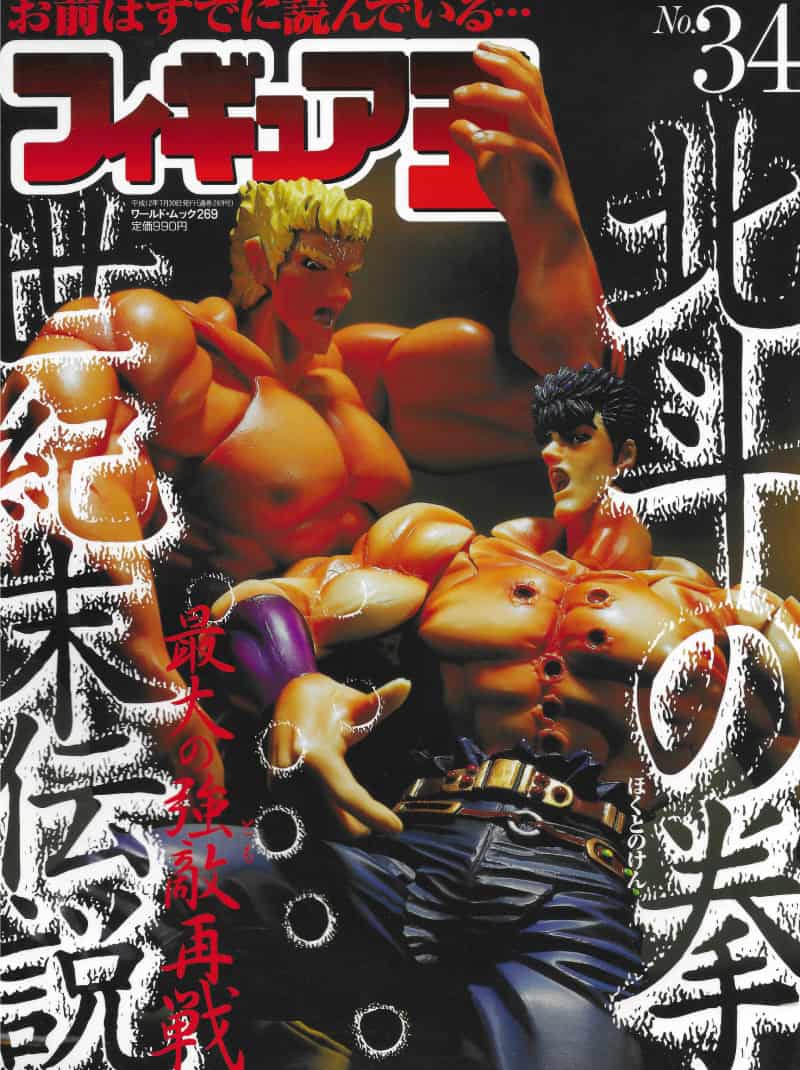
Figure Oh no. 34, World Mook 269, published on July 30, 2000 by World Photo Press, 990 yen. The Hokuto no Ken feature runs from page 9 to page 23.
In addition to the interview (text by Anzai Leo and photographs by Murata Tetsuya), it contains a recap of the fighting schools, a character chart, the three exclusive pages on the 200X, a catalog of products available in the summer of 2000, a look back at the Popy and Bandai toys from the 1980s, and a numbered list of the fifty versions of the Violence Action Figure line existing as of April 30, 2000, compiled under the supervision of Kaiyodo.
Sources
- Figure Oh no. 34, World Photo Press, July 30, 2000, pages 9 to 23. Interview 緊急企画 世紀末覇王対談・武論尊VS原哲夫, pages 10 to 13, recorded on May 26, 2000 at the Tokyo Hilton Hotel.
- All quotes are translated from Japanese by us.