


Details
- Original title
- るるぶ北斗の拳 世紀末最強ガイド
- People
- Buronson, Tetsuo Hara
Edition
- Publisher
- JTB Publishing (JTBパブリッシング)
- Collection
- JTBのMOOK (JTBのムック), series 聖地巡礼・サブカル
- Release
- March 23, 2026
- Colophon date
- April 1, 2026 (初版発行, print date of March 15, 2026)
- Price
- 1,500 yen before tax (1,650 tax included), digital edition 1,275 yen before tax (1,403 tax included)
- Pages
- 112 (all in color, 116 for the digital edition)
- Format
- AB format (257 × 210 mm), paperback, soft cover
- ISBN
- 978-4-533-17148-2
- ASIN
- 4533171486 (print), B0GQ2PM34B (Kindle)
Staff
- Original work
- Buronson (武論尊)
- Art
- Hara Tetsuo (原哲夫)
- Rights holders
- Coamix (コアミックス)
- Publisher
- JTB Publishing (JTBパブリッシング)
Written from a physical copy (colophon checked)
Gallery
 3View all images
Where to find it
Buy on Amazon JapanAffiliate link. As Amazon Associates, we earn from qualifying purchases.
MookHokuto no Ken
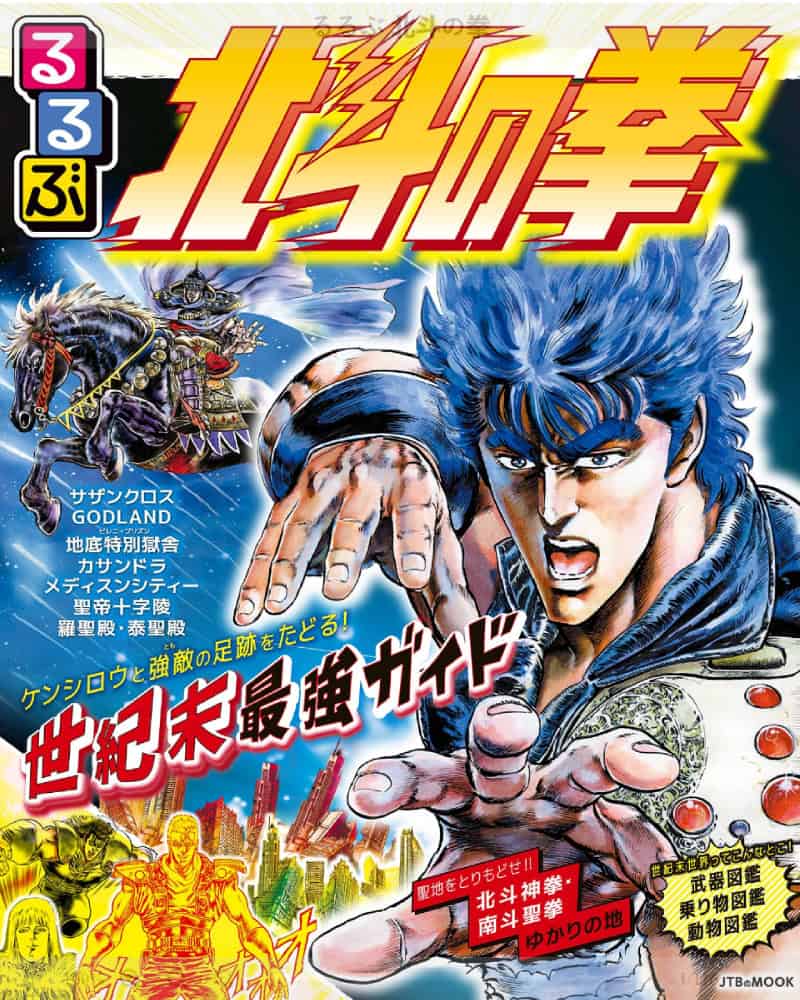
Rurubu Hokuto no Ken, the Ultimate End-of-Century Guide (JTB Publishing, 2026) るるぶ北斗の拳 世紀末最強ガイド
Overview
Rurubu (るるぶ) is the travel guide series of JTB Publishing, the publishing arm of the JTB tourism group. This volume, subtitled “The Ultimate End-of-Century Guide” (世紀末最強ガイド), applies its formula to the world of Hokuto no Ken to follow in the footsteps of Kenshiro and his opponents. It came out a few weeks before the broadcast of the new anime, to which it devotes its first spread.
The devastated world of 199X becomes a real destination. The series' usual sections are there, see, eat and drink, play, shop, sleep, along with others invented for the occasion, such as battle remains or naturalist profiles of gangs, most of them classified as extinct. Four illustrated encyclopedias present basic knowledge, weapons, vehicles and animals. The guide then divides the world into nine regions that follow the chronology of the manga, each with its model itinerary and a map rebuilt from the characters' journeys. One section lists the holy sites of the Hokuto Shinken and the Nanto Seiken, and the last page links each zone to the volumes of the Shinsōban edition.
The devastated world of 199X becomes a real destination. The series' usual sections are there, see, eat and drink, play, shop, sleep, along with others invented for the occasion, such as battle remains or naturalist profiles of gangs, most of them classified as extinct. Four illustrated encyclopedias present basic knowledge, weapons, vehicles and animals. The guide then divides the world into nine regions that follow the chronology of the manga, each with its model itinerary and a map rebuilt from the characters' journeys. One section lists the holy sites of the Hokuto Shinken and the Nanto Seiken, and the last page links each zone to the volumes of the Shinsōban edition.
Table of contents
Opening
- Prologuep. 1The full-page atomic mushroom cloud from the manga's prologue, “In 199X, the world was engulfed in nuclear flames!!” (一九九×年 世界は核の炎につつまれた!!), followed by a repurposed legal disclaimer: the guide's information dates from the year 199X and may have changed since then, due to violence and destruction.
- And yet we want to go, the end of the century!! (それでも行きたい 世紀末!!)p. 2Opening page: the world engulfed in nuclear flames presented as a harsh yet charming land, to be visited with one's usual values set aside.
- Follow Kenshiro's journey with the new anime!! (新作アニメでケンシロウの旅を追いかけろ!!)p. 3Double page dedicated to Hokuto no Ken -Fist of the North Star-, the new 2026 adaptation: technical details, cast and staff.
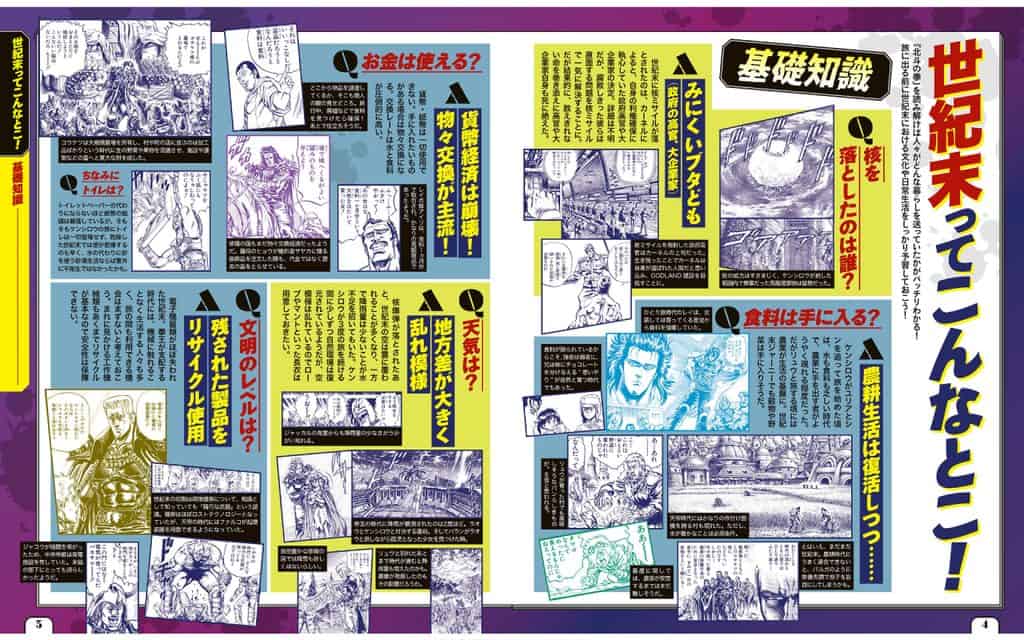
This is what the end of the century looks like! (世紀末ってこんなとこ!), the traveler's survival kit
- Basic knowledge (基礎知識)p. 4-5Survival tips, means of transportation, essential equipment checklist, weapons recommended by level, and traveler's precepts.
- Weapons encyclopedia (武器図鑑)p. 6-7The weapons of the 199X world, categorized and illustrated with manga panels reprocessed in two-tone color.
- Vehicles encyclopedia (乗り物図鑑)p. 8-9Motorcycles and trikes, the quintessential vehicles of the end of the century, with a comparison of the rides of Kenshiro, Jagi, Shin, Souther, Yuda, Falco, Kaiser, Mamiya, Bat and the gangs. Then four- and five-wheeled vehicles, armored vehicles of the Celestial Empire, the world's only train, ships including Akashachi's three-masted vessel, snow vehicles from the kingdom of Sava, and the editorial team's favorite, the buggy with enormous tires.
- Animals encyclopedia (動物図鑑)p. 10-11Surviving fauna observed with a naturalist's eye: raptors, crows, pigeons of the Imperial Capital, rats, bats, dogs, oxen, felines and horses, with a feature on Kokuō, Raoh's steed.
- Culture (文化編)p. 12Customs and traditions of the end of the century.
- Final checklist for the end-of-the-century journey (世紀末ジャーニー最終チェックシート)p. 13Final check-list before departure.
End-of-the-century area guide (世紀末エリアガイド), following in the footsteps of Kenshiro and his adversaries
- How to read the guide (エリアガイドの見方)p. 15Legend of the pictograms, the sections (見る, 飲む・食べる, 遊ぶ, 買う, 泊まる), the star ratings, and the maps, “imaginary diagrams of relative positions” (位置関係想像図) reconstructed from the characters' routes.
- The domain of KING (KING支配域)p. 16-23The village with underground water, the site of the first Hokuto Hyakuretsu Ken in the story, the village of Misumi and Southern Cross, presented as the region's largest entertainment city, with a floor-by-floor tour of Shin's tower, from the lobby to the throne room.
- The surroundings of Mamiya's village (マミヤの村周辺)p. 24-37The guide's core area: the oasis and its three-star-rated bar, GODLAND and the training facilities of Colonel's army, the village defended by Toyo, the underground prison of Villainy and the village of Mamiya, renowned for its safety since the disappearance of the GOLAN and Jackal.
- The domain of the King of Fists (拳王支配域)p. 38-48The lands of Raoh: the city with the statue of Jagi and the southern oasis, the region of Amiba's miracle village, the fortress of Cassandra (whose cells are offered as lodging), the eastern quarter of Mamiya's village, and Medicine City, Galf's medical town.
- The Nanto rising zone (南斗勃興域)p. 49-51In the footsteps of Rei and Shû: the city of Yuda, the hideout of the anti-Emperor forces and the construction site of Souther's Holy Emperor Cross Mausoleum.
- The King of Fists excursion zone (拳王周遊域)p. 52-57The lands tied to the Hokuto brothers: native villages, a village ruled by the King of Fists, Toki's village, Ryūga's fortress and Raoh's palace.
- The Hokuto march zone (北斗進軍域)p. 58-67The locations where the Five Stars of Nanto appear, the tower of the Last General of Nanto and the Hokuto Renkitōza.
- Take back the holy sites!! Places tied to Hokuto Shinken and Nanto Seiken (聖地をとりもどせ!! 北斗神拳・南斗聖拳ゆかりの地)p. 68-75The main Hokuto temple in the mountains, the dojo with Niō guardian statues, the dojo where one casts away tears, the training waterfalls of the young Kenshiro, the dojo with the tiger cage from the era of Jagi's betrayal, Fudô's dojo and its storehouse. Then sites connected to the people of Hokuto, Ryūken's grave before the Thousand-Armed Kannon statue, the nuclear shelter and Toki's clinic.
- The domain of the Celestial Emperor (天帝領)p. 76-87The refuge of Shōki, the City where the Hokuto army and Falco clash, and Jakoh's central Imperial Capital, the only city of the end of the century still gleaming, with its canal, its slave-powered electrical facilities and the exterior of the imperial palace.
- The Land of Shura (修羅の国)p. 88-103The most extensive section: landing beaches, coastline, Kaiser's county, Leia's village, the beach of origins, the castles of the three Rashō (Han, Hyoh and Kaioh), the Rashōden and Taiseiden palaces, and the tomb of Kaioh's mother. The 遊ぶ section suggests Shura cosplay, with a full cape and mask required.
- Ryū's adventure zone (リュウ冒険域)p. 104-109Following in the footsteps of Ryū, Raoh's son: the village where he was entrusted, Kōketsu's farm, the kingdom of Sava and the kingdom of Blanca.
- The end of the journey is the beginning of the journey, the hideout of Bolge (旅の終わりは旅の始まり…… ボルゲのアジト)p. 110-111Epilogue of the journey at Bolge's hideout, “the end of the journey is the beginning of the journey” (旅の終わりは旅の始まり).
Back to the Manga
- Volume correspondence table (紹介エリア掲載巻数一覧)p. 112The eighteen covers of the Shinsōban edition of Hokuto no Ken, connected by red threads to the guide's zones where each volume is referenced.
Table of contents translated and entry compiled by Hokuto Chronicles from the original book. First published on October 2, 2026. © 2026 Hokuto Chronicles. Any reuse, even partial or reworded, must credit Hokuto Chronicles with a link to this page.
Extras and supplements
- No bound supplements.
AI-assisted translation This page was translated from the original French using AI, with human review. Some wording may be imperfect. Read the original French version