

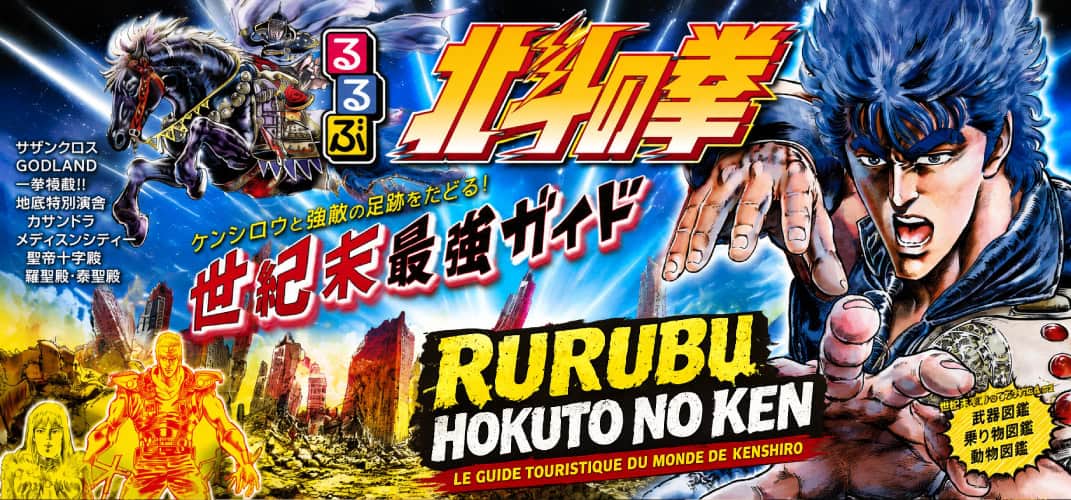
What if you went on vacation in the world of Hokuto no Ken? That is the promise, perfectly absurd and perfectly delivered, of “Rurubu Hokuto no Ken,” a Japanese mook that applies the format of Japan’s most famous travel guide to the post-apocalyptic world of Buronson and Tetsuo Hara. A guided tour.
A Rurubu guide like any other, or almost

In Japan, “Rurubu” (るるぶ) is an institution. This travel guide series, published by JTB Publishing, the publishing arm of tourism giant JTB, has been accompanying Japanese vacationers for decades. Its name comes from the final syllables of three verbs, miru (to see), taberu (to eat), and asobu (to have fun). Each guide divides its destination into zones, offers model itineraries, photo spots, addresses for grabbing a drink, and rates everything with little stars.
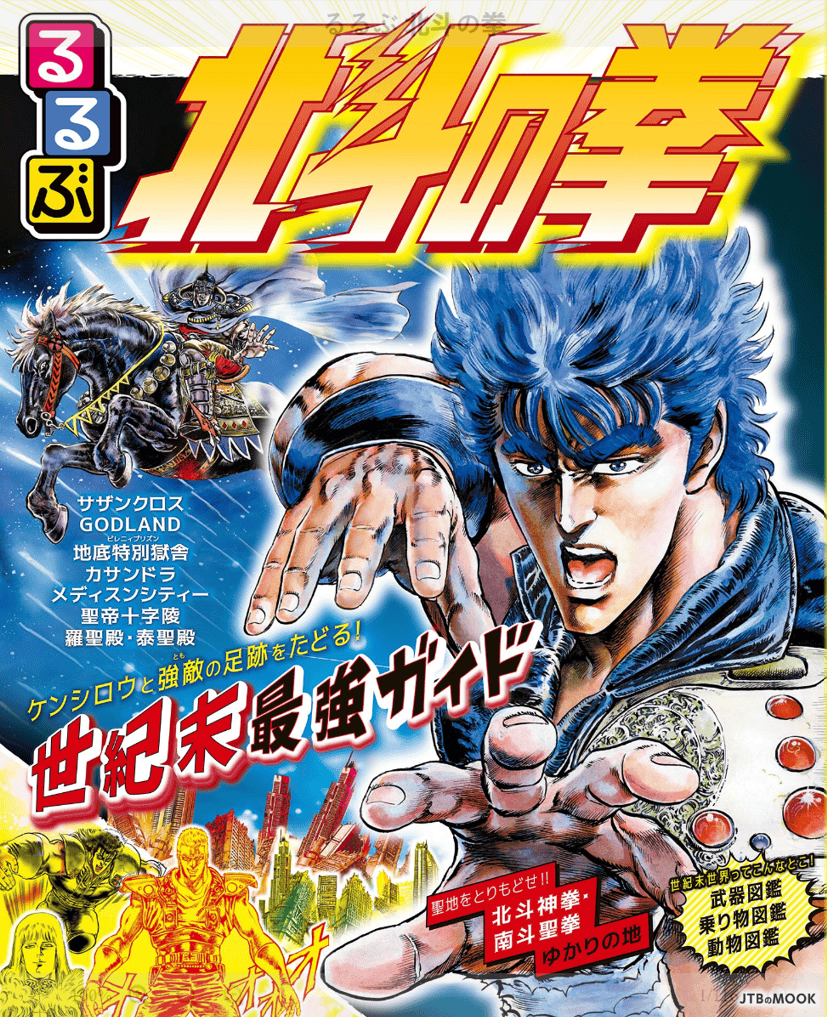
On March 23, 2026, JTB Publishing released a Rurubu unlike any other, the Rurubu Hokuto no Ken (るるぶ北斗の拳), subtitled “Seikimatsu Saikyō Guide,” the ultimate end-of-century guide. The concept involves treating the devastated world of Hokuto no Ken as an actual tourist destination, with the editorial rigor of a real Rurubu. The cover sets the tone with the promise of “following in the footsteps of Kenshiro and his most powerful adversaries” through Southern Cross, GODLAND, the underground prison of Villainy, Cassandra, Medicine City, and even the Rashōden and Taiseiden palaces.
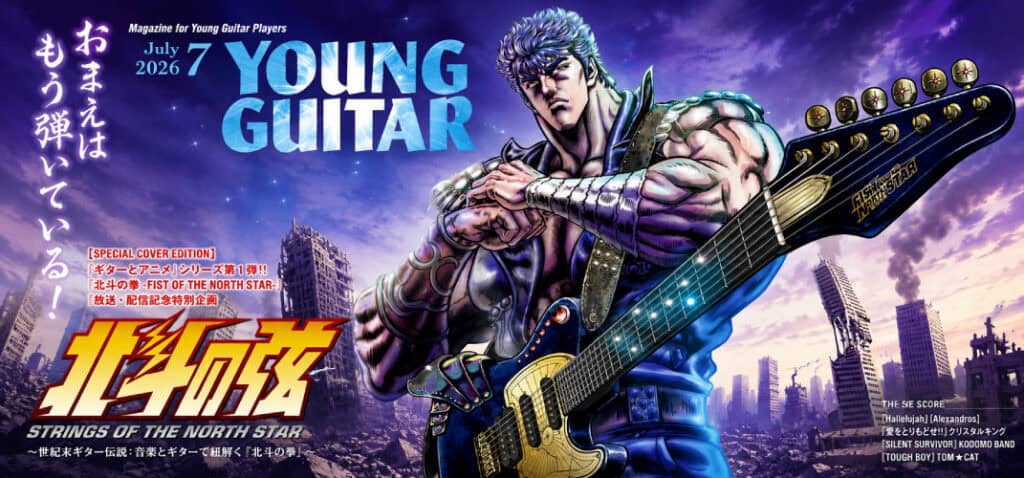
The release is no scheduling coincidence. It accompanies the launch of the new anime Hokuto no Ken -FIST OF THE NORTH STAR-, which has been airing in Japan since April 10, 2026 on Tokyo MX and BS11, and streaming worldwide on Prime Video. The mook dedicates its very first double page to the series, with technical details, cast, and staff.
A concept maintained from start to finish
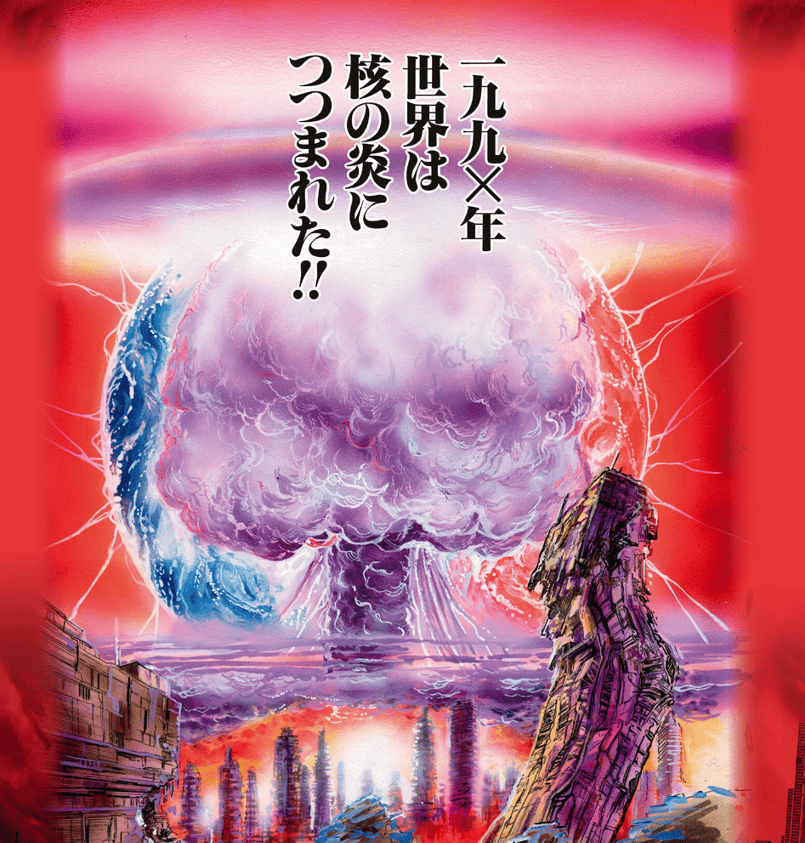
The book’s greatest strength is that it never abandons its concept. The world of 199X is treated as a perfectly normal tourist destination. The franchise’s universe, “engulfed in nuclear flames,” is presented as a harsh but charming land, to be visited by “setting aside your usual values” and embarking on the journey of the end of the century. The opening page reproduces the famous manga prologue, the atomic mushroom cloud in full page, before immediately moving on to a tongue-in-cheek legal disclaimer. The guide’s information dates from the year 199X and may have changed since due to violence and destruction; please verify before booking!
Beneath the humorous packaging, the mook rests on a thorough rereading of the manga. The itineraries, the relative positions of cities, the architecture of buildings, and the tour routes have all been reconstructed from the original scenes. And when the manga does not allow for a definitive conclusion, the guide flags its hypothesis instead of inventing an answer.
Each location from the manga becomes a “spot” covered using the collection’s classic categories.
- See (見る), viewpoints, panoramas, and “iconic scenes” to rediscover on site.
- Eat and drink (飲む・食べる), the bar at the oasis near Mamiya‘s village earns three stars on the “bar charm level,” thanks to the personality of its owner. Children are welcome and valuables are safe, since the stock is kept in a vault. The bar in Southern Cross, for its part, had the good taste of serving during the day and not only at night.
- Play (遊ぶ), bungee jumping from the upper floors of Shin‘s tower (where Yuria jumped, no less), parkour through Southern Cross’s skyscrapers “along Kenshiro’s route,” or a “street attraction” that involves walking on the trap-net from the manga’s very first village.
- Buy (買う), jewelry from the artisan village in the Land of Shura, or why not the “blood cross” branding iron available in Southern Cross: “simple design, souvenir guaranteed for life.”
- Sleep (泊まる), Cassandra’s cells are offered as accommodations. The shared cells are “suitable for families as well as group trips,” the solitary dungeon becomes a “special suite for small groups seeking privacy,” and an early morning wake-up call is guaranteed by the staff. The less adventurous can opt for old Toyo’s bed and breakfast (“maximum hospitality, defense rifle included”) or Jagi‘s old-school club, with rooms upstairs and a heliport on the roof.
Other categories were created just for the occasion. The “historic battle sites” (闘いの史跡散策) bring the great duels back to life at their actual locations, starting with the tower summit where Kenshiro faces Shin. Photo spots are marked with a camera icon. The “People! People!” section introduces local figures: Yuria and Shin, the bar owner, or Shōki the benefactor of the Celestial Emperor’s domain.
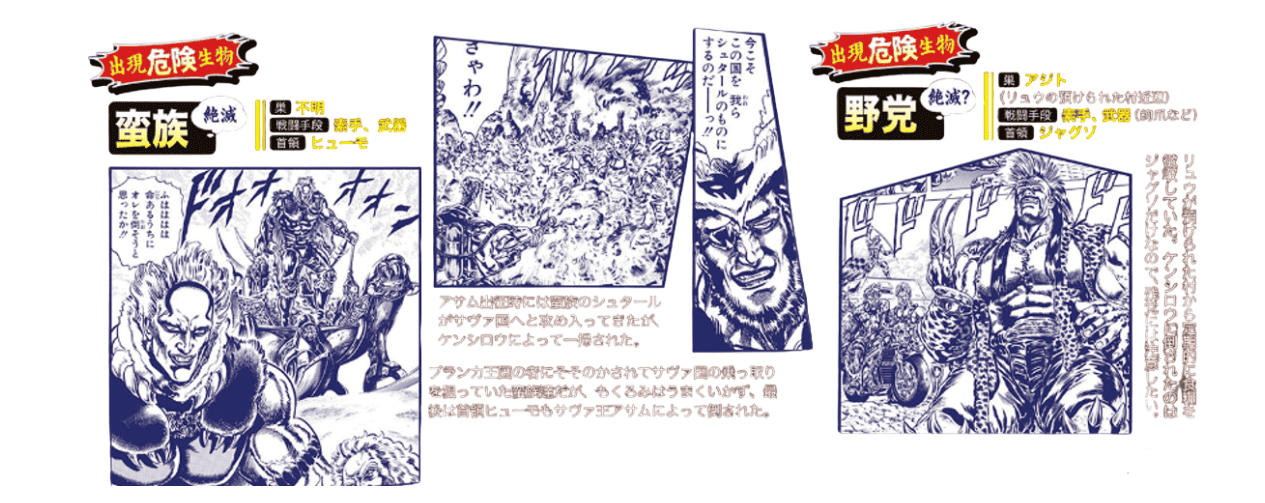
The best part is the “dangerous creatures” infoboxes (出現危険生物), which catalog local gangs as if they were animal species. KING, Zeed, the GOLAN, the Fang Clan, and Jackal‘s gang each get their own naturalist profile, with habitat, combat methods, pack leader, and conservation status. Most are classified as “extinct” (絶滅), in other words, Kenshiro has been through there. A few gangs only receive an “extinct?” or a “dissolved,” two designations that offer no guarantee to the traveler that they won’t run into them.
Each zone also receives a star rating whose criterion changes every time, in the purest tradition of Rurubu, subverted. The underground water village is judged on its “degree of emotion,” Southern Cross on its “degree of entertainment,” the castle of Hyoh and its fountains on their “degree of water features,” the battlefields of the Celestial Emperor’s domain on their “degree of falling,” the county of Kaiser on its “degree of inhumanity,” and Medicine City on its “degree of critters.”
Nine zones, model itineraries, and “hypothetical” maps
The heart of the mook is a zone-by-zone guide that roughly follows the manga’s chronology. The world is divided into nine major regions. Each has its own layout color scheme, numbered model itinerary, and internal page references, exactly like a real Rurubu.
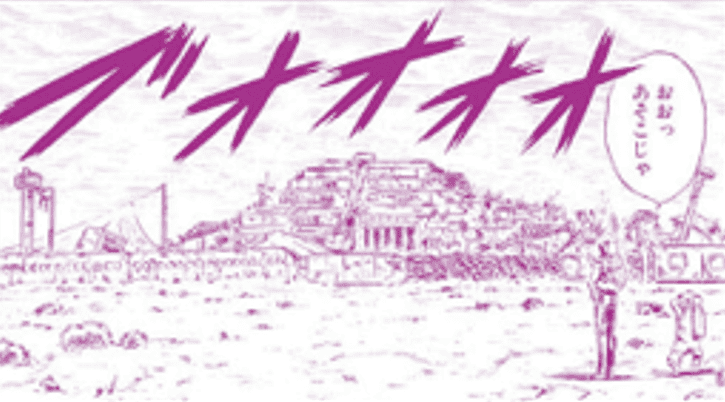
The domain of KING (p. 16) opens the journey with the underground water village where it all began, “the site of the first Hokuto Hyakuretsu Ken in history, a moving page,” the village of Misumi, and Southern Cross, presented as “the largest entertainment city in the region.” A guided tour of Shin’s tower is included, floor by floor, from the lobby to the throne room and its sumptuous armchairs “that betray the tastes of the master of the premises.”
The surroundings of Mamiya’s village (p. 24) form the “heart zone” of the guide, with the oasis and its bar, GODLAND and the training facilities of Colonel‘s army, the village defended by Toyo, the underground prison of Villainy, and Mamiya’s village itself, renowned for the quality of its security since the disappearance of GOLAN and Jackal.
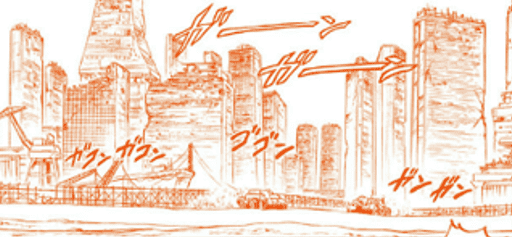
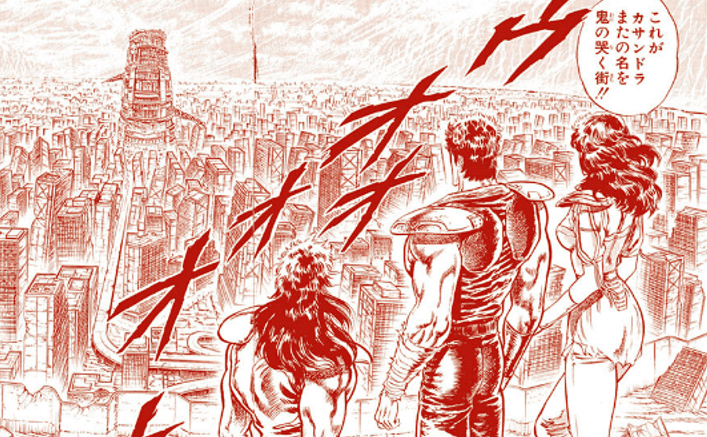
The domain of the King of Fists (p. 38) covers the lands of Raoh, the town with Jagi’s statue, the southern oasis, the region of the “miracle village” (Amiba is not far), the fortress of Cassandra, “the legendary prison-city,” and Medicine City, Galf’s medical town, where the “Play” section recommends going to see the dogs, “provided you truly love them.”
The Nanto development zone (p. 49) follows Rei and Shû, with the city of Yuda, the hideout of the anti-Emperor troops, and the massive construction site of the Holy Emperor’s Cross Mausoleum. A “dangerous creatures” sidebar is devoted to Souther‘s child recruiters, also extinct by now, what a relief.
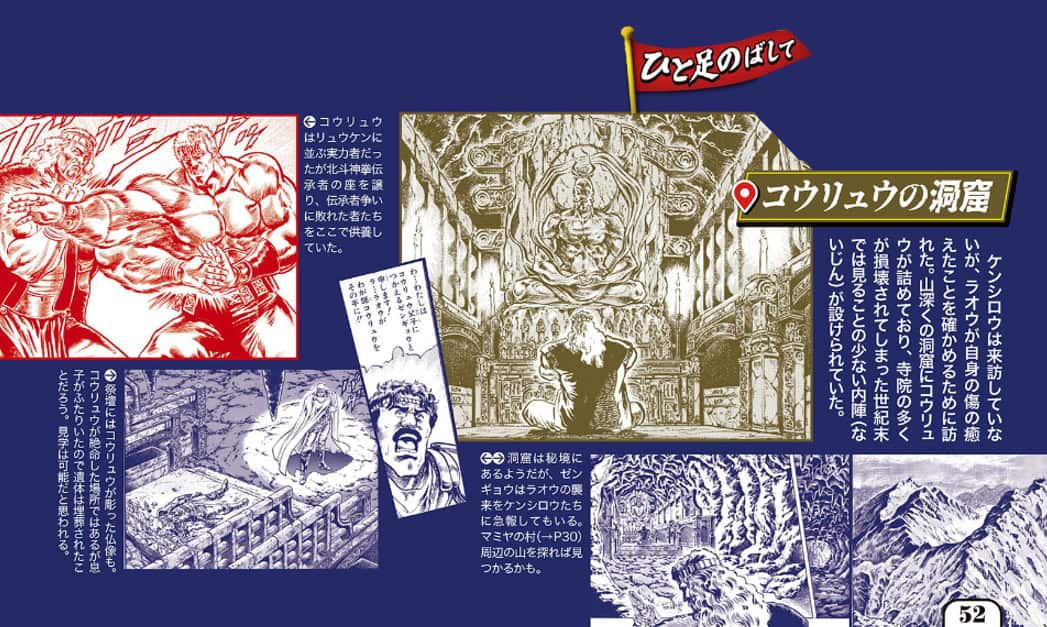
The King of Fists excursion zone (p. 52) explores the lands linked to the brothers of Hokuto: native villages, Toki‘s village, Ryūga‘s fortress, and Raoh’s palace.
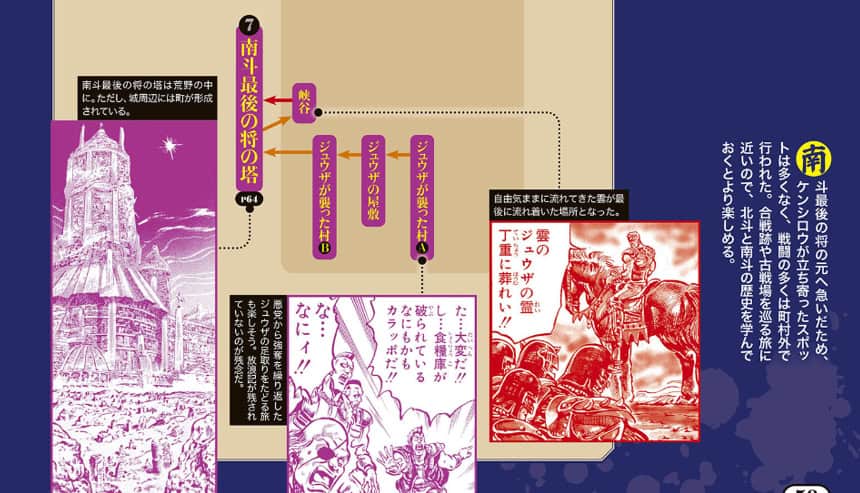
The Hokuto marching zone (p. 58) gathers the locations where the Five Stars of Nanto (Nanto Goshasei) appear, the castle of the Last General, and the Hokuto Renkitōza.
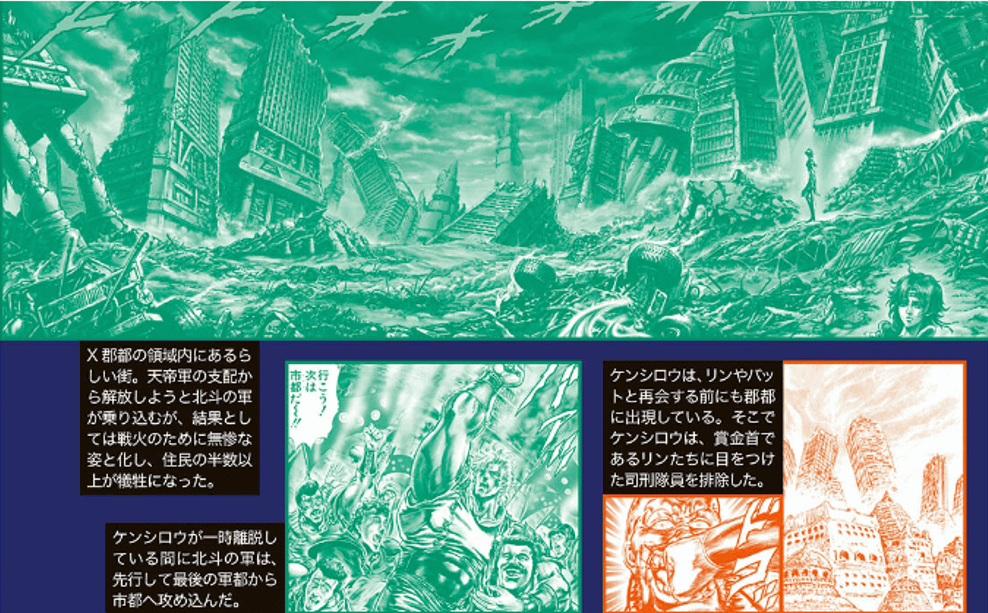
The domain of the Celestial Emperor (p. 76) is the heart of the Celestial Emperor arc, with Shōki’s refuge, the City where the Hokuto army clashes with Falco, and Jakoh‘s central Imperial Capital, “the only city still gleaming at the end of the century,” its canal, its electrical facilities powered by hundreds of slaves (“the hidden side of the scenery, worth pondering”), and the exterior of the imperial palace.
The Land of Shura (p. 88) is the most extensive section, from the landing beaches (“plan on camping, the terrain is rough beyond the coast”) to the county of Kaiser and the village of Leia, then to the castles of the three Rashō, Han, Hyoh, and Kaioh, all the way to the Rashōden and Taiseiden palaces and the tomb of Kaioh’s mother. The “Play” section even suggests cosplay: dressing up as a Shura to “understand a different culture through immersion,” full cape and mask required.
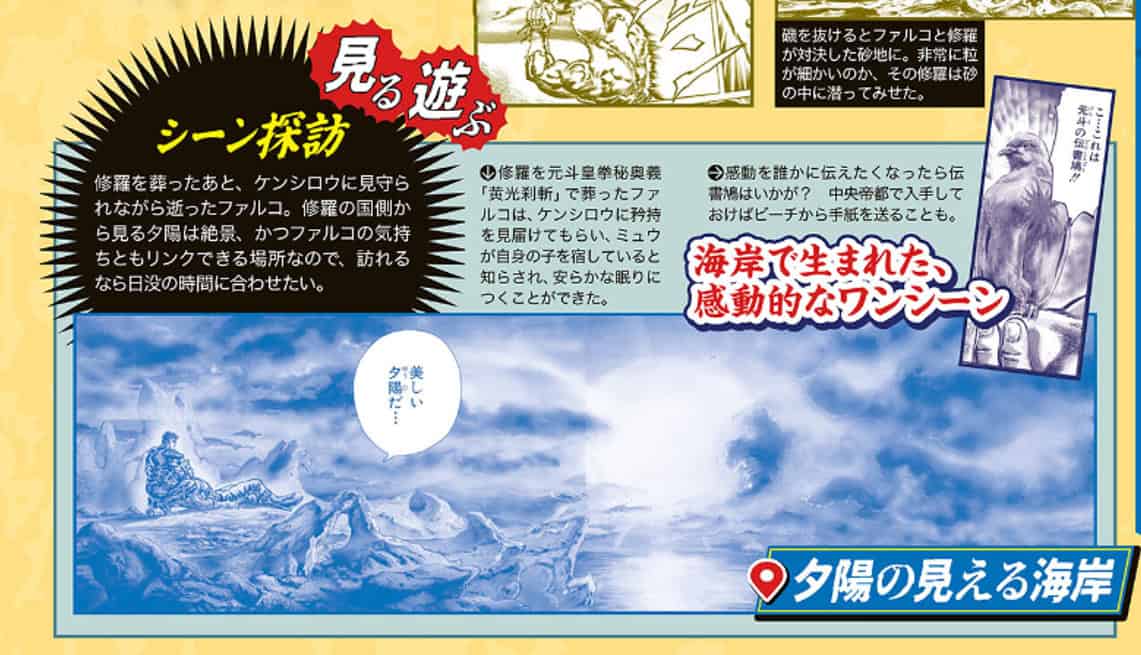
Ryū’s adventure zone (p. 104) closes the journey following in the footsteps of Raoh’s son, Ryū, the village where he was entrusted, Kōketsu’s farm, the kingdom of Sava, and the kingdom of Blanca, before the epilogue at Bolge‘s lair (p. 110–111), beautifully titled “the end of the journey is the beginning of the journey…”
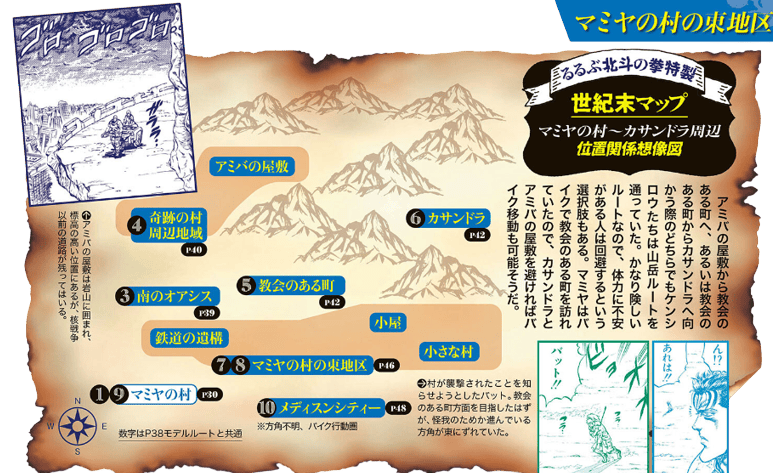
Each zone features an “end-of-century map” styled like parchment, soberly titled “imaginary diagram of relative positions” (位置関係想像図). Since the manga never provided precise geography, the authors reconstructed plausible maps based on the characters’ travels. A footnote specifies that “this diagram is solely intended to help understand the characters’ movements and may differ from actual distances and topography.” These maps do not come from the manga; they were created specifically for the guide, with the same mock seriousness as the rest of the book.
The traveler’s survival kit
Before the guide proper, the mook opens with a section titled “What is the end of the century like?” that compiles four illustrated encyclopedias using manga panels reprocessed in two-tone printing.
The weapons encyclopedia (p. 6) and the basic knowledge section (p. 4) provide survival tips, means of transportation, a list of essential equipment, weapons recommended by level, and “traveler’s precepts.”
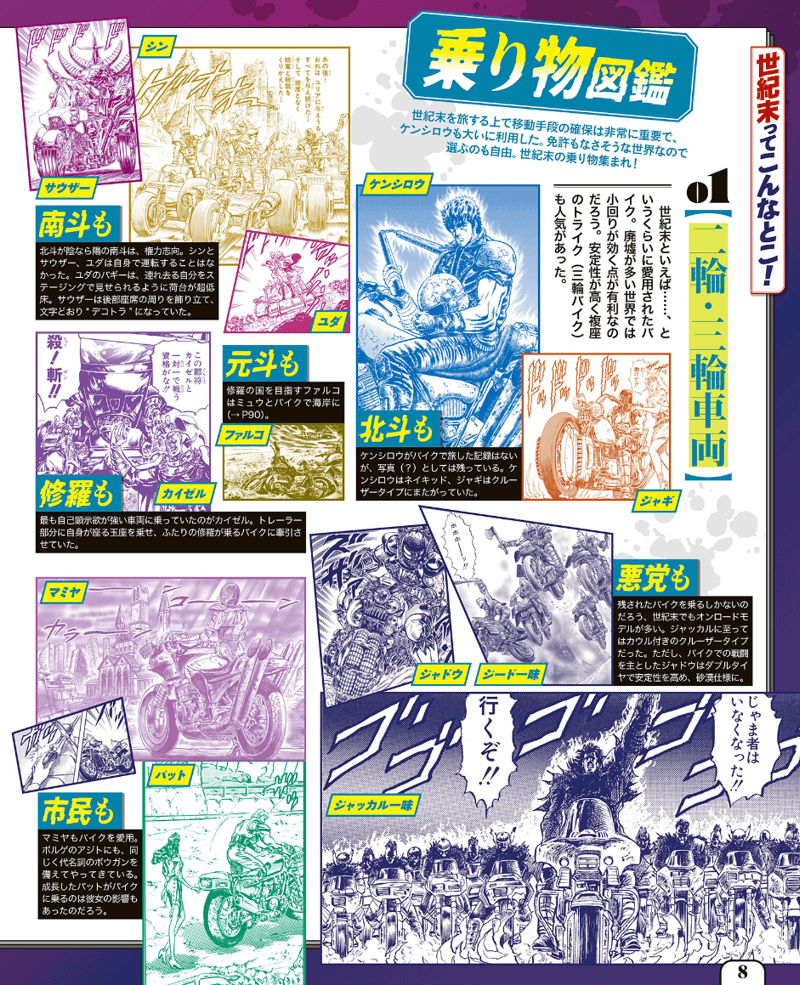
The vehicle encyclopedia (p. 8) classifies the means of transportation. Motorcycles and trikes form “the king of vehicles at the end of the century,” with a comparison of the rides of Kenshiro, Jagi, Shin, Souther, Yuda, Falco, Kaiser, Mamiya, Bat, and the various gangs. Next come four- and five-wheeled vehicles, the armored vehicles of the Celestial Empire, the world’s only train (belonging to a Shura from Kaioh’s entourage, steam-powered due to the lack of electrical infrastructure), ships, including the three-masted vessel of the pirate Akashachi, “probably capable of sailing on the open sea,” and snow vehicles in the mountains of the kingdom of Sava. The editors even have their personal favorite: the futuristic buggy with enormous tires, whose “roar is just too cool!”
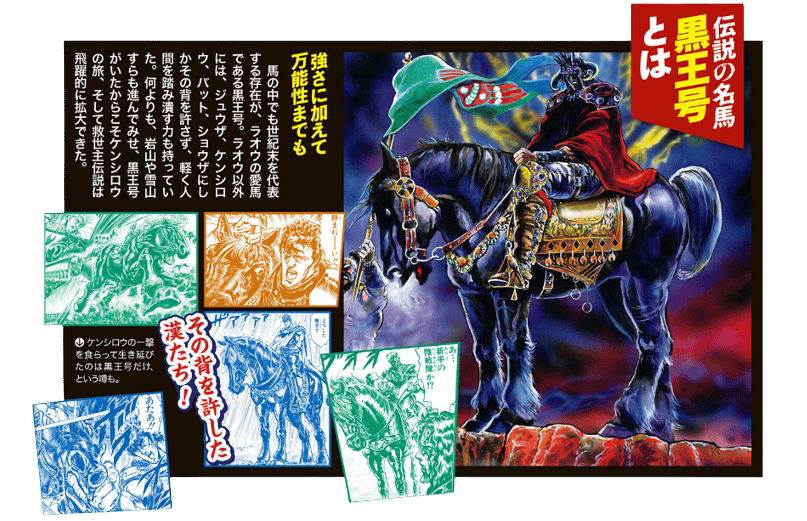
The animal encyclopedia (p. 10) observes the surviving fauna with a naturalist’s eye: raptors, crows (observed in great numbers during the duel between Raoh and Toki), pigeons of the Imperial Capital, rats, bats, dogs (companions or food supply, a touchy subject), cattle, felines, and horses. A sidebar is dedicated to the legendary Kokuō, Raoh’s steed, “versatility on top of power,” rumored to be the only living being to have survived a blow from Kenshiro. One legitimate question remains: have fish completely disappeared?
A culture section (p. 12) and a final checklist for the end-of-century trip (p. 13) round out the gear of the perfect post-apocalyptic tourist.
The holy sites of Hokuto and Nanto
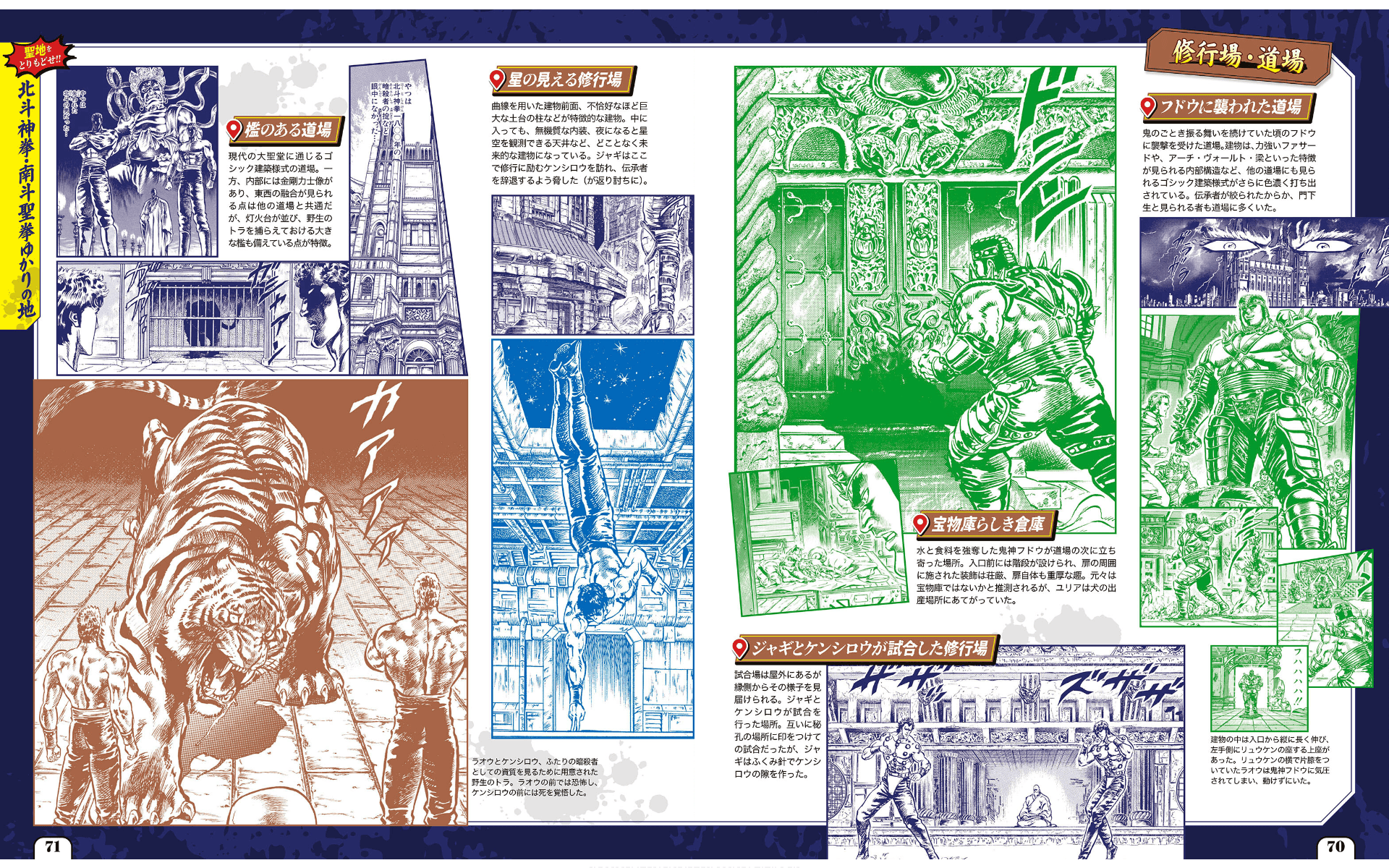
In the middle of the guide, a section titled “Reclaim the holy sites!!” (p. 68) lists the locations tied to Hokuto Shinken and Nanto Seiken as so many historical monuments. It features the main Hokuto temple in the mountains, from which rejected candidates were immediately banished, the dojo with its Niō guardian statues several meters tall, the dojo “where one casts away tears” (the one where Raoh forbade himself from crying), the training waterfalls of the young Kenshiro, the Gothic dojo with a tiger cage where Kenshiro trained during the time of Jagi’s betrayal, the dojo of Fudô, and even the warehouse of that same dojo, probably a former treasure hall, which Yuria had requisitioned as a whelping room for a dog.
Also included are the “places connected to the people of Hokuto.” The tomb of Ryūken was erected in front of a statue of the Thousand-Armed Kannon. The tombstone was broken by Shin, but the immense statue remains a valuable landmark for locating the site. Next come the nuclear shelter where the heroes survived for two weeks, and Toki’s clinic, which concerns the guide, as the building very likely collapsed and the accounts left by Amiba’s fake Toki remain the best available source.
The mook even contains, according to the publisher, a “stick your head through” photo cutout board featuring the Dekai Babaa, the fake old woman from the manga, the kind of board found in front of Japanese tourist attractions.
Back to the manga
One last element anchors the madness in reality. The very last page (p. 112) offers a correspondence table between each zone of the guide and the volumes of the Shinsōban edition of the manga (18 volumes), “to go back to the original” if nostalgia strikes. All 18 covers are reproduced, linked to their zones by a pattern of dots and red threads. After about a hundred pages spent visiting a destroyed world, the guide closes the journey by sending you back to the manga.
Technical specifications
- Title: Rurubu Hokuto no Ken (るるぶ北斗の拳), JTB no Mook collection
- Publisher: JTB Publishing
- Release: March 23, 2026 (Japan). The colophon indicates a first printing as of March 15, 2026 and a first edition as of April 1st, 2026.
- Format: AB (257 × 210 mm), 112 full-color pages
- Price: ¥1,500 before tax, ¥1,650 including tax (approximately $1)
- ISBN: 978-4-533-17148-2
- Language: Japanese only
- Copyright: © Buronson, Tetsuo Hara / Coamix 1983, © JTB Publishing 2026
- Where to buy: Japanese bookstores, Amazon Japan, and import websites
Verdict
The Rurubu Hokuto no Ken succeeds where many parodic tie-in products fail. It does not settle for a surface-level gag; it goes much further by maintaining its concept across 112 pages without ever breaking character. The layout is that of a genuine Rurubu. Pictograms, colors, stars, info boxes, tables, itineraries, “a little detour” sidebars: everything is faithfully reproduced. The book does not imitate a Rurubu; it is a real Rurubu, and it is precisely this graphic seriousness that, by contrast, makes every page funny. Beneath the joke, the documentary work is genuine. The reconstructed maps, the page cross-references, the correspondence table with the manga volumes, and the near-exhaustive catalog of locations from the manga make it a reference work on the geography of the world of Hokuto no Ken. An essential item for any fan, even without reading Japanese, as the two-tone manga panels and the page compositions already tell you all you need to know.
And if you feel like it after reading, the trap net at the first village is listed as an attraction, the cells of Cassandra accept reservations, and the bar at Southern Cross serves starting at noon. Have a great trip, and don’t forget: most dangerous creatures are officially extinct!
The mook exists only in Japanese and has never been released in a French edition. The section titles, captions, and excerpts cited in this feature were translated by us.
Rurubu Hokuto no Ken © JTB Publishing 2026. Hokuto no Ken © Buronson, Tetsuo Hara / Coamix 1983.

Comments are closed.