


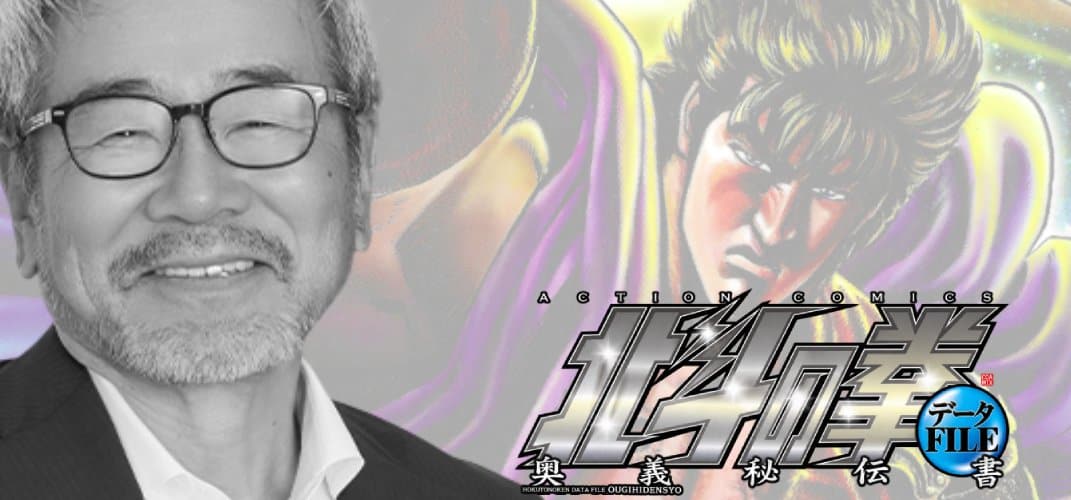
“The second chapter is the lifeblood of a series”: Nobuhiko Horie in 2006, from Jump to the Raoh Den film (Data File Ōgi Hidensho)
Details
- Date
- 2006
- Type
- Book / databook
- Interviewer
- The book’s editorial staff, Shiranui Pro (uncredited)
- Featuring
- Nobuhiko Horie
- Translation
- Hokuto Chronicles
In 2006, the Hokuto no Ken Data File Ōgi Hidensho, a data book produced by Shiranui Pro for Futabasha, closes its chapter “The Men Who Created Hokuto” (北斗を創った男たち) with its longest interview, featuring Nobuhiko Horie, the editor who oversaw Hokuto no Ken at Weekly Shōnen Jump before founding Coamix. After Buronson and Tetsuo Hara, he recounts the birth of the series from the editorial side, details the genesis of Hokuto Shinken as conceived for Souten no Ken and then presents the film Raoh Den Junai no Shō, for which he wrote the screenplay and served as executive producer. Translated by us.
“It is because the world lost all law and order that the story of Hokuto no Ken came to life”
Question. Tell us what led to the serialization of Hokuto no Ken.
Horie. Before Hokuto no Ken, Hara was publishing Tetsu no Donquijote, which didn’t do very well and was canceled after ten weeks. As a rule, at Jump, a series whose popularity doesn’t take off within about three weeks gets canceled. But in Hara’s case, the situation was a little different.
Question. How so?
Horie. It was after the cancellation had been decided that popularity gradually rose, reaching around tenth place in the reader survey. At tenth place, you don’t cancel a series. So Nishimura, the editor-in-chief at the time, told us we could wrap up a first part, take a break, then launch a second part. But even with a continuation, the series would probably have ended up with average popularity, so we ultimately decided to cancel Tetsu no Donquijote.
Question. What kind of content were you considering for the next work?
Horie. When he drew the first one-shot of Hokuto no Ken, I realized that Hara’s strength was in scenes where people get hit. It really looked like it hurt. In a motocross story, there are no fighting scenes, so we figured a combat-oriented work would be a better fit.
Question. Why did Hokuto no Ken become a martial arts manga?
Horie. At first we talked about making it a pro wrestling manga, but there were already quite a few pro wrestling manga at the time, and it felt a bit outdated. Since Hara is a fan of Bruce Lee, we decided to make it a martial arts manga. So I had him draw a one-shot for a special issue.
Question. How was it received?
Horie. Half the people said it wasn’t manga, the other half found it interesting. After that debate, we published it in the special issue, and it came in first in that issue’s survey. Everyone was stunned.
Question. Was it really that successful?
Horie. At the time, Kinnikuman had just been adapted into an anime series and was at the peak of its popularity. Its spin-off, Tatakae!! Ramenman, was being serialized, and we surpassed it. But everyone said that first-place finish was a fluke. So we did another one-shot, a sequel, and it came in first again.
Question. So the serialization was decided without any difficulty?
Horie. Two first-place finishes in the special issue survey, and we had surpassed Yudetamago’s Tatakae!! Ramenman, so I thought the series was a sure thing. And yet, they still wouldn’t give it to us.
Question. Were there other obstacles?
Horie. I was writing the story myself, on top of my work as an editor. People around me said it would be too hard to do both. I also thought I couldn’t write the story while serving as editor, and having someone else handle the script seemed like the easiest way to get the series approved. So we searched for a scriptwriter.
Question. That’s where Buronson comes in.
Horie. Hara particularly wanted a scriptwriter who understood naniwabushi, and Buronson’s name came up.[1] He had just finished Mad Dog, so I went to ask him to write the script.
Question. Did he accept willingly?
Horie. Hokuto no Ken already existed in the form of two one-shots. Jumping on a moving train probably isn’t very pleasant for a scriptwriter. But since we knew each other, it was agreed that he would at least think about the first chapter. He wrote it, it turned out very well, and I felt that with Hara’s staging on top of it, we’d have a tremendous work on our hands. So I asked him to continue, and that’s how the tandem of Tetsuo Hara and Buronson began.
Question. How was the end-of-century setting decided?
Horie. The thing is, in Hokuto no Ken, people inevitably have to die and fight. In a society governed by law, that’s impossible. So we needed a lawless setting. I wondered whether such a world could exist, and at the time, with Nostradamus’s prophecy, people believed something would happen at the end of the century. That’s when I got the idea that Hokuto no Ken would come to life in the wastelands after a world war, a world without law or order. In a world like that, the universe of Hokuto no Ken can express itself without restraint.
Question. Visually, it brings Mad Max to mind.
Horie. Exactly. It even led to an argument with the deputy editor-in-chief at the time. He said a world with that kind of atmosphere didn’t exist, and I insisted it did. I argued that readers would have no problem accepting a Mad Max-style universe. He replied that Mad Max hadn’t been successful, I replied that it had, and we got into an argument (laughs).
Question. Why did you name Kenshiro’s martial art Hokuto Shinken?
Horie. There is a Chinese myth according to which the god of the Hokuto presides over death and the god of the Nanto over life. One day, a man comes to these two gods with peaches to ask them to save his son’s life. The god of the Hokuto consults his register and says the son must die at age ten. But he adds that, since the man brought peaches, he would like to do something for him. So the god of the Nanto writes a nine in front of the ten. “There you go, your son will live to ninety.” It is from this myth that the name Hokuto Shinken comes, a martial art placed under the star of the god of death.
Question. Ever since I read Hokuto no Ken, I’ve never looked at the Big Dipper the same way.
Horie. The Big Dipper revolves around the North Star, you know. The North Star is the Celestial Emperor, and it is said that the Big Dipper is the chariot that protects him. And long ago, on the Silk Road, the Big Dipper and the North Star were the stars of hope, because without them you couldn’t find your way. In fact, the name of our film company, North Stars Pictures, was chosen with the idea that it would be a beacon of hope for the film industry.
“The success of the second chapter convinced me the series would hold up”
Question. I heard Hara say that during the series, he had a hard time getting the nēmu, the storyboard, for the second chapter approved. Specifically, where was the difficulty?
Horie. It’s the story of the old man with the seeds.[2] A serialized manga continues if its second chapter is popular. The first one matters, but it’s the second that’s most important. However, in the story originally planned for the second chapter, you couldn’t see at all why Kenshiro was traveling. As long as you can’t clearly see why he’s crossing the desolate wastelands of the century’s end, you don’t understand his way of life. I thought the series wouldn’t hold up without that, but since we couldn’t find a good idea, we went ahead and drew the pages anyway. And when I read them, they weren’t interesting. I thought, this won’t do. If we botch the second chapter, it’s all over. So I told Hara and Buronson we needed to rethink the episode. Apparently, they were both thinking the same thing, and they agreed.[3] And while we were working out what exactly to do, the story of the old man with the seeds came along. When Kenshiro, upon seeing that old man, says “It’s been a long time since I’ve seen a human being,” I knew that was it.
Question. The purpose of Kenshiro’s journey had been found.
Horie. Yes. As he crosses the desolate wastelands of the century’s end, where everyone has become like beasts, Kenshiro fights for the human beings he encounters. You could finally see his way of life: going toward human beings and protecting them. The second chapter was popular too, and I was convinced the series would hold up. That’s how much the second chapter matters. It’s the lifeblood of a series.
Question. At the time, were the cruel scenes criticized?
Horie. No, there wasn’t much criticism. Those scenes exist, but we always clearly showed why things came to that point. We never depicted violence for violence’s sake. We made sure to show clearly that there was a specific reason for things to come to that.
Question. Are the very distinctive death cries of the thugs Hara’s creation?
Horie. Yes. The guy explodes saying “hidee” (“that’s awful”), so it becomes “hidebu.” Even the death cries have their reason. That said, those death cries were funny, and it’s true we also got a bit carried away with the momentum (laughs).
Question. There was also “Pabbibbuppeppō.”[13] Pushed that far, it makes you laugh.
Horie. That one is pure overkill. The world is so grim that Hara slips in gags to brighten it. And it’s also because it’s his drawing that we laugh at it. He made a point of keeping a comic side, so the manga wouldn’t turn into sheer cruelty and darkness.
Question. One scene really stuck with me. Kenshiro tells a thug “You have five seconds left to live,” the thug replies “Five seconds, no…” and immediately Rei kills him, saying “Then die right now!!” That’s a gag too.
Horie. Kenshiro is completely outrageous (laughs). To a thug whose pressure point he struck in the back, causing his spine to twist, he promises to save him if he reveals where Shin is, then walks away saying “See ya” (laughs). He lied to him (laughs).
Character names with no nationality
Question. How did you come up with the many martial arts names?
Horie. For that, we naturally drew inspiration from Chinese martial arts. We also looked for characters that were visually appealing, with a good ring to them, while maintaining a certain logic. And we adapted the arm and leg movements accordingly.
Question. Did any technique names give you trouble?
Horie. Not really. Buronson came up with some too. But inventing them is real work. Even today, people ask me for technique names, and each time you have to imagine the movement. The movement has to be something that can be reproduced as is, without the kanji being too complicated.
Question. How many technique names are there?
Horie. Technique names alone number over two hundred. Some were created for video games. We think a book dedicated to the techniques would be an interesting project to do someday.
Question. This volume catalogs all the techniques from the manga.
Horie. Today, there are probably twice as many as in the manga.
Question. Some techniques are practically gags.
Horie. There’s even a technique called Hokuto Ressha Hō, the “railway cannon of the Hokuto” (laughs). That one caused quite a stir. People said it wasn’t a martial art. Buronson got angry that time. I had let it slip through without noticing myself, and I had to rush to Toei and Fuji TV to have it rewritten in front of me.[4]
Question. There was also the Nanto Ningen Hōdan, the “human cannonball of the Nanto,” where a henchman gets shot out of a cannon. I figured that with a hundred and eight schools, the Nanto must have had one like that.
Horie. That’s a sideshow act (laughs). That’s not a martial art. At the time, we had a good laugh about it.
Question. How were the characters’ names chosen: Jagi, Amiba, Raoh?
Horie. For that, you’d better ask Buronson. He’s the one who named Raoh. If there is a rule, it’s that we looked for names you couldn’t tie to any country. Neither Japanese nor Chinese. Names that are pure signs, let’s say.
Question. They have something strange about them.
Horie. Written in kanji, they look Chinese, but to the ear, not at all. We were aiming for that boundary. Only Kenshiro had been named by Hara from the start, and we kept it as is. For the others, we started from sounds that stick in your head.
Question. It was a way of naming characters that had never been seen before.
Horie. Yes. I think naming Toki “Toki” was really well done. Kenshiro, Raoh, they sound like people who fight, whereas Toki sounds more like someone who doesn’t fight. The name Toki is pure Buronson talent. As for Shin, it also carries the meaning of “sin,” and Amiba comes from amoeba.[5] Jagi is probably a guy full of jaki, evil spirit.
“The birth of Hokuto Shinken dates back to the era of the Three Kingdoms”
Question. How is the creation of Hokuto Shinken imagined within the series?
Horie. At some point, the art of the Hokuto Sōke, the main house of the Hokuto, had been taken to its ultimate form. The counters were also perfected, and it became an art that wasn’t very effective. But at the same time, it was felt that an assassination art absolutely had to be created. It was by refining what made it an assassination art that Hokuto Shinken was born.
Question. New blood had to be introduced to create a new art.
Horie. Where that wolf blood comes from is precisely the theme of Souten no Ken, which is currently being published. The mystery of that wolf blood, added to the art of the Hokuto Sōke to create Hokuto Shinken, gradually becomes clearer as you read Souten no Ken. By the time this book comes out, we’ll probably already know (laughs).
Question. What is this wolf blood?
Horie. Eastern and Western cultures mingled along the Silk Road, and before the common era, a nomadic people, the Yuezhi, controlled that road. In our storyline, it’s an art developed by these Yuezhi.[6] The Yuezhi are a wandering people born from the disappearance of the kingdom of Israel, and we imagined that they had created an art to protect themselves, and that it had been preserved in their land.
Question. So the art passed down among the Yuezhi entered China?
Horie. Around the year 200, the art of the Yuezhi entered China along with Buddhism. It merged with the art of the Hokuto Sōke, and Hokuto Shinken was born. And that’s not all: the country at the end of the Silk Road is Japan. That’s why the wind of the Silk Road blows constantly through the Hokuto no Ken series.
Question. So Hokuto Shinken has such deep roots.
Horie. To be more precise, China had Confucianism, and Christianity and Buddhism had come via the Silk Road. But at that time, Buddhism remained a minority religion. The Buddhists, convinced that theirs was the religion of peace, wanted at all costs to spread their teachings. But without the protection of the powerful, teachings don’t spread. So in a China at war, the Buddhists constantly studied who was going to seize power. And at a certain point, they chose the heroes of the era. That moment was the time of the Three Kingdoms: Wei, Wu and Shu.
Question. The era of the Three Kingdoms falls precisely around the year 200. That coincides with the 1,800 years of Hokuto Shinken history.
Horie. Yes. The Buddhists then narrowed the candidates for the title of hero down to three: Cao Cao, Sun Quan and Liu Bei. Protect those three, and kill anyone who stood in their way. It was during this process that Hokuto Shinken was born as an assassination art. By protecting them, they intended to put them in their debt. They narrowed the candidates to three, but it is Heaven that decides who will take the empire. They let them fight and watched. Cao Cao didn’t become emperor, but his son Cao Pi became the first emperor of Wei. Hokuto Shinken is the art that watched over this history while protecting the heroes.
Question. It supported history from the shadows.
Horie. Yes. At the time, the Buddhists, as missionaries, were not stopped at borders. They therefore had information on all of China, and they gathered once a year to discuss the heroes of the empire. They judged that any of the three, Cao Cao and the other two, would make a worthy emperor, and left the rest to Heaven. The result was the era of the Three Kingdoms. That’s what we imagined behind the scenes. But the Buddhists are going to hold it against me for attributing the creation of an assassination art to them. I hope they’ll forgive us. It’s only the backstory of a work of fiction.
Question. When did Hokuto Shinken arrive in Japan?
Horie. All I can say is that the First Emperor of Qin is said to have actually had Western blood. It’s said he had blue eyes. He apparently had distinctly Iranian, Western blood. And then the character for Qin can also be read “hata,” and there are the Hata, a great family from the Asuka period, right? They claimed descent from the First Emperor of Qin, so many generations removed. In other words, people who came from the continent. If you follow those connections, it should become clear. In fact, Soga no Umako, of the Soga clan, reportedly had Iranian features.
Question. The history of Hokuto Shinken is global.
Horie. People often think Hokuto Shinken was born in China, but it doesn’t stop at China but is connected to other countries through the Silk Road. For the look of the film as well, I asked them to think about the Silk Road.
Question. Can we consider the setting of the manga, up until the departure for the Land of Shura, to be Japan?
Horie. Somewhere like Japan (laughs).
Question. Is the Land of Shura China?
Horie. Somewhere like China, but larger. In Souten no Ken, they go to China, right? Keep that in mind and it should become clear. As you read Souten no Ken, the inner workings of Hokuto no Ken gradually come to light.
“I want Reina to remain engraved in people’s hearts”
Question. What triggered the project to adapt Hokuto no Ken into a film?
Horie. Initially, the main trigger was the launch of Souten no Ken.
Question. Souten no Ken takes place one generation before Hokuto no Ken.
Horie. As I was saying earlier, Hokuto no Ken is set at the end of the century, but from the very start we considered it a drama connected to the era of the Three Kingdoms. So we took the generation before Hokuto no Ken, the 1930s. There’s also the episode of how Hokuto Shinken arrived in Japan, and going back even further, the episode of its birth from the art of the Hokuto Sōke during the era of the Three Kingdoms. So we said that with Hokuto no Ken, you could count up to an episode 4.
Question. Why did you launch Souten no Ken?
Horie. When I founded my own company, Coamix, and launched Comic Bunch, since Hokuto no Ken was episode 4, we decided to start episode 3 in Comic Bunch. That was the trigger.
Question. Tell us about the path to the film adaptation.
Horie. Oh, rather than a path… The very name Coamix means Co-A-Mix, a company that does comics and animation. So making animation was decided from the very founding of the company.
Question. And the first animated work is Hokuto no Ken.
Horie. There was also the pachislot boom, but above all, we felt that the first work from our company had to be Hokuto no Ken. At first, we planned an OAV, but then Hokuto no Ken’s popularity surged again and we decided to make it a film.
Question. Does the film focus mainly on episode 4?
Horie. At first, I thought about covering episode 4 in a single film, but in roughly ninety minutes, you can’t show everything. So we concluded it would need to be divided into about five films.
Question. Fitting it all into one film would indeed be difficult.
Horie. And besides, in Hokuto no Ken, it’s not just Kenshiro. The supporting characters are very popular too. Raoh and the others are just as beloved as Kenshiro, so you need at least five films. First, two Raoh Den, with a Yuria Den in between. Then, after the Yuria Den and the second Raoh Den, a Toki Den, and to finish, a legend of Kenshiro, I think. It will probably cover the continuation, after the journey to the Land of Shura.[7]
Question. Will Reina, the new character in Raoh Den Junai no Shō, become the mother of the child Raoh leaves behind?[8]
Horie. Hmm (laughs). You’re right on the mark, but let’s keep the mystery for now (laughs).
Question. Ever since the serialization days, the fact that Raoh had a child intrigued me.
Horie. Readers must have wondered whose child that was. It’s not Yuria’s, in any case. But I wanted to show that Raoh also had a love story. As the title of the first film, Junai no Shō, indicates, the theme is the pure love between Raoh and Reina. It’s the first time Raoh shows compassion toward a woman.
Question. Does this story take place before the nuclear war?
Horie. After. By watching the film, you’ll understand why Raoh wasn’t really interested in the struggle for the succession of Hokuto Shinken. It’s because he had another great dream, I think. And Reina is closely tied to it. Reina doesn’t exist in the manga, but I want her to remain engraved in everyone’s heart.
Question. Among the women connected to Raoh, there is also Tô.
Horie. In her case, it’s a one-sided love taken to the extreme. Reina is a woman connected to him on a much deeper level. Raoh can only be himself in front of her. In front of other women, he acts as Ken-Oh, but in front of Reina, he says what he truly thinks. That’s why Reina doesn’t call him Ken-Oh. Seeing the film should make it clear.
Question. That makes us look forward to the film even more.
Horie. You’ll see what Raoh feels. Many characters in Hokuto no Ken end up defeated, but I think the quality of the work lies in showing each of their victories. Even defeated and killed by Kenshiro, it was a victory for that character, and I want to show that, character after character. So I focus on showing why Raoh was able to say, in his final hour, “I have no regrets in my life!!”
Question. That line from Raoh has remained famous.
Horie. To be able to say that while dying would be a blessing. I want to show why he was able to feel that way.
“For Kenshiro’s distinctive cry, a voice closer to the real thing”
Question. What did you pay attention to for the adaptation?
Horie. There are five films, but each one has to form a complete story. We’re very careful about that. I’d really like people to go see it in theaters. A world where the average height is three meters can only be felt on the big screen (laughs). In other words, on a cinema screen, the characters are at their actual size.
Question. What was difficult in the animation?
Horie. This time, we’re making the animation studio team do everything they hate. Armies in armor: nobody wants to draw that. And then the horses. Mounted combat is also difficult, because each of the four legs moves independently. Even a scene where Raoh is on horseback is difficult, since you have to give each of the four legs a different movement.
Question. It’s true that we haven’t seen many horses up until now.
Horie. In previous animated adaptations of Hokuto no Ken, you barely see any horses apart from Kokuō. Yet in an era without oil, the horse is the most efficient means of transport, and there must have been many others.
Question. What else did you emphasize?
Horie. What I really emphasized was the cry.[9] At first, Hiroshi Abe was happy that Kenshiro had few lines. But as soon as he realized that the cries counted as lines, he was amazed at how many there were. On top of that, it had to be a cry different from anything heard before, so it must have been tough.
Question. That cry is practically Kenshiro’s signature.
Horie. We discussed the ideal battle cry among the three of us: Abe, Hara and myself. When you really belt it out, your throat gives out in a single day. We thoroughly discussed the cry we truly wanted, not “atatatatatataataa” but rather “uoatatatatataa, taa.” So the cry should be completely different between the teaser, the trailer and the film. In the teaser, it’s not yet the final version, it’s more like “achaa.” The trailer is a bit more polished, and the film gives the finished version.
Question. Do you have any specific requirements regarding the CGI?
Horie. For the first time, Hara feels that the drawn faces truly look like Raoh and Kenshiro. That’s thanks to Masaki Satō, the chief animation director.[10]
Question. What exactly worked well?
Horie. They have real presence. With more time, I’m sure we could have made something even more powerful. But time was limited, and we did what we could within those constraints.
“I’d like everyone to edit the five Hokuto no Ken films in their own way”
Question. Were you part of the team for the previous TV series?
Horie. At most, I checked the scripts. For everything else, I left it to Toei. But this film, I’m designing it from start to finish. I also wrote the screenplay myself. With the intention of following through on every idea, even ones that came up on the spot.
Question. What part of the story does the film cover?
Horie. The film blends the Holy Emperor’s Cross Mausoleum with original episodes. But we cut a lot. When we faithfully storyboarded everything, we exceeded the planned ninety minutes by forty. We have to get back to ninety, so we have to sacrifice even more episodes.
Question. That’s a shame.
Horie. During the manga’s serialization as well, we moved forward by sacrificing a great number of episodes. I remember all of them. So this time, I wanted to reintroduce the ones we had abandoned. So that even people who read the manga would make discoveries. We’re only adding what had been set aside back then. So the flavor of the manga isn’t altered.
Question. It sounds like the content is very dense.
Horie. Ninety minutes go by in a flash. This time, we chose the Holy Emperor’s Cross Mausoleum arc, one of the most beloved by readers in the entire Hokuto no Ken series. And part of the drama is shared with the Yuria Den. You also get to see how a certain fight appeared through Yuria’s eyes. The whole thing is structured to reveal all the human relationships in Hokuto no Ken.
Question. So the five films are connected to each other.
Horie. The Yuria Den will be released as an OAV, and we have the lines in certain scenes echo each other. By bringing the five works together and editing them yourself, you should be able to create your own film. I’d really love for people to give it a try.
“I intend to show the story of Raoh and the others, which had been left aside until now”
Question. The connections between the six stars of the Nanto are not well developed in the manga.[11] Will the film show them?
Horie. We plan to show a great deal of them. By watching the OAV, you’ll understand, for example, the relationship between Rei and Yuria. Originally, the six stars of the Nanto are essentially the six stewards of the one hundred and eight schools of the Nanto. There’s also the episode that explains why Yuria, who doesn’t practice martial arts, was able to become the Last General. The Yuria Den shows what ability she had.
Question. Will the Nanto episodes that remained mysterious be shown?
Horie. The Nanto has one hundred and eight schools. First, Yuda drags several dozen of them into his betrayal, in other words, he goes over to the dark side. Then Souther leaves in turn with a few schools. The Nanto forces are then split in two. The remaining half are people who want peace, so they keep quiet. These forces rally around Yuria, the Last General of the Nanto. The people follow, and it becomes a great power, comparable to Raoh’s army. Then comes the time for the decisive battle between Yuria’s army and Raoh’s army. That’s how it unfolds.
Question. Does the OAV show these episodes?
Horie. Yes. The Yuria Den shows why people flock to Yuria. Yuria carries a symbolic object on her, and through that connection, you also see why Kenshiro is the savior. You understand it by watching the OAV. Everything we had imagined behind the scenes until now, we show entirely in these works.
Question. So the other characters also contain vast stories within them.
Horie. Until now, we had to feature the hero Kenshiro, so we couldn’t tell the stories of the other heroes. If we did, we’d end up with chapters where Kenshiro didn’t appear at all. A serialized manga can’t hold up like that, so we only told what concerned him. All the rest of the storyline was left aside. This time, we showed what had been left aside. But Kenshiro remains the hero.
Question. We can’t wait to see how it unfolds.
Horie. In the end, I’m the one who wrote the screenplay, but at first, I was writing it with a screenwriter who thought we couldn’t show everything, that with that much material, the film couldn’t be interesting. I said it could and I saw it through to the end. And finally, the screenwriter admitted that maybe it could work after all (laughs).
Question. It must have been hard to hold everything together.
Horie. The thing is, there are essentially two heroes, Raoh and Kenshiro. And then there are the other characters too, and holding all of that together is difficult. The screenwriter said that if it were a single Schwarzenegger-type character going on a rampage, he’d understand. But I maintained that no, this was precisely a story that only works because there are two heroes.
Question. How did the production of the film go?
Horie. Everyone was overwhelmed, working at a hellish pace. There are a hundred animators on the film, and we only asked them to do difficult things. A simple drawing can be done quickly, but with this art style, it’s grueling. Hokuto no Ken is a work that people in animation really wanted to make, but one they shied away from. Horses, armies of tens of thousands of armored men: it’s enough to make you beg for mercy. But in reality, we still haven’t shown enough. Even for the film, we cut many episodes. I’d like to eventually make a complete version.
Question. To show everything, perhaps the only option would be a novelization.
Horie. Yes. There was a speech scene by Raoh that we cut this time. Even in a movie, you can’t express everything. I think I could add the cut episodes later, when the OAV comes out. But then again, people might not come to see the movie (laughs). In the meantime, I’d like people to come see in theaters this world where the average height is three meters. The two actors, Abe and Takashi Ukaji, are both over 1.90 meters tall.
Question. The voice alone must have power.
Horie. A “wooh!” coming out of a large body is something else entirely. This time, above all, I wanted something realistic. I wanted Kenshiro’s and Raoh’s voices to come from people who are nearly two meters tall. The jawbone structure also had to resemble that of the characters. I thought that way we could capture Kenshiro’s true voice. That’s why we chose Abe for Kenshiro and Ukaji for Raoh. We also recruited new voice actors, and they’re all huge. So the battle cry, too, you have to hear it in theaters. You’ll walk out feeling relieved, guaranteed![12]
Editors’ notes
- Tetsu no Donquijote: Hara’s first series, published in Weekly Shōnen Jump from 1982 to 1983. The story of a lone warrior who takes on the most powerful team in Japanese motocross.
- Kinnikuman: a pro-wrestling manga published in Weekly Shōnen Jump from 1979 to 1987, in which the hero, Kinnikuman, and his superhuman companions fight fierce battles against opponents who rise up one after another. Adapted into an anime series and films. Its sequel, Kinnikuman II Sei, is currently running in Weekly Playboy.
- Tatakae!! Ramenman: a martial arts manga published in Fresh Jump from 1982 to 1989. Its hero, Ramenman, was originally a character in Kinnikuman, but he became more popular than Kinnikuman himself, and was given his own standalone story set in China.
- Mad Dog: drawn by 鷹沢圭. Published in Weekly Shōnen Jump in 1983.
- Nostradamus: born in 1503. A physician and astrologer, author of a world-famous collection of prophecies. According to his followers, he is said to have predicted the French Revolution and World War II. In Japan, he became famous overnight in the 1970s when he was presented as the man who foretold the end of the world “in the seventh month of 1999.”
- The Silk Road: the name given to the historic trade route linking China to the Mediterranean world centered on Rome, which was also a major conduit for exchanges between East and West. Because the Shōsō-in in Nara preserves treasures from China and Iran, the ancient capital Heijō-kyō is sometimes called “the eastern terminus of the Silk Road.”
- Souten no Ken: running in Weekly Comic Bunch since 2001. Its hero, Kenshiro Kasumi, is the successor of Hokuto Shinken two generations before Kenshiro, and the story takes place in 1930s Shanghai. Its narrative, which traces the roots of Hokuto Shinken, is a must-read for fans.
- The Yuezhi: a nomadic people, and the name of their state, which ruled over North and Central Asia from the 1st century BCE to the 3rd century CE. Enriched by trade between East and West, they fled westward after their defeat by the Xiongnu and took the name Great Yuezhi. Their origins, whether Tibetan, Mongolian or Iranian depending on the hypothesis, remain unclear, especially since they left no written records.
- The Three Kingdoms (三国志): a common name for the history of the rise and fall of Wei, Wu and Shu, from the end of the Eastern Han to the Three Kingdoms period. There are two accounts: the official chronicle, the Records of the Three Kingdoms (三国志), and the Romance of the Three Kingdoms (三国志演義), which notably compiles the tales of storytellers. It is unknown when this novel arrived in Japan, but it is said that during the Sengoku period, Oda Nobunaga praised Tokugawa Ieyasu’s vassals by comparing them to the generals of the Three Kingdoms.
- The First Emperor of Qin: the first to unify China and take the title of emperor. His mother is said to have been a concubine that his father, Zichu, had obtained from the great merchant Lü Buwei, but according to one hypothesis, she was already pregnant with Lü Buwei’s child at that time.
- The Hata: an ancient Japanese clan whose founding ancestor is said to be Yuzuki no Kimi, who came from Korea. Arriving via Kyūshū, the clan subsequently spread throughout the country, and it is said that their civil engineering techniques played a significant role in the transfers of the capital to Nagaoka and then to Heian.
- The Soga: a clan that dominated from the Kofun period to the Asuka period. Their origins are debated: according to one hypothesis, they were a powerful family from what is now Osaka Prefecture or Nara Prefecture. According to another, they were immigrants from the continent who settled in the region. Whatever their origins, their ties with immigrants seem to have been close, and it is said that their advanced techniques were the source of the clan’s rise.
- Arnold Schwarzenegger: born in 1947. Actor, bodybuilder and politician. He became famous overnight with the huge success of Terminator, then showed a range that also embraced comedy and established himself as a Hollywood star. Today, however, he refrains from making action films.
Reading note
The questions are unsigned. The volume’s colophon credits the texts to 橋本学 (noNPolicy). The eight subheadings, reproduced here as section titles, the thirteen notes, the introductory paragraph and the profile sidebar are by the editorial staff. The sidebar notes that Horie joined Shueisha in 1979, that he oversaw Hokuto no Ken among other hits, that he became editor-in-chief of Weekly Shōnen Jump in 1993 and that he left Shueisha in 2000 to found Coamix. The page title introduces him as the former managing editor (担当編集者) of the series, screenwriter and executive producer (脚本・製作総指揮) of the film. The volume does not date the interview, its colophon is dated April 30, 2006. Horie speaks of the film in the future tense and invites people to come see it in theaters: the interview was conducted before its release.
- ↑ Naniwabushi is a popular genre of sung storytelling whose name, by extension, refers to stories of loyalty and human feeling.
- ↑ The old man with the seeds is the old man who protects a bag of seed rice in the second chapter.
- ↑ Buronson tells the same episode differently in his interview in the same volume. He says he nearly fell out with Horie, while Horie says that the two authors agreed to rework the episode.
- ↑ The Hokuto Ressha Hō and the Nanto Ningen Hōdan are techniques from the TV series, hence the mention of Toei and Fuji TV.
- ↑ For Shin, Horie is probably thinking of the English word sin.
- ↑ On the origins of the Hokuto Shinken, from the Yuezhi to the Soga clan, Horie is talking about the series’ backstory (設定), which he himself says is invented, not established history.
- ↑ The five parts of the pentalogy came out under the titles Raoh Den Junai no Shō, Yuria Den, Raoh Den Gekitō no Shō, Toki Den and ZERO Kenshiro Den.
- ↑ The child of Raoh mentioned in the question is Ryū.
- ↑ The “cry” translates 怪鳥音, as in Hara’s interview.
- ↑ Hara presents Masaki Satō as chief director (総監督), whereas Horie calls him chief animation director (作画総監督).
- ↑ “The six stars of the Nanto” translates 南斗六星, the six fighters known on the site as the Nanto Six Sacred Fists.
- ↑ For the relief promised at the end, Horie uses スカッと, the word Hara was already repeating in 1986 (スカット!スカット!) about the deaths of villains (All About The Man).
- ↑ Death cry of one of the manga’s thugs (ぱっびっぶっぺっぽおっ), quoted by the interviewer as the most extravagant of the series, in the line of the “hidebu” Horie has just explained. Site transcription: Pabbibbuppeppō.
Sources
- Hokuto no Ken Data File Ōgi Hidensho (北斗の拳 データFILE 奥義秘伝書), Shiranui Pro, Futabasha, Action Comics collection, colophon dated April 30, 2006, “SPECIAL INTERVIEW No.3,” pp. 60-67 (book entry). Editorial copy.
Quotes translated and entry compiled by Hokuto Chronicles from the original publication. First published on October 22, 2026, updated on October 23, 2026. © 2026 Hokuto Chronicles. Any reuse, even partial or reworded, must credit Hokuto Chronicles with a link to this page.