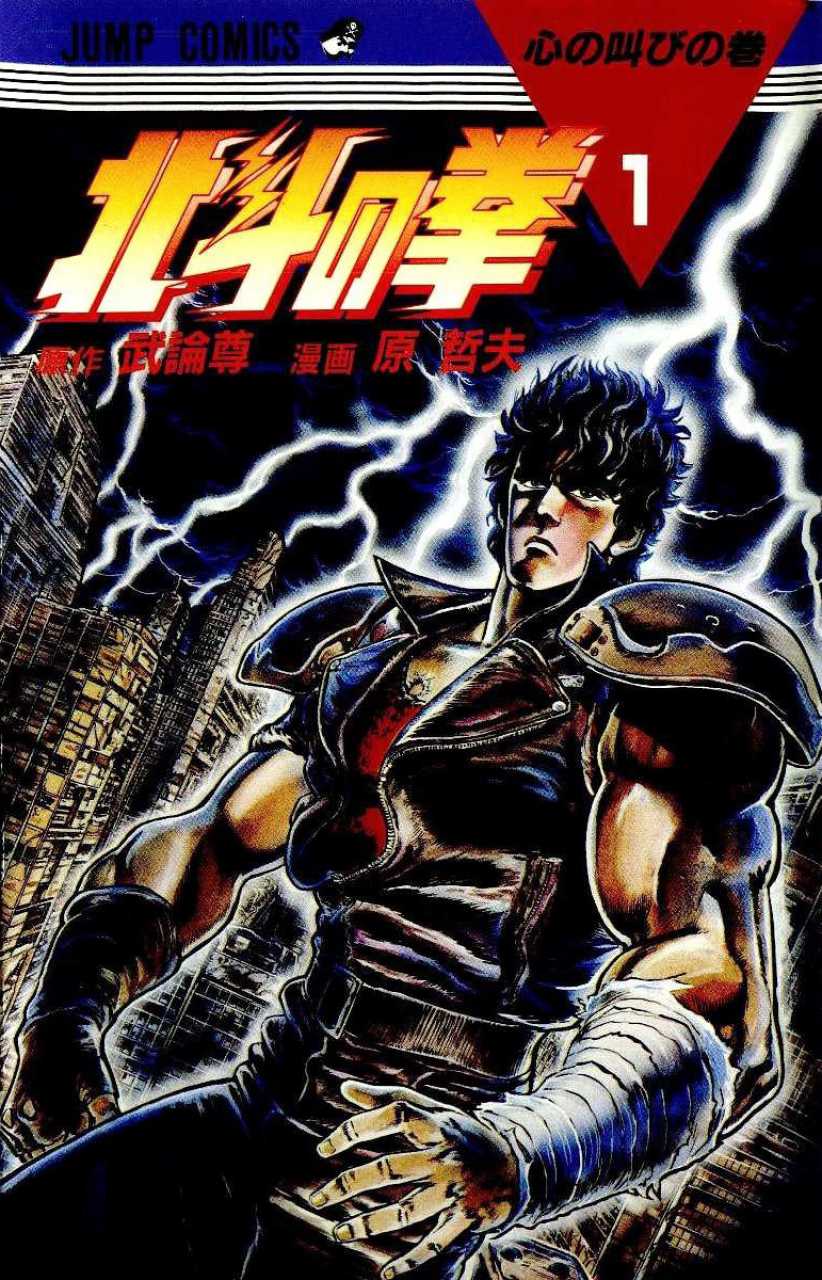
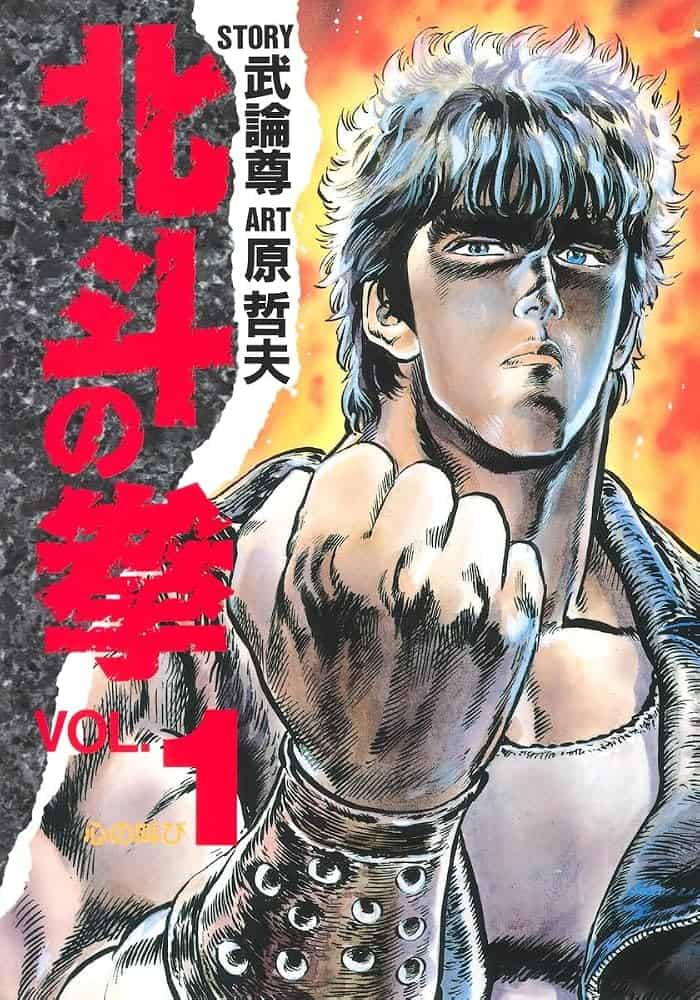
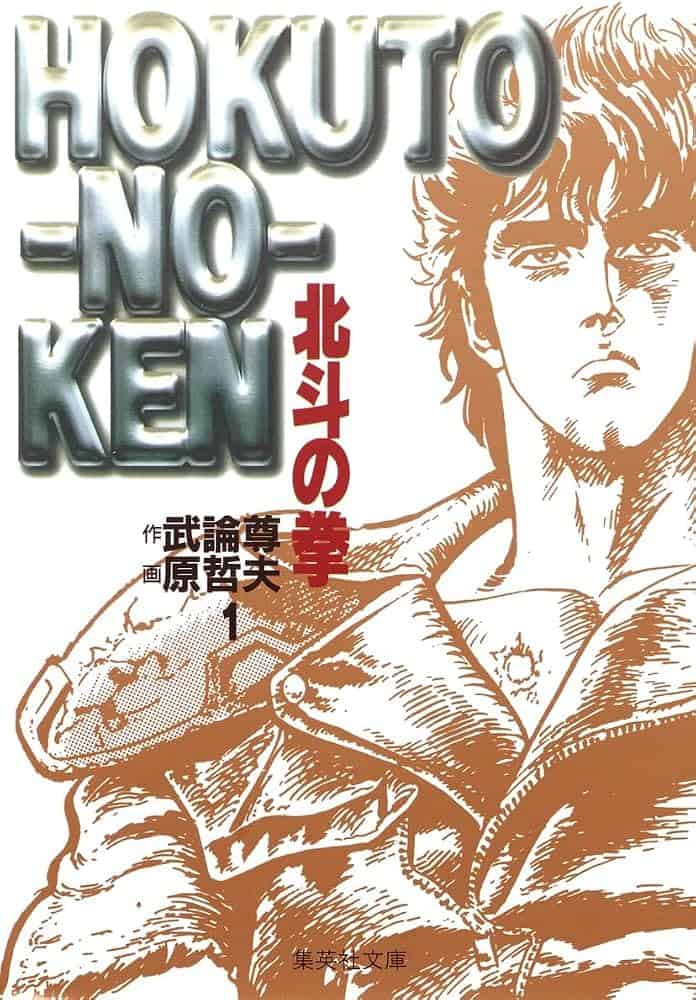
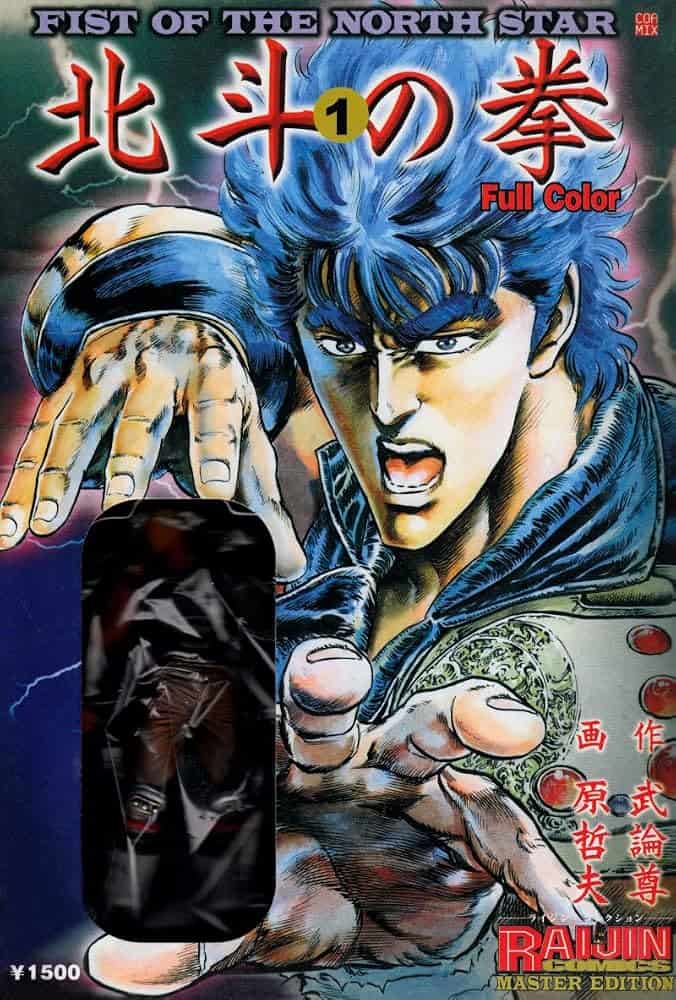
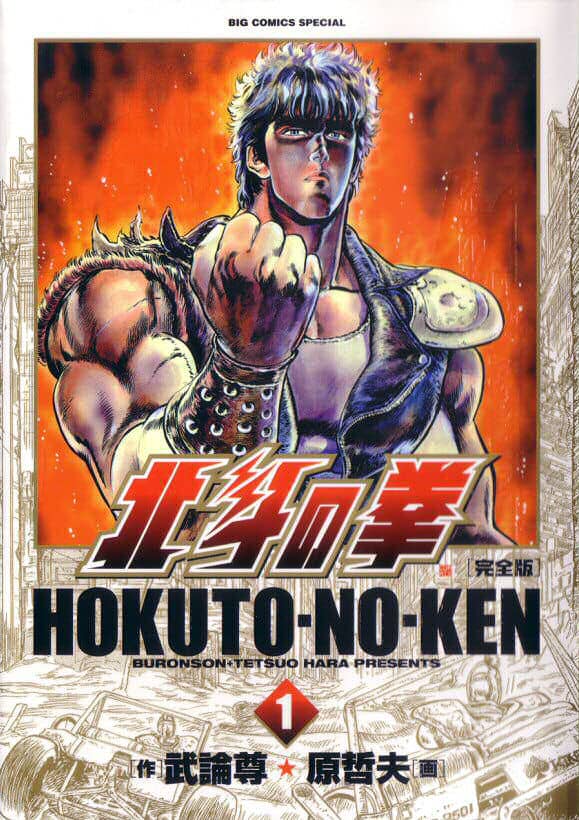
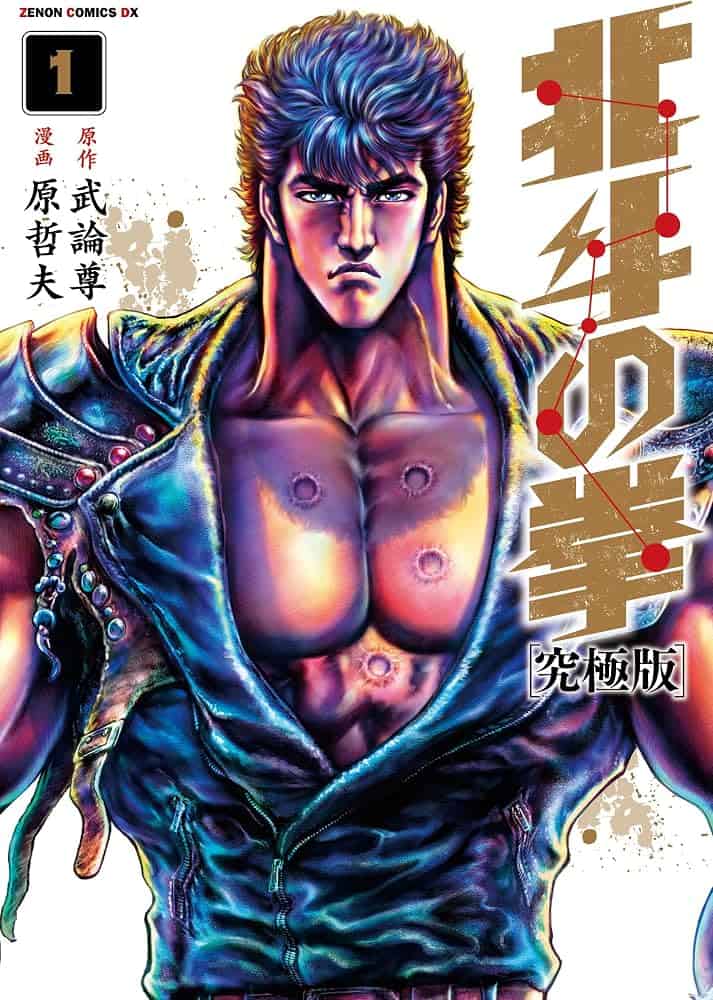
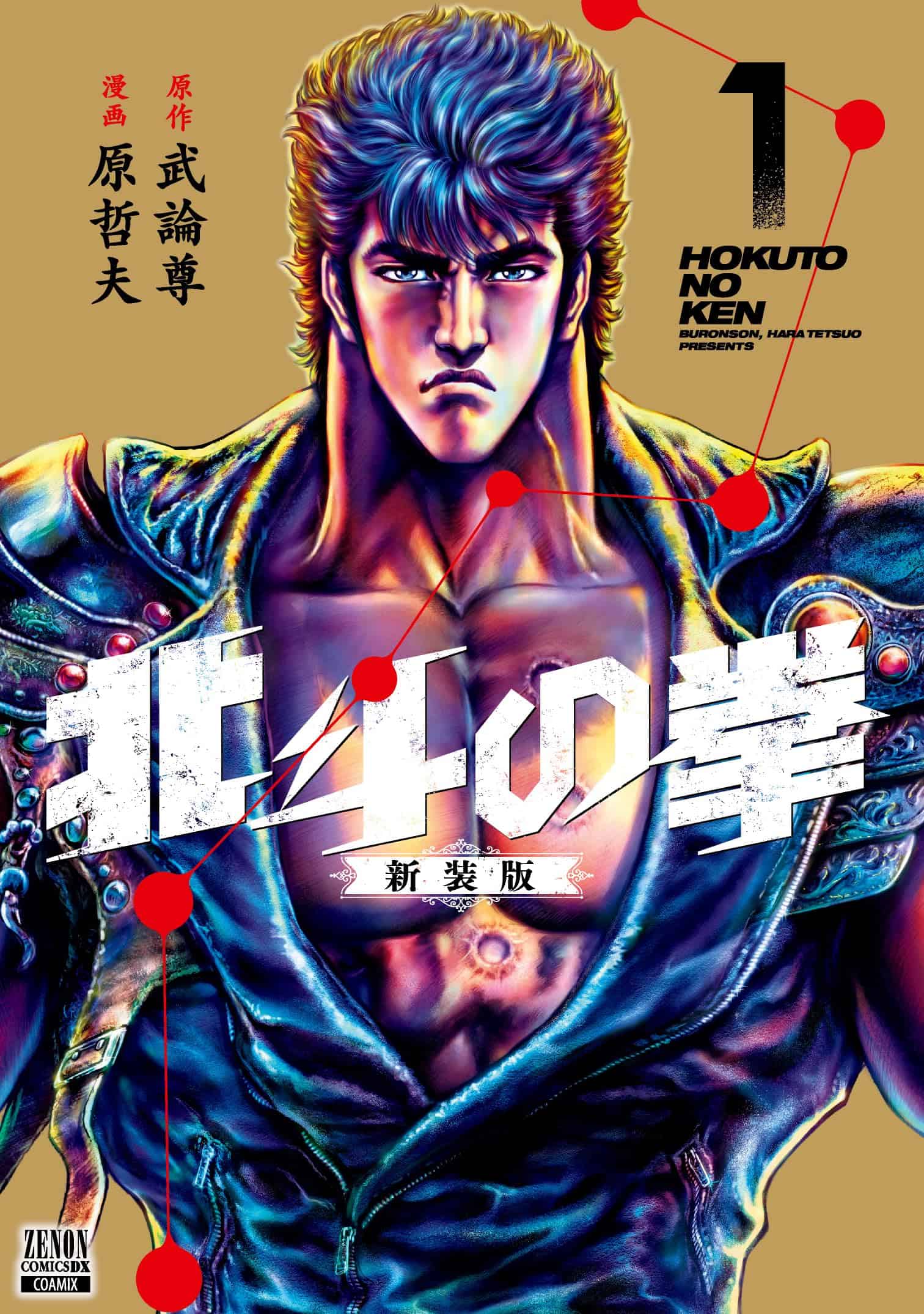
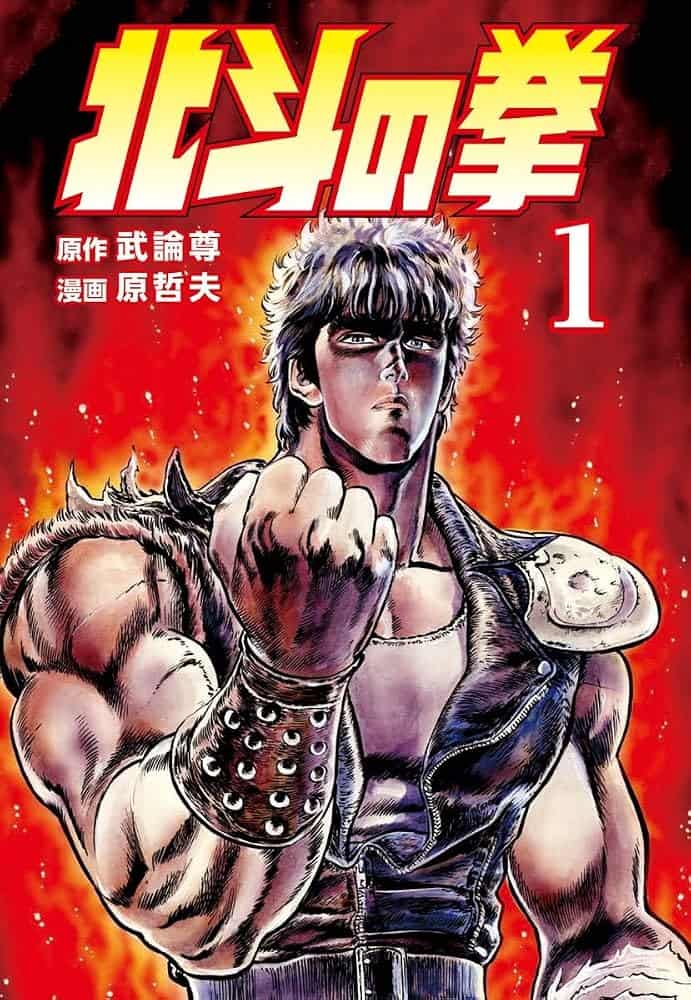
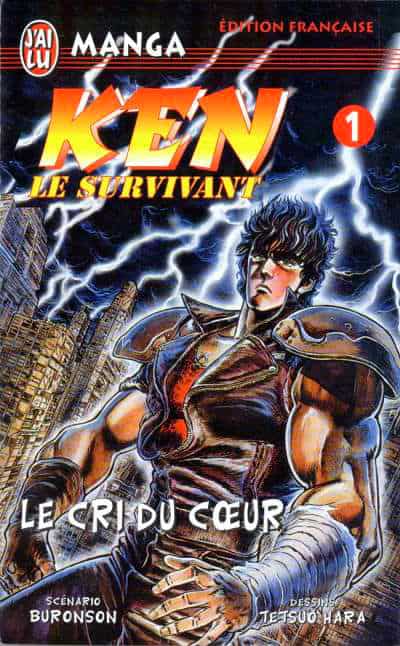
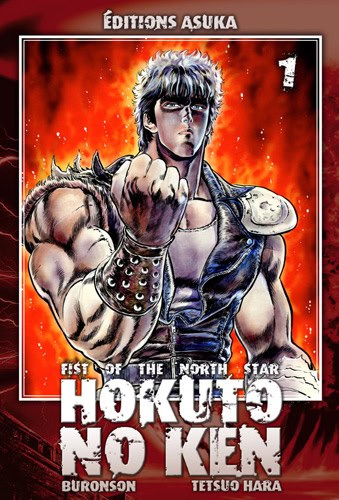
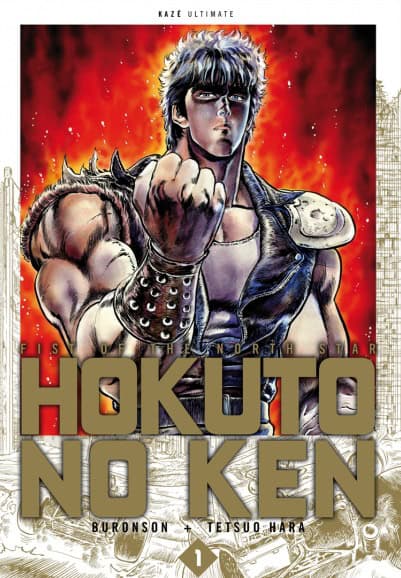
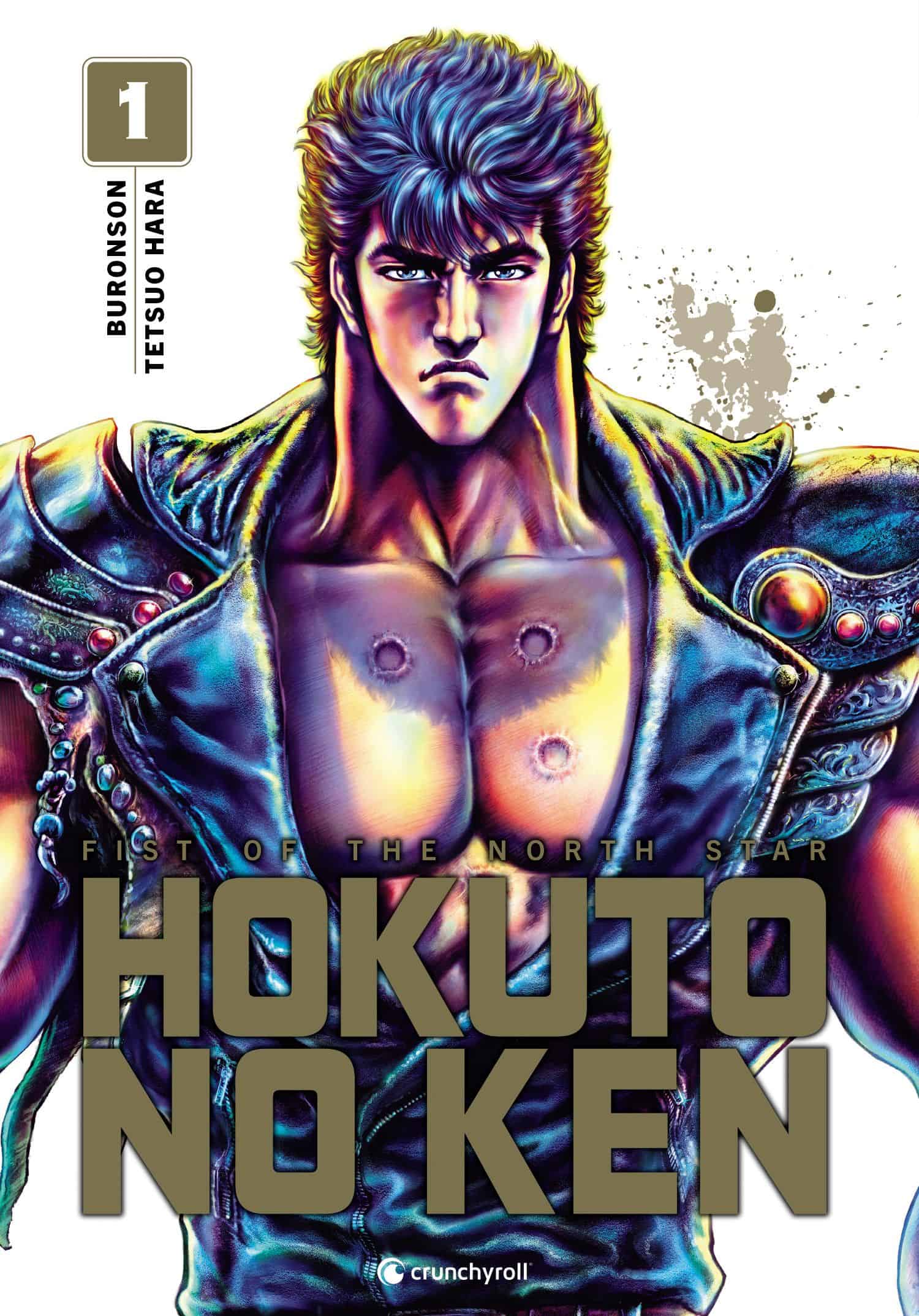
Hokuto no Ken (北斗の拳) is a manga in twenty-seven volumes, serialized from issue 41 of 1983, released on September 13, 1983, to issue 35 of 1988 in Shueisha's Weekly Shonen Jump, written by Buronson and illustrated by Tetsuo Hara. In a world ravaged by nuclear war, Kenshiro, heir to Hokuto Shinken, a deadly art passed down to a single disciple per generation, faces over the course of 245 chapters the heirs of rival schools and his own brothers-in-arms. The mother work of the entire Hokuto universe, the series has spawned animated adaptations, films, gaiden, parodies and video games for over forty years.
Synopsis
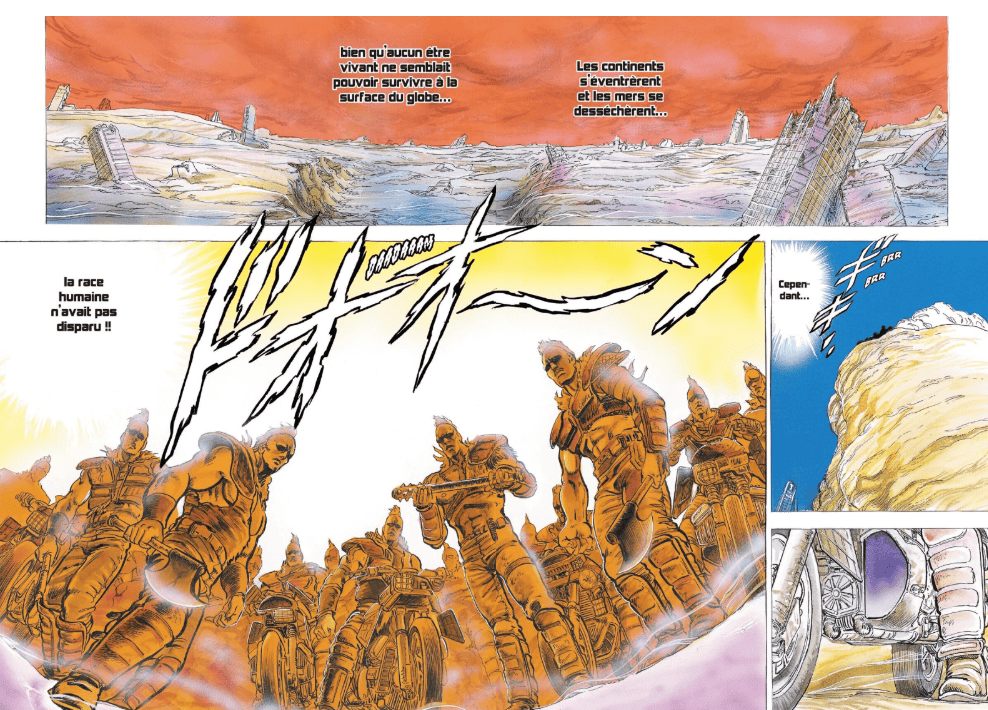
In 199X, the world was engulfed in nuclear flames. Civilization vanished, and an era came in which violence ruled the world. Set against the backdrop of a century's end devastated by the ultimate war, where the law of the strongest prevails, the series depicts Kenshiro, heir to Hokuto Shinken, that deadly art transmitted to a single disciple per generation, who grows into a savior bearing love and sorrow. Kenshiro's battles against his rivals, his love for his fiancee Yuria, and the bonds then the rifts that tie him to Raoh, Toki and Jagi, his adopted brothers also trained in Hokuto Shinken.
Official publisher summary, translated by us.
The 1983 pilot stories
Before the series, Hokuto no Ken existed in the form of two one-shots by Tetsuo Hara, published in Fresh Jump, a Shueisha magazine, in the April and June 1983 issues. Their hero, Kasumi Kenshiro, lives in contemporary Japan: heir to the Hokuto Shinken passed down by his father, he avenges the death of his fiancee Yuki in the first story, then sets out in the second to eradicate the Taizanji Kenpō, the assassin organization responsible for her death. Most of the series' hallmarks are already present: the secret pressure points, the delayed death, the doctrine that the body uses only a fraction of its power, and the series' future iconic catchphrase, in a slightly different wording.
Published at the end of the magazine, the two stories each took first place in the reader survey. This double success prompted Shueisha to launch the serialization in the Weekly Shonen Jump in September 1983, with Buronson as scriptwriter and a setting transposed to a world ravaged by nuclear war. The two one-shots were collected the same year at the end of the two volumes of Tetsu no Donquijote, the author's previous series, and have never been published in France.
From the pilot to the weekly series
The birth of the concept is recounted by Nobuhiko Horie himself, in a commentary published with the kyūkyokuban edition. A young editor at Weekly Shonen Jump assigned to Tetsuo Hara, he and the artist searched for the signature technique that would set their martial arts project apart. In a Chinese bookstore in the Jimbōchō district, he came across the anecdote of a medical student who, while studying pressure points, worsened an eye condition by overstimulating the point supposed to cure it. Horie had his idea: destroying the body by striking its pressure points. The name of the series came to him from a Chinese myth, in which a child destined to die at nineteen manages to live to ninety thanks to two sages playing go, the gods Hokuto and Nanto, the first ruling over death, the second over life. Horie drew from this the title and the name of the art. If Hokuto is the god of death, Kenshiro would be his son, and his fist the Hokuto Shinken.
After the success of the two pilot stories, the editorial staff of the Weekly Shonen Jump launched the series project. As Tetsuo Hara considered the weekly pace unsustainable on his own, his editor Nobuhiko Horie recruited a scriptwriter: Buronson, already the author of the hit Doberman Keiji in the same magazine. In an interview published in 2013 on the series' official website, the scriptwriter recounts the project that was pitched to him at the time, a contemporary story in which a high school student Kenshiro escaped from a reformatory. Two elements of the pilot convinced him to accept: the principle of the secret meridians, whose delayed death offered a dramatic device that could be used at will, and the line that would become "You are already dead." He set one condition: to retain control over the story's setting.
Buronson ruled out contemporary Japan, where firearms would make kenpō laughable, and transposed the story into a world ravaged by nuclear war, where the fist becomes the ultimate weapon once again. He cites two sources for this vision: the film Mad Max 2, whose lawless wastelands provided him with the image onto which he projected Kenshiro, and the memory of the mass graves from the Pol Pot era, visited in Cambodia, which showed him what violence leaves behind.
The making of the series relied on a trio. Buronson wrote the script, Hara drew, and Horie shuttled between the two. Throughout the entire publication, the two authors almost never met, and the editor, who followed the series through to its end, contributed to the construction of the story to such an extent that he was credited in the final chapter on equal footing with the authors. The official website presents him as the inventor of the Hokuto Shinken concept and calls him the third author of the series. Buronson also recounts the difficult early days of writing. After a first chapter that came easily, the second was harder to finalize. Buronson rewrote it up to the very last deadline, and it was the final scene that saved it, the one with the seeds placed on old Misumi's grave, which, according to him, gave the series the direction it had been searching for.
Prepublication began in issue 41 of 1983, released for sale on September 13. According to the recollections published by Shigeo Nishimura, editor-in-chief of the magazine at the time of the launch, the first chapter took second place in the reader survey, then the series settled into first place and held it for three years, with Horie refraining from sharing the results with Hara. At the end of 1984, in the midst of the series' publication, the Weekly Shonen Jump's print run reached four million copies.
The continuation and the ending
Buronson and Hara wanted to conclude the series with the fight against Raoh. In the interview published in 2013 on the official website, the scriptwriter recounts what happened next. The editorial department of Weekly Shonen Jump, then headed by Hiroki Goto, decided to extend the series at the peak of its popularity. Buronson, who believed he had a two-month break before writing the continuation, learned that he had to carry on the following week. The second part opens with a time skip of several years and concludes in issue 35 of 1988, after five years of publication and 245 chapters. The final chapter credits, alongside the two authors, the name of their editor Nobuhiko Horie.
The Story
Shin and the Southern Cross
In 199X, a nuclear war has erased civilization. In the desert that remains, a man walks toward a village in search of water: Kenshiro, successor of Hokuto Shinken, the assassination art that destroys the body from within by striking its secret pressure points. Thrown in prison, he meets Bat, a resourceful young boy, and Rin, a little girl struck mute after the massacre of her parents, who hands him the key to his cell. When Zeed's gang attacks the village, Kenshiro annihilates them single-handedly, then sets off again. Bat, then Rin, eventually follow him.
His hunt began before the story. The man he seeks is named Shin, successor of Nanto Seiken, the rival school whose strikes slash the body from the outside. It was he who once defeated him, carved the seven scars on his chest with his own fingers, and took his fiancee Yuria, convinced that power alone would be enough to make her love him. From his citadel of Southern Cross, he rules through the KING organization, whose lieutenants Kenshiro takes down one by one: Spade, Diamond, Club, and Heart, until the final confrontation. Defeated, Shin tells Kenshiro that Yuria is no more, that she threw herself from the top of the palace, then he himself leaps into the void to avoid dying by Kenshiro's hand. Kenshiro buries him and resumes his journey with Bat and Rin.
GOLAN and Jackal
The trio's path first crosses GOLAN, a militia of former elite soldiers that has seized control of a water source and abducts women from the surrounding area to build its ideal nation. With Rin captured, Kenshiro enters their fortress alone and kills the abductors one by one, up to the Colonel, a fanatic convinced he is carrying out the will of God, who in turn dies facing Hokuto Shinken.
Taki, an old acquaintance of Bat, then leads the trio to a village where an old woman, Toyo, raises orphans and digs a well. Having gone to steal water from the neighboring village for her, Taki is killed. Kenshiro shatters the rock with a single punch and water gushes forth. The peace does not last. As soon as Kenshiro has left, Jackal's gang attacks the village, and his dynamite kills Toyo. Cornered, Jackal plays his last card: an escapee from Villainy prison, he knows what monster sleeps in its depths. He frees Devil Rebirth, a colossus sentenced for seven hundred murders, and passes himself off as his brother. Kenshiro slays the giant, and Jackal dies at his side, blown apart by his own dynamite. Toyo and the children are avenged.
The village of Mamiya, the Fang Clan, and Rei
The trio reaches the fortified village of Mamiya, a young woman who has taken up arms and who bears an uncanny resemblance to Yuria. Kenshiro becomes the village's guard, as the Fang Clan, led by the massive Kiba Daiō, attacks relentlessly. The clan has infiltrated a spy: Rei, successor of Nanto Suichôken, the graceful fist of the waterfowl, who only accepted this role to pursue his own quest. He is searching for the man who kidnapped his sister Airi, and all he has is a single description: seven scars on the chest. Rei betrays the clan and sides with Kenshiro. When the Fangs capture Kou, Mamiya's little brother, and execute him before the village, the two men attack their encampment and destroy the pack.
Kiba Daiō takes his revenge. He has the loved ones of the two guards tracked down, finds Airi, reduced to slavery, and takes her hostage, then captures Mamiya when she comes to rescue her. He demands that Rei kill Kenshiro, knowing that if Hokuto and Nanto clash, they destroy each other. The two men appear to kill one another, but their death is a ruse. They struck each other's points of apparent death. The clan lets down its guard, the hostages are recovered, and Kenshiro kills Kiba Daiō, whose body, even turned to steel, cannot withstand the blow. Rei then learns that the man with seven scars he has been hunting is not Kenshiro. Someone is committing crimes under his name.
Jagi, Cassandra, and the false Toki
The impostor's name is Jagi. A fellow disciple of Kenshiro at the Hokuto Shinken dojo, he challenged the succession by force and paid the price. His younger brother's fist disfigured him, forcing him to live ever since under an iron helmet. He carved seven scars on his own chest and spreads his crimes under Kenshiro's name to tarnish the one who broke him. It was he who kidnapped Airi and killed Rei's parents; Rei's quest finds its end here. Kenshiro tracks him to his hideout. Cornered, Jagi reveals that it was he who pushed Shin to betray him, and that the tragedy of Yuria was his doing. Kenshiro also learns from him that his two other brothers, Toki and Raoh, are alive. Then he executes him.
As the legitimate successor, Kenshiro must settle what the succession struggle left behind. Rumor places Toki, the gentle brother who healed the sick through his art, in the village of miracles. But the man who rules there tortures his patients and uses them as guinea pigs. Kenshiro engages in combat, Rei arrives, and the imposture is exposed. This false Toki is Amiba, a man of Nanto who was never able to learn its secrets and who imitates Hokuto by experimenting on prisoners. The real Toki is imprisoned in Cassandra, the prison from which no one escapes, where the King of Fists makes the successors of the schools and their secrets disappear.
Kenshiro, Rei, and Mamiya march on Cassandra. Fūga and Raiga, the twins who guard its gate, serve the warden only because he holds their little brother hostage. Defeated by Kenshiro and convinced they have found the savior, they open the gate of their own free will. Kenshiro kills the warden Uighur and finally finds Toki. On the day of the nuclear war, Toki closed the shelter door from the outside to give up his place to Kenshiro and Yuria, and radiation has been consuming him ever since. It is he who identifies the master of Cassandra, the man who calls himself the King of Fists: Raoh, the eldest of the Hokuto brothers, who has set out to conquer the world.
The entrance of Raoh
The King of Fists' army invades the region. Learning that a column is marching on the village where Airi and Rin are waiting, Rei rushes there and saves Rin, who was injured while protecting Airi. Then Raoh appears in person. Rei has already seen the death star, the one that shines near the Big Dipper and condemns anyone who glimpses it to die within the year. Facing an opponent beyond his reach, he chooses to sacrifice himself to give Kenshiro a chance and unleashes the ultimate technique of Nanto, the Dankō Sōsaiken, which dooms both fighters. It fails. Raoh's fist leaves him alive, but the pressure point Shinketsushū promises him three days of agony.
Kenshiro wants to face Raoh. Toki holds him back and issues the challenge himself. The two men of Hokuto fight relentlessly, Toki is wounded, and Kenshiro's fury erupts. The first confrontation between Kenshiro and Raoh begins. Both men are gravely wounded, and before the decisive blow, Toki intervenes. His words convince Raoh to leave the battlefield. The duel ends without a victor.
Yuda and the death of Rei
Mamiya sets out to find a remedy at Medicine City to ease Rei's agony and is captured. Kenshiro frees her, but a new adversary appears: Yuda, successor of Nanto Kōkakuken, the baleful star among the six Nanto masters. It was he who killed Mamiya's parents and abducted her long ago. Rei, with less than three days left to live, demands this fight. To extend his life a little, Toki strikes the pressure point Shinreidai, an ordeal so painful that Rei's hair turns white.
Each of the six Nanto masters bears a star of destiny. The confrontation pits the star of Justice against the baleful star, the heart of Rei, who loves Mamiya, against the treacherous and venomous fist of Yuda. Rei stakes what remains of his life and strikes Yuda down. The fight over, he bids farewell to each of them, then retreats into a cabin so as not to show his death, and his life fades behind the closed door. His quest is fulfilled: Airi is saved, avenged, and entrusted to those who can protect her.
Souther and the Mausoleum of the Holy Cross
Souther, the supreme star, the most powerful of the six Nanto masters, has proclaimed himself Holy Emperor. He enslaves children to build his pyramid, the Mausoleum of the Holy Cross. Kenshiro meets Shu there, successor of Nanto Hakuroken, the star of Benevolence, who protects the children and opposes Souther without respite. It was Shu who, long ago, had sensed the strength in the child Kenshiro and spared his life by sacrificing his own eyes.
The first confrontation is cut short. Souther's body holds a secret, and Kenshiro, defeated, is left for dead. Shu then confronts Souther. The Holy Emperor takes children hostage, has his opponent's leg tendons severed, then forces him to carry the capstone of the mausoleum to the summit alone. Shu is chained there, pierced by arrows and spears, and dies crushed beneath the stone he carried, before the eyes of Kenshiro, who has returned to the battlefield. The second duel begins on the monument's steps. Kenshiro uncovers Souther's secret: his heart and all his pressure points are reversed, and he discovers the origin of his cruelty: at the moment of transmission, the school demands that the pupil kill his master, and Souther killed Ohgai, the adoptive father who raised him. The Mausoleum was the tomb he was building for that beloved master. Defeated, Souther dies in the monument's secret chamber, beside his master's mummy.
Ryūga and the Last General of Nanto
After Souther's death, Raoh chooses to confront Toki and takes the road to the dojo where their master Ryuken trained them. Toki awaits him there and the fight begins. The confrontation reveals what binds the two brothers: Toki fights to keep the promise of their childhood, to stop Raoh by his own hand should he ever go astray, and Raoh spares the brother he never stopped loving. There is no hatred between them, and the King of Fists resumes his conquest of the world. During his absence, his army was led by Ryūga, the star Sirius, Yuria's elder brother. To gauge whether Kenshiro is the man capable of saving the era, Ryūga attacks Toki, who has renounced fighting, and provokes Kenshiro's wrath. Kenshiro's fist pierces him, and Ryūga explains himself as he dies. The last image of Toki shows him standing, Ryūga in his arms.
The Last General of Nanto then enters the scene, protected by the Five Stars: Wind, Fire, Mountain, Cloud, and Sea. To lead Kenshiro to him, they seek to hold back Raoh. Huey of the Wind and Shûren of the Fire fall one after the other. Jûza of the Clouds, the free man who obeys no one, agrees to fight upon learning the General's name: Yuria, his half-sister, the woman he has always loved. She survived Southern Cross, taken in by the Five Stars, and Fudô of the Mountain reveals the full story to Kenshiro. Jûza delays Raoh at the cost of his life, never once yielding. Rihaku of the Sea is wounded in the fall of Yuria's palace. Fudô, the only man whose madness and strength ever frightened Raoh, dies standing before him, making him relive that fear in front of his own soldiers. Kokuō, Raoh's horse, then comes to Kenshiro and carries him to the decisive battlefield. The duel between the two men who loved Yuria can begin.
Defeated, Raoh salutes his brother's strength and entrusts Yuria to him, revealing his final act: she is consumed by an incurable illness, and his fist, far from killing her, extended the life she had left by a few years. Then, refusing to die by any hand but his own, he strikes his own pressure point, raises his fist to the sky, and releases all his aura, declaring that he has not a single regret in all his life. He dies standing. Kenshiro takes Yuria in his arms and disappears with her. The world finds peace, and years pass. This period left empty by the series is the subject of the bonus chapter LAST PIECE, published in 2014.
The Celestial Emperor
Years later, the world has fallen back into chaos. Rin and Bat, now adults, lead the Hokuto Army, which frees the people from oppressors. Bounties have been placed on their heads. When a woman is about to be executed in Rin's place by Bask, a regional commander drawn by the bounty, Kenshiro reappears, riding Kokuō. The journey resumes. Along the way, the bounty hunter Ein challenges them for the bounty money, then joins their side.
The Central Capital rules over the country in the name of the Celestial Emperor. But real power belongs to the governor Jakoh, who holds the Emperor hostage and through this commands the masters of Gento Kōken, the school charged with guarding the throne. Their general, Falco of Gold, had once severed his own leg to divert the invasion of Raoh's army. Because Jakoh holds the Emperor, Falco confronts Kenshiro. Rin, Bat, and Ein infiltrate the Capital to rescue the Celestial Emperor, Rui, held in the underground chambers. Rui is Rin's twin sister: at their birth, Jakoh had ordered one of the two killed, and Falco, unable to bring himself to do it, had spared Rin and entrusted her in secret. Ein sacrifices his life to save Rui and Rin. Jakoh is killed by Falco, but his son Jasco abducts Rin and takes to the sea. Falco is the first to set off in pursuit.
The Land of Shura
Kenshiro crosses the sea on Rin's trail. Akashachi, an old pirate met along the way, warns him: the Land of Shura is a hell where only strength matters. It is also the land where Hokuto was born. On the beach, Kenshiro finds Falco, gravely wounded, victor over a nameless Shura at the cost of his life. The country is held by three Rasho, masters of Hokuto Ryuken, the other branch of Hokuto, reputed to be the most terrible fist in the world. Shachi, Akashachi's lost son and a disciple of Ryuken, takes Rin from her captors: he wants to send Kenshiro against the three Rasho and hands her over to Han, the third among them. Kenshiro defeats Han and discovers that the Land of Shura is his native land, and local legend foretells the return of a savior from across the sea: Raoh.
The second Rasho, Hyoh, is Kenshiro's blood brother, his memory sealed since childhood by Jukei, the man who transmitted Ryuken to the three Rasho. The first Rasho, Kaioh, abducts Rin and awaits Kenshiro. His demonic aura leaves Kenshiro near death, saved by Shachi and Akashachi, who loses his life in the process. Kaioh reveals that he is the elder brother of Raoh and Toki, then kills Sayaka, his own sister and Hyoh's fiancee, to set the two blood brothers against each other. Shachi's fist interrupts their duel. At the Taiseiden, where Leia and Shachi search for the key to the seal that restrains Kenshiro's fist, Kaioh maims Shachi, but the tears of the statue of a woman, moved by this man willing to die for love, revive him. The reprieve is short: Shachi dies of his wounds, watched over to the end by Leia. Kenshiro breaks the seal of the house of Hokuto and marches on Kaioh, who strikes one last pressure point on Rin. Blinded, she will love the first being she sees upon waking. Hyoh, his memory restored, saves her. Before the mark of the Big Dipper on Kaioh's forehead, Kenshiro unveils the tragedy engraved in the statue: Hokuto Shinken and Hokuto Ryuken were born of two boys, Shuken and Ryuoh, sons of two sisters of the house of Hokuto. Kenshiro's Hokuto Shinken strikes Kaioh down. Defeated, Kaioh carries the body of Hyoh, mortally wounded, and buries himself in the lava, his brother in his arms. The Land of Shura is free.
Ryū, the heir of Raoh
Kenshiro sets off again with Ryū, the child left behind by Raoh, whose adoptive parents were killed by Kohketsu's gang. At Kohketsu's stronghold, where he exploits Balga, a former captain of Raoh's army, by holding the children of his men hostage, Kenshiro lets Ryū fight his first battle: the boy frees the hostages, then defies Kohketsu, and Kenshiro's fist finishes what the boy started. Further north, in the snowy mountains, the two travelers meet Sara, princess of Sava, who leads them to her father, King Asam. Ill and forced to display his strength to his people to hold his throne, Asam sees in Kenshiro a successor. His three sons, Kai, Bukoh, and Satra, who had been fighting over the throne, reconcile before him and swear to rule together. Asam dies on the snowy plain, attacked by Hyumo, and Kai falls under the spears of Blanca, the holy land of the far north.
Blanca, once upheld by faith, has become the land of the fanatics of Baran, the Emperor of Light, a former soldier of Raoh who wields a form of Hokuto Shinken learned by observing his master. As a child, Baran lost his sister, who died praying to a god that never answered, and from his hatred of the gods was born the will to become one. Realizing his error before Kenshiro, he chooses to die in front of his people, and teaches Ryū what the death of a man truly is. Kenshiro then parts ways with Ryū, who vows to one day surpass his father.
Bolge and the farewell
Kenshiro returns to Yuria's grave. Mamiya awaits him there with news: on the very day of his wedding to Rin, Bat renounced a love he knew was false. The pressure point struck by Kaioh had condemned Rin to love the first being she would see upon waking, and it was Bat she had seen. He erased Rin's memory and took her away to help her find Kenshiro again. But Kenshiro, who sees Yuria's face in the night sky, loses his memory in turn. At the place of their very first meeting, Rin and Kenshiro, both without memories, find each other again, and Bat watches over from afar this love he hopes to see reborn. It is then that Bolge appears, a killer once disfigured by Kenshiro, who slaughters while carving seven scars on his victims to mark his vengeance. Kenshiro is no longer in any condition to fight him. Bat then carves seven scars on his own chest and surrenders himself in Kenshiro's place. Tortured, his only wish is for the happiness of Kenshiro and Rin, and his cry of agony restores Kenshiro's memory and his fist. Kenshiro strikes down Bolge, who dies taking Bat with him in his final blow. The dying Bat entrusts Rin to Kenshiro. Rin refuses; she will not build her happiness on Bat's death, and returns to his side. Kenshiro had foreseen everything: pressure points tracing the Big Dipper around Bat's heart keep him alive. Bat will live at Rin's side. Kenshiro sets off alone on the desert road; there is no name on his grave, and if he must die, it will be in the heat of battle.
LAST PIECE
On March 24, 2014, Coamix's Monthly Comic Zenon published in its May issue the first part of Hokuto no Ken -LAST PIECE-, subtitled 我が背に乗る者, "Celui qui me chevauchera" in the French translation: fifty-five pages, including seven color opening pages, by the original duo, Buronson as scriptwriter and Tetsuo Hara as artist. It was the first new episode of the main story since the end of the serialization in 1988. The second part appeared in the June issue, released on April 25, but the complete episode was available before it: volume 11 of the kyūkyokuban, which collects it in its entirety, came out on April 19.
In the interview conducted for the kyūkyokuban edition, published in its final volume, Hara recounted the making of the episode. Buronson had written the script for around thirty pages. Hara spent six months on it, alongside his ongoing series, and expanded it to eighty-seven pages; in his view, a return after so many years only made sense if it was long enough. The episode fills a period the series had left empty, the one between Kenshiro's disappearance, having left with Yuria and Kokuō after his victory over Raoh, and his reunion with Rin and Bat, now adults leading the Hokuto Army. The story also answers a mystery left open since 1988, the origin of the bandage Kokuō wears over his left eye in the second part of the series. It introduces Shōza, son of Jûza, who serves Kenshiro and Yuria during their retreat. In his afterword to volume 11, Buronson places this empty period at around ten years.
The episode is collected only in editions derived from the kyūkyokuban. In France, it is published at the beginning of volume 11 of Crunchyroll's Extreme Edition, presented outside the numbering as a "Special Chapter," its first publication in French.
Adaptations and derivative works
The series was adapted into anime as early as October 1984 by Toei, airing 152 episodes across two series through 1988, and cinema followed with Hokuto no Ken: The Movie in 1986. The 2000s saw two returns to animation: the OAV Shin Hokuto no Ken, adapted from the novel Jubaku no Machi, then the Shin Kyūseishu Densetsu pentalogy, three films, Raō Den Gekitō no Shō, Raō Den Junai no Shō and ZERO Kenshiro Den, flanking two OAV, Toki Den and Yuria Den. A new animated adaptation has been airing since 2026.
On the manga side, Tetsuo Hara gave the series a prequel: Souten no Ken, launched in 2001, which follows Kasumi Kenshiro, the 62nd successor of Hokuto Shinken, in 1930s Shanghai, and its sequel Souten no Ken Regenesis.
In the 2000s, Weekly Comic Bunch hosted a series of gaiden entrusted to other artists, each devoted to a character from the original manga: Raoh, Rei, Toki, Jûza and Yuria each received their own, preceded by the one-shot Karei naru Fukushūsha. The Raoh gaiden was adapted into an animated series in 2008. Monthly Comic Zenon carried on the tradition with the gaiden of Jagi and the Goshasei.
The universe has also spawned a whole world of parodies: Hokuto no Ken Ichigo Aji and DD Hokuto no Ken, both adapted into animation, Kenoh-gun Zako-tachi no Banka, devoted to the nameless soldiers of the King of Fists' army, Tensai Amiba no Isekai Hao Densetsu, which sends Amiba to another world, or Seikimatsu Drama Satsuei-den, still ongoing.
Finally, the series has generated over forty years of video games, from the Famicom to current platforms, cataloged in our dedicated section.
The volumes
- Volume 1, released on March 15, 1984, eight chapters.
- Volume 2, released on June 15, 1984, nine chapters.
- Volume 3, released on September 15, 1984, nine chapters.
- Volume 4, released on December 15, 1984, nine chapters.
- Volume 5, released on March 15, 1985, nine chapters.
- Volume 6, released on June 15, 1985, nine chapters.
- Volume 7, released on September 15, 1985, nine chapters.
- Volume 8, released on November 15, 1985, nine chapters.
- Volume 9, released on January 15, 1986, nine chapters.
- Volume 10, released on April 15, 1986, nine chapters.
- Volume 11, released on July 15, 1986, nine chapters.
- Volume 12, released on September 15, 1986, nine chapters.
- Volume 13, released on November 15, 1986, nine chapters.
- Volume 14, released on January 15, 1987, nine chapters.
- Volume 15, released on March 15, 1987, nine chapters.
- Volume 16, released on May 15, 1987, nine chapters.
- Volume 17, released on July 15, 1987, nine chapters.
- Volume 18, released on September 15, 1987, nine chapters.
- Volume 19, released on November 15, 1987, nine chapters.
- Volume 20, released on January 15, 1988, nine chapters.
- Volume 21, released on March 15, 1988, nine chapters.
- Volume 22, released on May 15, 1988, nine chapters.
- Volume 23, released on July 15, 1988, nine chapters.
- Volume 24, released on September 15, 1988, nine chapters.
- Volume 25, released on November 15, 1988, ten chapters.
- Volume 26, released on January 15, 1989, ten chapters.
- Volume 27, released on March 15, 1989, ten chapters.